
房地产

Search documents
巨亏百亿、节节败退,康佳究竟犯了什么错?
Xin Lang Cai Jing· 2026-02-13 11:07
Core Viewpoint - The article discusses the decline of Konka, a once-prominent player in the Chinese television market, highlighting its significant financial losses and strategic missteps that have led to its current precarious position in the industry [5][11]. Financial Performance - Konka is expected to report a net profit loss of between 12.581 billion to 15.573 billion yuan for 2025, a staggering increase from a loss of 3.296 billion yuan the previous year, marking a year-on-year increase of 3.8 to 4.7 times [5][6]. - The company's revenue for 2025 is projected to be between 9 billion to 10.5 billion yuan, reflecting a decline of 5.53% to 19% compared to the previous year [5][6]. - As of the end of 2025, Konka's net assets are expected to turn negative, ranging from -5.334 billion to -8.001 billion yuan, which could trigger delisting risks under stock exchange regulations [10][11]. Business Strategy and Challenges - Konka's diversification strategy has led to a lack of focus on its core consumer electronics business, resulting in diminished market presence and competitiveness [5][17]. - The company has ventured into various sectors such as real estate, semiconductors, and environmental protection, but these efforts have not yielded profitable results and have instead strained its resources [17][18]. - The consumer electronics segment, which accounts for approximately 90% of Konka's revenue, has been underperforming, with a gross margin of only 3.23% and significant losses in its core television business [7][8]. Market Position - Once a leading brand in the television market, Konka has fallen to a position outside the top tier, with its brand recognition declining among younger consumers [8][11]. - The company's market share has diminished significantly, with its television shipments ranking it outside the top four in the industry [8][11]. Management Changes and Future Outlook - Following a change in control to China Resources Group, Konka's management has undergone significant restructuring, with hopes that the new leadership will stabilize the company and guide it through its financial difficulties [19][20]. - China Resources has provided financial support, including a low-interest loan of 3.97 billion yuan, aimed at alleviating Konka's cash flow issues and supporting its operational needs [22][24]. - The path to recovery for Konka involves focusing on its core consumer electronics business while also developing its semiconductor and PCB sectors, requiring time and strategic effort to regain market position [24].


建业地产(00832.HK)1月物业合同销售额3.98亿元 同比减少为31.1%
Ge Long Hui· 2026-02-13 10:20
Core Viewpoint - Jianye Real Estate (00832.HK) reported a significant decline in property contract sales for January 2026, indicating challenges in the current market environment [1] Group 1: Sales Performance - The company achieved property contract sales of RMB 398 million in January 2026, representing a year-on-year decrease of 31.1% [1] - The total contracted sales area was 58,636 square meters, which is a year-on-year decrease of 36% [1] - The average selling price per square meter was RMB 6,788, reflecting a year-on-year increase of 7.6% [1]
您认同吗?今年,我国经济预计增长4.9%,GDP会超过146万亿元
Sou Hu Cai Jing· 2026-02-13 10:01
Core Viewpoint - The optimistic prediction for China's GDP growth in 2026 is set at 4.9%, supported by policy stabilization and structural transformation factors, with potential to closely approach this figure due to various economic drivers [1][3][20]. Economic Growth Forecast - The overall GDP growth rate for 2026 is expected to be 4.9%, aligning with mainstream institutional forecasts, with a consensus range of 4.5% to 5.0% [3][4]. - Major institutions like Goldman Sachs and Morgan Stanley project a baseline growth of 4.8%, while local institutions set their growth center at 4.8% to 5.0% [3][4]. Policy Support - Fiscal policy is expected to be proactive, with a projected increase in broad fiscal spending by approximately 1.2 trillion yuan compared to 2025, maintaining a deficit ratio at a reasonable level of 4% [4]. - Monetary policy anticipates 1-2 reserve requirement ratio cuts and one interest rate reduction, with social financing growth expected to remain around 8.5% [5]. Domestic Demand as Growth Engine - Domestic consumption is projected to be the primary driver of the 4.9% growth, with final consumption expenditure contributing approximately 55% to GDP growth [7][12]. - Specific policies, such as the expansion of the "old-for-new" program, are expected to stimulate large-scale consumption [8]. Investment Trends - Investment patterns are characterized by strong manufacturing, stable infrastructure, and a significant reduction in the negative impact of real estate [9]. - Manufacturing investment is expected to maintain over 5% growth in high-tech sectors, while infrastructure investment is projected to rebound to 5%-6% [9]. Export Resilience - China's exports are anticipated to show unexpected resilience, particularly in high-value products like AI servers and semiconductor equipment, with export growth rates of 5%-6% [11]. - The trade surplus is expected to remain high, with net exports contributing 0.8%-0.9% to GDP growth [11]. New Five-Year Plan Impact - The new five-year plan is expected to catalyze new productive forces, with significant investments in high-tech industries and infrastructure projects commencing in 2026 [17][18]. - The transition from the previous five-year plan to the new one is expected to enhance investment efficiency and stimulate economic growth [18]. Quarterly Growth Dynamics - The GDP growth is projected to follow a pattern of lower growth in the first half of the year, with an increase in the latter half, reaching approximately 5.1% in the fourth quarter [16].
富力地产(02777)1月总销售收入共约7.2亿元 同比减少8.05%
Zhi Tong Cai Jing· 2026-02-13 09:54
Group 1 - The core point of the article is that R&F Properties (02777) reported a total sales revenue of approximately RMB 720 million in January 2026, representing a year-on-year decrease of 8.05% [1] - The total sales area for the month reached approximately 65,100 square meters [1]
碧桂园(02007)因零息强制性可转换债券获转换而发行合计1.69亿股
智通财经网· 2026-02-13 08:49
Group 1 - The core announcement is that Country Garden (碧桂园) will issue a total of 169 million shares due to the conversion of zero-coupon mandatory convertible bonds, which will mature 78 months after June 30, 2025 [1]

人工智能恐慌蔓延——房地产、卡车运输与物流行业成为最新受害者
Xin Lang Cai Jing· 2026-02-13 08:19
Group 1: Impact of Artificial Intelligence on Industries - Artificial intelligence is becoming a market focus, negatively impacting real estate, trucking, and logistics stocks, alongside financial and software service stocks due to concerns over job displacement [1][3] - Elon Musk indicated that as AI replaces employees, office buildings may soon become vacant, reflecting a broader concern about job losses in various sectors [1][3] - The trucking industry faces specific pressures, with Algorhythm Holdings claiming its tool can increase freight volume by 300% to 400% without hiring additional staff, leading to a significant drop in transportation and logistics stocks [1][3] Group 2: Company-Specific Developments - Siemens' stock rose slightly after the company raised its earnings forecast for the fiscal year 2026, indicating that AI's impact on industrial manufacturing, product design, and operations management may be arriving faster than expected [1][4] - L'Oréal's stock fell by 7.3% in the U.S. due to the company's annual sales falling short of expectations, highlighting challenges in the consumer goods sector [5] Group 3: Broader Economic Context - The European Union passed an economic restructuring plan aimed at enhancing competitiveness amid fragmented global trade relations influenced by previous U.S. policies [5] - The Munich Security Conference highlighted that the international order has been disrupted, suggesting that EU economic reforms extend beyond mere financial considerations [5]
宏观经济专题:地方两会观察:内需和科技的新图景
KAIYUAN SECURITIES· 2026-02-13 07:43
Economic Growth Targets - The weighted average GDP growth target for 31 provinces in 2026 is set at 5.0%, down from 5.3% in 2025[2] - 17 provinces have lowered their targets, while 14 have kept them unchanged; 7 provinces set interval targets, indicating a likelihood of a national target range of 4.5% to 5%[2][13] - Economic powerhouses are expected to bear more responsibility for growth, with half of the top ten provinces maintaining their original targets[2][13] Investment Focus - The average fixed asset investment growth target has decreased from 6.3% to 5.1%, with all provinces either lowering or maintaining their 2025 targets[3][37] - Emphasis is placed on expanding private and livelihood investments, with many provinces encouraging private capital participation in various sectors[3][38] - Specific investment plans include a commitment of 721.46 billion yuan in Guangdong for livelihood projects[38] Consumption Trends - The weighted average target for social retail sales growth is approximately 4.8%, down from 5.4% in 2025[4] - Provinces are focusing on increasing residents' income through measures like raising basic pensions and providing subsidies[4] - New consumption models are being developed, particularly in sectors like health, culture, and entertainment, with a focus on "emotional economy"[4] Technological Development - The "Artificial Intelligence+" initiative is entering a comprehensive application phase, with local governments promoting AI in various sectors[5] - Emerging industries such as integrated circuits, aerospace, and renewable energy are prioritized, aligning with the "14th Five-Year Plan"[5] Real Estate Market - The main strategies for the real estate sector include revitalizing existing stock and improving housing quality[6] - Many provinces are initiating programs to purchase existing homes for affordable housing, marking a shift from previous strategies[6] National Conference Outlook - The national GDP growth target is likely to be set between 4.5% and 5%, with a focus on expanding domestic demand and technological breakthroughs[6] - Investment strategies will continue to support key projects and enhance livelihood investments, while the real estate sector will focus on revitalizing existing stock[6]
短期经济增长
Guoxin Securities Co., Ltd· 2026-02-13 07:25
Economic Growth - The operating rate of blast furnaces in 247 steel mills nationwide was 79.55%, an increase of 0.53 percentage points from the previous week[1] - The capacity utilization rate of steel mills rose to 85.71%, up by 0.26 percentage points week-on-week[1] - The average daily pig iron output reached 2.2864 million tons, an increase of 0.072 million tons from the previous week[1] Inflation - The average wholesale price index for agricultural products was 129.91, up by 0.36% compared to January's average[2] - The average wholesale price index for the "vegetable basket" was 132.80, reflecting a 0.46% increase from January[2] Interest Rates - The average overnight SHIBOR rate was 1.3192%, down by 0.0514 percentage points from the previous week[3] - The average 1-day repo rate was 1.3963%, decreasing by 0.0684 percentage points week-on-week[3] Policy Developments - The State Council approved the "Modern Capital Metropolitan Area Spatial Coordination Plan (2023-2035)" aimed at establishing a world-class metropolitan area centered around the capital[4] - A joint announcement by the People's Bank of China and eight departments clarified that virtual currency-related activities are illegal and strictly prohibited within the country[4] Risk Factors - Potential geopolitical deterioration beyond expectations poses a risk to economic stability[5] - An unexpected recession in Europe and the U.S. could adversely affect market conditions[5]
上海二手房9连跌 未来涨跌分歧很大
Xin Lang Cai Jing· 2026-02-13 06:21
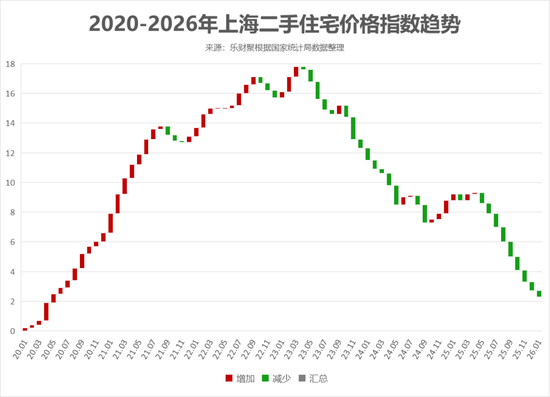
Core Viewpoint - The Shanghai second-hand housing market has experienced a continuous decline in prices since the second half of last year, with the latest data showing a month-on-month decrease of 0.4% in January 2026, marking the ninth consecutive month of decline. However, the rate of decline is slowing down, indicating a potential stabilization in the market [1][9]. Market Sentiment - There is a significant divide in market opinions regarding the future of Shanghai's housing prices. Some believe prices have reached a bottom due to government intervention, while others anticipate further declines as buyer pessimism persists. This divergence is reflected in transaction volumes, which have remained above 20,000 units monthly since the end of last year, with 7,770 units signed in the first 12 days of January 2026, indicating a relatively strong market for this period [3][11][12]. Transaction Volume Insights - The increase in transaction volume suggests a mix of market participants, with some exiting due to bearish sentiments and others entering with bullish expectations [4][12]. Optimistic Perspective - The optimistic faction believes that the government's acquisition of older, smaller properties serves as a price anchor, effectively preventing further price drops. They cite a rental yield exceeding 2.5%, which surpasses the cost of special bonds, providing a safety margin. Additionally, January's transaction volume reached 22,800 units, a five-year high, with a decrease in listings [5][13]. Predictions from Optimistic Viewpoint - The expectation is for a smoother property exchange process (selling old to buy new), with a potential small spring recovery in Q1 2026 and a stable year overall [6][14]. Cautious Perspective - The cautious faction argues that the scale of government acquisitions is too small to alter the prevailing supply-demand imbalance. They view the recent uptick in activity as a temporary phenomenon influenced by the late Lunar New Year and the withdrawal of some agents, labeling it a "data illusion." They highlight that only 24.6% of price quotes are increasing, with 75% of homeowners still reducing prices, and anticipate a market impact from the upcoming release of limited-sale properties in May [7][15]. Predictions from Cautious Viewpoint - The forecast indicates stable transaction volumes but continued downward pressure on prices, with May being a critical testing period for market resilience [16]. Summary of Market Dynamics - The current situation is characterized not merely by price fluctuations but by a battle for liquidity restoration. A widespread price increase in 2026 seems unlikely, although government support has stabilized prices for older, smaller properties in core areas [17].
主权与韧性的时代:五十图“马”说2025
Minsheng Securities· 2026-02-13 05:50
Macro Trends - China's economy is transitioning from a real estate cycle bottoming out to a strategic shift towards high-end manufacturing, with real estate prices stabilizing around 4.53% of GDP, approaching the lower end of the 4%-6% range seen in the US and Japan[12][14]. - The manufacturing sector is accelerating domestic substitution in key areas like automotive and machinery, moving from scale dividends to high-value global value chain competition[2]. Global Expansion - Chinese companies are evolving from merely exporting products to building ecosystems, leveraging channels, capital, and products for comprehensive value and cultural output[3]. - The gaming industry has seen significant success, with 12 Chinese games ranking in the global top 30 revenue list, led by Tencent's "Honor of Kings"[50]. Consumer Behavior - The consumption cycle is shifting from a "total volume era" to a "structural era," focusing on precise segmentation and supply reconstruction, driven by a younger high-net-worth demographic[4]. - Retail and commercial real estate are transitioning from simple sales to a focus on professionalism and experiential offerings, reflecting a K-shaped differentiation in consumer preferences[4]. Asset Management - The global asset management landscape is undergoing a profound transformation, with gold and other assets moving independently from traditional stock-bond frameworks, challenging conventional asset allocation strategies[5]. - The rise of quantitative products and the diversity of ETF funds are significantly impacting active management models, reshaping the funding ecosystem both domestically and internationally[5].