
光伏

Search documents
对华加税30%!马克龙再度变脸欲当出头鸟,中方点名警告加反制
Sou Hu Cai Jing· 2026-02-24 09:52
Group 1 - The core issue revolves around French President Macron's proposal to impose a 30% tariff on all imports from China, which has raised tensions within the EU and prompted a warning from China regarding potential retaliatory measures against EU dairy products and wine [1][3][24] - The French government is reacting to a significant trade deficit with China, which is projected to exceed 300 billion euros by 2025, with France alone facing a deficit of 10.6 billion USD [16][18] - The competitive pressure from Chinese products, particularly in the electric vehicle and renewable energy sectors, has led to a sense of urgency within France to protect its domestic industries [12][20] Group 2 - Macron's aggressive stance is seen as a response to the challenges faced by European industries, particularly in light of the economic impacts of the Russia-Ukraine conflict and the subsequent energy supply issues [10][12] - The proposal for tariffs has not garnered unanimous support within the EU, with countries like Germany and Italy expressing opposition, highlighting the internal divisions within the bloc [22][24] - China's response to the tariff proposal includes the implementation of countervailing duties on EU dairy products, which could have significant implications for French agricultural exports [41][45] Group 3 - The French media has echoed the government's concerns, suggesting that without action, Europe risks falling into a "destructive recession" due to competition from Chinese industries [24][26] - The situation reflects a broader trend of protectionism in international trade, with France's approach being characterized as a direct challenge to China, which could escalate tensions further [5][7] - The ongoing trade dynamics indicate that France may need to reassess its strategy and engage in dialogue with China to find mutually beneficial solutions, rather than pursuing unilateral measures [51]


微导纳米业绩快报:2025年净利润2.13亿元,同比下降6.12%
Ge Long Hui· 2026-02-24 09:30
Core Viewpoint - The semiconductor industry continues to experience high growth, while the photovoltaic industry faces increasing supply-demand pressures. The company focuses on innovation to seize semiconductor market opportunities and address challenges in the photovoltaic sector [1] Group 1: Financial Performance - The company's operating revenue for 2025 was 2.632 billion yuan, a slight decrease of 2.52% year-on-year [1] - Semiconductor equipment revenue reached 881 million yuan, a significant increase of 169.12% year-on-year, accounting for 33.50% of main business revenue [1] - Photovoltaic equipment revenue was 1.589 billion yuan, a decline of 30.62% year-on-year [1] Group 2: Profitability - The net profit attributable to the parent company was 213 million yuan, a decrease of 6.12% year-on-year [1] - The net profit attributable to the parent company after deducting non-recurring gains and losses was 153 million yuan, down 18.49% year-on-year [1] Group 3: Factors Influencing Performance - The decline in overall revenue was primarily due to a reduction in the acceptance quantity of photovoltaic equipment [1] - Changes in product structure and new capacity led to increased depreciation and amortization, along with asset impairment losses related to photovoltaic projects [1] - The company continues to maintain high R&D investment to advance its semiconductor business and sustain its leading position in next-generation photovoltaic cell technology [1]

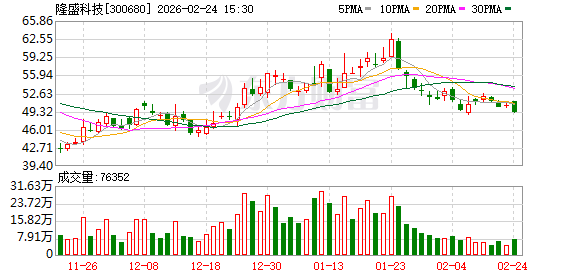
隆盛科技:暂无太空光伏相关产能布局
Zheng Quan Ri Bao· 2026-02-24 09:12
Group 1 - The core viewpoint of the article is that Longsheng Technology is currently focused on optimizing energy procurement costs through its investment in Longxin Photovoltaic New Energy, rather than expanding into space photovoltaic production [2] - Longsheng Technology's investment in Longxin Photovoltaic New Energy is primarily aimed at meeting its own energy needs for production [2] - There is no current plan for Longsheng Technology to develop space photovoltaic production capacity [2]
南玻A(000012.SZ):光伏玻璃目前暂无厚度小于1mm的产品
Ge Long Hui· 2026-02-24 07:18
Core Viewpoint - The company, Nanfang Glass (南玻A), currently does not offer photovoltaic glass products with a thickness of less than 1mm [1] Group 1 - The company has clarified on its interactive platform regarding the specifications of its photovoltaic glass products [1]


招商证券:北美启动光伏扩产 国产受益供应链中重视辅材
智通财经网· 2026-02-24 07:11
Core Viewpoint - Tesla and SpaceX plan to build 100GW of solar capacity in the U.S. over the next three years, which will lead to a revaluation of related domestic auxiliary materials, equipment, and leading manufacturing companies, particularly emphasizing the opportunities in auxiliary materials [1][2] Group 1: North American Solar Expansion - North America is expected to initiate solar manufacturing capacity expansion, with Tesla and SpaceX's plans potentially yielding significant returns due to tariff protections and FEOC subsidies [2] - The anticipated demand for ground-mounted solar in North America is projected to support a capacity of 100GW, driven by natural growth and future data center needs [2] Group 2: Supply Chain Opportunities - The ground solar expansion in North America will create opportunities for Chinese supply chains, while space solutions are still evolving [3] - SpaceX is likely to favor the P-HJT route for solar technology, with HJT and perovskite equipment manufacturers expected to benefit [3] Group 3: Auxiliary Materials - The ground auxiliary materials supply chain is expected to benefit with high certainty and sustainability, while space auxiliary materials may experience significant inflation due to extreme conditions [4] - Tesla's collaboration with domestic auxiliary material companies suggests that ground solar expansion will likely utilize existing supply chains, with light asset auxiliary materials gradually being matched to North American factories [4]


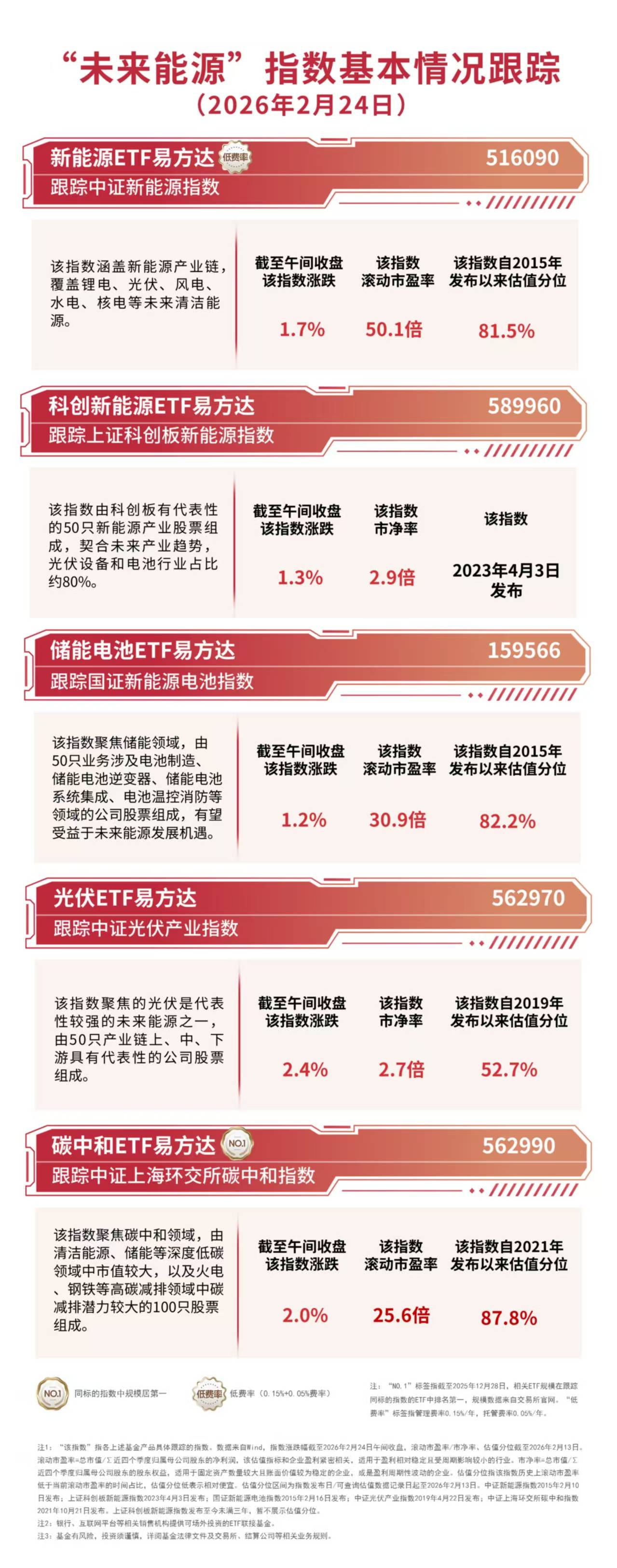
光伏板块走强,关注光伏ETF易方达(562970)、科创新能源ETF易方达(589960)投资价值
Sou Hu Cai Jing· 2026-02-24 05:01
Core Viewpoint - The renewable energy sector in China is experiencing significant growth, with substantial increases in photovoltaic installations and a positive trend in related indices [1]. Group 1: Market Performance - The China Securities Photovoltaic Industry Index rose by 2.4% [1] - The China Securities Shanghai Carbon Neutrality Index increased by 2.0% [1] - The China Securities New Energy Index saw a rise of 1.7% [1] - The Shanghai Stock Exchange Sci-Tech Innovation Board New Energy Index grew by 1.3% [1] - The National Energy Administration reported a projected 14% year-on-year increase in new photovoltaic installations by 2025 [1] Group 2: Industry Growth Projections - By the end of 2025, the total installed capacity of photovoltaic power generation in China is expected to reach 1.2 trillion watts, representing a 35% year-on-year growth [1] - New installations are projected to include 164 million kilowatts of centralized photovoltaic and 153 million kilowatts of distributed photovoltaic [1] Group 3: ETF and Index Information - The Easy Fund New Energy ETF tracks the China Securities New Energy Index, which covers the entire new energy industry chain, including lithium batteries, photovoltaics, wind power, hydropower, and nuclear power [2] - The Easy Fund Photovoltaic ETF tracks the China Securities Photovoltaic Industry Index, consisting of 50 representative companies across the photovoltaic industry chain [5] - The Easy Fund Carbon Neutrality ETF focuses on the carbon neutrality sector, comprising 100 stocks from clean energy and high carbon reduction potential industries [6]
工业硅期货早报-20260224
Da Yue Qi Huo· 2026-02-24 04:58
1. Report Industry Investment Rating - Not provided in the report 2. Core Viewpoints of the Report - For industrial silicon, the supply decreased last week, the demand remained low, and the cost support increased. It is expected to fluctuate in the range of 8300 - 8490 for the 2605 contract [6]. - For polysilicon, the supply production schedule continued to decrease, the demand in various downstream sectors also decreased, and the cost support remained stable. It is expected to fluctuate in the range of 48240 - 50370 for the 2605 contract [9]. - The main bullish factors are cost increase support and manufacturers' production suspension and reduction plans; the main bearish factors are the slow recovery of post - holiday demand and the strong supply and weak demand of downstream polysilicon [11][12]. 3. Summary According to the Directory 3.1 Daily Viewpoints 3.1.1 Industrial Silicon - **Supply**: The supply last week was 71,000 tons, a 13.41% decrease compared to the previous week [6]. - **Demand**: The demand last week was 60,000 tons, a 20.00% decrease compared to the previous week, and the demand remained low [6]. - **Cost**: The production cost of sample oxygen - passing 553 in Xinjiang was 9769.7 yuan/ton, with no change compared to the previous week, and the cost support increased during the dry season [6]. - **Basis**: On February 13, the spot price of non - oxygen - passing in East China was 9200 yuan/ton, and the basis of the 05 contract was 805 yuan/ton, with the spot at a premium to the futures [6]. - **Inventory**: The social inventory was 562,000 tons, a 1.44% increase compared to the previous week; the sample enterprise inventory was 200,800 tons, a 2.52% decrease compared to the previous week; the main port inventory was 136,000 tons, a 1.45% decrease compared to the previous week [6][15]. - **Disk**: MA20 was downward, and the price of the 05 contract closed below MA20. The main position was net short, and the short position decreased [6]. - **Expectation**: The supply production schedule decreased and remained at a low level, the demand recovery showed signs, and the cost support increased. The 2605 contract of industrial silicon is expected to fluctuate in the range of 8300 - 8490 [6]. 3.1.2 Polysilicon - **Supply**: The production last week was 20,100 tons, with no change compared to the previous week. The production schedule for February is expected to be 79,700 tons, a 20.93% decrease compared to the previous month [8]. - **Demand**: The production of silicon wafers last week was 10.05GW, a 3.17% decrease compared to the previous week, and the inventory was 300,600 tons, a 6.14% increase compared to the previous week. Currently, silicon wafer production is in a loss state. The production of battery cells in January was 41.44GW, a 11.37% decrease compared to the previous month, and the inventory of external sales factories last week was 9.31GW, a 1.52% increase compared to the previous week. Currently, battery cell production is in a profitable state. The production of components in January was 35.2GW, a 9.04% decrease compared to the previous month, and the domestic monthly inventory was 24.76GW, a 51.73% decrease compared to the previous month; the European monthly inventory was 34.2GW, a 9.26% increase compared to the previous month. Currently, component production is in a profitable state [8]. - **Cost**: The average cost of N - type polysilicon in the industry is 40,830 yuan/ton, and the production profit is 11,420 yuan/ton [8]. - **Basis**: On February 13, the price of N - type dense material was 52,250 yuan/ton, and the basis of the 05 contract was 3945 yuan/ton, with the spot at a premium to the futures [9]. - **Inventory**: The weekly inventory was 349,000 tons, a 2.34% increase compared to the previous week, and it was at a high level in the same period of history [9]. - **Disk**: MA20 was downward, and the price of the 05 contract closed below MA20. The main position was net long, and the long position decreased [9]. - **Expectation**: The supply production schedule continued to decrease, the demand in various downstream sectors also decreased, and the overall demand showed a continuous decline. The cost support remained stable. The 2605 contract of polysilicon is expected to fluctuate in the range of 48240 - 50370 [9]. 3.2 Market Overview 3.2.1 Industrial Silicon - The prices of various contracts and spot prices of industrial silicon showed different degrees of changes, and the social inventory and sample enterprise inventory also changed [15]. 3.2.2 Polysilicon - The prices of various contracts and spot prices of polysilicon showed different degrees of changes, and the weekly total inventory increased [17]. 3.3 Price and Cost Trends 3.3.1 Industrial Silicon - The price - basis and delivery product price difference trends of industrial silicon were presented, and the cost trends of different regions and specifications were also shown [19][35]. 3.3.2 Polysilicon - The disk price trend and basis trend of polysilicon were presented, and the cost trend of the polysilicon industry was also shown [22][67]. 3.4 Inventory and Production Trends 3.4.1 Industrial Silicon - The inventory trends of industrial silicon in different regions and the production and capacity utilization trends were presented [25][29]. 3.4.2 Polysilicon - The inventory trend and production trend of polysilicon were presented [67]. 3.5 Supply - Demand Balance 3.5.1 Industrial Silicon - The weekly and monthly supply - demand balance tables of industrial silicon were presented, showing the production, import, export, consumption, and balance situations [42][45]. 3.5.2 Polysilicon - The monthly supply - demand balance table of polysilicon was presented, showing the supply, import, export, consumption, and balance situations [69]. 3.6 Downstream Industry Trends 3.6.1 Organic Silicon - The price, production, and inventory trends of DMC in the organic silicon industry were presented, as well as the price trends of downstream products such as 107 glue, silicone oil, raw rubber, and D4 [48][50]. 3.6.2 Aluminum Alloy - The price, supply, inventory, and production trends of the aluminum alloy industry were presented, as well as the demand situations in the automotive and wheel hub sectors [56][61]. 3.6.3 Polysilicon Downstream - The price, production, inventory, and supply - demand balance trends of silicon wafers, battery cells, photovoltaic components, and photovoltaic accessories in the polysilicon downstream industry were presented, as well as the cost - profit trends of components and the photovoltaic grid - connected power generation trends [72][84][89].
万联晨会-20260224
Wanlian Securities· 2026-02-24 04:56
Core Insights - The A-share market experienced a decline, with the Shanghai Composite Index falling by 1.26% to close at 4082.07 points, and the Shenzhen Component Index dropping by 1.28% [2][8] - The total trading volume in the A-share market was approximately 1.98 trillion RMB, with over 3600 stocks declining [2][8] - In terms of industry performance, the comprehensive and defense industries led the gains, while the non-ferrous metals sector saw the largest decline [2][8] - The Hong Kong market showed a positive trend, with the Hang Seng Index rising by 2.53% [2][8] - The U.S. stock markets all closed lower, with the Dow Jones down by 1.66%, the S&P 500 down by 1.04%, and the Nasdaq down by 1.13% [2][8] Important News - The U.S. Supreme Court ruled that certain tariffs imposed by the U.S. government were illegal, prompting a response from China's Ministry of Commerce, which is assessing the implications and urging the U.S. to cancel unilateral tariff measures [3][9] - The National Energy Administration of China plans to implement a new energy system and sector-specific energy planning, focusing on major strategic projects and enhancing electric vehicle charging networks [3][9]
未知机构:2026年核心投资主线前期两个板块的股价经过一定回调积蓄了2026年春节后-20260224
未知机构· 2026-02-24 04:10
Summary of Conference Call Records Industry Overview - **Core Investment Themes for 2026**: The stock prices of two sectors have undergone a correction, building momentum for a potential rise after the 2026 Spring Festival, indicating these sectors have upward potential [1][1]. - **Recent Events in Commercial Aerospace**: No significant events occurred during the Spring Festival in the space photovoltaic and commercial aerospace sectors. Key events before the festival include the successful listing of Dianke Lantian on the Sci-Tech Innovation Board on February 10, which accelerates the capitalization of related rocket and satellite companies. Additionally, the successful launch of Long March 10 on February 11 marks the completion of low-altitude demonstration verification and indicates the reusability of the spacecraft [1][1]. Commercial Aerospace Sector Analysis - **Market Performance**: The commercial aerospace sector has seen a significant correction of 30% to 40% since reaching a peak in mid-January 2026, following a rally that began in August 2025 [2][2]. - **Catalysts for Future Growth**: Key catalysts for the commercial aerospace sector include: - Progress in reusable rocket launches and recoveries, with several private companies expected to take action from late February to early March 2026. - IPO progress of companies planning to go public in 2026, including domestic firms like Zhongke Yuhang and Tianming Technology, which could lead to thematic rotation and capital inflow [2][2]. - **Divergence in Sector Performance**: The commercial aerospace sector has corrected while the space photovoltaic sector has continued to rise, driven by a shift in catalysts from the US-China low-orbit satellite arms race to the construction of photovoltaic capacity in the US, addressing local electricity shortages and data center power demands [2][2]. Photovoltaic Capacity Planning - **US Companies' Plans**: Tesla and SpaceX plan a combined photovoltaic capacity of 200 GW, with Tesla focusing on ground-based distributed power stations and storage, while SpaceX targets low-orbit satellites and space-based photovoltaic stations [3][3]. - **Domestic Collaborations**: From late January to early February 2026, Tesla's team conducted research on several domestic photovoltaic companies, while SpaceX engaged with Maiwei and unlisted Huasheng New Energy, indicating a high level of confidentiality in their dealings [3][3]. - **Equipment Sector Opportunities**: The equipment sector is expected to see clear order placements from Q2 to Q3 2026, with significant growth anticipated [3][3]. Key Equipment and Material Targets - **Core Equipment Targets**: Key companies in various segments include: - Silicon material: Dalian Energy - Crystal pulling: Liancheng CNC, Jingsheng Electromechanical - Slicing: Yujing Co., High Measurement Co. - Battery: Jiejia Weichuang, Laplace for TOPCON; Maiwei for heterojunction equipment - Components: Aotewei, Jingshan Qingji for string welding and lamination machines [4][4]. - **Recommended Companies**: Maiwei, Liancheng CNC, Aotewei, and Jingsheng Electromechanical are highlighted as having significant upside potential [4][4]. Supply Chain and Material Insights - **Auxiliary Material Targets**: The auxiliary material sector shows sustained demand, with key companies including: - Silver paste: Dike, Poly - Glue film: Foster, Haiyou - Glass: Yamaton - Junction boxes: Zerun New Energy - Welding strips: Yubang New Materials - The silver paste segment is particularly strong due to rising silver prices and increased demand for heterojunction products [4][4]. - **Main Chain Targets**: GCL Group and Jinko Solar are both in discussions with Tesla regarding collaboration [5][5]. Robotics Sector Developments - **Technological Advances**: Several domestic companies have showcased advancements in humanoid robotics, indicating a pivotal year for the industry in 2026 [6][6]. - **Tesla's Humanoid Robot Plans**: The V3 version of Tesla's humanoid robot is expected to be released in Q1 2026, with mass production targeted for the end of 2026, aiming for an annual capacity of 500,000 to 1 million units [6][6]. - **Investment Recommendations**: The humanoid robot sector is currently weak, but the release of Tesla's V3 version is anticipated to be a significant catalyst. Key investment targets include Weichuang Electric and Keda Li, with a focus on high-value components [7][7].
未知机构:长江电新节后观点全面开花看好电新大行情总体长-20260224
未知机构· 2026-02-24 03:35
Summary of Conference Call Records Industry Overview - The conference call primarily discusses the renewable energy sector, focusing on solar energy, energy storage, lithium batteries, wind power, and electric power equipment. The overall sentiment is optimistic about the growth potential in these areas, particularly in North America and China [1][2][3][4]. Key Points and Arguments Solar Energy - The North American visits by solar equipment companies and changes in U.S. trade policies are expected to catalyze the space solar and energy storage markets [1] - The Solar Association's January cost analysis provides support for price recovery in the industry, with a need to monitor demand expectations for traditional solar trends [1] - Companies recommended for investment include space solar battery and satellite power firms such as JunDa, RiSheng, MingYang, JingNeng, and TianHe, as well as equipment manufacturers with strong order visibility like MaiWei, AoTeWei, JingSheng, and ShuangLiang [1] Energy Storage - The first implementation guidelines for large-scale energy storage (OBBB) have been released, alleviating the most pessimistic expectations, while the expiration of fentanyl and equivalent tariffs presents a marginal benefit for U.S. energy storage sentiment [2] - Anticipation of increased orders for North American AIDC energy storage and the introduction of provincial pricing regulations in China are expected to stimulate market activity [2] - The household storage sector is showing resilience in Q1, with strong performance in Ukraine, Australia, and the UK, and expectations for significant month-on-month production increases in March [2][3] Lithium Batteries - Post-holiday production is expected to continue rising, potentially reaching new highs, with a favorable window for price negotiations across the supply chain [3] - Long-term recommendations focus on battery segments, particularly companies with alpha potential like Ningde and Yiwei, while also suggesting investments in undervalued separator and copper foil sectors [3] - Companies with price elasticity in the lithium iron phosphate segment, such as PuTaiLai, Enjie, JiaYuan, TianCi, FuLin, YuNeng, and ShangTai, are also recommended [3] Wind Power - Emphasis on the new wind power cycle starting in the 14th Five-Year Plan, with expectations for commercial aerospace developments and profitability recovery in wind turbine manufacturing [4] - Recommended companies in the wind power sector include DaJin, HaiLi, TianShun, and MingYang Intelligent [4] Electric Power Equipment - During the Spring Festival, PJM plans to invest $11.8 billion in the power grid to support data centers, while OpenAI has announced a $600 billion investment plan with $1,000 billion in financing [4] - Continued recommendations for "North America Power Shortage 3+3" include transformers from SiYuan, Igor, and JinPan, as well as AI power solutions from SiFang, MaiMi, and KeShiDa [4] - Focus on high-voltage transformer export expansion with companies like TeBei, WangBian, BaiYun, AnKao, and HongYuan [4] New Directions - Attention is drawn to Tesla's contract situation and upcoming robot version releases, with recommended robotics companies including SanHua, XinQuan, SiLing, FuSai, RongTai, BeiTe, and MingZhi, along with potential suppliers like KeDaLi [4]
