传媒

Search documents
交银施罗德基金余李平:坚守AI算力核心主线,在科技浪潮中稳健前行
Sou Hu Cai Jing· 2026-01-26 10:33
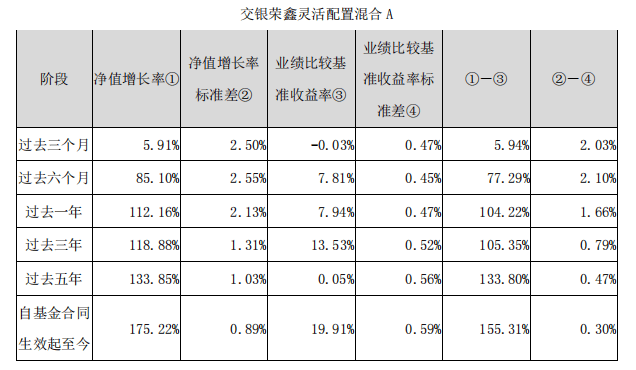
Core Viewpoint - The fund managed by Yu Liping has demonstrated strong performance, with significant net value growth over various time frames, indicating a deep understanding of the technology industry and its dynamics [1][2]. Performance Summary - In the past three months, the fund's A-class share achieved a net value growth of 5.91%, significantly outperforming the benchmark of -0.03% [1][2]. - Over the past six months, the fund's growth reached 85.10%, and over the past year, it achieved 112.16%, showcasing substantial excess return capability [1][2]. - The fund has shown consistent performance over three years with a growth of 118.88% and over five years with 133.85% [2]. Market Analysis - The technology sector in the A-share market is experiencing a "structural market with upward fluctuations," driven by liquidity easing and policy support for technological innovation [3]. - There is a shift in market focus from previously high-performing overseas AI computing sectors to the realization of fundamental performance, leading to a rebalancing phase [3]. - The AI boom is positively impacting various supply-demand dynamics in critical sectors such as storage, power infrastructure, and lithium battery materials [3]. Investment Strategy - The excess returns of the fund are primarily attributed to the sustained focus on the "overseas AI computing theme," with a strategy of stable holding of core assets [4]. - The fund has moderately increased allocations to lithium battery materials, storage, semiconductor equipment, and media sectors, which have performed better than expected [4]. - The fund manager acknowledges a cautious approach in some market conditions, indicating a need for improved depth in market understanding [4]. Future Outlook - For 2026, the fund manager maintains a "relatively optimistic judgment" on the capital market, identifying technology as a key structural direction [6]. - Key areas of focus include the continuous improvement of domestic AI capabilities, potential breakthroughs in AI applications, initial stages of large-scale robot applications, and acceleration of commercialized reusable rockets [6]. - The investment strategy will continue to prioritize AI computing while gradually extending into broader technology sectors, aiming for a balance between volatility control, yield elasticity, and certainty [6].

张坤四季报:困难只是暂时的,中国消费“有鱼可钓”!
市值风云· 2026-01-26 10:15
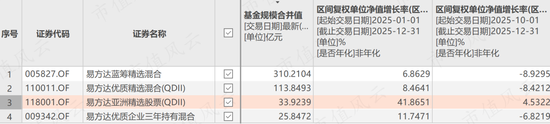
Core Viewpoint - The current market pricing for some high-quality companies is very low, making them attractive even for privatization [1][12]. Group 1: Fund Performance - In Q4 2025, the assets under management by Zhang Kun decreased to 48.3 billion, with a quarterly shrinkage of over 8 billion [4]. - The performance of Zhang Kun's four funds showed significant structural differentiation, with the largest fund, E Fund Blue Chip Select Mixed Fund, losing nearly 9% in Q4, underperforming its benchmark by over 6% [4][5]. - In contrast, the E Fund Asia Select Stock Fund achieved a positive return of 4.5% in Q4, outperforming its benchmark by over 2%, and had an annual increase of nearly 42% for 2025 [4][5]. Group 2: Sector Adjustments - Zhang Kun continued to reduce holdings in the liquor sector, albeit at a slower pace compared to Q3 2025, maintaining a near 10% position in leading liquor stocks like Kweichow Moutai and Wuliangye [6]. - Significant reductions were also observed in pharmaceutical and media stocks, with JD Health seeing its holdings cut by about half [8]. Group 3: Consumer Market Outlook - Zhang Kun expressed optimism about the future of domestic consumption, citing that the current weak consumption data is not a long-term trend [10]. - He believes that the Chinese government's goal of reaching a middle-income level by 2035 indicates substantial growth potential for income, which will enhance consumer spending [11]. - The stabilization of housing prices, which have been a barrier to consumer confidence, is expected to further boost spending as wealth perception improves [11]. Group 4: Technology and Innovation - A strong domestic consumer market is viewed as a crucial driver for technological innovation, with examples from leading AI models abroad demonstrating the revenue potential from consumer subscriptions [12]. - Zhang Kun emphasized that with a stronger consumer environment, domestic tech companies could generate more income to support research and development, accelerating their growth to catch up with global leaders [12]. Group 5: Long-term Investment Perspective - Despite short-term pressures, Zhang Kun maintains a long-term positive outlook on China's consumption potential and economic development, positioning for investments in quality companies that will grow alongside rising living standards [13].



2025Q4传媒持仓分析:重仓股配置比例下降 前期涨幅高的收益确认,AI应用标的配置提升
ZHESHANG SECURITIES· 2026-01-26 08:24
重仓股配置比例下降 前期涨幅高的收益确认,AI应用标的配置提升 —— 2025Q4传媒持仓分析 行业评级:看好 2026年1月26日 分析师 冯翠婷 电话 fengcuiting@stocke.com.cn 证书编号 S1230525010001 2025Q4传媒行业机构持仓情况总结 证券研究报告 1、传媒行业重仓股配置环比下降,体现为前期涨幅较高的收益确认,AI应用相关标的25Q4增配明显,为26年1月AI应用行情蓄力 2 2025Q4传媒重仓股配置比例为3.87%,环比下降0.79pcts,高于行业标准配置比例的2.24%;剔除腾讯控股后,2025Q4传媒重仓股配置比例为 1.49%,环比下降0.53pcts;2025Q4传媒板块行业配置比例明显下降,主要体现为前期涨幅较高的个股的收益确认,但仍然显著超配,部分AI应用相 关标的如【三七互娱】、 【蓝色光标】、【易点天下】等25Q4增配明显,为26年1月AI应用行情蓄力。 2、传媒行业重仓股配置环比下降,前期涨幅较高的收益确认 传媒行业重仓股规模为1538.73亿元,环比减少345.72亿元,环比下降18.35%。其中前十大重仓股规模合计为1420.55亿 ...
传媒持仓分析:重仓股配置比例下降前期涨幅高的收益确认,AI应用标的配置提升
ZHESHANG SECURITIES· 2026-01-26 07:50
1、传媒行业重仓股配置环比下降,体现为前期涨幅较高的收益确认,AI应用相关标的25Q4增配明显,为26年1月AI应用行情蓄力 证券研究报告 重仓股配置比例下降 前期涨幅高的收益确认,AI应用标的配置提升 —— 2025Q4传媒持仓分析 行业评级:看好 2026年1月26日 分析师 冯翠婷 电话 fengcuiting@stocke.com.cn 证书编号 S1230525010001 2025Q4传媒行业机构持仓情况总结 2 2025Q4传媒重仓股配置比例为3.87%,环比下降0.79pcts,高于行业标准配置比例的2.24%;剔除腾讯控股后,2025Q4传媒重仓股配置比例为 1.49%,环比下降0.53pcts;2025Q4传媒板块行业配置比例明显下降,主要体现为前期涨幅较高的个股的收益确认,但仍然显著超配,部分AI应用相 关标的如【三七互娱】、 【蓝色光标】、【易点天下】等25Q4增配明显,为26年1月AI应用行情蓄力。 2、传媒行业重仓股配置环比下降,前期涨幅较高的收益确认 传媒行业重仓股规模为1538.73亿元,环比减少345.72亿元,环比下降18.35%。其中前十大重仓股规模合计为1420.55亿 ...
美元债双周报(26 年第4 周):地缘风险与财政隐忧下美债利率升至半年新高-20260126
Guoxin Securities· 2026-01-26 06:25
Investment Rating - The report maintains a "weaker than market" rating for the U.S. stock market [6][80]. Core Views - The U.S. economy shows resilient consumer spending, with the November PCE price index rising by 2.8% year-on-year, indicating moderate inflation [1]. - The actual GDP growth for Q3 2025 was revised up to 4.4%, driven by strong exports and consumer resilience, suggesting robust economic expansion [2]. - Concerns over potential sell-offs of U.S. Treasuries by European pension funds due to geopolitical tensions have led to market volatility, with U.S. Treasury yields rising [3][4]. - The long-term fiscal situation in the U.S. remains a concern, with a budget deficit of approximately 6% of GDP, historically associated with economic downturns [4]. Summary by Sections Economic Indicators - The November PCE report aligns with market expectations, showing a year-on-year increase of 2.8% and a month-on-month increase of 0.2% [1]. - The core PCE also rose by 2.8% year-on-year, indicating persistent inflationary pressures above the Federal Reserve's 2% target [1]. Market Reactions - European pension funds have begun to sell U.S. Treasuries in response to geopolitical risks, with significant amounts being divested [3]. - The market reacted to these developments with declines in major U.S. stock indices and an increase in long-term Treasury yields [3]. Investment Strategy - The report suggests a "short duration core + steepening satellite" strategy for U.S. Treasuries, focusing on 3-5 year investment-grade bonds to secure stable coupon income while managing exposure to long-term bonds [4].
春季行情仍在途,注意总体赚钱效应已逼近高位
Zheng Quan Shi Bao Wang· 2026-01-26 05:44
Group 1 - The core viewpoint is that the current market is experiencing a spring rally, characterized by a recovery in market confidence and a focus on sectors that are not heavily weighted in broad-based ETFs, particularly in consumer and real estate chains [2][3][4][10] - The liquidity environment is a key driver of the current spring rally, supported by new insurance premiums entering the market and the return of overseas funds due to the appreciation of the RMB [4][7] - The market is expected to see a structural bull market with alternating phases of upward and sideways movements, with the current phase transitioning from the second to the third upward segment [6][12][14] Group 2 - Investment opportunities are identified in sectors with strong earnings forecasts, particularly in AI hardware, batteries, pharmaceuticals, steel, and non-bank financials [5][9][11] - The focus on "technology + resource products" is emphasized, with sectors such as semiconductors, AI, new energy, and chemicals being highlighted for their growth potential [7][9] - The market is advised to pay attention to the performance of cyclical stocks and the impact of regulatory policies on market dynamics, particularly in the context of the anticipated earnings reports from listed companies [10][12][13]
张坤四季报:困难只是暂时的,中国消费“有鱼可钓”!
Xin Lang Cai Jing· 2026-01-26 03:19
Group 1 - The core focus of the article is on the performance and strategic adjustments of funds managed by Zhang Kun of E Fund, highlighting the significant differentiation in fund performance and his outlook on domestic consumption and investment opportunities [1][2][3] Group 2 - In Q4 2025, Zhang Kun's managed fund size decreased to 48.3 billion yuan, with a quarterly reduction exceeding 8 billion yuan [2][3] - The largest fund, E Fund Blue Chip Selection Mixed Fund (005827.OF), experienced a nearly 9% loss in Q4, underperforming its benchmark by over 6%, while the E Fund Asia Select Stock Fund (118001.OF) achieved a 4.5% positive return, outperforming its benchmark by over 2% and recording a nearly 42% increase for the entire year [2][3][4] Group 3 - Zhang Kun continued to reduce holdings in the liquor sector, albeit at a slower pace compared to Q3 2025, maintaining a near 10% position in leading liquor stocks like Kweichow Moutai and Wuliangye [4][5][6] - Significant reductions were also noted in pharmaceutical and media stocks, with JD Health seeing a cut of about half in holdings, alongside Tencent Holdings and Focus Media [5][6][7] Group 4 - In overseas investments, Samsung Electronics replaced Tencent Holdings as the top holding in the E Fund Asia Select, with Zhang Kun opting to take profits as stock prices surged [6][7][8] Group 5 - Zhang Kun expressed a strong belief in the future of domestic consumption, arguing that current consumer weakness is not a permanent state and will improve, supported by government goals for income growth and stabilization of housing prices [8][9][10] - He emphasized that a robust domestic consumption market is crucial for technological innovation, suggesting that increased consumer spending will benefit domestic AI companies and accelerate their development [10][11][12] - Zhang Kun remains optimistic about the long-term potential of Chinese consumption and economic growth, viewing current market valuations of quality companies as attractive for long-term investors [10][11][12]


宏观周周谈-当前的核心矛盾是什么
2026-01-26 02:49
Summary of Key Points from Conference Call Records Industry and Company Overview - The discussion primarily revolves around macroeconomic trends, inflation expectations, and the performance of various industries in the context of the Chinese and U.S. markets. [1][2][3] Core Insights and Arguments Market Sentiment - Market sentiment has improved, particularly in second and third-tier cities, indicating a recovery in market activity to about 50-66% of previous levels. [2] Inflation Expectations - A "pork-oil resonance" phenomenon is anticipated in 2026, signaling the end of deflation and a return to inflation, with a CPI central tendency expected to reach 0.5% and PPI likely turning positive in Q3. [1][3][4] Industry Focus - Industries that may benefit from the positive PPI include resource-related sectors and raw materials, while the technology sector's valuations are no longer seen as advantageous. [1][4] U.S. Stock Market Outlook - The U.S. stock market is expected to experience a rally from May to August 2026, potentially boosting related sectors such as computing power. However, the main focus remains on the implications of PPI turning positive. [1][6] PPI Impact on Industries - Positive PPI is expected to favor industries such as construction materials, non-ferrous metals, steel, and basic chemicals, while sectors like machinery, automotive, electronics, pharmaceuticals, and home appliances show strong alpha correlation but weak beta correlation. [1][7][8] Currency Exchange Rate - The Chinese yuan is projected to appreciate significantly, with the effective exchange rate expected to return to levels seen at the end of 2024. This appreciation will benefit yuan-denominated assets, including Hong Kong stocks. [1][9] Geopolitical Risks - Geopolitical risks are increasing due to the disintegration of the old international order, U.S. strategic adjustments, and rising global political uncertainties. Key areas of concern include the Russia-Ukraine conflict, the situation in Iran, and developments in U.S.-China relations. [1][10][11] Other Important but Potentially Overlooked Content Specific Industry Dynamics - The relationship between PPI and various industries has shifted, with some sectors like real estate losing their previous correlation with PPI, while others have become more competitive due to changes in consumer behavior and market dynamics. [1][7][8] Recent Developments in Geopolitical Situations - The situation in Greenland has shown signs of easing, with diplomatic negotiations taking precedence over military threats. However, tensions remain in the Middle East, particularly regarding Iran and the ongoing Russia-Ukraine conflict. [10][11][12][14] U.S.-China Relations - Recent developments indicate a potential stabilization in U.S.-China relations, with high-level diplomatic engagements expected to continue throughout the year. [15][16]
A股三大指数集体高开,创业板指涨0.48%
Feng Huang Wang Cai Jing· 2026-01-26 01:36
Group 1 - A-shares opened higher with the Shanghai Composite Index up 0.21%, Shenzhen Component Index up 0.37%, and ChiNext Index up 0.48% on January 26, 2023, driven by sectors like non-ferrous metals and photovoltaic [1] - Recent market dynamics show a divergence in fund flows, with over 570 billion yuan exiting broad-based ETFs while approximately 110 billion yuan flowed into thematic industry ETFs, indicating a positive overall market sentiment [2] - The focus remains on "technology + resource products" as key investment themes, with sectors like AI semiconductors, new energy, and non-ferrous metals showing strong performance and growth potential [2] Group 2 - The spring market is expected to progress, with key themes including commercial aerospace and AI applications, alongside a focus on price increase chains driven by supply-demand mismatches [3] - The current price increase trend is supported by the expansion of AI hardware chains and upstream raw material chains benefiting from supply gaps, such as lithium carbonate and PTA [3] - The global shift in commodity prices, particularly in gold and silver, suggests a need to adjust pricing frameworks for scarce physical assets and core equity assets due to declining currency value [4]

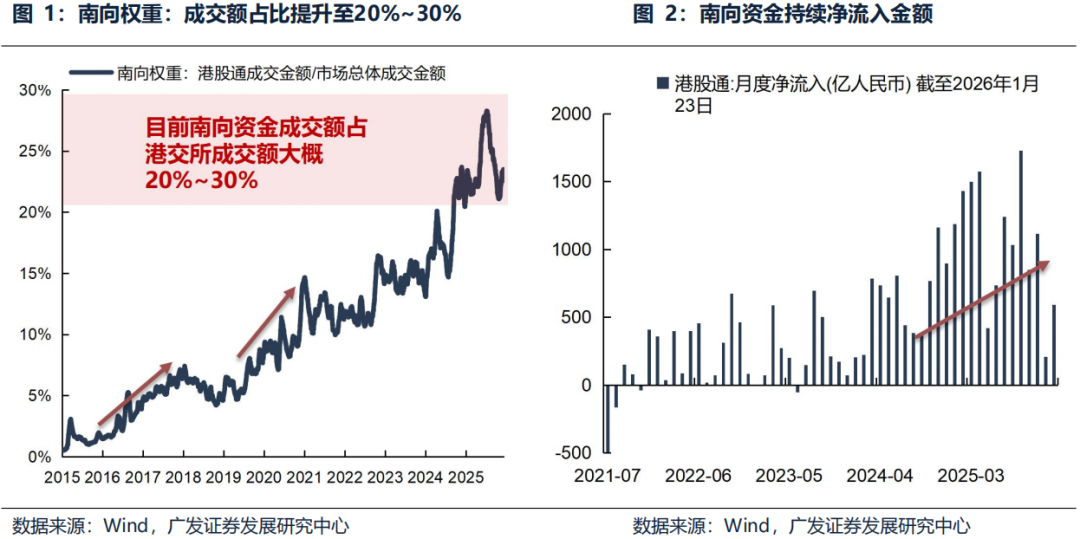
广发策略:从不买就跑输到买了就跑输——再看南下定价权
智通财经网· 2026-01-25 23:38
Group 1 - Since September 2024, the proportion of southbound capital transactions has rapidly increased to 20%-30%, nearly doubling compared to before 2024 [2][5] - In 2025, both active and passive foreign capital have become synchronous indicators of the Hong Kong stock market, showing no leading characteristics [2][5] - During sharp declines or corrections in the Hong Kong stock market, southbound capital tends to buy against the trend [2][5] Group 2 - Each round of pricing power competition typically begins with the optimization of the Stock Connect policy or the influx of incremental capital, which usually flows into dividend and scarce assets [5] - Net outflows of southbound capital often occur in response to adverse industry policies or external macroeconomic environments, particularly in sectors where foreign capital pricing power is increasing, such as software services, hardware equipment, consumer services, and discretionary retail [5][12] - Industries less likely to experience significant net outflows include those favored by long-term capital, such as banking, telecommunications, and public utilities, unless there are clear adverse policies affecting the sector [5][12] Group 3 - The proportion of medium to long-term capital in the current round of southbound capital inflow into Hong Kong stocks has increased, with insurance capital making 41 stakes, 35 of which are in H-shares, marking the highest record in the past decade [8] - Key industries for increased holdings include discretionary retail, finance (banking, insurance), innovative pharmaceuticals, software services, and hardware equipment [8] Group 4 - Current industries with pricing power for southbound capital and Chinese capital include semiconductors and dividend stocks, while industries lacking pricing power include internet, hardware equipment, software services, home appliances, and media [11][12] - Active management public funds have low pricing power in the Hong Kong stock market, focusing heavily on AI-related CSP giants, electronics, and innovative pharmaceuticals [16]