科技行业

Search documents
移出经营异常名录不留痕监管有温度企业增活力
Zheng Quan Shi Bao· 2025-06-02 16:59
Core Viewpoint - The recent implementation of the "no trace" policy for removing companies from the business anomaly list reflects a significant shift in regulatory thinking, moving from punishment to rehabilitation, allowing businesses to recover and thrive [1][2][3] Group 1: Regulatory Changes - The State Administration for Market Regulation has issued a notice to remove companies from the business anomaly list without publicizing their previous status, effectively eliminating the stigma associated with past mistakes [1] - The revised management measures for the business anomaly list aim to create a credit punishment mechanism that encourages compliance rather than perpetuating a cycle of difficulties for businesses that have corrected their errors [1][2] Group 2: Impact on Businesses - Over 60% of surveyed companies believe that the impact of being listed as a business anomaly is excessive and long-lasting, indicating a disconnect between the severity of the punishment and the nature of the infraction [2] - Case studies, such as a technology company losing a significant project bid due to a minor reporting error, highlight the detrimental effects of historical records on business opportunities [2] Group 3: Credit Repair Mechanism - The "no trace" reform is fundamentally about establishing a credit repair mechanism, which has shown to enhance business satisfaction and vitality in regions like Zhejiang and Shanghai [2][3] - The concept of balancing credit repair with credit punishment is crucial for a mature market economy, allowing businesses to restart after correcting their mistakes [2] Group 4: Future Directions - The need for a tiered management system that aligns regulatory intensity with the nature and severity of violations is emphasized, as seen in Jiangsu's credit risk grading model [3] - The "no trace" reform represents a significant advancement in regulatory philosophy, aiming to foster a healthier business environment rather than creating unnecessary barriers [3]
港股收盘(06.02) | 恒指收跌0.57% 稳定币概念逆势飙涨 内房、医药股等普遍承压
智通财经网· 2025-06-02 08:47
Market Overview - The Hong Kong stock market started June on a negative note, with the Hang Seng Index dropping to 23,157.97 points, down 0.57% or 131.8 points, with a total turnover of HKD 145.245 billion [1] - The Hang Seng Tech Index fell over 3% at one point but later narrowed its losses, closing down 0.7% at 5,134.11 points [1] - The market has shown signs of recovery after the "reciprocal tariffs" impact, with a significant decline in risk premiums being a key driver [1] Blue Chip Performance - Sands China (01928) led blue-chip gains, rising 4.28% to HKD 16.08, contributing 2.69 points to the Hang Seng Index [2] - Macau's gaming revenue for May reached MOP 21.193 billion, a 5% year-on-year increase, with total revenue for the first five months at MOP 97.707 billion, up 1.7% [2][5] - Other notable blue-chip movements included Chow Tai Fook (01929) up 3.22% and Galaxy Entertainment (00027) up 1.8%, while CSPC Pharmaceutical (01093) fell 4.81% [2] Sector Highlights Stablecoin Sector - The stablecoin sector surged following the enactment of the Stablecoin Ordinance in Hong Kong, with LianLian Digital (02598) rising 64.27% and Yike (09923) up 39.87% [3][4] - The ordinance aims to enhance the regulatory framework for digital asset activities in Hong Kong, with compliant stablecoins expected to launch by the end of the year [4] Gaming Sector - The gaming sector saw most stocks rise, with Sands China and Wynn Macau (01128) also posting gains [5] - Citigroup forecasts a 5% year-on-year increase in gaming revenue for June, estimating daily revenue at approximately MOP 6.17 billion [5] Gold Sector - Gold stocks performed well, with Tongguan Gold (00340) up 18.23% and other gold-related stocks also seeing gains due to rising gold prices amid geopolitical tensions [6] - Spot gold prices reached USD 3,350 per ounce, reflecting a nearly 2% increase [6] Real Estate Sector - The real estate sector faced challenges, with major developers like Agile Group (03383) and R&F Properties (02777) experiencing significant declines [7] - The top 100 real estate companies in China reported a 10.8% year-on-year drop in sales for the first five months of 2025 [7] Automotive Sector - The automotive sector is under pressure due to a new wave of price wars, with companies like GAC Group (02238) and Li Auto (02015) seeing declines [8] - The Ministry of Industry and Information Technology has expressed opposition to "cutthroat" competition in the automotive industry [8] Notable Stock Movements - Mixue Group (02097) reached a new high, closing up 7.54% at HKD 584.5, with an upgraded target price reflecting strong sales growth [9] - Alibaba Pictures (01060) rose 7.41% after announcing a name change to Damai Entertainment, indicating a strategic shift towards live events [10] - Leap Motor (09863) reported a 148% year-on-year increase in May deliveries, prompting an upgrade in sales forecasts [11] - CSPC Pharmaceutical (02005) fell 5.46% after reporting a significant drop in revenue and profit for Q1 2025 [12]

全球资产配置每周聚焦:“特朗普服软”交易兴起-20250602
Shenwan Hongyuan Securities· 2025-06-02 08:41
大 类 资 产 配 置 本研究报告仅通过邮件提供给 中庚基金 使用。1 2025 年 06 月 02 日 "特朗普服软"交易兴起 - 证券分析师 金倩婧 A0230513070004 jinqj@swsresearch.com 冯晓宇 A0230521080005 fengxy2@swsresearch.com 林遵东 A0230524100005 linzd@swsresearch.com 王胜 A0230511060001 wangsheng@swsresearch.com 研究支持 涂锦文 A0230123070009 tujw@swsresearch.com 联系人 涂锦文 (8621)23297818× tujw@swsresearch.com ——全球资产配置每周聚焦 (20250523-20250530) 请务必仔细阅读正文之后的各项信息披露与声明 策 略 研 究 证 券 研 究 报 告 相关研究 ⚫ 全球资产价格回顾:本周(20250523–20250530)。本周美国政坛持续震动。5 月 28 日,马斯克宣布 离开特朗普政府,政府效率部的"马斯克"改革暂时告一段落。此外,特朗普 23 日表示 ...
摩根士丹利中国首席策略师:中资股票迎来资金流入机遇
Huan Qiu Wang· 2025-06-01 03:28
【环球网财经综合报道】根士丹利中国首席策略师王滢周五发表最新市场观点指出,在美元趋势性走弱与人民币 稳步升值的背景下,当前估值处于低位、全球投资者配置普遍不足的中资股票,正迎来显著的资金流入机遇。她 尤其强调,离岸中资股市场(如港股)表现潜力更优,人民币升值对其支撑作用更为直接有力。 王滢分析认为,人民币汇率走强对离岸中资股市场形成双重利好。"一方面,人民币升值直接提升以港币或美元计 价、但主要资产和盈利来源在内地的离岸上市公司资产价值与盈利预期;另一方面,汇率因素能更有效地吸引国 际资本流入离岸市场,因其交易结算更为便利。"她表示,相较之下,在岸A股市场虽亦受益,但传导机制相对间 接。 在众多中资板块中,王滢特别点明看好科技股的长线前景。"中国科技企业展现出的强大创新能力令人印象深 刻,"她强调,"尽管行业曾经历周期性调整,但其在人工智能、云计算、半导体及先进制造等关键领域的持续突 破,奠定了相当亮丽的长期增长基础。结合当前估值水平,科技板块提供了具有吸引力的风险回报比。" 王滢指出,历经前期调整,无论是恒生指数还是MSCI中国指数,其估值均处于历史低位区间,显著低于全球主要 市场平均水平。与此同时,全球机 ...


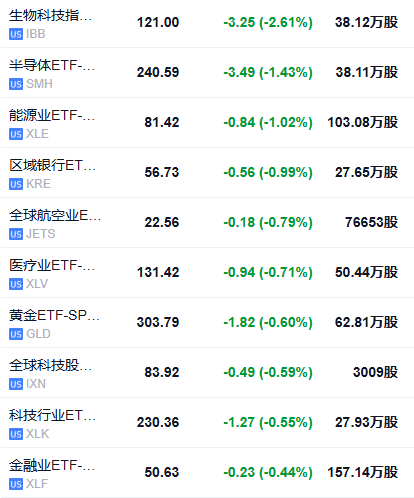
美股盘初,主要行业ETF普跌,生物科技指数ETF跌超2%,半导体ETF、区域银行ETF均跌超1%。
news flash· 2025-05-30 13:43
美股盘初,主要行业ETF普跌,生物科技指数ETF跌超2%,半导体ETF、区域银行ETF均跌超1%。 | 生物科技指 ... | 121.00 | -3.25 (-2.61%) 38.12万股 | | | --- | --- | --- | --- | | us IBB | | | | | 半导体ETF - ... | 240.59 | -3.49 (-1.43%) | 38.11万股 | | us SMH | | | | | 能源业ETF --- | 81.42 | -0.84 (-1.02%) | 103.08万股 | | us XLE | | | | | 区域银行ET ... | 56.73 | -0.56 (-0.99%) | 27.65万股 | | us KRE | | | | | 全球航空业E ... | 22.56 | -0.18 (-0.79%) | 76653股 | | us JETS | | | | | 医疗业ETF - ... | 131.42 | -0.94 (-0.71%) | 50.44万股 | | us XLV | | | | | 黄金ETF-SP ... | 303.79 | - ...
拓荆科技: 关于股东解除一致行动关系暨权益变动的提示性公告
Zheng Quan Zhi Xing· 2025-05-30 10:19
Core Viewpoint - The announcement details the termination of the concerted action agreement among shareholders of Tuojing Technology, indicating that this change does not affect the actual shareholding structure or control of the company [1][6]. Group 1: Termination of Concerted Action Agreement - The termination of the concerted action agreement does not involve any increase or decrease in the actual shareholding of the shareholders, as it is merely a dissolution of the agreement [1]. - After the termination, the company will still not have a controlling shareholder or actual controller, maintaining its operational independence [1][6]. - The termination of the concerted action agreement does not violate any public commitments made by the shareholders [1]. Group 2: Shareholding Structure - Following the termination, the eight natural shareholders will calculate their holdings separately, while the eleven employee shareholding platforms will continue to consolidate their holdings, totaling 25,149,516 shares, which represents 8.9907% of the company's total share capital [6][7]. - Before the termination, the combined holdings of the natural shareholders and employee platforms amounted to 31,625,068 shares, accounting for 11.3056% of the total share capital [6][7]. - The actual number of shares held by the shareholders remains unchanged post-termination, ensuring that no single shareholder or their concerted action partners can exert control over the company [7][8].

专访德银全球首席策略师:对美欧达成贸易协议乐观,黄金和优质债券仍是对冲风险核心资产
Di Yi Cai Jing· 2025-05-30 09:01
Core Viewpoint - The main victims of the trade conflict are likely to be the U.S. economy, with both businesses and consumers bearing the burden of higher tariffs, which is not the desired outcome for the U.S. government [1][4]. Group 1: Trade Agreement Outlook - There is optimism regarding a potential trade agreement between the U.S. and the EU, with expectations that the trade conflict will be resolved in a pragmatic manner, allowing businesses to continue trading and promoting economic growth [1][4]. - The upcoming talks between EU Trade Commissioner Maroš Šefčovič and U.S. counterparts are scheduled to take place during the OECD ministerial meeting in Paris [1]. Group 2: Economic Impact of Tariffs - The imposition of tariffs is expected to lead to higher inflation and maintain elevated prices, while also causing economic growth to slow down [5][6]. - The scale and duration of the tariffs will significantly influence the extent of their economic impact, with businesses likely to adjust over time to mitigate these shocks [6]. Group 3: Investment Strategies - In response to market volatility caused by tariffs, the focus has shifted to hedging strategies, with gold and high-quality bonds being core assets for risk mitigation [1][8]. - There is a recommendation to pay attention to U.S. technology companies' earnings and opportunities arising from Germany's fiscal stimulus plans [1][8]. Group 4: European Economic Resilience - The EU has experience in handling trade relations, particularly since the Brexit negotiations began in 2016, and the establishment of the single market has taken decades [7]. - The EU's internal non-tariff barriers present opportunities for market potential, and the focus will be on developments in U.S.-EU trade relations, especially after the "90-day suspension period" [7]. Group 5: German Fiscal Policy - The German government's decision to abandon the "debt brake" is seen as a significant event, allowing for substantial infrastructure investments over the next decade, particularly in 2026 and 2027 [9]. - This fiscal policy is expected to lead to notable economic growth in Germany, which will also positively impact the Eurozone economy [9]. Group 6: Emerging Markets Perspective - Emerging markets, particularly in Asia, will be affected by the changing global trade landscape, but companies have shown resilience in adapting to macroeconomic and regulatory changes [10]. - India is viewed positively, especially in the financial sector, while large internet and IT companies in China are also seen as having strong earnings potential [10]. Group 7: Gold as a Hedge - Gold is recommended as a high-quality hedging tool, with its structural upward trend recognized by many investors [11]. - Active asset allocation is emphasized as crucial in uncertain market conditions, allowing for adjustments in equity asset proportions [11]. Group 8: Bond Market Insights - There is a growing scarcity of high-quality bonds, with German government bonds still considered a safe haven, contributing to the rising yields in Germany and the Eurozone [12]. - Flexibility in managing duration and credit risk is advised, particularly in a moderately high inflation environment [12]. Group 9: Central Bank Strategies - The protectionist policies of the U.S. may lead to divergent strategies among central banks, with the European Central Bank expected to have room for further rate cuts [13]. - The Fed may also implement several rate cuts, although the timing remains uncertain [13]. Group 10: Currency Predictions - The euro is expected to strengthen against the dollar, albeit at a slower pace than in the previous months, driven by the "whatever it takes" policy and anticipated economic growth by 2027 [14]. Group 11: Underestimated Risks - The bond market, particularly long-term bonds, is highlighted as a potential source of risk, with the U.S. 30-year Treasury yield reaching 5% [15]. - High tariff levels pose a risk of obstructing trade, which could be detrimental to the market [15]. Group 12: Common Investor Mistakes - Investors are advised to conduct thorough analysis before trading, as overreacting to market signals can lead to unnecessary sell-offs [16].


宇树科技从有限公司变更为股份公司;DeepSeek开源新版R1模型丨数智早参
Mei Ri Jing Ji Xin Wen· 2025-05-29 23:24
每经记者|可杨 每经编辑|张海妮 丨 2025年5月30日 星期五 丨 NO.1 宇树科技从有限公司变更为股份公司 5月29日,宇树科技向合作伙伴发布通知称,因公司发展需要,杭州宇树科技有限公司即日起名称变更 为"杭州宇树科技股份有限公司"。原公司所有业务由"新公司"继续经营,原公司签订的所有合同继续有 效。 点评:宇树科技从有限责任公司到股份有限公司的转身,是企业自身发展壮大的必然选择,也是科技行 业创新发展的生动缩影。在新的股份制架构下,期待宇树科技凭借更强大的资本实力、更灵活的运营机 制与更高效的治理结构,在科技领域开启新的征程。 大模型明星企业DeepSeek深夜"上新"。5月29日凌晨,DeepSeek开源了R1最新0528版本。DeepSeek目前 没有对该版本进行任何说明,只是"悄悄"地开放了模型。著名代码测试平台Live CodeBench显示,其性 能可以媲美OpenAI最新的o3模型的高版本。也有网友对新版R1的风格进行了测试,结果几乎和OpenAI 的o3差不多。 点评:开源是推动技术进步和生态发展的重要方式。DeepSeek R1新版本的开源,为开发者提供了更多 选择和创新机会,有助于 ...


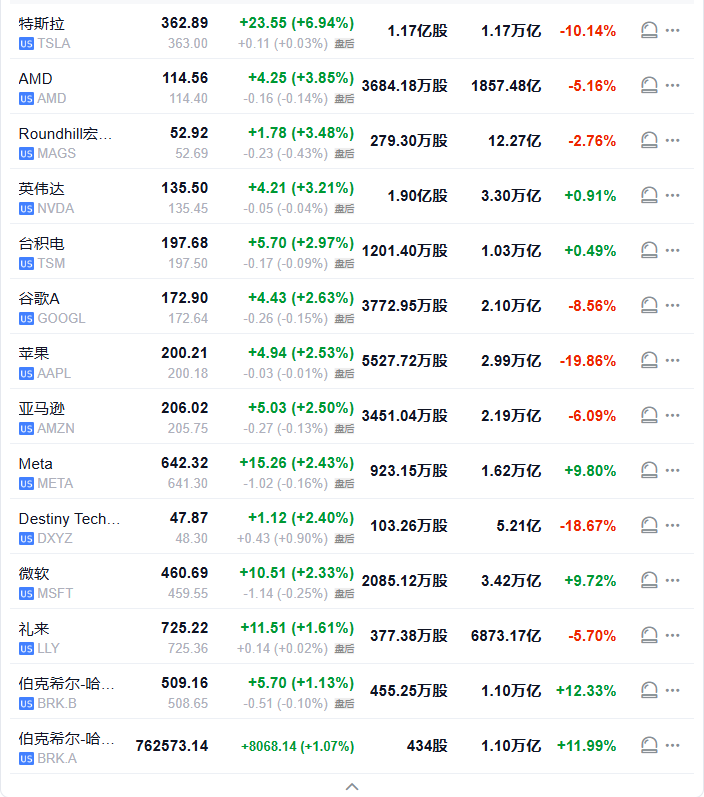
美股七巨头收盘播报|特斯拉收涨超6.9%,英伟达等也至少涨超2%
news flash· 2025-05-27 20:17
此外,AMD收涨3.85%,台积电ADR涨2.97%,礼来涨1.61%,巴菲特旗下伯克希尔哈撒韦B类股涨 1.13%。 | 特斯拉 | 362.89 | +23.55 (+6.94%) | 1.17亿股 | 1.17万亿 -10.14% | | ( ) ... | | --- | --- | --- | --- | --- | --- | --- | | us TSLA | 363.00 | +0.11 (+0.03%) 盘后 | | | | | | AMD | 114.56 | +4.25 (+3.85%) | 3684.18万股 | 1857.48亿 | -5.16% | ( ) ... | | us AMD | 114.40 | -0.16 (-0.14%) 盘后 | | | | | | Roundhill宏 ... | 52.92 | +1.78 (+3.48%) | 279.30万股 | 12.27亿 | -2.76% | [] ··· | | us MAGS | 52.69 | -0.23 (-0.43%) 盘后 | | | | | | 英伟达 | 135.50 | +4.21 (+3.21%) ...





中金:美国还能“扛多久”?
中金点睛· 2025-05-25 23:32
Group 1 - The article discusses the dramatic changes in Trump's tariff policy towards China, with tariffs fluctuating from 34% to 125% and then down to 10% after negotiations, indicating a volatile trade environment [1][3] - The market has shown resilience, recovering losses incurred after the initial tariff announcements, suggesting that the impact of tariffs may not be as severe as initially feared [1][3] - The article highlights the necessity for the U.S. to lower tariffs to avoid significant economic and inflationary pressures, as high tariffs are unsustainable for both the U.S. and China [3][5] Group 2 - Tariffs are expected to have a significant impact on U.S. inflation, potentially raising the Consumer Price Index (CPI) by 1 percentage point, although factors like low oil prices and inventory replenishment may delay this effect until late Q3 [25][32] - The article outlines that U.S. inventory levels have increased significantly, with a 20% rise in import amounts and a 2.4% increase in nominal inventory compared to the previous year, indicating a robust supply chain response [10][18] - Different industries will experience varying levels of pressure from tariffs, with textiles, apparel, computers, and electronics facing the most significant challenges due to their high reliance on imports from China [22][23] Group 3 - The article emphasizes that U.S. economic growth can be sustained until the end of the year, supported by consumer spending and investment, but warns that renewed tariffs could lead to stagnation [36][37] - It notes that the Federal Reserve's ability to lower interest rates is constrained by inflationary pressures, which could further suppress private sector credit expansion and investment [8][36] - The potential for tax cuts and further tariff reductions could alleviate some of the economic pressures, but the timing and implementation of these measures remain uncertain [9][57] Group 4 - The financial market's stability is under scrutiny, particularly following a downgrade in the U.S. credit rating by Moody's, which could affect investor confidence and market dynamics [58][59] - The article points out that the upcoming debt ceiling resolution and increased bond supply could lead to liquidity issues in the market, impacting the overall financial landscape [59][61] - Long-term concerns about the U.S. dollar's status as a reserve currency are raised, particularly if tariffs continue to affect trade balances and investor sentiment [65]