银行理财

Search documents
信银理财封春升:“长钱长投”推动银行理财资金多元配置
Shang Hai Zheng Quan Bao· 2025-07-24 18:58
Core Viewpoint - The banking wealth management sector is experiencing significant growth opportunities due to ongoing policy support for long-term capital entering the market, despite facing challenges related to investor risk appetite and liquidity matching [2][3]. Group 1: Characteristics of Banking Wealth Management - Banking wealth management funds inherently possess "long money" characteristics, with low net value volatility and stable liability scales conducive to long-term investment [3]. - The focus is on promoting the issuance of closed-end products with a maturity of one year or more to reduce redemption pressure [3]. - There is an increasing allocation of equity assets in technology and innovative pharmaceuticals, which requires long-term holding to capture growth dividends [3]. Group 2: Challenges in Banking Wealth Management - The sector faces a challenge of "short-termization" of funds, as overall investor risk appetite is low, limiting the proportion of funds that can be allocated to equity assets [3]. - Market volatility and redemption pressures lead to a tendency for funds to favor "short-term behavior" [3]. - The banking wealth management institutions need to enhance their investment research capabilities in timing, drawdown control, and risk diversification [4]. Group 3: Strategies for Improvement - The company is adopting a "dual-driven" model of "multi-asset multi-strategy + investment advisory support" to enhance asset allocation capabilities and client service quality [4]. - The investment advisory service includes a four-stage support system covering product creation, operation, volatility response, and review [4]. - Recommendations include optimizing internal assessment mechanisms to focus on long-term risk-adjusted returns and encouraging the establishment of professional multi-strategy and equity research teams [5]. Group 4: Institutional Support and Recommendations - There is a need for collaborative efforts to promote long-term investment in banking wealth management funds [5]. - Suggestions include introducing a similar OCI account mechanism for certain banking wealth management products to mitigate the impact of short-term net value fluctuations on client behavior [6]. - Advocating for tax deferral support and integrating more banking wealth management products into personal pension accounts to create a sustainable long-term funding ecosystem [6].


告别“削峰补欠” 银行理财打法全面升级
Zhong Guo Zheng Quan Bao· 2025-07-23 21:00
Core Viewpoint - The banking wealth management industry is transitioning to a "true net value era" due to regulatory requirements, necessitating strategies to reduce product net value volatility [1][2] Group 1: Industry Response to Net Value Volatility - Wealth management companies are focusing on optimizing asset allocation and employing diversified investment strategies to address net value volatility challenges [1][2] - Companies are releasing previously retained floating profits and are now enhancing product yields by increasing short-duration asset purchases and allocating funds to public funds [1][2] - The use of credit bond ETFs is becoming popular among wealth management firms as a means to improve investment returns [1][2][3] Group 2: Asset Allocation Strategies - Companies are increasing the proportion of stable asset allocations, such as deposits and preferred stocks, while limiting equity positions to avoid significant net value declines [2] - There is a focus on multi-asset strategies and exploring dynamic adjustment mechanisms to manage risks effectively [2][3] - Risk management is being conducted at both product and asset levels, with attention to liquidity reserves and monitoring deviations in actual yields [2][3] Group 3: Growth of Credit Bond ETFs - Credit bond ETFs are gaining traction due to their advantages in liquidity and the ability to provide leveraged exposure [3][4] - The market for credit bond ETFs has seen rapid growth, with a 60% market share in the bond ETF sector as of July 20 [3] - Wealth management firms are particularly interested in AAA-rated credit bond ETFs for their liquidity and suitability for short-term allocations [3][4] Group 4: Future Trends and Innovations - The banking wealth management sector is expected to bring additional funds into the equity market, with estimates ranging from 80 billion to 120 billion yuan annually [5][6] - Companies are innovating products around the dual themes of "stable returns + low volatility" and are increasingly incorporating equity assets to enhance product yields [5][6] - There is a shift from single asset strategies to multi-asset strategies, with a focus on optimizing asset allocation in a low-interest-rate environment [5][6]
【银行理财】合资理财规模高增,银行理财产品收益分化——银行理财周度跟踪(2025.7.14-2025.7.20)
华宝财富魔方· 2025-07-23 09:05
Core Viewpoint - The article highlights significant growth in the scale of joint venture wealth management products in 2025, with a notable increase in management sizes for specific companies, indicating a positive trend in the industry [2][6]. Regulatory and Industry Dynamics - The scale of joint venture wealth management has seen a remarkable increase, with five companies reaching a total of 191.7 billion yuan by July 23, 2025, representing an increase of over 50% since the beginning of the year [2][6]. - Among these, the management scale of BNP Paribas and BlackRock's joint venture reached 61.1 billion yuan and 42.8 billion yuan respectively, both showing substantial growth this year [2][6]. - BNP Paribas focuses on stable returns with a strategy centered on fixed income, while BlackRock adopts a multi-strategy approach, enhancing product returns and risk control [6]. Peer Innovation Dynamics - Minsheng Wealth Management has upgraded the redemption speed for its cash management products, allowing for faster access to funds, which enhances investment efficiency and reduces idle cash periods [7]. Yield Performance - For the week of July 14-20, 2025, cash management products recorded an annualized yield of 1.37%, down 3 basis points from the previous week, while money market funds yielded 1.22%, down 1 basis point [8]. - The yield gap between cash management products and money market funds narrowed by 3 basis points [8]. - In pure fixed income products, yields for those with maturities under six months generally increased, while those over six months saw a decline [9]. Credit Spread Tracking - The credit spread has been narrowing since May, currently at historical low levels since September 2024, indicating limited value [11][15]. - The net asset value of bank wealth management products has a low break-even rate of 0.84%, down 0.02 percentage points, suggesting stability in the market [15]. Market Outlook - The article suggests that the ongoing regulatory adjustments and low interest rate environment may continue to pressure the yields of wealth management products in the medium to long term [12]. - Companies are expected to focus on low-volatility, high-liquidity assets to manage fluctuations effectively, which may limit potential returns [12].

“黄金+”银行理财配置升温,现在“上车”合适吗
Jin Rong Shi Bao· 2025-07-22 12:28
Core Viewpoint - The recent surge in gold prices, surpassing $3,400 per ounce for the first time since June 17, is primarily driven by rising expectations of interest rate cuts by the Federal Reserve and a weakening dollar [1] Group 1: Market Trends - Gold prices have been fluctuating at high levels this year, leading to an increase in the issuance of "gold+" wealth management products by various financial institutions [1] - As of July 20, over 40 wealth management products featuring "gold" in their names have been issued, mainly by bank wealth management subsidiaries [1] Group 2: Product Structure and Strategy - "Gold+" is a configuration concept that integrates gold into multi-asset portfolios, serving as a crucial factor for risk hedging and smoothing returns [1] - Wealth management companies are utilizing tools like gold ETFs and derivatives to launch "gold+" products, which lower investment thresholds while managing risks [1] - Most publicly available "gold+" wealth management products have gold allocations ranging from 5% to 10%, with some products reaching up to 30% [2] Group 3: Investment Recommendations - Experts suggest that investors should adopt a "configuration" approach rather than a speculative one, viewing gold as a long-term risk-hedging asset [3] - It is recommended that investors prioritize products with risk levels of R2 or lower and transparent strategies, while being cautious of high-leverage derivatives [3] - Investors should dynamically track macroeconomic conditions, as gold prices are influenced by factors such as the dollar index and geopolitical events [3]
2023年以来九成目标盈理财产品提前终止丨机警理财周报
2 1 Shi Ji Jing Ji Bao Dao· 2025-07-22 09:58
Market Overview - The bond market remained volatile with an overall balanced and loose funding environment, with the weighted average of DR007 at 1.51% and the 10-year government bond yield at 1.67% [2] - The Hong Kong stock market performed well, with the Hang Seng Technology Index and Hang Seng Index increasing by 5.53% and 2.84% respectively, while the A-share market also showed positive performance with the ChiNext Index, Shenzhen Component Index, and CSI 1000 Index rising by 3.17%, 2.04%, and 1.41% respectively [2] Product Performance - The number of underperforming wealth management products remained low, with 24,431 public wealth management products in existence as of July 20, 2025, and a comprehensive underperformance rate of 0.43% [3] - The underperformance rates for equity and mixed wealth management products were 41.46% and 5.45% respectively, while fixed income public wealth management products had an underperformance rate of 0.09% [3] New Product Issuance - A total of 457 wealth management products were issued by 31 wealth management companies from July 14 to July 18, 2025, representing a 17.48% increase from the previous week [4] - The majority of newly issued products were R2 (medium-low risk), closed-end net value type, and fixed income public products, with a slight increase in mixed products to 14, accounting for 3.0% [4] - Pricing for most products increased, with 3-6 month products rising to over 2.5% and products over 3 years rising to 2.35% [4] Target Yield Products - Five institutions launched five target yield public wealth management products, with the "Sunshine Jin Feng Li Enhanced Target Yield Phase 1" from Everbright Wealth Management aiming for a target yield of 2.80% [5] - As of the report date, 256 target yield products had been terminated early this year, with over 90% of these due to reaching their target yield [6] - Among the expired products, the highest target annualized yield was 6.29% for the "Feng Li Ling Dong Rui Yi Target Yield Fixed Term Open 1" from Xingyin Wealth Management [6] Industry Trends - Daily open-type products have become increasingly popular in the low-interest-rate environment, offering broader investment ranges and better yield potential compared to cash management products [10] - The scale of QDII wealth management products has surpassed 200 billion yuan, with 389 QDII products issued, primarily fixed income [11] - Joint venture wealth management companies have significantly increased their management scales this year, with notable growth from firms like BNP Paribas and BlackRock [12]
不出意外!2025年下半年,国内或将迎来6大趋势!
Sou Hu Cai Jing· 2025-07-20 05:02
Economic Overview - The domestic economy shows promising performance with a GDP growth of 5.3% year-on-year in the first half of 2025 [1] - The average wage income for residents reached 12,628 yuan, reflecting a growth of 5.7% [1] - Consumer Price Index (CPI) has slightly decreased by 0.1% year-on-year, indicating stable price levels [1] - Challenges remain in the real estate market, consumer demand, and employment situation, suggesting a prolonged recovery for the real economy [1] Trends in the Market - **Trend 1: Divergence in Housing Prices** Housing prices are expected to show divergence, with second and third-tier cities experiencing a slowdown in price declines, while first-tier cities like Shanghai and Shenzhen may face further price corrections [3][5] - **Trend 2: Increased Demand for Bank Wealth Management Products** As bank deposit rates decline from 3.05% to 1.55% for three-year fixed deposits, more savers are turning to bank wealth management products for better returns, despite rising risks associated with these products [7] - **Trend 3: Employment Challenges for Individuals Over 35** Many companies prefer hiring individuals under 35, making it increasingly difficult for those over 35 to find jobs, leading to a rise in self-employment and gig work among older individuals [9] - **Trend 4: Record Low Birth Rates in 2025** The birth rate is projected to hit a historical low, with only 4.32 million births in the first half of 2025, potentially falling below 9 million for the entire year due to high marriage and housing costs [11] - **Trend 5: Acceleration of Rural Entrepreneurship** There is a growing trend of individuals returning to their hometowns to start businesses, driven by high living costs in major cities and rapid economic growth in rural areas [13] - **Trend 6: Proliferation of Artificial Intelligence** AI is increasingly integrated into daily life, with applications in customer service, delivery, and manufacturing, indicating a shift towards automation in various sectors [14]

投顾周刊:外资机构集体上调中国2025年GDP增速预测
Wind万得· 2025-07-19 22:25
Group 1 - The return of "AI players" has led to a strong performance in the AI computing sector, with several actively managed equity products seeing significant net value increases, surpassing related ETF products. The light communication and PCB sectors have experienced rapid growth due to the AI boom, and Chinese companies are expected to benefit from the global AI development dividends [2][3] - High-performing funds have capitalized on emerging trends, with many focusing on innovative pharmaceuticals, new consumption, and artificial intelligence sectors. The emergence of niche products such as short drama-themed funds and controllable nuclear fusion funds indicates a diversification in investment strategies [2][3] - In the second quarter, many high-performing funds increased their equity asset allocations, with technology and pharmaceuticals becoming core investment directions. This shift reflects a strategic response to structural opportunities in the market [3] Group 2 - Foreign institutions have collectively raised their GDP growth forecasts for China in 2025, with Morgan Stanley increasing its prediction from 4.5% to 4.8%, Goldman Sachs from 4.6% to 4.7%, and UBS from 4% to 4.7% [3][5] - Citigroup has upgraded the ratings for the Chinese and South Korean stock markets to "overweight," projecting the Hang Seng Index to reach 25,000 points by the end of this year and 26,000 points by mid-next year, while the CSI 300 Index is expected to hit 4,200 points by year-end and 4,350 points by mid-next year [4][5] Group 3 - NVIDIA has confirmed the resumption of H20 chip sales in China, with CEO Jensen Huang stating that the U.S. government has assured the granting of licenses, and NVIDIA aims to initiate deliveries promptly [6] - Recent global stock market performance has shown mixed results, with the Hang Seng Index and Shenzhen Component Index in China both rising over 2%, while the U.S. markets also saw gains in the Nasdaq and S&P 500 indices [7] Group 4 - The bond market has shown varied performance, with yields on 1-year, 5-year, and 10-year Chinese government bonds all declining, while the 10-year U.S. Treasury yield increased slightly [9][10] - Recent data indicates that fixed-income products dominate the bank wealth management market, with fixed-income plus products accounting for 48.34% of new offerings and 61.23% of total assets, reflecting a preference for stable returns and low-risk assets [14][15]

含权理财半年考:可转债、公募REITs成收益引擎
2 1 Shi Ji Jing Ji Bao Dao· 2025-07-18 15:40
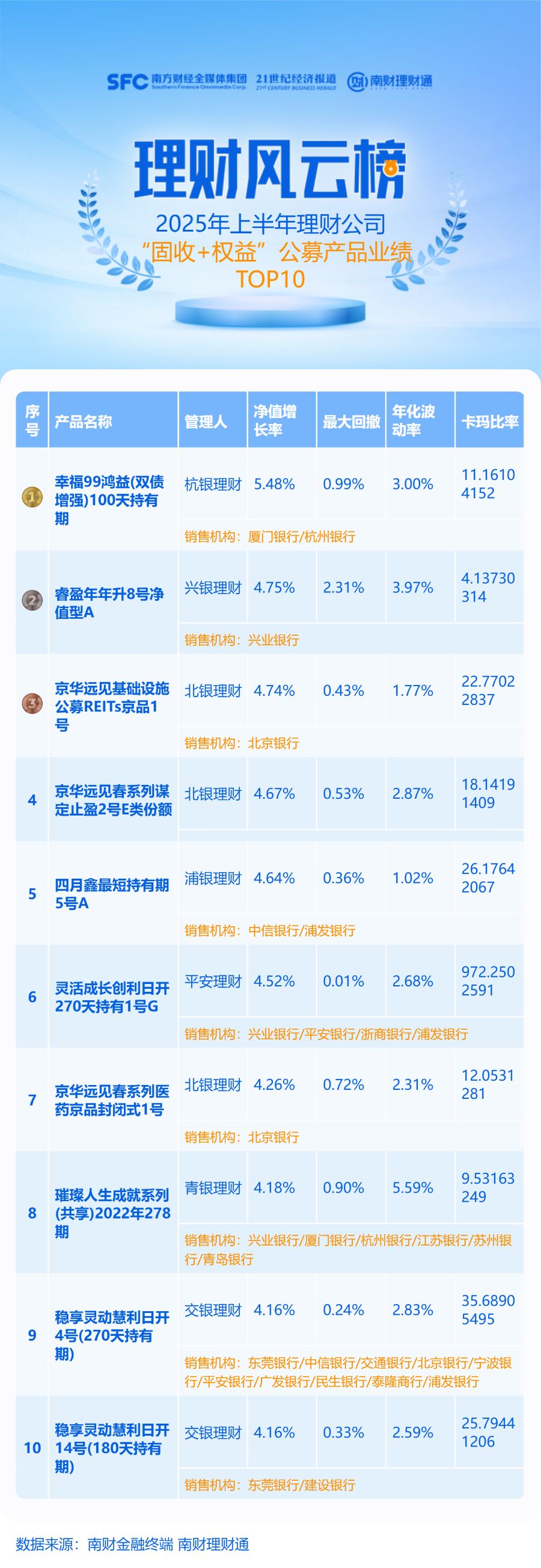
Overall Performance - In the first half of 2025, the bond market entered a high volatility phase, while the A-share market showed a mild upward trend. The "fixed income +" products promoted by bank wealth management performed well, with one product yielding over 5% and five products yielding over 4.5% [4] - Among the top ten "fixed income + equity" products, Beiyin Wealth Management stood out with three products making the list, while Jiaoyin Wealth Management had two products. Other products came from five different wealth management companies [4] - The top-ranked product, "Happiness 99 Hongyi (Double Bond Enhancement) 100-Day Holding Period" from Hangyin Wealth Management, achieved a net value growth rate of 5.48% [4] Highlighted Product Analysis - The top product, "Happiness 99 Hongyi (Double Bond Enhancement) 100-Day Holding Period," is a medium-risk public fixed income product with a minimum holding period of 100 days. Its high yield is primarily attributed to investments in convertible bonds, alongside fixed income and equity assets [5][6] - The second-ranked product, "Ruiying Year-on-Year Growth No. 8," is a one-year fixed income product that has seen a significant drop in total shares, down over 65% from the previous year. However, it rebounded in 2025 with a net value growth rate of 5.42% due to a shift towards more active management and increased equity positions [6][9] - The third-ranked product, "Jinghua Vision Infrastructure Public REITs," benefited from the strong performance of the public REITs market, achieving a net value growth rate of 4.74%. The product primarily invests in short-duration credit bonds and REITs [10] Market Performance - In the first half of 2025, the A-share market showed a mixed performance, with the North Exchange market being the standout performer, as the North Certificate 50 Index rose by 38.72%. The broader indices, such as the Shanghai Composite Index and Shenzhen Component Index, increased by 2.76% and 0.48%, respectively [14] - Traditional cyclical and financial sectors became safe havens for funds, with the non-ferrous metals, banking, and defense industries leading in gains [14] Product Performance - Industry-specific products yielded strong returns, with five industry index theme products from Huaxia Wealth Management entering the top ten, focusing on precious metals and micro-growth styles, both exceeding 25% in gains [14] - The product "Sunshine Red Infrastructure Public REITs Preferred No. 1" from Everbright Wealth Management achieved third place, with over 80% of its assets allocated to public REITs, benefiting from stable cash flow returns amid low bond yields [14]
理财6月报:2年以上期限产品定价严重倒挂!
2 1 Shi Ji Jing Ji Bao Dao· 2025-07-18 06:49
Core Viewpoint - The report highlights the performance and trends in the bank wealth management industry for June 2025, indicating a significant decline in the net loss rate of wealth management products, alongside stable issuance and maturity rates, reflecting a cautious yet optimistic market environment [2][4][12]. Break-even Situation - In June 2025, the break-even rate of wealth management products reached a new low of 0.54%, with fixed-income products at 0.17%, mixed products at 5.58%, and equity products at 15.65% [2][4][12]. - The majority of public fixed-income products maintained a break-even rate of 0 or saw a decrease in their break-even rates [4][11]. New Issuance Situation - A total of 1,795 wealth management products were issued by 32 companies in June 2025, remaining stable compared to May's 1,806 products [2][5]. - The structure of new products showed an increase in short-term, low-risk, high-liquidity products, with the proportion of level one risk products rising to 22.1% [6][8]. Maturity Situation - In June 2025, 1,089 closed-end RMB wealth management products matured, marking a 30.26% increase from the previous month [3][8]. - The overall performance compliance rate for matured products was 82.42%, with fixed-income products achieving a performance compliance rate of 48.25% [9][10]. Existing Situation - As of the end of June, there were 27,381 existing wealth management products, with fixed-income products accounting for 92.55% [11]. - The proportion of open-ended products increased to 54.79%, indicating a shift in product structure [11]. Product Performance - Equity wealth management products showed the best performance in the first half of the year, with an average net value growth rate of 5.82% [12][14]. - Fixed-income products had the lowest average net value growth rate of 1.26%, but exhibited superior stability with a maximum drawdown of only 0.19% [12][14].
上海全球资管中心建设|中保投资副总裁陈子昊:私募股权投资在上海国际金融中心建设中的功能发挥
Sou Hu Cai Jing· 2025-07-17 00:44
Group 1 - Private equity investment serves as a crucial bridge connecting the innovation needs of the real economy with the effective supply of social capital, playing an indispensable role in enhancing the global resource allocation capability of Shanghai as an international financial center [2][29] - The recent Central Financial Work Conference emphasized accelerating the construction of a financial powerhouse, focusing on five key areas: technology finance, green finance, inclusive finance, pension finance, and digital finance, which will guide the future development of the financial industry in China [2][8] - Shanghai aims to become a leading global financial center by 2035, characterized by an open modern financial market system and a global RMB asset allocation center, competing with New York and London [2][9] Group 2 - Private equity investment is a vital component of the direct financing system, guiding social capital towards the real economy, particularly innovative enterprises and strategic emerging industries [3][4] - The development level and activity of private equity investment are important indicators of the maturity and competitiveness of an international financial center [3][4] - Private equity investment enhances corporate governance and operational efficiency by actively participating in major decisions of invested companies, promoting the establishment of standardized governance structures [7] Group 3 - The "five key areas" outlined in the recent financial strategy highlight the historical mission of private equity investment to support national strategies, including technological self-reliance, green low-carbon development, and regional coordinated development [8][21] - Private equity investment must return to its core purpose of enhancing the quality and efficiency of financial services to the real economy, avoiding short-term speculation [8][21] - Promoting the healthy development of private equity investment is essential for preventing and mitigating financial risks, which includes improving fundraising, investment, management, and exit mechanisms [8][21] Group 4 - Shanghai's financial market is characterized by a high concentration of financial resources, talent, information, and technology, providing favorable conditions for private equity fund operations [9] - The city has been at the forefront of financial innovation in China, implementing pilot programs for qualified foreign and domestic limited partners, which fosters a conducive policy environment for private equity investment [9] - Strategic emerging industries in Shanghai, such as integrated circuits and biomedicine, offer a rich pool of quality investment targets for private equity [9][13] Group 5 - Private equity investment can significantly contribute to the development of technology finance by providing funding support across the entire chain of technological innovation [10][11] - The focus on "hard technology" projects in key sectors like integrated circuits and artificial intelligence is essential for Shanghai's goal of becoming a global technology innovation center [10][11] - Private equity investment should enhance post-investment support and management for technology enterprises, facilitating their growth and addressing challenges [11] Group 6 - Private equity investment plays a critical role in promoting green finance by directing capital towards environmentally sustainable projects and supporting the transition to a low-carbon economy [12] - Establishing green-themed funds and participating in carbon markets are key strategies for private equity firms to engage in green finance [12] - The transformation of traditional industries towards greener practices can be facilitated through private equity investment, which can help upgrade production methods [12] Group 7 - Private equity investment is essential for inclusive finance, aiming to provide affordable financial services to underserved groups, including small and micro enterprises [14][15] - Collaborating with government-led funds can enhance the reach of private equity investment in the inclusive finance sector [14][15] - Focusing on specific areas of inclusive finance, such as agricultural modernization and community businesses, can further support social equity [14] Group 8 - The development of pension finance is crucial for addressing the aging population in Shanghai, with private equity investment playing a role in creating specialized funds for the elderly care industry [16][17] - Collaborating with insurance capital to invest in the pension sector can leverage resources for better outcomes [16][17] - Exploring asset securitization in the elderly care sector can improve capital efficiency and support the development of sustainable pension services [17] Group 9 - Digital finance is a strategic focus for Shanghai, aiming to enhance the efficiency and inclusivity of financial services through technological innovation [19][20] - Private equity investment can support the digital transformation of traditional financial institutions and invest in foundational technologies for digital finance [19][20] - Engaging in the development of digital financial infrastructure is essential for creating a robust digital finance ecosystem [20]