证券业

Search documents
上证早知道|央行,今日操作;事关创新药,国家医保局宣布;上期所,调整手续费
Shang Hai Zheng Quan Bao· 2025-11-05 00:47
Monetary Policy and Market Operations - The People's Bank of China will conduct a 700 billion yuan reverse repurchase operation on November 5, 2025, to maintain liquidity in the banking system, with a term of 3 months [1][2] - In October 2025, the central bank's liquidity injection included a net investment of 200 billion yuan in government bonds, 4 billion yuan in reverse repos, and 2 billion yuan in medium-term lending facilities [2] Stock Market and New Accounts - In October 2025, A-share new accounts totaled 2.3099 million, a decrease of 21.36% from September and a 66.26% drop year-on-year [2] Commodity Futures and Trading Fees - Starting November 10, 2025, trading fees for aluminum alloy futures and printing paper futures will be adjusted to 0.0005 of the transaction amount, with no fees for intraday closing positions [3] Automotive Industry - In October 2025, wholesale sales of new energy passenger vehicles reached 1.61 million units, a year-on-year increase of 16% and a month-on-month increase of 7% [2] Healthcare and Pharmaceuticals - The negotiation for the 2025 National Basic Medical Insurance Drug List has concluded, with a new drug list set to be released in December 2025 and implemented on January 1, 2026 [5] - The global innovative drug market is projected to grow from $1.1 trillion in 2024 to $1.5 trillion by 2030, with significant market opportunities for Chinese innovative drugs [5] Technology and Electronics - Nintendo has raised its sales forecast for the Switch 2 to 19 million units by March 2026, reflecting strong market demand [6] - The consumer electronics industry is expected to grow, driven by AI technology and stable demand in various regions [6] Investment and Financing - In the fourth quarter of 2025, equity ETFs have attracted over 100 billion yuan in net subscriptions, indicating strong investor interest [10]
陆家嘴财经早餐2025年11月5日星期三
Wind万得· 2025-11-04 22:31
Group 1 - The Ministry of Commerce responded to ASML's announcement of halting wafer supply to ASML (China), which disrupts the global semiconductor supply chain, stating that the Dutch side should bear full responsibility [2] - The State Council announced the holiday schedule for 2026, including New Year's Day, Spring Festival, Labor Day, and National Day [2] Group 2 - President Xi Jinping met with Russian Prime Minister Mishustin, emphasizing the need to expand mutual investment and explore cooperation in traditional and emerging sectors such as AI and green development [3] - The Central Financial Office's head met with Goldman Sachs' CEO, discussing the importance of implementing agreements to stabilize China-US economic relations [3] - The People's Bank of China reported a net injection of 20 billion yuan in government bonds, indicating a restoration of liquidity measures [3] - China's service trade import and export totaled 59,362.2 billion yuan in the first three quarters, with a year-on-year growth of 7.6% [3] Group 3 - The Vice Chairman of the CSRC announced plans for more open measures to enhance the efficiency of overseas listings and support the inclusion of various financial instruments in Hong Kong's stock market [4] - Public fund performance benchmarks have been categorized to encourage equity investment, with a focus on high-recognition stock indices [4] - A-shares experienced a decline with over 3,600 stocks falling, while local stocks in Fujian surged [4] - The Hang Seng Index fell by 0.79%, with significant declines in sectors like AI and renewable energy [4] Group 4 - In October, A-share new account openings dropped by 66% year-on-year, while the total for the first ten months increased by 11% [5] - Southbound funds have significantly increased their positions in the Hong Kong market, with a record net inflow of over 1.27 trillion HKD this year [5] - Major foreign institutions have conducted research on 309 A-share companies, focusing on high-growth sectors [5] Group 5 - Brokerages are optimistic about the Hong Kong market in 2026, with expectations of improved fundamentals driving further growth [6] - The STAR Market has seen over 590 companies listed, raising over 900 billion yuan, with significant revenue growth reported [6] - Leap Motor denied rumors of being acquired by FAW Group, clarifying that the reports were false [6] Group 6 - The recent negotiations for the 2025 drug catalog concluded, with significant price reductions discussed for innovative drugs [9] - Five departments issued guidelines to promote the application of AI in healthcare across various sectors [9] - In October, China's wholesale sales of new energy passenger vehicles reached 1.61 million units, marking a 16% year-on-year increase [9] Group 7 - The storage supply shortage continues, with several companies receiving additional orders and planning price increases [10] - BlackRock's CEO discussed the future of finance involving digital assets and blockchain technology at an investment summit [11] Group 8 - Tesla's CEO faces opposition regarding his compensation plan from major shareholders, raising concerns about his future with the company [12] - Ele.me is rebranding to "Taobao Flash Purchase," transitioning from a standalone delivery platform to an instant retail service [12] - XPeng Motors is restarting its Robotaxi project in anticipation of L4 vehicle production next year [12] Group 9 - Starbucks announced a strategic partnership with Boyu Capital to jointly operate its retail business in China, valuing the joint venture at approximately 4 billion USD [13] Group 10 - The US government shutdown has reached its 35th day, tying the record for the longest shutdown in history [14] - Japan's government is prioritizing investments in strategic sectors, including AI and semiconductors [14] - South Korea's budget for 2026 is set to increase by 8.1%, with significant allocations for AI transformation [15]


央行释放重要信号
Wind万得· 2025-11-04 22:31
Group 1 - The People's Bank of China (PBOC) announced a 700 billion yuan reverse repo operation to maintain liquidity in the banking system, with a term of 3 months, indicating a loose monetary policy approach [2] - On the same day, the PBOC conducted a 1,175 billion yuan 7-day reverse repo operation at a rate of 1.40%, resulting in a net withdrawal of 357.8 billion yuan due to the maturity of 4,753 billion yuan in reverse repos [2] - The PBOC's actions reflect a "long-short combination" liquidity management strategy, aiming to stabilize market liquidity expectations while providing support for year-end liquidity management [2] Group 2 - In October, the PBOC achieved a net injection of 20 billion yuan through open market treasury transactions, indicating a gradual restoration of treasury transactions as a regular liquidity adjustment tool [2] - The PBOC's Deputy Governor Lu Lei emphasized the importance of adjusting policy support based on domestic and international economic conditions, ensuring effective implementation of monetary policy tools [2] - According to a report by CITIC Securities, the liquidity gap is expected to narrow to around 100 billion yuan in November, with low volatility in funding rates anticipated due to the PBOC's recent resumption of treasury transactions [3] Group 3 - PBOC Governor Pan Gongsheng highlighted the need to optimize the basic currency issuance mechanism and maintain reasonable growth in financial aggregates in a recent article [3] - The focus is on enhancing the role of policy interest rates and narrowing the width of the short-term interest rate corridor to improve the transmission of monetary policy to market rates [3]

黄金逆袭暗藏玄机!美联储提前停止缩表,全球流动性紧张超预期
Sou Hu Cai Jing· 2025-11-04 16:07
Group 1: Market Reactions and Trends - The financial market experienced an unusual reaction in late October, with gold prices rising despite positive trade developments between China and the U.S. [1][3] - Gold prices surged over 3% within three trading days following the trade announcement, breaking the $2900 per ounce mark, contrary to traditional expectations [3][5] - The rise in gold prices is attributed to its role as a warning signal regarding potential risks in the monetary credit system, rather than just geopolitical tensions [5][7] Group 2: Federal Reserve Actions - The Federal Reserve announced an unexpected early termination of its balance sheet reduction, moving the date from January 2026 to December 2025, indicating rising liquidity pressures in the market [9][11] - The reduction in bank reserves, which fell to $2.93 trillion in October, approached the Fed's lower threshold of $2.5-3 trillion, prompting the decision to halt the balance sheet reduction [11][13] - The Fed's actions reflect lessons learned from past financial crises, aiming to prevent a repeat of liquidity issues experienced in 2019 [13][15] Group 3: Financial System Vulnerabilities - The tightening liquidity environment has exposed vulnerabilities within the financial system, with rising non-performing loan rates among regional banks [15][17] - The U.S. Treasury's increased issuance of short-term debt to cover fiscal deficits has further strained bank reserves, contributing to a cycle of rising financing costs and reduced risk tolerance among smaller banks [17][19] - The Fed's strategy to shift funds from mortgage-backed securities to short-term Treasury bonds aims to enhance the stability of the financial system while preparing for potential future liquidity needs [19][21] Group 4: Global Market Implications - The Fed's decision to halt balance sheet reduction has provided relief to emerging markets, with a decrease in the dollar index and a narrowing of dollar bond spreads [21][23] - However, commodity markets have shown mixed reactions, with gold prices rising due to ongoing demand for currency credit hedging, while oil and industrial metals remain under pressure from weak global economic recovery expectations [21][25] - The ongoing adjustments in monetary policy and market dynamics suggest a need for investors to focus on long-term trends amidst short-term volatility [25]

央行恢复公开市场国债买卖,释放什么信号?
Zhong Guo Zheng Quan Bao· 2025-11-04 12:50
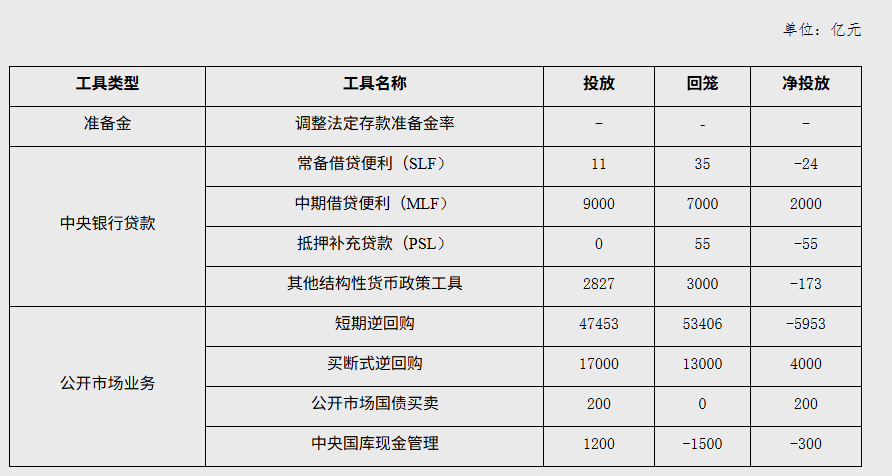
Core Viewpoint - The People's Bank of China (PBOC) has resumed the operation of buying and selling government bonds, which is expected to support the real economy and stabilize market expectations [1][3][4]. Group 1: Liquidity Injection Details - As of November 4, 2023, the PBOC reported a net injection of 20 billion yuan through open market government bond transactions, indicating the resumption of operations that were paused since January [1][4]. - The PBOC's liquidity tools include various instruments, with a notable net injection of 200 billion yuan in government bonds, while other tools like the Medium-term Lending Facility (MLF) saw a net injection of 2000 million yuan [2]. Group 2: Market Conditions and Economic Signals - The current 10-year government bond yield is around 1.8%, and the overall bond market is performing well, which supports the decision to resume bond transactions [4]. - The resumption of government bond transactions is seen as a signal to stabilize economic growth, particularly for the fourth quarter of this year and the first quarter of next year [4]. Group 3: Reverse Repo Operations - On November 5, the PBOC will conduct a 700 billion yuan reverse repurchase operation with a three-month term, maintaining liquidity in the banking system [5]. - The continuation of reverse repo operations is aimed at injecting medium-term liquidity into the market, with expectations of further operations in November [5].
债市由逆风变顺风,继续看多:11月债市投资策略
Hua Yuan Zheng Quan· 2025-11-04 06:38
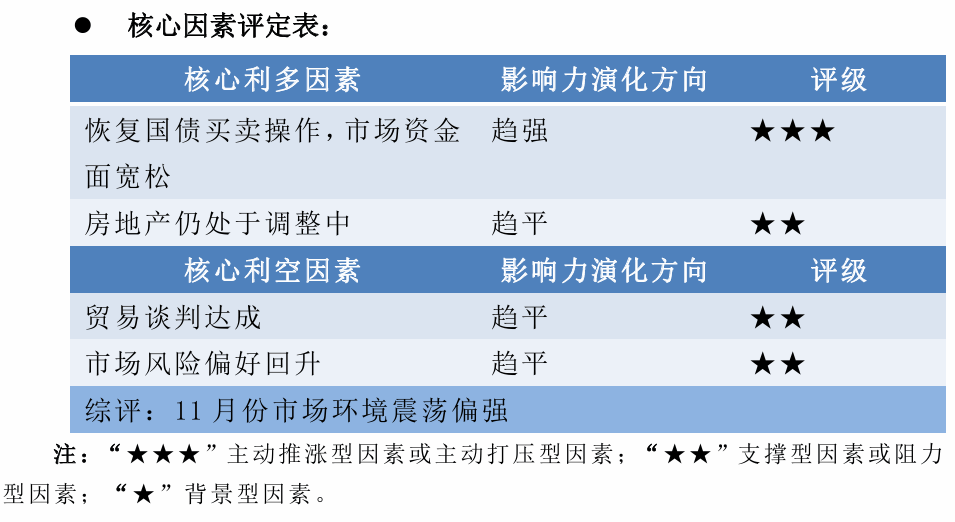
Group 1 - The core view of the report indicates a shift in the bond market from headwinds to tailwinds, with a continued bullish outlook for November [1] - In 2025, the bond market is expected to rely heavily on increased allocations from bank proprietary trading, with a total bond market balance increasing by 16.4 trillion yuan in the first three quarters [2] - Government bonds accounted for a significant portion of this increase, with an increment of 11.4 trillion yuan, while financial bonds increased by 3.0 trillion yuan [2] Group 2 - The report highlights that the growth rate of bond investments by banks has significantly increased, with a year-on-year growth of 21.1% for the four major banks and 17.5% for smaller banks as of September [2] - The report notes that the demand for credit remains weak, leading banks to focus on bond investments as a primary driver for asset scale expansion [2] - The report anticipates that conditions for a further reduction in policy interest rates may be in place, supported by a decline in the cost of interest-bearing liabilities for banks [2] Group 3 - Non-bank institutions are reported to have low bond positions and shorter durations, with a potential increase in bond market sentiment as the central bank resumes government bond trading [2] - The report suggests that there is potential for significant allocation of credit bonds by wealth management products, estimating a potential increase of several trillion yuan [2] - The report predicts that the 10-year government bond yield may return to around 1.65% by the end of the year, with a bullish outlook for the bond market continuing into November [2][3]
薛鹤翔:政策助力期债价格回升
Sou Hu Cai Jing· 2025-11-04 03:03
Core Viewpoint - Since October, the prices of government bond futures have shown a strong upward trend, reversing the weak performance of the third quarter, primarily due to the central bank's increased open market operations and the resumption of government bond trading, leading to a more relaxed market liquidity environment [1][29]. Group 1: Market Analysis - The average daily trading volume of government bond futures in October was 318,100 contracts, a decrease of 13.76% month-on-month, mainly due to the National Day holiday [4]. - The average open interest increased by 10.49% month-on-month to 678,000 contracts, indicating strong hedging demand in the market [4]. - The central bank's open market operations have resulted in a slight net injection of liquidity, maintaining a relatively stable overall funding rate [4][22]. Group 2: Economic Indicators - The U.S. ADP employment figures for September showed a decrease of 32,000 jobs, which was below expectations and previous values, leading to increased risk aversion [8]. - The U.S. Consumer Price Index (CPI) for September rose by 0.3% month-on-month and 3.0% year-on-year, slightly above the previous value but below market expectations, indicating moderate inflation [8]. - The central bank's decision to cut interest rates by 25 basis points on October 29 was influenced by the soft employment data and the government shutdown, which affected the release of several economic indicators [8]. Group 3: Policy and Future Outlook - The central bank has resumed government bond trading operations to stabilize market expectations and enhance liquidity, which is expected to support government bond prices [26][27]. - The central bank is likely to continue implementing a supportive monetary policy stance, providing both short-term and long-term liquidity arrangements to maintain relatively loose financing conditions [27]. - Despite achieving consensus in U.S.-China trade negotiations, external uncertainties remain, and the domestic economy is facing challenges, particularly in the real estate sector, which continues to show weakness [29].
21万亿元理财资金精准支持实体经济
Jin Rong Shi Bao· 2025-11-04 02:01
Core Insights - The bank wealth management market reached a scale of 32.13 trillion yuan by the end of Q3 2025, showing a year-on-year growth of 9.42% [1] - The market demonstrated strong resilience, with a cumulative growth of 2.2 trillion yuan in the first three quarters, surpassing the average growth rate of 5.1% over the past six years [1][2] - The number of investors in wealth management products reached 139 million, an increase of 12.70% year-on-year, generating a total return of 568.9 billion yuan for investors [1] Market Dynamics - The growth in scale is attributed to lower deposit rates and stable product performance supported by "floating profits" [2] - The annualized yield for fixed-income wealth management products reached 2.16%, maintaining good net value stability despite downward pressure [2] - The decline in deposit rates has made wealth management products more attractive compared to traditional deposits, enhancing customer experience [2] Product and Participant Trends - Fixed-income products remain the primary driver of growth, accounting for 97.14% of the total wealth management product scale, with a total of 31.21 trillion yuan [4] - The market structure shows stability, with a slight increase in mixed products, while equity and commodity derivative products remain relatively small [4] - The "fixed income plus" products are expected to gain attention as they offer the potential for excess returns in a low-interest environment [4] Company Market Share - Wealth management companies have increased their market share, with their products accounting for 91.13% of the total market by the end of Q3 2025, marking a 1.52 percentage point increase since June [5] - The growth in market share is supported by banks' efforts to integrate wealth management subsidiaries and expand distribution channels beyond their parent banks [5] Asset Allocation and Economic Support - The total investment assets in the bank wealth management market reached 34.33 trillion yuan, with a year-on-year growth of 8.53% [6] - The allocation primarily focuses on fixed-income assets, with significant investments in bonds, cash, and bank deposits [6] - Approximately 21 trillion yuan has been allocated to support the real economy, with a notable emphasis on ESG-themed products and other specialized offerings [7]
10月我国制造业PMI为49.0%,资金面持续宽松,债市延续暖势
Dong Fang Jin Cheng· 2025-11-04 00:30
10 月我国制造业 PMI 为 49.0%;资金面持续宽松,债市延续暖势 【内容摘要】10 月 31 日,资金面持续宽松;债市延续暖势;转债市场主要指数集体收涨,转 债个券多数上涨;各期限美债收益率走势分化,主要欧洲经济体 10 年期国债收益率普遍下行。 一、债市要闻 (一)国内要闻 【习近平出席亚太经合组织第三十二次领导人非正式会议并发表重要讲话】当地时间 10 月 31 日上午,亚太经合组织第三十二次领导人非正式会议第一阶段会议在韩国庆州和白会议中心 举行。国家主席习近平出席会议并发表题为《共建普惠包容的开放型亚太经济》的重要讲话。 习近平在讲话中指出,亚太经合组织成立 30 多年来,引领亚太地区走在全球开放发展前列, 助力亚太成为全球经济最具活力的地区。当前,世界百年变局加速演进,亚太地区发展面临的 不稳定不确定因素增多。越是风高浪急,越要同舟共济。各方要坚守亚太经合组织促进经济增 长、增进人民福祉的初衷,坚持在开放发展中分享机遇、实现共赢,推进普惠包容的经济全球 化,构建亚太共同体。 【李强主持召开国常会,研究深化重点领域改革扩大制度型开放工作】国务院总理李强 10 月 31 日主持召开国务院常务会议 ...
规划建议及部委文章中的“增量”
一瑜中的· 2025-11-03 14:34
Core Viewpoint - The article emphasizes the key points from the "15th Five-Year Plan" and related documents, highlighting economic growth, technological advancement, and the importance of domestic demand and income growth. Group 1: "15th Five-Year Plan" Key Information - The main goals include maintaining economic growth within a reasonable range, improving total factor productivity, and significantly increasing the resident consumption rate [3][4] - Specific industries are identified for consolidation and enhancement, including mining, metallurgy, chemicals, and emerging strategic industries like new energy and quantum technology [3][4] - The plan emphasizes "extraordinary measures" to achieve breakthroughs in key technologies across various sectors [3] - Domestic demand is prioritized with a focus on increasing public service spending and government investment in livelihood projects [3] - New approaches to resident income include promoting collective wage negotiations and improving minimum wage adjustment mechanisms [3] Group 2: Auxiliary Documents Key Information - The "Guidance Questions" document outlines a target for per capita GDP to exceed $20,000 by 2035, requiring an average annual GDP growth of 4.17% during the 15th and 16th Five-Year Plans [5][26] - Financial and capital market reforms are highlighted, including the restructuring of small financial institutions and the completion of financial legislation [5][6] - The real estate sector is addressed with measures to promote the sale of existing homes and regulate pre-sale fund supervision [7] - State-owned enterprises are encouraged to consolidate and avoid redundant construction, while also improving the wage determination mechanism [7] Group 3: Recent Noteworthy Events - The recent meeting between the Chinese and U.S. presidents resulted in agreements to adjust tariffs and suspend certain export controls, which may impact trade dynamics [8][24] - The introduction of new financial regulations aims to enhance the performance of investment funds and restrict certain financial practices [9][29] - The National Development and Reform Commission reported on local government debt limits and the allocation of funds to support various projects, emphasizing investment in digital economy and infrastructure [9][22]