
高技术制造业

Search documents
工业经济稳中有进 持续迸发增长新动能
Shang Hai Zheng Quan Bao· 2025-10-26 23:34
Core Viewpoint - The industrial economy in China has shown steady growth in the first three quarters of the year, characterized by innovation-driven development, resilient industries, and green transformation [1][9]. Innovation-Driven Growth - Innovation is a key driver for high-quality industrial development, moving away from traditional factor inputs to focus on original and disruptive technological advancements [2]. - In the first three quarters, the added value of the equipment manufacturing industry grew by 9.7%, accounting for 35.9% of the total industrial output, marking 31 consecutive months above 30% [2]. - High-tech manufacturing also saw a 9.6% increase, outpacing the overall industrial growth by 3.4 percentage points, highlighting its significant impact on industrial expansion [2]. - The demand for new energy vehicles and electronic information has positively influenced the equipment manufacturing sector, creating a virtuous cycle of demand, production, and innovation [2]. Resilient Industries - Industrial resilience is crucial for maintaining stable operations and adapting to external shocks, with the machine tool industry exemplifying this resilience [4]. - The demand for high-end machine tools is increasing due to the rapid development of new industries such as new energy vehicles and aerospace, presenting both opportunities and challenges for domestic manufacturers [4]. - A specific example includes a new machine tool developed by a company that improves processing efficiency by 40% compared to conventional models, reflecting innovation in response to market needs [4]. - Exports of machine tools from Jiangsu province reached 10.97 billion yuan, a 15.3% increase year-on-year, driven by both leading and small enterprises [4]. Green Development - The green transformation of the industrial sector has made significant progress, with notable increases in the production of green products [7][8]. - In the first three quarters, the production of new energy vehicles rose by 29.7%, lithium-ion battery production increased by 46.9%, and charging station production grew by 22.2%, supporting the electric vehicle industry's transition [8]. - The production of green energy equipment also saw substantial growth, with wind turbine production up by 72.4%, nuclear power generator production up by 38.9%, and solar cell production up by 14.0% [8]. Outlook for Future Growth - The conditions for stable growth in the industrial economy remain favorable, with ongoing advancements in new industrialization and the integration of technological and industrial innovation [9]. - Recent policies aimed at promoting green low-carbon development are expected to enhance both the quality and reasonable growth of the industrial sector [9].
深度报道︱前三季度用电量创新高 从电力数据看“算力新城”拔节生长
国家能源局· 2025-10-26 02:50
Group 1 - The total electricity consumption in China reached a historical high of 7.77 trillion kWh in the first three quarters, with year-on-year growth rates of 2.5%, 4.9%, and 6.1% respectively, indicating a gradual recovery in growth rates [1][4] - The third quarter saw unprecedented high temperatures, with electricity consumption exceeding 1 trillion kWh for two consecutive months, equivalent to the annual electricity consumption of ASEAN countries, contributing to a total of 2.9 trillion kWh in the third quarter [3][4] - The increase in electricity consumption reflects the resilience of China's energy supply capabilities, with production of coal, oil, gas, and electricity all maintaining growth, and clean energy generation accounting for 35.3% of total generation, up 1.9 percentage points year-on-year [6][4] Group 2 - The growth in electricity consumption indicates enhanced economic vitality, with the secondary industry’s electricity consumption increasing by 2.7 percentage points compared to the first half of the year, and the tertiary industry’s consumption rising by 1.2 percentage points [8][4] - The internet and related services sector saw a significant year-on-year electricity consumption increase of 33.8%, highlighting the rapid development of the digital economy as a new growth driver [9] - In Gansu's Qingyang, a key node in the "East Data West Calculation" project, electricity consumption related to computing has surged, with the project driving local tertiary industry investment growth by nearly 20% [11][13] Group 3 - The secondary industry’s electricity consumption reached 4.91 trillion kWh in the first three quarters, with a year-on-year growth of 5.1% in the third quarter, contributing 51% to the overall electricity consumption growth [17] - In Ningbo, the manufacturing sector's electricity consumption grew by 14.87% year-on-year in September, with the equipment manufacturing sector contributing 40% to the overall manufacturing electricity consumption growth [17] - Suzhou's electricity consumption in the computer, communication, and other electronic equipment manufacturing sectors exceeded 6 billion kWh in the third quarter, with a year-on-year growth of 8.5%, reflecting the rapid expansion of high-tech and equipment manufacturing industries [19]


中国GDP增速5.3%!人民币贬值楼市波动大,难道是要走日本老路?
Sou Hu Cai Jing· 2025-10-26 00:21
Economic Growth - China's GDP grew by 5.2% year-on-year in the first three quarters of 2025, with the second quarter also at 5.2% and the first quarter at 5.4%, demonstrating resilience amid global economic turmoil [1] - This growth occurred despite a 13.9% decline in national real estate development investment and a 5.5% decrease in the sales area of commercial housing [3] Real Estate Market Concerns - The divergence between economic growth and the downturn in the real estate market has raised concerns about a potential repeat of Japan's real estate bubble burst in the 1990s [3] - In September 2025, 64 out of 70 major cities saw new residential prices decline month-on-month, with first-tier cities experiencing a 1.0% drop in second-hand housing prices [5] Historical Comparisons - Compared to Japan's real estate bubble, where land prices fell over 40% after the bubble burst, China's average price decline is around 10% as of the end of 2023 [5][6] - Japan's urbanization rate was 77% at the time of its bubble burst, while China's current urbanization rate is approximately 66%, indicating room for growth [6] Housing Demand and Supply - China's urbanization process is expected to continue generating housing demand, as the urbanization rate for registered residents is still below 50% [6] - The average down payment ratio for Chinese homebuyers is over 34%, providing a buffer against negative equity, contrasting with Japan's lower down payment rates during its bubble [8] Policy Responses - China has implemented policies since 2024 to stabilize the real estate market, including lowering down payment ratios and adjusting mortgage rates, with a focus on promoting market recovery [8] - In contrast, Japan's government was slow to respond during its bubble period, leading to severe tightening measures that exacerbated the economic downturn [8] Market Dynamics - The real estate market in China shows significant differentiation, with cities like Shanghai experiencing price increases while some second and third-tier cities face declines [10][12] - The current housing supply in China is tight, with an average of 1.10 rooms per urban resident, compared to Japan's 1.52 rooms during its bubble period [12] Economic Structure - In 2025, real estate investment in China decreased by 13.9%, contributing negatively to economic growth, while consumption accounted for 53.5% of growth, indicating a more diversified economic structure [16] - The manufacturing sector in China is showing resilience, with high-tech manufacturing value-added increasing by 9.6% year-on-year [16] External Environment - China is facing a tense global trade environment but has seen a positive turnaround in export growth in the first three quarters of 2025 [16] - Unlike Japan's experience during its bubble burst, China's monetary policy remains autonomous and is set to be moderately accommodative in 2025 [19]
未名宏观|2025年9月经济数据点评:高质量发展,经济“稳中求进”
Jing Ji Guan Cha Bao· 2025-10-25 07:12
Economic Overview - GDP growth for the first three quarters of 2025 is 5.2%, an increase of 0.4 percentage points compared to the same period in 2024 [2] - In Q3 2025, GDP reached 354,550 billion yuan, growing by 4.8% year-on-year, a decrease of 0.4 percentage points from Q2 2025, but an increase of 0.2 percentage points from Q3 2024 [2][10] - High-tech industries continue to grow rapidly, contributing to the overall economic quality improvement despite external pressures [2][10] Supply Side - Industrial added value in September 2025 increased by 6.5% year-on-year, the highest in three months, driven by improved manufacturing orders and policy effects [3][12] - Manufacturing and high-tech industries show resilience in transitioning towards high-quality development, although global demand uncertainty and low real estate investment pose challenges [3][12] Demand Side - Retail sales of consumer goods in September 2025 grew by 3.0% year-on-year, a decline of 0.4 percentage points from the previous month, indicating weak consumption growth [4][15] - Fixed asset investment from January to September 2025 decreased by 0.5% year-on-year, reflecting policy adjustments and a cautious investment sentiment among enterprises [4][18] - Exports in September 2025 totaled 328.57 billion USD, growing by 8.3% year-on-year, with significant increases in exports to non-U.S. countries, particularly in high-tech products [4][19][21] Price Trends - The Consumer Price Index (CPI) in September 2025 decreased by 0.3% year-on-year, primarily due to falling food prices, while industrial consumer goods prices showed slight increases [7][26] - The Producer Price Index (PPI) fell by 2.3% year-on-year, but the decline was narrower than in previous months, indicating some stabilization in industrial prices [7][31] Monetary and Financial Conditions - New social financing in September 2025 was 35,296 billion yuan, a decrease of 6.2% year-on-year, reflecting weak overall financing demand [8][34] - M1 growth accelerated to 7.2% year-on-year, indicating improved liquidity and increased corporate demand for short-term financing [8][35] - M2 growth slowed to 8.4% year-on-year, suggesting a stable but cautious monetary supply environment [8][44]
首破10万亿元!经济第一大省“晒”成绩单
Shang Hai Zheng Quan Bao· 2025-10-25 00:52
Economic Overview - Guangdong's GDP for the first three quarters of this year reached 10.517698 trillion yuan, marking a year-on-year growth of 4.1% [1][3] - This is the first time Guangdong's GDP has surpassed the 10 trillion yuan mark in the first three quarters, comparable to the total GDP of 10.767107 trillion yuan for the entire year of 2019 [1][3] Sector Performance - The primary industry added value was 383.85 billion yuan, growing by 4.5%; the secondary industry added value was 3.927075 trillion yuan, growing by 2.7%; and the tertiary industry added value was 6.206773 trillion yuan, growing by 4.9% [3] - Industrial added value for large-scale industries in Guangdong increased by 3.5% year-on-year, with a 1.3 percentage point increase compared to the period from January to August [3] New Growth Drivers - Advanced manufacturing and high-tech manufacturing sectors saw added value growth of 5.4% and 6.4%, respectively, accounting for 55.5% and 33.8% of total industrial added value [3] - Specific sectors such as electronic and communication equipment manufacturing, computer and office equipment manufacturing, and advanced equipment manufacturing grew by 7.0%, 11.0%, and 7.8% respectively [3] - Production of certain high-tech and new energy products experienced rapid growth, with industrial robots, service robots, civilian drones, and 3D printing equipment increasing by 33.7%, 15.2%, 44.8%, and 40.3% respectively [3] Investment Trends - Fixed asset investment in Guangdong declined by 14.1% year-on-year, with real estate development investment dropping by 20.6% and new commercial housing sales area decreasing by 12.5% [4] Consumer Market - The total retail sales of consumer goods in Guangdong grew by 2.8% year-on-year, with significant growth in the replacement-related goods sector [5] - Retail sales of cultural and office supplies, home appliances, and communication equipment increased by 21.0%, 31.0%, and 16.5% respectively [5] Government Response - The Guangdong Provincial Committee emphasized the need to maintain confidence and address economic challenges with actionable measures to ensure a strong finish to the fourth quarter and achieve annual economic and social development goals [6]
广东经济三季报:“稳”与“升”交织中释放新结构性潜能
2 1 Shi Ji Jing Ji Bao Dao· 2025-10-24 14:15
Economic Overview - Guangdong's GDP for the first three quarters reached 10,517.698 billion yuan, with a year-on-year growth of 4.1%, showing a stable economic performance [2] - The primary industry added value was 383.85 billion yuan (4.5% growth), the secondary industry 3,927.075 billion yuan (2.7% growth), and the tertiary industry 6,206.773 billion yuan (4.9% growth) [2] Industrial Growth - Guangdong's industrial production growth rate increased to 3.5% year-on-year, up 1.3 percentage points from January to August [4] - Advanced manufacturing and high-tech manufacturing sectors saw value-added growth of 5.4% and 6.4%, respectively, accounting for 55.5% and 33.8% of total industrial value-added [4] - Notable increases in production for industrial robots (33.7%), service robots (15.2%), civilian drones (44.8%), and 3D printing equipment (40.3%) were reported [4] New Product Development - New products such as robots, drones, 3D printing equipment, and electric vehicles maintained double-digit growth rates in production [3] - Investment in research and experimental development, internet services, and software and IT services grew by 12.7%, 81.2%, and 23.5%, respectively [3][7] Service Sector Performance - The service sector's value-added increased by 4.9%, with financial services growing by 9.8% [5] - Key service industries such as information transmission, software and IT services, and transportation saw revenue growth of 9.5%, 6.6%, and 8.3%, respectively [5] Consumption and Investment Trends - Retail sales of consumer goods grew by 2.8%, with online sales increasing by 16.2%, indicating a shift towards e-commerce [7] - Fixed asset investment decreased by 14.1%, with real estate development investment down by 20.6% [7] Foreign Trade Dynamics - Guangdong's foreign trade reached 7.02 trillion yuan, accounting for 20.9% of the national total, with a year-on-year growth of 3.8% [9] - The province is diversifying its trade markets and enhancing support for enterprises to maintain export growth amid global uncertainties [9] Future Outlook - The Guangdong provincial government emphasizes the need for confidence and proactive measures to address economic challenges and ensure a strong finish to the year [10]
前三季度浙江GPD超6.8万亿元 进出口保持韧性增长
Sou Hu Cai Jing· 2025-10-24 10:19
Economic Performance - Zhejiang's GDP reached 68,495 billion yuan in the first three quarters, with a year-on-year growth of 5.7% at constant prices [1] - The primary industry added value was 1,735 billion yuan, growing by 3.7%; the secondary industry added value was 26,086 billion yuan, growing by 5.2%; and the tertiary industry added value was 40,674 billion yuan, growing by 6.0% [1] Trade and Export - Zhejiang's import and export maintained resilient growth, with total imports and exports reaching 4.17 trillion yuan, exports at 3.16 trillion yuan, and imports at 1.01 trillion yuan, accounting for 12.4%, 15.8%, and 7.4% of the national total respectively [1] - Year-on-year growth rates for imports and exports were 6.2%, 8.3%, and 0.2%, all significantly higher than the national average [1] Emerging Industries - The development of emerging industries in Zhejiang accelerated, with high-tech manufacturing, digital economy core industries, equipment manufacturing, and strategic emerging industries growing by 12.4%, 11.6%, 10.6%, and 9.6% respectively [3] - Investment in high-tech industries and digital economy core industries increased by 12.3% and 10.0%, both significantly higher than the overall investment growth [3] Private Sector Contribution - The added value of private enterprises in Zhejiang's industrial sector grew by 7.4%, outpacing the overall industrial growth by 0.3 percentage points, contributing 76.2% to the industrial added value growth [3] - Private enterprises accounted for 82% of the province's total import and export, contributing 6.3 percentage points to the overall growth, with exports increasing by 9.4% [3]

2025年前三季度宏观政策“三策合一”研究报告
Sou Hu Cai Jing· 2025-10-24 08:51
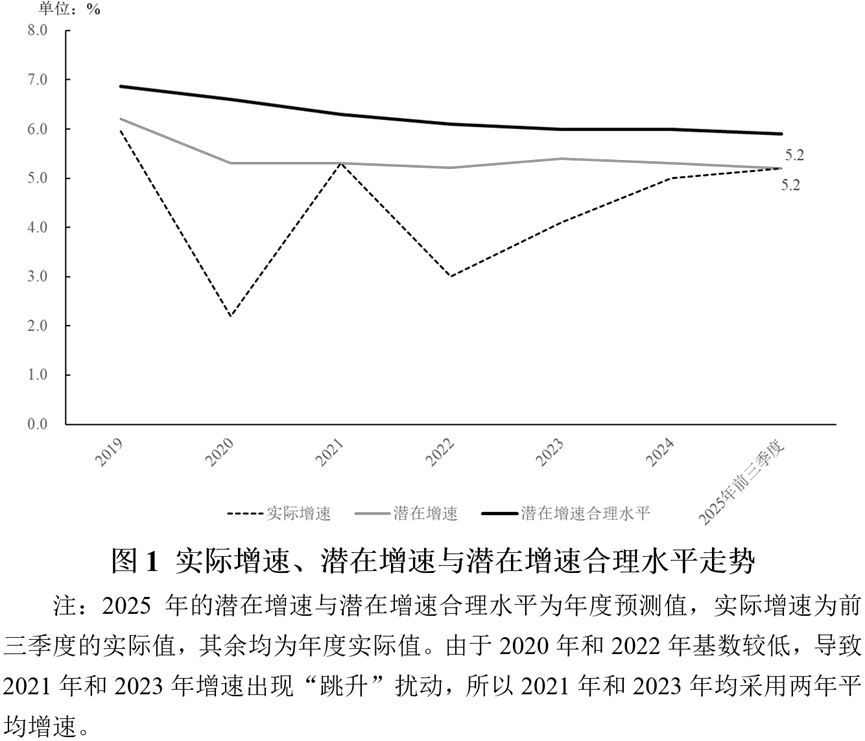
Core Viewpoints - The main contradiction in the current macroeconomic environment is insufficient domestic demand, particularly in consumer spending, highlighting the strategic importance of enhancing consumption [2][9] - It is recommended to maintain the actual GDP growth rate above the potential growth rate of 5.2% for 2025 and set the 2026 GDP growth target around 5% to signal stability [2][37] - A gradual approach to price level control is suggested, aiming for a three-step process to achieve a core CPI growth target of 2% over two to three years [2][38] Macroeconomic Overview - The GDP growth rate for the first three quarters of 2025 is 5.2%, aligning closely with the potential growth rate, indicating a stable economic operation [6] - Industrial profits have shown positive improvement, with a 0.9% year-on-year increase in profits for large industrial enterprises from January to August 2025 [7] - The service sector has also experienced growth, with a 5.4% year-on-year increase in value added, particularly in modern service industries [8] Current Economic Contradictions - The primary contradiction in the macroeconomy is on the demand side, characterized by insufficient consumer demand, with retail sales growth slowing to 4.5% year-on-year in the first three quarters [9][11] - Investment demand has also declined, with fixed asset investment showing a -0.5% year-on-year growth, a drop of 3.3 percentage points from the first half of the year [9] Macroeconomic Policy Evaluation - The monetary policy index for the first three quarters of 2025 is 44.0, indicating a slight increase in policy strength, with M2 growth at 8.4% by the end of September [12] - The fiscal policy index stands at 57.9, reflecting an increase in fiscal policy strength, with public budget expenditure growing by 3.1% year-on-year [13] - The overall efficiency of stabilization policies is rated at 50.0, showing a positive trend in policy effectiveness [26] Policy Recommendations - It is advised to enhance stabilization policies to address the lack of effective domestic demand, with a focus on both monetary and fiscal measures [38] - Growth policies should prioritize the development of new productive forces, with an emphasis on employment-friendly industrial policies [39] - Structural policies need to optimize investment, industrial, and income distribution structures to better balance total supply and demand [39]
GDP增长5.2%,解码中国经济“三季报”
3 6 Ke· 2025-10-24 02:47
Core Insights - China's GDP for the first three quarters grew by 5.2% year-on-year, indicating a steady economic performance amidst a complex international environment [1][2] - The quarterly GDP growth rates showed a mild recovery trend: 5.4% in Q1, 5.2% in Q2, and 4.8% in Q3, with a quarter-on-quarter growth of 1.1% in Q3, suggesting a gradual accumulation of internal economic momentum [1][2] Economic Overview - The total GDP reached 10,150.36 billion yuan, with a growth rate that outpaced both the previous year and the same period last year by 0.2 and 0.4 percentage points respectively, maintaining a leading position among major global economies [2] - Industrial production demonstrated strong resilience, with a 6.2% year-on-year increase in the added value of industrial enterprises above designated size, particularly in equipment manufacturing and high-tech manufacturing, which grew by 9.7% and 9.6% respectively [2] - The service sector also showed steady recovery, with a 5.4% year-on-year increase in added value, led by the information transmission, software, and IT services sector, which grew by 11.2% [2] Consumption and Employment - The consumer market continued to recover, with total retail sales of consumer goods growing by 4.5% year-on-year, driven by strong sales in essential and some upgraded goods, with categories like food, sports and entertainment products, and jewelry seeing retail growth rates exceeding 10% [2][3] - The policy of replacing old consumer goods with new ones has shown significant effects, with retail sales in categories such as home appliances, furniture, and communication equipment also growing around 20% [3] - Employment and prices remained stable, with an average urban unemployment rate of 5.2% and a slight decrease of 0.1% in the Consumer Price Index (CPI) year-on-year [3] New Growth Drivers - New economic drivers are accelerating, with the added value of the lithium-ion battery manufacturing industry growing by 29.8% and the production of new energy vehicles increasing by 29.7% [3] - The total import and export volume reached 33,607.8 billion yuan, with a year-on-year growth of 4.0%, and private enterprises' imports and exports grew by 7.8%, accounting for 57.0% of the total [3] Expert Insights - Experts noted that the economic growth rate is relatively high compared to global standards, with the IMF predicting a global growth rate of 3.2% for 2025 [4] - Recommendations for enhancing consumer capacity include improving wage determination mechanisms and increasing the proportion of labor remuneration in initial distribution [5] - The importance of innovation and R&D investment is emphasized, with R&D intensity increasing from 1.91% in 2012 to 2.68% in 2024, and a significant rise in the share of basic research funding [5][6]