
AI

Search documents
港股通50ETF(159712)涨超1.2%,港股边际利好积聚
Mei Ri Jing Ji Xin Wen· 2025-11-24 03:01
Core Viewpoint - The report from招商香港 indicates that the Hong Kong stock market is experiencing marginal benefits, with significant performance in the AI and non-ferrous metal sectors, driven by technological upgrades and global digitalization trends [1] Group 1: Industry Insights - The AI industry is showing strong growth momentum due to technological upgrades and the global digitalization trend [1] - The non-ferrous metal sector is benefiting from global supply chain restructuring and demand from the new energy sector, presenting structural opportunities [1] - There is a continued deepening of industry differentiation, with resilience observed in the service sectors such as healthcare and accommodation, while cyclical industries like manufacturing are showing signs of contraction [1] Group 2: Market Outlook - Overall, the Hong Kong stock market is expected to reach an upward turning point driven by the dual themes of AI and non-ferrous metals [1] - The Hong Kong Stock Connect 50 ETF (159712) tracks the Hong Kong Stock Connect 50 Index (930931), which consists of 50 leading companies in the Hong Kong market, selected based on market capitalization and liquidity [1] - The index encompasses both emerging sectors like new consumption and fintech, as well as traditional economic sectors, reflecting the overall performance of representative quality listed companies in the Hong Kong market [1]
全球科技为何下跌?
2025-11-24 01:46
Summary of Key Points from Conference Call Industry Overview - The global technology sector is experiencing a significant downturn, influenced by various macroeconomic factors and industry-specific challenges [1][2][3]. Core Insights and Arguments 1. **Monetary Policy Outlook**: The Federal Reserve is expected to maintain a passive easing monetary policy until mid-2026, with potential interest rate cuts of 25 basis points in December [1][3]. 2. **Long-term Investment in Tech**: Domestic long-term funds have significantly increased their positions in technology stocks during the recent market adjustment, particularly in the robotics sector, anticipating a bullish trend before the 2026 Spring Festival [1][4]. 3. **AR Market Dynamics**: The global AR competitive landscape is shifting from a dominance of OpenAI to a multi-tiered competition, benefiting companies like Nvidia and domestic AR firms, suggesting long-term investment opportunities [1][5]. 4. **Performance Disparity**: Recent market performance has shown a clear divide, with companies closely associated with OpenAI, such as Microsoft and Nvidia, performing better than those entirely reliant on OpenAI [1][7]. 5. **AI Industry Development**: The AI sector continues to evolve, with high evaluations for new models like Gemini 3 and Grok 4.1, while OpenAI faces challenges including financial pressure and declining market share [1][8][9]. 6. **OpenAI's Challenges**: OpenAI is experiencing significant challenges, including reduced user engagement and a drop in market share from 80% to 66%, indicating potential issues with its business model [1][9][10]. 7. **Impact of OpenAI's Developments**: OpenAI's recent developments have caused short-term volatility in the tech stock market, but the long-term outlook remains positive due to the emergence of multi-company competition [1][11]. 8. **Regulatory Challenges**: OpenAI's operations are constrained by strict regulations, particularly from left-leaning political forces, which could hinder its growth and innovation [1][12][13]. 9. **Market Trends**: The global AI market is transitioning from OpenAI's dominance to a more competitive environment, with its market share potentially dropping to 50% while competitors like Google and X.AI gain ground [1][14][15]. 10. **Investment Recommendations**: Investors are advised to focus on sectors such as robotics and brokerage firms, while also considering the implications of upcoming economic policies [1][17][18]. Additional Important Insights - **Domestic Fund Flows**: Recent inflows into domestic indices like the CSI 300 and Shanghai Composite indicate strong support for the market, with significant capital inflow of nearly 25 billion [1][16]. - **Market Sentiment**: The current market sentiment reflects a cautious approach from institutional investors, with expectations of a potential rebound in tech stocks as the year progresses [1][19][20]. - **Future Investment Strategies**: Investors should consider a balanced asset allocation strategy, focusing on technology leaders and sectors poised for growth, while being mindful of market volatility [1][22]. This summary encapsulates the key points discussed in the conference call, providing a comprehensive overview of the current state and future outlook of the technology sector and its associated challenges and opportunities.
降息疑云之下,美股如何演绎?
Sou Hu Cai Jing· 2025-11-24 00:30
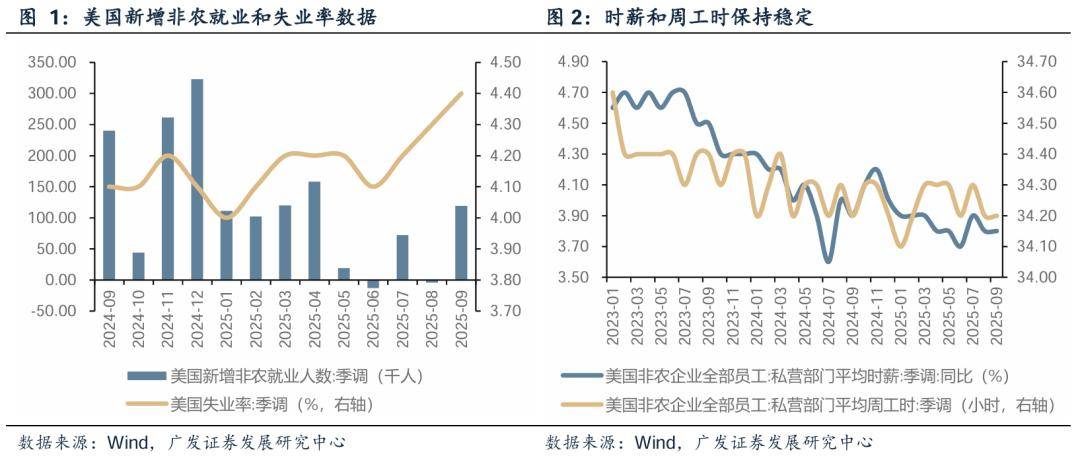
Group 1 - The core point of the article is that the U.S. non-farm payrolls increased by 119,000 in September, significantly exceeding expectations of 52,000, while the unemployment rate rose slightly to 4.4%, the highest level since October 2021 [1][19][24] - The average hourly wage increased by 0.2% month-on-month and 3.8% year-on-year, with expectations of 0.3% and 3.7% respectively [19][24] - The non-farm report is interpreted by investors as neutral to weak, leading to a rise in the probability of a 25 basis point rate cut in December from 39% to 71% [1][24] Group 2 - The current economic conditions suggest that the urgency for a rate cut in December is not strong, as inflation remains moderately rising and the risk of a significant downturn in the job market is low [3][32][38] - Historical analysis indicates that "soft landing" rate cuts typically range from 75 to 100 basis points, and with no clear signs of recession, the Federal Reserve may pause rate cuts in the short term [3][38][40] - There are internal divisions among Federal Reserve officials regarding the direction of monetary policy, with some supporting a rate cut in December [3][40] Group 3 - The U.S. stock market is expected to experience a rebound in the short term as recent concerns over AI bubbles, liquidity tightening, and macroeconomic uncertainties have largely dissipated [9][43] - The current economic landscape features both "K-shaped" and "Goldilocks" economic conditions, which historically have not negatively impacted stock market performance [12][49][52] - The health of corporate balance sheets remains acceptable, with only Oracle showing high leverage, alleviating concerns over debt risks [45] Group 4 - The liquidity situation in the U.S. has improved significantly following the government reopening, which has alleviated previous concerns about dollar liquidity [47] - The recent non-farm payroll data has shifted expectations regarding interest rate cuts, with the market now anticipating a more favorable environment for risk assets [49][55] - The focus for investors should remain on sectors with strong alpha potential, particularly in AI sub-sectors, while also considering potential rotations into healthcare, which has seen recent inflows [18][55]

硬科技再获增量资金加持!多个产业利好消息!静待转机!
Sou Hu Cai Jing· 2025-11-24 00:30
Market Overview - The market experienced a significant decline, with the Shanghai Composite Index dropping over 2% and the ChiNext Index falling over 4% on November 21, leading to a total trading volume of 1.97 trillion yuan, an increase of 257.5 billion yuan from the previous trading day [1][2] - Nearly 5,100 stocks fell, with 99 stocks hitting the daily limit down, indicating a broad market downturn [1] Key Industry Developments - Sixteen hard technology-themed funds were rapidly approved, focusing on AI and chips, which is expected to enhance liquidity in the tech sector, although the impact on market sentiment may be limited due to low risk appetite [3][5] - Changxin Storage launched its latest DDR5 product series, marking a significant advancement in domestic storage chip technology, which is expected to benefit the semiconductor industry in the long term [3][5] - The first large-capacity all-solid-state battery production line in China has been established, potentially leading to significant advancements in battery technology and increased energy density for electric vehicles [3][6] - Huawei officially released and open-sourced its innovative AI container technology, Flex:ai, which aims to improve the utilization of computing resources in AI workloads [3][7] - The Ministry of Industry and Information Technology announced the official launch of commercial trials for satellite IoT services, aimed at stimulating private sector growth and supporting the integration of the digital economy with the real economy [3][7] Global Market Influences - The U.S. government is considering allowing NVIDIA to sell H200 chips to China, which could alleviate AI computing power bottlenecks and benefit the domestic AI industry [3][10] - Federal Reserve officials indicated potential room for interest rate cuts, which has increased market speculation regarding future monetary policy adjustments [3][10] Strategic Insights - The market is expected to continue its volatile adjustment phase in the short term, with a focus on liquidity pressures and the upcoming December economic policy meetings [4] - Long-term investment opportunities may arise from sectors benefiting from policy support and supply-demand improvements, such as steel, agriculture, and lithium batteries [4]
十大券商一周策略:需要AI给答案!市场静待转机,慢牛预期不变
Zheng Quan Shi Bao· 2025-11-23 22:55
Group 1 - The volatility of global risk assets is primarily due to liquidity issues and an over-reliance on AI narratives, leading to necessary valuation corrections when industrial development lags behind market expectations [1] - The recent adjustments in the US non-farm employment data and the downshift in interest rate cut expectations from the Federal Reserve have amplified concerns regarding the sustainability of AI infrastructure in North America [1] - The current market environment may lead to a "sharp drop and slow rise" pattern in A-shares and Hong Kong stocks, similar to the US market, as stable return-oriented funds continue to enter the market [1] Group 2 - The Chinese stock market is currently experiencing weakness due to year-end profit-taking and reduced positions by investors, compounded by a lack of internal policy support [2] - Despite the cautious consensus, there is a strong belief in the positive outlook for the Chinese market, with expectations for stabilization and upward momentum in the near future [2] - Key investment themes include AI applications, robotics, domestic consumption, and infrastructure development in Xinjiang [2] Group 3 - The market is in a "three-phase overlap" characterized by a mid-bull market consolidation, critical economic verification, and a policy vacuum, leading to increased volatility [3] - The recent fluctuations in the overseas environment, including the Federal Reserve's interest rate expectations, have affected market liquidity and investor sentiment [3] - Long-term bullish factors remain intact, with a focus on strategic positioning ahead of key meetings in December [3] Group 4 - The current market adjustment has created a preliminary sense of space, with expectations for improved overseas liquidity and reduced domestic funding pressure [4] - Emphasis on safety margins in high volatility environments, focusing on sectors such as seasoning products, leisure foods, and communication services [4] - Recommendations include increasing positions in traditional cyclical sectors and potential growth areas like domestic computing power and innovative pharmaceuticals [4] Group 5 - The recent adjustment in A-shares is attributed to weak domestic economic data, a strong dollar, and year-end performance pressures [6] - The market is expected to remain in a state of fluctuation until mid-December, when significant policy decisions are anticipated to provide direction [6] - The outlook for the first quarter of the following year suggests a potential return to an upward cycle, particularly for large-cap blue-chip and financial cyclical stocks [6] Group 6 - The recent market pullback is influenced by global financial vulnerabilities and concerns over the sustainability of AI capital expenditures [7] - The current state of the AI industry is compared to a critical juncture in the internet sector in 1997, highlighting the uncertainty of future applications [7] - Recommendations focus on sectors benefiting from physical asset consumption, including upstream resources and cyclical industries [7] Group 7 - The recent decline in the A-share index is viewed as a "clear sky turbulence," with expectations for limited future volatility [8] - The current bull market logic based on liquidity is approaching a turning point, necessitating a shift towards fundamental-driven growth [8] - The anticipated transition from a liquidity-driven bull market to a fundamental-driven one will require monitoring political and economic cycles [8] Group 8 - The recent global equity market weakness has led to a rotation in market dynamics, with a focus on three main investment directions: AI technology, economic recovery, and undervalued dividends [9] - The performance of low-valued dividends is closely tied to the progress of the AI industry, which is dependent on breakthroughs in both application and consumption [9] Group 9 - The recent adjustments in the A-share market are expected to stabilize as institutional investors begin to position for 2026 following the central economic work conference in mid-December [10] - The technical analysis suggests that the Shanghai Composite Index may find strong support around the 3700-point level, limiting further downside [10] - The long-term outlook remains positive, with expectations for a renewed buying opportunity in the market [10]
暴跌之下0秒20%涨停,封单400万手骤减至4.9万手,藏何玄机?
Sou Hu Cai Jing· 2025-11-23 18:12
Core Viewpoint - Despite a significant market downturn, a stock named Pingao managed to hit the daily limit up of 20%, raising questions about the underlying market dynamics and potential manipulation [1][2][7]. Market Environment - The overall market experienced a sharp decline, with the index dropping by 4% and over 5,030 stocks falling, indicating a widespread panic among investors [5][6]. - The ChiNext index also saw a decline exceeding 4%, reflecting the bearish sentiment across the market [5]. Stock Performance - Pingao's stock achieved a 20% limit up in a market where most stocks were declining, suggesting a concentration of funds into a few recognizable stocks [7]. - The stock's limit order volume plummeted from 4 million hands to 49,000 hands, indicating a significant withdrawal of buying power [3][8]. Trading Dynamics - The trading data showed a notable imbalance, with total buying reaching 59.28 million yuan, accounting for 43% of total transactions, while selling amounted to 30.52 million yuan, or 22% of total transactions [7]. - The drastic reduction in limit order volume is seen as a dangerous signal, suggesting that buying interest is rapidly retreating while selling pressure is increasing [8][9]. Financial Performance - Pingao reported a loss of 10.68 million yuan in 2023, a year-on-year decline of 15%, with projections indicating a staggering 500% drop in net profit for 2024 [10]. - The company is expected to continue facing losses, with the first three quarters of 2025 projected to exceed the total losses of 32.84 million yuan recorded in 2023 [10]. Market Behavior - The phenomenon of loss-making stocks surging in price is not uncommon in the A-share market, often driven by speculative trading in popular sectors like AI and semiconductors [10][13]. - The current market environment, characterized by a significant downturn, raises concerns about the sustainability of such price movements, particularly for stocks like Pingao that are not supported by strong fundamentals [18][28]. Investor Sentiment - The drastic changes in limit order volume and the overall market context suggest that investors should exercise extreme caution when dealing with stocks that exhibit such volatile behavior [28][30]. - The rapid decision-making of institutional investors compared to retail investors creates a challenging environment for the latter, who may struggle to react appropriately to market fluctuations [13][30].
A股本轮上涨行情基础并未改变 短期调整或带来布局良机
Shang Hai Zheng Quan Bao· 2025-11-23 18:09
上周,避险情绪主导全球金融市场,全球主要股市悉数下跌,其中科技股波动幅度显著。在这一传导效 应下,A股市场同样经历调整,上证指数失守3900点。新能源、光伏、电力设备等板块回调明显,银 行、船舶制造、消费等少数概念相对抗跌。 该机构分析称,前期热门主线的成交集中度已出现不同程度的消化,意味着交投情绪降温及风险消化。 交易层面的阻力释放后,若后续产业层面催化剂出现,市场情绪有望再度回暖。 对于近期市场的波动,券商研报分析认为,海外"AI泡沫"焦虑、美联储降息预期回落、资金情绪趋于谨 慎等因素共振,引发了全球主要市场联动下挫。在这一背景下,A股市场也难以完全避免冲击。但支撑 本轮中国股市上涨行情的基本面因素并未出现变化。前期热门主线的估值消化完成后,投资者可积极布 局来年春季行情。 海外市场波动加剧引发A股回调 近期,受美股AI板块高位震荡及海外"AI泡沫"讨论升温影响,A股科技板块同步出现明显调整,拖累主 要指数下行。对于近期市场的回调,机构普遍认为外部扰动是主要诱因。 兴业证券表示,11月以来,受美联储降息预期回落、"AI泡沫"言论影响,全球风险资产跟随美股同步调 整,近期A股与港股的波动随之加剧。中银国际证 ...
【十大券商一周策略】需要AI给答案!市场静待转机,慢牛预期不变
Zheng Quan Shi Bao Wang· 2025-11-23 15:36
Group 1 - The core viewpoint is that the volatility of global risk assets is primarily due to liquidity issues and an over-reliance on AI narratives, leading to necessary valuation corrections when industrial development lags behind market expectations [1] - The recent adjustments in the A-share and Hong Kong stock markets may present opportunities for investors to reallocate towards equities, particularly in traditional manufacturing and resource sectors [1][5] - The market is currently experiencing a "three-phase overlap," characterized by a consolidation phase in the middle of a bull market, a critical period for verifying economic conditions, and a policy vacuum affecting performance [3] Group 2 - The Chinese stock market is expected to stabilize and potentially rally in the coming months, with a focus on AI applications, robotics, and domestic consumption as key themes [2] - The recent adjustments in the A-share market are attributed to weak domestic economic data, a strong dollar, and year-end profit-taking, with expectations for a recovery following important policy meetings in December [5][10] - The current market environment is marked by high volatility, necessitating a focus on safety margins in investment strategies, particularly in sectors like food and beverage, textiles, and cyclical industries [4][11]






六大机构,最新A股研判来了
Zhong Guo Zheng Quan Bao· 2025-11-23 14:12
Group 1 - The technology growth sector has experienced a significant pullback, leading to adjustments in the A-share market, but the downside space is considered limited after continuous adjustments, with expectations for a market recovery starting in November and an early layout window for the spring 2026 market [1][7] - Investment institutions suggest focusing on dividend stocks, cyclical stocks benefiting from rising commodity prices, as well as innovative pharmaceuticals and defense industries; there are also rebound opportunities in AI computing power, storage, energy storage, and robotics sectors [1][6][7] Group 2 - The Ministry of Industry and Information Technology is committed to advancing high-quality development of the industrial internet, emphasizing smart, green, and integrated directions to support new productive forces [2] - The State-owned Assets Supervision and Administration Commission is promoting the professional integration of central enterprises, with key project signings in critical areas such as new materials, artificial intelligence, and logistics [3] Group 3 - Sixteen hard technology-themed funds have been approved, including the first batch of AI ETFs and chip ETFs, indicating a growing interest in technology investments [4] - Market sentiment remains cautious, with a focus on dividend stocks for defensive strategies, and a potential rebound in the technology sector as concerns over AI bubbles diminish [5][6] Group 4 - The lithium battery industry chain is experiencing high demand, driven by strong market conditions in energy storage and the upcoming sales peak for new energy vehicles, with expectations for continued high prosperity [8] - The AI industry continues to show strong momentum, supported by domestic policies promoting self-innovation and new productive forces, with long-term value becoming more apparent if AI giants enhance their profitability [9][10] Group 5 - Future market outlook suggests that major A-share indices may exhibit strong oscillation patterns, with a focus on three key areas: essential resource products with rigid supply, traditional industries benefiting from supply-side reforms, and high-elasticity sectors like military and AI industry chains [11]
关键时刻!最新研判来了
中国基金报· 2025-11-23 11:44
Group 1 - The recent global market turmoil is attributed to multiple factors, including the Federal Reserve's mixed signals on interest rate cuts, concerns over AI sector sustainability, and geopolitical tensions affecting supply chains [4][5][6]. - A-shares and H-shares are viewed as having long-term strategic opportunities despite recent adjustments, with expectations for policy support and foreign capital inflow remaining intact [8][9]. - The outlook for A-shares and H-shares is positive, with analysts suggesting that the current market environment presents a window for investment [8][9][10]. Group 2 - Gold is expected to remain a strong asset in the medium to long term, supported by global monetary expansion and increasing central bank purchases [11][12][13]. - Analysts predict that the global stock market will continue to trend upwards, driven by liquidity and risk appetite, although caution is advised regarding inflation and geopolitical risks [14][15][16]. - The oil market is anticipated to experience a range-bound trading pattern, influenced by geopolitical factors and supply-demand dynamics [17][18][19]. Group 3 - A-shares are considered to have superior investment value, with a focus on high-growth sectors such as technology and advanced manufacturing, while also incorporating defensive strategies [20][21]. - The investment landscape for 2026 is expected to favor A-shares, H-shares, gold, and short-term U.S. Treasuries, as global liquidity conditions remain favorable [21][22]. - Attention should be paid to liquidity and geopolitical risks, particularly in light of potential economic data releases and the Federal Reserve's policy decisions [23][24][25].
