互联网服务

Search documents
小米集团20251118
2025-11-19 01:47
Xiaomi Group Q3 2025 Earnings Call Summary Company Overview - **Company**: Xiaomi Group - **Date**: Q3 2025 Earnings Call Key Financial Highlights - Total revenue reached **RMB 113 billion**, a **2.5%** year-over-year increase, marking a historical high [2][3] - Adjusted net profit was **RMB 11.3 billion**, up **81%** year-over-year, also a record [2][3] - Gross margin improved to **22.9%**, an increase of **2.5 percentage points** year-over-year [3] Smartphone Performance - Sales of the **Xiaomi 17 series** smartphones grew by **30%** compared to the previous generation, with high-end versions accounting for over **80%** of sales [2][4] - The **Pro Max** model achieved significant success in the **RMB 6,000+** price segment, indicating effective high-end strategy [4][7] - Xiaomi ranked among the top three in global smartphone shipments with a market share of **13.6%** [6] IoT and Smart Home Business - IoT revenue reached **RMB 27.6 billion**, showing continuous growth for seven consecutive quarters with a gross margin of **23.9%** [2][8] - The IoT platform connected over **1 billion devices**, indicating ongoing ecosystem expansion [8][21] - A new smart home appliance factory commenced production with an annual capacity of **7 million units** [8][12] Internet Services and User Engagement - Global monthly active users reached **742 million**, a **8.2%** increase year-over-year [2][9] - Internet services revenue was **RMB 9.4 billion**, up **10.8%**, with a gross margin of **76.9%** [2][11] - Advertising revenue grew to **RMB 7.2 billion**, reflecting a **17.4%** increase [2][12] Electric Vehicle (EV) Business - EV revenue amounted to **RMB 28.3 billion**, with **108,796** units delivered, averaging a post-tax price of **RMB 260,000** [5][14] - The EV segment is identified as a new growth driver for the company [5] Research and Development - R&D expenses reached **RMB 9.1 billion**, a **52.1%** increase year-over-year, with R&D personnel comprising **44.2%** of total employees [5][15] - The company plans to invest over **RMB 200 billion** in R&D over the next five years [10] Strategic Initiatives - Xiaomi aims to enhance product premiumization and intelligence through proprietary chip and operating system development [10] - The company targets entry into the top 100 of the Fortune Global 500 by **2030** [10] Market Position and Challenges - Xiaomi's market share in mainland China reached **14.9%**, with growth in all regions except India [6] - The company faces challenges from rising memory costs, which are expected to pressure gross margins in the coming years [19][30] - Strategies to mitigate cost pressures include price increases and product structure optimization [19] Sustainability and ESG Efforts - Xiaomi's MSCI ESG rating improved from B to A, marking the third consecutive year of improvement [18] Future Outlook - The company plans to continue expanding its overseas market presence, particularly in Southeast Asia and Latin America [27][32] - Xiaomi's strategy includes enhancing operational efficiency in existing stores rather than opening new ones [31][32] This summary encapsulates the key points from Xiaomi Group's Q3 2025 earnings call, highlighting financial performance, market position, strategic initiatives, and future outlook.

百度集团-SW绩后高开逾2% 三季度总营收312亿元 AI业务收入增速超50%
Zhi Tong Cai Jing· 2025-11-19 01:31
Core Insights - Baidu's stock opened over 2% higher following the release of its Q3 2025 financial results, with a current price of HKD 113.9 and a trading volume of HKD 48.94 million [1] Financial Performance - Total revenue for Q3 2025 reached CNY 31.2 billion, with core revenue at CNY 24.7 billion [1] - AI business revenue was disclosed for the first time, showing a year-on-year growth of over 50% [1] AI Business Highlights - AI cloud revenue increased by 33% year-on-year [1] - AI application revenue reached CNY 2.6 billion [1] - AI native marketing service revenue surged by 262% to CNY 2.8 billion [1] Autonomous Driving Services - The number of fully autonomous driving orders from Baidu's "Luobo Kuaipao" service reached 3.1 million, accelerating from a year-on-year growth rate of 148% to 212% [1] - In October 2025, the average weekly fully autonomous driving orders exceeded 250,000 [1] - As of November 2025, the cumulative number of autonomous driving service orders provided to the public surpassed 17 million [1]

【机构策略】A股市场出现技术和情绪修复的概率加大
Zheng Quan Shi Bao Wang· 2025-11-19 01:08
Group 1 - The A-share market is currently in a phase of consolidation around the 4000-point level, with a likelihood of continued rebalancing between cyclical and technology sectors [1] - The semiconductor and robotics sectors showed active performance, while battery, coal, and steel sectors experienced significant declines [1][2] - The recent tightening of overseas liquidity is a major factor putting pressure on global equity markets, with expectations of a cooling in Fed rate cut predictions due to internal disagreements within the FOMC [2] Group 2 - The Shanghai Composite Index has been fluctuating around the 3950-point level, indicating a potential for technical and emotional recovery in the A-share market after a series of declines [1][2] - The market is expected to face challenges in generating strong upward momentum until new leading sectors emerge [1] - Investors are advised to consider opportunistic buying after the recent adjustments, as the index has been consolidating for some time [2]
全国卫星导航定位基准站将被纳入统一监管;道指、纳指收跌逾1%丨盘前情报
2 1 Shi Ji Jing Ji Bao Dao· 2025-11-19 00:36
Market Overview - On November 18, the A-share market experienced fluctuations, with the Shanghai Composite Index and Shenzhen Component Index both dropping over 1% during the day. The Shanghai Composite Index closed down 0.81% at 3939.81 points, while the Shenzhen Component Index fell 0.92% to 13080.49 points, and the ChiNext Index decreased by 1.16% to 3069.22 points [2][3] - The total trading volume in the Shanghai and Shenzhen markets reached 1.93 trillion yuan, an increase of 15.3 billion yuan compared to the previous trading day [2] Sector Performance - The market showed mixed performance across sectors, with over 4100 stocks declining. Notably, AI application concepts rose against the trend, while semiconductor and robotics sectors showed active performance. Conversely, popular themes recently faced corrections, with the Fujian sector experiencing significant declines and the lithium battery sector showing weakness [2] - Sectors with notable gains included AI applications and software development, while battery, coal, and steel sectors faced the largest declines [2] International Market - On the same day, U.S. stock indices collectively fell, with the Dow Jones down 1.07%, the S&P 500 down 0.83%, and the Nasdaq down 1.21%. Major tech stocks like Amazon and AMD dropped over 4%, while Microsoft and Nvidia fell more than 2% [4][5] - European markets also saw declines, with the FTSE 100 down 1.27%, the CAC 40 down 1.86%, and the DAX down 1.74% [4][5] - International oil prices increased, with WTI crude oil rising by 1.39% to $60.74 per barrel [4][5] Policy and Development Initiatives - The Ministry of Industry and Information Technology aims to establish around 200 high-standard digital parks by 2027, focusing on digital transformation and management improvements for industrial enterprises [7] - The National Development and Reform Commission approved five inter-regional power mutual assistance projects, with a total investment of 24.4 billion yuan, enhancing cross-regional power supply capabilities [9][10] - Beijing plans to incubate 3,000 technology-based enterprises and 600 specialized and innovative enterprises by 2027, aiming to form a robust technology transfer system [11] Company Announcements - Several companies reported significant developments, including: - Furi Shares' third-largest shareholder transferring 6.36% of shares [15] - Xianhui Technology receiving contracts worth approximately 796 million yuan from CATL [15] - Jiemai Technology signing a cooperation agreement with CATL for lithium battery composite materials [15] - Hongbo Shares won an arbitration case, receiving over 243 million yuan in compensation [16] Fund Flow Analysis - The internet services sector saw a net inflow of 4.186 billion yuan, while the battery sector experienced a significant net outflow of 10.625 billion yuan [17] - Notable stocks with net inflows included Liou Shares and N Hengkun, while Sunshine Power and CATL faced substantial net outflows [17]



ChatGPT、X,都崩了!
Shang Hai Zheng Quan Bao· 2025-11-18 14:39
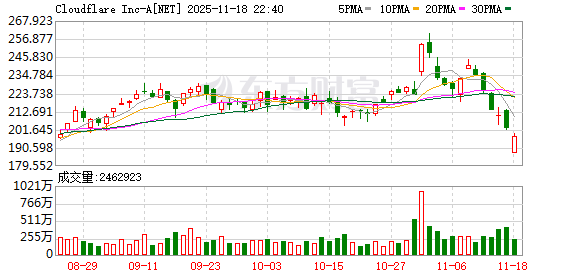
Cloudflare股价盘前一度下跌超5%。 18日,知名网络基础设施公司Cloudflare表示,其全球网络出现问题,导致许多网站和应用程序的服务中断,包括X(原twitter)和ChatGPT在内的多家互 联网平台无法访问。据媒体报道,Spotify和亚马逊也出现了服务中断。 官网显示,Cloudflare是一个全球性的云平台,为世界各地的各种规模的企业提供广泛的网络服务,同时提高其关键互联网资产的性能和可靠性。 Cloudflare还为全球125个国家/地区的330个城市提供数据传送服务。 半小时后,Cloudflare表示目前正经历内部服务故障,部分服务可能会间歇性受到影响。 大约20分钟后,该公司发布消息称,中断情况已开始缓解,但仍在继续调查该问题。 截至21:13,该公司表示,其部分服务的错误率已"恢复到事件发生前的水平",并且正在继续努力恢复其他服务。 2019年9月13日,Cloudflare在纽约证券交易所敲钟上市。 北京时间19:17(伦敦时间11:17),Cloudflare官网状态显示其支持的门户提供商目前遇到一些问题,因此客户查看或回复支持案例时可能会遇到错误。 截至发稿,包括X和C ...
卢伟冰:小米汽车本周预计完成全年交付任务
新华网财经· 2025-11-18 14:21
Core Viewpoint - Xiaomi Group reported a strong performance in Q3, achieving revenue of 113.1 billion RMB, a year-on-year increase of 22.3%, and a record net profit of 11.3 billion RMB, up 80.9% [1][12]. Group 1: Financial Performance - In the first three quarters, Xiaomi's total revenue reached 340.4 billion RMB, nearing last year's total, with adjusted net profit of 32.8 billion RMB, exceeding last year's total [1]. - Internet services revenue in Q3 was 9.4 billion RMB, a year-on-year growth of 10.8%, with a gross margin of 76.9% [10]. - The automotive and AI innovation segment generated revenue of 29 billion RMB, a significant year-on-year increase of 199%, with 28.3 billion RMB from electric vehicles alone [12]. Group 2: Automotive Business - Xiaomi's automotive business achieved a milestone by turning a profit in Q3, with a single-quarter operating profit of 700 million RMB [12]. - The company delivered over 100,000 vehicles in Q3, bringing total deliveries for the first three quarters to over 265,000 [13][16]. - Xiaomi's electric vehicles ranked among the top three in the mid-to-large SUV market for several months, and in October, it became the best-selling SUV brand in China [16]. Group 3: Smartphone and IoT Business - Xiaomi's smartphone business showed steady growth, with global shipments of 43.3 million units, marking nine consecutive quarters of year-on-year growth [5]. - The IoT and lifestyle products segment generated revenue of 27.6 billion RMB, reflecting a year-on-year increase of 5.6%, with over 1 billion connected IoT devices [7][8]. - The number of users with five or more devices connected to the AIoT platform reached 21.6 million, a growth of 26.1% year-on-year [7].

大家业绩都beat预期
Xin Lang Cai Jing· 2025-11-18 14:10
Core Viewpoint - Pinduoduo reported strong financial results for Q3, with a focus on international expansion despite facing challenges in revenue growth and external policy risks [1][4][5]. Financial Performance - Q3 total revenue reached 108.2765 billion yuan (approximately 11.52095 billion USD), a year-on-year increase of 9% [2]. - Net profit attributable to ordinary shareholders for Q3 was 29.3282 billion yuan (approximately 4.1197 billion USD), reflecting a year-on-year growth of 17% [2]. - The company holds over 400 billion yuan in cash reserves [3]. Competitive Landscape - Pinduoduo's GMV for Temu in Q3 reached 24 billion USD, with a year-on-year growth of 75% for the first three quarters [3]. - The company continues to focus on its core business and internationalization, contrasting with its domestic competitors who spend 30-50 billion yuan quarterly on subsidies for delivery and flash sales [3]. Challenges - Revenue growth has slowed down [4]. - Management has no plans for stock buybacks, which may exert pressure on the stock price [5]. - Temu faces significant external policy risks [5]. Market Context - The overall performance of major Chinese tech companies in Q3 has been strong, with Xiaomi reporting a 22.3% year-on-year revenue increase and Baidu's AI-related revenues showing substantial growth [6].

BIDU(BIDU) - 2025 Q3 - Earnings Call Transcript
2025-11-18 13:30
Financial Data and Key Metrics Changes - In Q3 2025, total revenues were RMB 31.2 billion, a decrease of 7% year-over-year [26] - Baidu Core reported total revenue of RMB 24.7 billion, also down 7% year-over-year [26] - Baidu Core's online marketing revenue decreased by 18% year-over-year to RMB 15.3 billion, while non-line marketing revenue increased by 21% year-over-year to RMB 9.3 billion [26] - Operating loss was RMB 15.1 billion, with a margin of 61% for Baidu Core [28] - Net loss attributable to Baidu was RMB 11.2 billion, with a diluted loss per ADS of RMB 33.88 [29] Business Line Data and Key Metrics Changes - AI Cloud revenue reached RMB 6.2 billion, increasing by 21% year-over-year [26] - Subscription-based revenue from AI accelerator infrastructure surged 128% year-over-year, becoming the primary driver of AI Cloud's expansion [4][23] - Revenue from AI-native marketing services, including agents and digital humans, reached RMB 2.8 billion, up 262% year-over-year [14][26] Market Data and Key Metrics Changes - Apollo Go provided over 3 million fully driverless operational rides in Q3, representing a 212% year-over-year increase [9][17] - Apollo Go's global footprint expanded to 22 cities, up from 16 last quarter [11] - Baidu App's MAU reached 708 million, up 1% year-over-year, with daily average time spent per user increasing by 2.3% year-over-year [20] Company Strategy and Development Direction - The company is focusing on AI-driven innovations across its business lines, including AI Cloud, autonomous driving, and AI-native marketing services [4][22] - Apollo Go is entering a phase of rapid global expansion, with plans to scale operations and improve technology based on operational data [10][49] - The company is committed to enhancing its AI capabilities and expanding its AI-powered revenue streams [22][44] Management's Comments on Operating Environment and Future Outlook - Management expressed confidence in the growth trajectory of the AI Cloud business, driven by strong demand for AI-centric services [36] - The company anticipates that the AI transformation will create long-term competitiveness, despite near-term pressures on revenue and margins [52] - Management highlighted the importance of continuous innovation in AI applications to capture long-term opportunities [42] Other Important Information - The company introduced a new AI-native view to better reflect valuation drivers based on its current portfolio [22][43] - Total cash and investments as of September 30, 2025, were RMB 296.4 billion [30] - The company has invested over RMB 100 billion in AI since March 2023 and plans to maintain high levels of investment [55] Q&A Session Summary Question: How will Ernie 5.0 drive the next stage of application? - Management emphasized an application-driven approach for Ernie's iteration, focusing on enhancing digital humans and FM Agents for better user engagement and efficiency [31][34] Question: What is the outlook for the cloud business? - Management noted that the cloud business is growing above the industry average, with strong demand for AI-centric services expected to continue [36][38] Question: How is AI search monetization progressing? - Management reported that nearly 70% of mobile search result pages now contain AI-generated content, with ongoing tests showing promising early monetization results [50][52] Question: What are the plans for Apollo Go's global expansion? - Management outlined plans for continued scaling of operations, adding more cities, and improving technology based on operational data [48][49] Question: What is the rationale behind the asset impairment this quarter? - Management explained that the impairment was part of a comprehensive review to align the asset base with advanced AI computing demands [55]
巴菲特退休前大动作:首度建仓谷歌、继续抛售苹果
新浪财经· 2025-11-18 13:20
Core Insights - Berkshire Hathaway has initiated a position in Alphabet for the first time in Q3, while further reducing its stake in Apple [2][5] - As of the end of Q3, Berkshire's total market value in U.S. stocks reached $267 billion, with the top ten holdings accounting for 86.69% of the total portfolio [3][5] Group 1: Berkshire's Stock Activity - In Q3, Berkshire purchased approximately 17.85 million shares of Alphabet, valued at about $4.34 billion, representing 1.62% of its total holdings and ranking as the tenth largest position [3][4] - Berkshire reduced its Apple holdings by approximately 41.79 million shares, a decrease of over 14.92% from the previous quarter, yet still holds over 238 million shares valued at approximately $60.66 billion, making Apple its largest holding [5] - Additionally, Berkshire sold 37.2 million shares of Bank of America, reducing its stake from 11.12% to 10.96%, and completely exited its position in D.R. Horton, a major U.S. homebuilder [5] Group 2: Alphabet's Financial Performance - Alphabet reported Q3 revenue of approximately $102.3 billion, a year-over-year increase of about 16%, with cloud services revenue reaching around $15.2 billion, growing 34% year-over-year [4] - The company's net profit for the quarter was approximately $35 billion, reflecting a year-over-year growth of about 33%, with earnings per share at approximately $2.87 [4] Group 3: Management Transition - Warren Buffett announced on November 10 that he will no longer write Berkshire's annual report, indicating a transition of management power as the company builds a position in Alphabet [5]



小米前三季度经调净利已超去年总额 汽车业务首季盈利
Xin Jing Bao· 2025-11-18 12:57
Core Insights - Xiaomi Group reported Q3 revenue of 113.1 billion yuan, a year-on-year increase of 22.3%, marking the fourth consecutive quarter of exceeding 100 billion yuan [2] - Adjusted net profit reached 11.3 billion yuan, up 80.9% year-on-year, setting a new historical high [2] - The smart electric vehicle and AI innovation business segment generated revenue of 29 billion yuan, with a year-on-year increase of over 199% [2] Financial Performance - For the first three quarters, total revenue reached 340.4 billion yuan, nearing last year's total, with adjusted net profit of 32.8 billion yuan, surpassing last year's total [3] - Smartphone business showed steady growth with global shipments of 43.3 million units, achieving year-on-year growth for nine consecutive quarters [3] - Internet services revenue in Q3 was 9.4 billion yuan, a year-on-year increase of 10.8%, with a gross margin of 76.9% [5] Business Segments - The smartphone and AIoT segment generated revenue of 84.1 billion yuan, with smartphone revenue at 46 billion yuan [3] - The IoT and lifestyle consumer products segment grew steadily, with Q3 revenue of 27.6 billion yuan, a year-on-year increase of 5.6% [3] - Xiaomi's AIoT platform connected over 1 billion IoT devices, with users having five or more connected devices reaching 21.6 million, a year-on-year increase of 26.1% [3] Electric Vehicle Development - Xiaomi's electric vehicle segment achieved significant breakthroughs, with Q3 revenue reaching 29 billion yuan [6] - The first SUV model, Xiaomi YU7, launched on June 26, received over 200,000 pre-orders within three minutes [6] - In Q3, Xiaomi delivered over 100,000 vehicles, setting a new quarterly record, with total deliveries exceeding 260,000 units for the year [7] R&D Investment - Xiaomi's R&D investment for the first three quarters reached 23.5 billion yuan, with Q3 investment at 9.1 billion yuan, a year-on-year increase of 52.1% [8] - The company aims to invest over 30 billion yuan in R&D this year, focusing on core technologies such as chips and systems to build competitive barriers [8]