家电制造

Search documents
美的集团(000333.SZ):全人形X系列1代机器人的整机设计已完成,目前处于内部技术研发阶段
Ge Long Hui· 2025-09-25 07:22
Core Insights - Midea Group has developed three robot platforms: humanoid, full humanoid, and super humanoid robots [1] Group 1: Robot Platforms - The humanoid robot "Meiro" has begun operations at Midea's washing machine factory in Jingzhou, engaging in tasks such as information collection, equipment maintenance, and standardized operations like material handling [1] - The full humanoid X series generation 1 robot has completed its design and is currently in the internal R&D phase, with application trials expected to start next year [1] - The super humanoid U series robot is in the concept design and validation stage, focusing on innovative product development based on application scenarios [1] Group 2: Product Features and Innovations - The household humanoid robot "Mira" made its global debut at the 2025 World Artificial Intelligence Conference (WAIC), showcasing capabilities such as understanding commands to make coffee and interact with Midea's high-end smart home systems [1]

13国青年迷上湖北!楚文化引共鸣
Cai Fu Zai Xian· 2025-09-25 07:15
Group 1 - The first "International Youth Yangtze River Journey" event took place from September 19 to September 23, connecting global youth and promoting dialogue on Yangtze civilization [1][22] - Youth representatives from 13 countries, including Egypt, Brazil, and Argentina, explored the cultural richness and contemporary value of the Yangtze River [1][22] - The event highlighted Hubei's economic vitality, cultural charm, and technological momentum nurtured by the Yangtze culture [1][5] Group 2 - A flag-raising ceremony was held in Jingzhou, with speeches from notable figures including the Maldives Minister of Youth Empowerment and Argentina's former Minister of Science and Technology [3] - Participants visited the Jingzhou Museum, where they engaged with ancient Chinese artifacts, including a 2300-year-old multiplication table, showcasing the historical significance of mathematics [5] - The event included hands-on experiences with traditional crafts such as Chu embroidery and bamboo slips, emphasizing the living heritage of cultural practices [9] Group 3 - The event underscored Hubei's transition from "prospering by the river" to "strengthening by innovation," focusing on high-quality development along the Yangtze Economic Belt [11] - International youth learned about the smart factory initiatives at Midea's refrigerator plant in Jingzhou, reflecting advancements in digital and intelligent manufacturing [13] - The Hubei Youth Innovation Park showcased entrepreneurial teams transforming ideas into reality, highlighting the region's innovative spirit [15] Group 4 - Participants discussed future urban visions at the Optics Valley Air Rail and visited the China Bridge Museum, recognizing China's bridge design and construction capabilities [17] - The event facilitated dialogues on sustainable development among international youth and experts from Hubei University and the Yangtze Cultural Research Institute [19] - The cultural connections between Chu culture and Iranian mythology were noted, emphasizing the shared spiritual resonance despite geographical distances [21]


美的集团:全人形X系列1代机器人的整机设计已完成 预计明年开始尝试应用验证
Ge Long Hui A P P· 2025-09-25 05:39
Core Viewpoint - Midea Group is actively developing three robotic platforms: humanoid, full humanoid, and super humanoid robots, indicating a strategic focus on automation and robotics in its operations [1] Group 1 - The Midea robot "Mei Luo" has begun operations at Midea's washing machine factory in Jingzhou, participating in tasks such as information collection, equipment maintenance, and fixed inspections [1] - The robot is also involved in standardized operational processes, including material handling and equipment loading and unloading [1]
港股午评:恒科指大涨1.9%,科技股继续上攻,铜价上涨铜业股助力有色金属股齐涨
Ge Long Hui· 2025-09-25 04:10
Market Performance - The Hong Kong stock market indices continued to rise, with the Hang Seng Tech Index increasing by 1.91%, while the Hang Seng Index and the Hang Seng China Enterprises Index rose by 0.43% and 0.6% respectively, indicating a sustained recovery in market sentiment [1] Technology Sector - Major technology stocks performed well, with JD.com rising over 6%, Baidu increasing by 4.35%, Xiaomi up by 3.6%, Kuaishou nearly 3%, Tencent up by 1.46%, and Alibaba and Meituan also showing gains [1] Copper and Metals - A supply tightness due to an accident at the world's second-largest copper mine led to a rise in copper prices, significantly boosting metal stocks. China Molybdenum surged by 25%, while other companies like China Nonferrous Mining and Minmetals Resources also saw strong gains, with Zijin Mining reaching a historical high [1] Automotive Sector - The automotive sector saw a boost, driven by the strong performance of Chery's IPO, with companies like Leap Motor, Xpeng, and NIO all experiencing increases [1] Semiconductor and Construction - Semiconductor stocks continued to perform well, alongside active movements in the steel, building materials, and high-speed rail infrastructure sectors [1] Underperforming Sectors - Conversely, the home appliance and banking sectors showed weak performance, with Hisense Home Appliances dropping over 5%, Haier Smart Home down nearly 4%, and major banks like China Merchants Bank, Industrial and Commercial Bank of China, and Postal Savings Bank of China all declining by 2% [1]
海尔在春武里市开设了投资额达100亿泰铢的空调生产基地
Shang Wu Bu Wang Zhan· 2025-09-24 17:10
Core Insights - Haier has established an air conditioning production base in Chonburi, Thailand, with an investment of 10 billion THB [1] - The project will be executed in three phases, starting with an annual production capacity of 3 million units, expanding to 3.5 million units by 2026, and reaching 6 million units by 2027 [1] - The new factory is expected to create 3,000 jobs and will serve both domestic and international markets [1] Company Strategy - This new facility is Haier's second production base in Thailand, complementing its existing factory in Kabin Buri, which primarily produces refrigerators and air conditioning products [1] - Haier's chairman, Zhou Yunjie, emphasized that this significant investment reflects the company's confidence in the Thai economy and aims to position Thailand as a strategic manufacturing hub in Southeast Asia [1] - The investment marks an important milestone in China-Thailand cooperation, coinciding with the 50th anniversary of diplomatic relations between the two countries [1] Market Focus - The air conditioning products manufactured at the new facility will be targeted for the domestic Chinese market, while also being exported to the EU, North America, and Middle Eastern countries, which are projected to become the largest export markets for Haier [1]

海尔泰国春武里空调工业园投产,年产能600万套
Xin Lang Cai Jing· 2025-09-24 12:53
Core Viewpoint - Haier Group has officially launched its air conditioning industrial park in Chonburi, Thailand, marking a significant expansion in its production capabilities in the Southeast Asian market [1] Group 1: Industrial Park Details - The industrial park is located in the Eastern Economic Corridor of Thailand, covering an area of approximately 324,000 square meters [1] - The annual planned production capacity of the park is 6 million units, indicating a robust manufacturing capability [1] Group 2: Product Range - The product line includes 14 major categories and thousands of models, encompassing home air conditioners (floor-standing, wall-mounted, window units), commercial water machines, heat pumps, automotive air conditioning, and container temperature-controlled air conditioning [1] - The diverse product offerings are designed to cater to various air conditioning needs for residential, commercial, and specialized applications [1]
2025全国新一线城市排名出炉:重庆第3,合肥第11,佛山第15
Sou Hu Cai Jing· 2025-09-24 12:12
Core Insights - The latest ranking from the New First-Tier Cities Research Institute for 2025 shows that Chongqing has risen to 3rd place, Hefei remains at 11th, and Foshan ranks 15th, indicating that cities that can effectively integrate industry, population, and consumption will advance more rapidly [1] Group 1: Chongqing - Chongqing's rise is attributed to its acceleration in "smart manufacturing," with the Western Microelectronics Park and Liangjiang New Area contributing significantly [3] - The city produces one out of every four laptops globally, and its rail transit mileage has exceeded 600 kilometers, enhancing its commercial appeal [3] Group 2: Hefei - Hefei continues to be recognized as the "strongest venture capital city," with significant investments from companies like BOE Technology Group, NIO, and Changxin Storage, leading to a new industry output value exceeding 1 trillion [4] - The University of Science and Technology of China contributes over 10,000 graduates annually, resulting in a high net inflow of young talent, while housing prices remain lower than in the Yangtze River Delta [4] Group 3: Foshan - Foshan maintains its position through a dual-driven strategy of "manufacturing + home furnishings," ranking fifth nationally in industrial scale with strong exports in home appliances and ceramics [6] - The connectivity provided by the Nanhai and Shunde subway lines to Guangzhou facilitates a daily cross-city passenger flow of 1.7 million, allowing Foshan to benefit from urban integration [6]

海尔智家:完善用户投诉响应与管理机制|2025华夏ESG实践品质甄选案例
Hua Xia Shi Bao· 2025-09-24 09:36
Company Overview - Haier Smart Home Co., Ltd. is a subsidiary of Haier Group, focusing on the "smart home" sector, with its origins tracing back to the establishment of Qingdao Refrigerator Factory in 1984. The company was listed on the Shanghai Stock Exchange in 1993, on the Frankfurt Stock Exchange in 2018, and on the Hong Kong Stock Exchange in 2020, achieving a global capital market layout of "A+D+H". Haier Smart Home employs over 100,000 people globally, with more than one-third being foreign employees [1]. Quality Management and Certifications - In 2024, all factories in Haier Smart Home's domestic operation zone and all factories in Haier Europe passed the ISO 9001 quality management system certification, with a certification coverage rate of 96%. Additionally, 46 domestic factories received QC 080000 certification, and 5 factories achieved ANSI ESD S20.20 certification [2]. User Interaction and Service Model - Haier Smart Home upgraded its user interaction system in 2024, allowing users to communicate with service personnel through various platforms such as the Haier Smart Home APP and mini-programs. The company utilizes big data to accurately identify user needs and intelligently dispatch service requests, achieving second-level response times [2]. Complaint Management and Service Training - The company established a user complaint response and management mechanism, ensuring a 100% complaint resolution and satisfaction rate for the 66,212 complaints received in 2024. Haier Smart Home also developed a comprehensive digital service training system, conducting over 7,300 practical training sessions nationwide, with participation from over 100,000 service personnel [3]. Commitment to Quality and User Experience - Haier Smart Home adheres to the "user-oriented" philosophy, creating a management system that encompasses quality control, harmful substance management, and ESD protection. The establishment of a user experience committee aims to refine product standards and continuously enhance user experience, contributing to a strong reputation in the home appliance ecosystem [4].
港股收盘丨恒指涨1.37% 阿里巴巴涨9%
Di Yi Cai Jing· 2025-09-24 08:37
Group 1 - The Hang Seng Index rose by 1.37%, while the Hang Seng Tech Index increased by 2.53% [1] - Technology stocks showed strong performance, with Alibaba rising by 9% to reach a new high, announcing a collaboration with NVIDIA on Physical AI [1] - Semiconductor company SMIC saw a nearly 6% increase, hitting a historical high [1] Group 2 - Home appliance stocks performed well, with Hisense Home Appliances surging by 14% after establishing a joint laboratory with Dow [1] - Pharmaceutical stocks faced a downturn, with Yimeng Bio falling by nearly 9% [1]


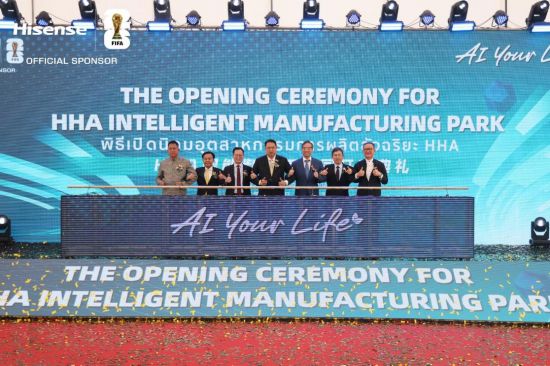
海信HHA智能制造工业园开工仪式在泰国举行
Huan Qiu Wang· 2025-09-24 06:09
Core Viewpoint - Hisense has commenced the construction of its largest overseas industrial park in Thailand, marking a significant step in enhancing Sino-Thai economic cooperation and expanding its presence in the ASEAN market [1][3]. Group 1: Project Overview - The HHA Intelligent Manufacturing Industrial Park is located in the Amata City Chonburi Industrial Park and is a key part of Hisense's global strategy [1]. - The park is designed to be a world-class facility, incorporating advanced technologies such as AI quality inspection and digital twin technology to create a fully digitalized production line [3]. Group 2: Strategic Importance - The establishment of the industrial park coincides with the 50th anniversary of diplomatic relations between China and Thailand, emphasizing the strong ties and mutual benefits of the partnership [3]. - Hisense aims to leverage Thailand's geographical advantages and deepen local collaborations to enhance cultural integration and economic cooperation [3]. Group 3: Future Plans - The HHA Industrial Park will be developed in three phases, with completion expected by 2030, focusing on high standards of construction, efficiency, and operation [3]. - Hisense is committed to ESG principles, aiming for green and intelligent development while promoting local employment and industry growth through various community initiatives [3][4].