
乘用车

Search documents
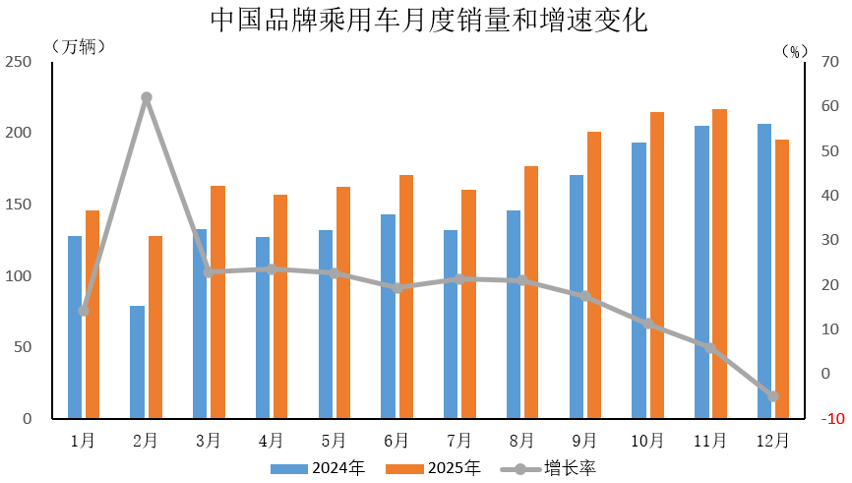
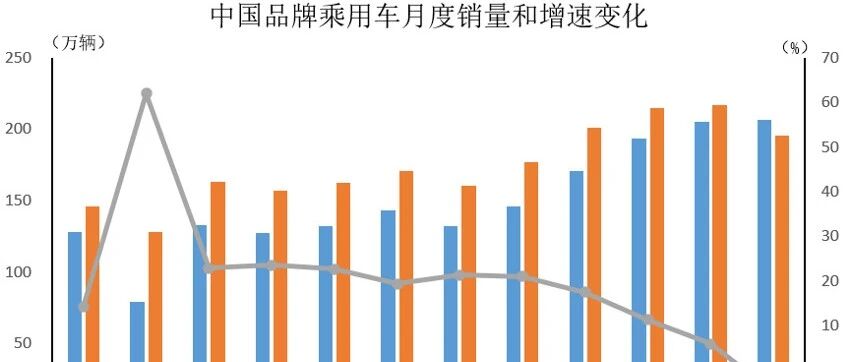
中汽协:2025年12月中国品牌乘用车共销售195.8万辆 环比下降9.7% 同比下降5.1%
智通财经网· 2026-01-23 05:47
Core Insights - In December 2025, Chinese brand passenger car sales reached 1.958 million units, representing a month-on-month decline of 9.7% and a year-on-year decline of 5.1% [1] - The market share of Chinese brand passenger cars accounted for 68.8% of total passenger car sales, an increase of 2.7 percentage points compared to the same month in 2024 [1] - For the entire year of 2025, sales of Chinese brand passenger cars totaled 20.936 million units, marking a year-on-year growth of 16.5% [1] - The market share for Chinese brand passenger cars for the year was 69.5%, which is an increase of 4.3 percentage points compared to 2024 [1]

数据简报 | 2025年12月中国品牌乘用车销售情况简析
中汽协会数据· 2026-01-23 04:13
Group 1 - In December 2025, sales of Chinese brand passenger cars reached 1.958 million units, representing a month-on-month decrease of 9.7% and a year-on-year decrease of 5.1%, accounting for 68.8% of total passenger car sales, with a market share increase of 2.7 percentage points compared to the same period in 2024 [2] - In 2025, total sales of Chinese brand passenger cars amounted to 20.936 million units, showing a year-on-year growth of 16.5%, and capturing 69.5% of the total passenger car sales, with a market share increase of 4.3 percentage points compared to 2024 [2]
2025年11月中国插电式混合动力乘用车进出口数量分别为413辆和148367辆
Chan Ye Xin Xi Wang· 2026-01-23 03:32
Core Insights - The report by Zhiyan Consulting analyzes investment opportunities and market trends in China's plug-in hybrid electric vehicle (PHEV) industry from 2026 to 2032 [1] Import and Export Data - In November 2025, China imported 413 plug-in hybrid passenger vehicles, representing a year-on-year decrease of 21.6%, with an import value of $0.61 million, which is a year-on-year increase of 4.6% [1] - In the same month, China exported 148,367 plug-in hybrid passenger vehicles, showing a significant year-on-year growth of 507.8%, with an export value of $29.27 million, reflecting a year-on-year increase of 359.5% [1] Industry Analysis - Zhiyan Consulting is recognized as a leading industry consulting firm in China, specializing in in-depth industry research, business plans, feasibility studies, and customized services [1] - The firm emphasizes its commitment to providing comprehensive industry solutions to empower investment decisions through professional insights and market acumen [1]

2025年11月中国非插电式混合动力乘用车进出口数量分别为9266辆和50142辆
Chan Ye Xin Xi Wang· 2026-01-23 03:32
Core Insights - The report by Zhiyan Consulting analyzes investment opportunities and market trends in China's plug-in hybrid (including range-extended) passenger vehicle industry from 2026 to 2032 [1] Import and Export Data - In November 2025, China imported 9,266 non-plug-in hybrid passenger vehicles, representing a year-on-year increase of 8.2%, with an import value of $37.4 million, up 12% [1] - In the same month, China exported 50,142 non-plug-in hybrid passenger vehicles, marking a significant year-on-year growth of 64.5%, with an export value of $816 million, an increase of 67.6% [1] Industry Analysis - Zhiyan Consulting is recognized as a leading industry consulting firm in China, specializing in in-depth industry research reports, business plans, feasibility studies, and customized services [1] - The firm emphasizes its professional approach, quality services, and keen market insights to provide comprehensive industry solutions that empower investment decisions [1]

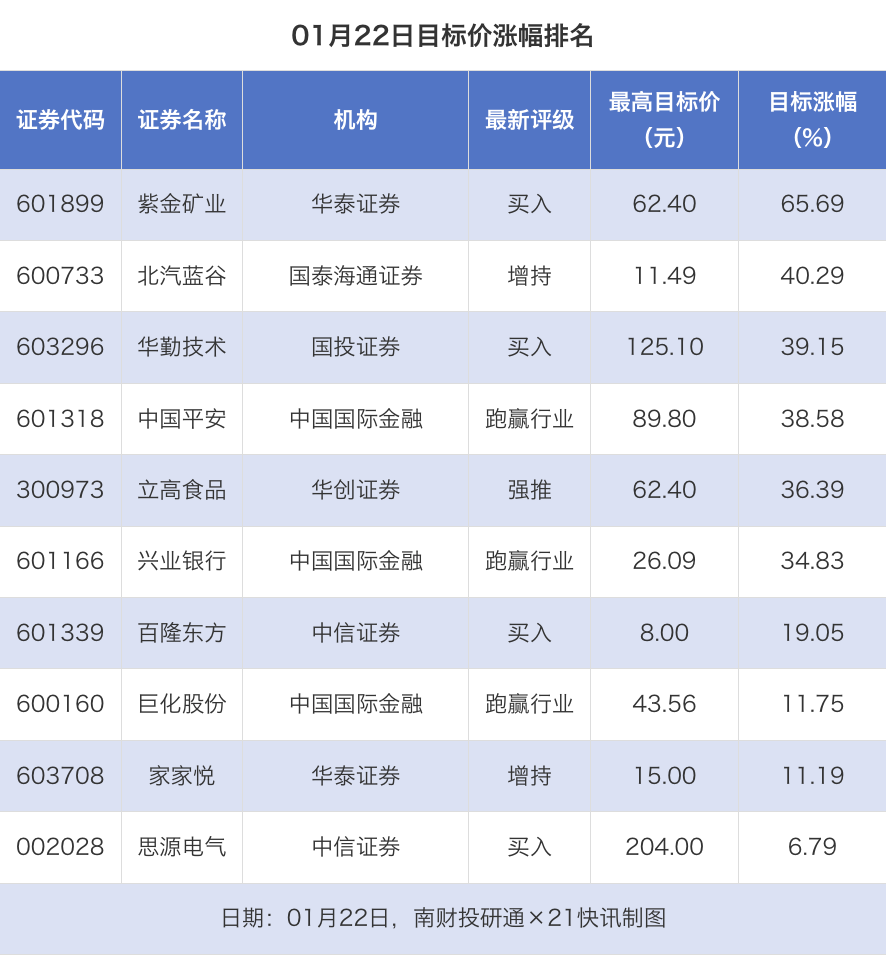
24股获推荐,紫金矿业目标价涨幅超60%丨券商评级观察
2 1 Shi Ji Jing Ji Bao Dao· 2026-01-23 01:09
Group 1 - The core viewpoint of the article highlights the target price increases for several listed companies, with Zijin Mining, BAIC Blue Valley, and Huqin Technology leading the rankings with target price increases of 65.69%, 40.29%, and 39.15% respectively, across the industrial metals, passenger vehicles, and consumer electronics sectors [1][2]. Group 2 - On January 22, a total of 24 listed companies received recommendations from securities firms, with Lihigh Food receiving 2 recommendations, while companies like Baolong Oriental and BAIC Blue Valley received 1 recommendation each [4]. - The companies that received first-time coverage on January 22 include BAIC Blue Valley with a "Buy" rating from Guotai Junan Securities, Yanzhou Coal with an "Outperform" rating from Guosen Securities, Hezhu Intelligent with a "Buy" rating from Huayuan Securities, and Jiachih Technology with a "Buy" rating from Kaiyuan Securities [5][6].




乘用车板块1月22日跌0.74%,赛力斯领跌,主力资金净流出15.34亿元
Zheng Xing Xing Ye Ri Bao· 2026-01-22 09:02
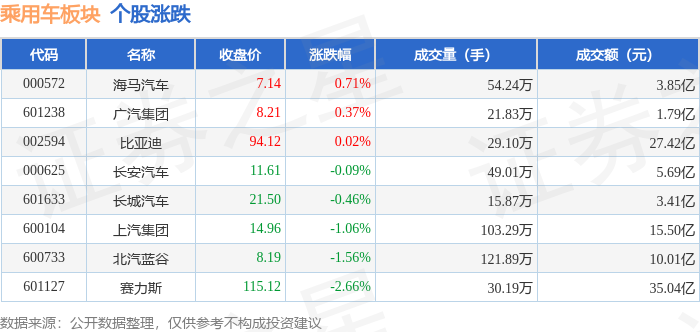
从资金流向上来看,当日乘用车板块主力资金净流出15.34亿元,游资资金净流入5.13亿元,散户资金净 流入10.21亿元。乘用车板块个股资金流向见下表: 证券之星消息,1月22日乘用车板块较上一交易日下跌0.74%,赛力斯领跌。当日上证指数报收于 4122.58,上涨0.14%。深证成指报收于14327.05,上涨0.5%。乘用车板块个股涨跌见下表: | 代码 | 名称 | 收盘价 | 涨跌幅 | 成交量(手) | 成交额(元) | | --- | --- | --- | --- | --- | --- | | 000572 | 出版中集 | 7.14 | 0.71% | 54.24万 | 3.85 Z | | 601238 | 广汽集团 | 8.21 | 0.37% | 21.83万 | · 1.79亿 | | 002594 | 比亚迪 | 94.12 | 0.02% | 29.10万 | 27.42 Z | | 000625 | 长安汽车 | 11.61 | -0.09% | 49.01万 | 5.69亿 | | 601633 | 长城汽车 | 21.50 | -0.46% | 15.87万 | 3.41 ...

乘联分会:1月1-18日全国乘用车市场零售67.9万辆 同比下降28%
智通财经网· 2026-01-21 11:23
Group 1: Market Performance - From January 1 to 18, the national passenger car retail sales reached 679,000 units, a year-on-year decrease of 28% and a month-on-month decrease of 37% [1][5] - During the same period, the wholesale volume of passenger cars was 740,000 units, down 35% year-on-year and 30% month-on-month [1][9] - The retail sales of new energy vehicles (NEVs) in the same timeframe were 312,000 units, reflecting a 16% year-on-year decline and a 52% month-on-month decline [1][5] Group 2: Production Trends - In the first two weeks of January, the production of pure fuel light vehicles was 91,000 units, down 85% year-on-year and 77% month-on-month [1] - The production of hybrid and plug-in hybrid vehicles totaled 139,000 units, a year-on-year decrease of 65% and a month-on-month decrease of 75% [1] Group 3: Policy Impact - The National Development and Reform Commission announced a policy to implement large-scale equipment updates and a trade-in program, which is expected to boost domestic car consumption [5] - The subsidy for passenger car trade-ins is projected to decrease by 20% to 30% compared to 2025, indicating a structural adjustment in the policy [5][11] Group 4: Future Outlook - The market is expected to improve as local subsidy details and channels are fully launched, along with the gradual release of purchasing power before the Spring Festival [5] - The first month of the year typically sees a "New Year sales boost," and despite the current weak performance, there is an anticipation of a slight increase in year-on-year sales due to pre-orders and market dynamics [9][11]



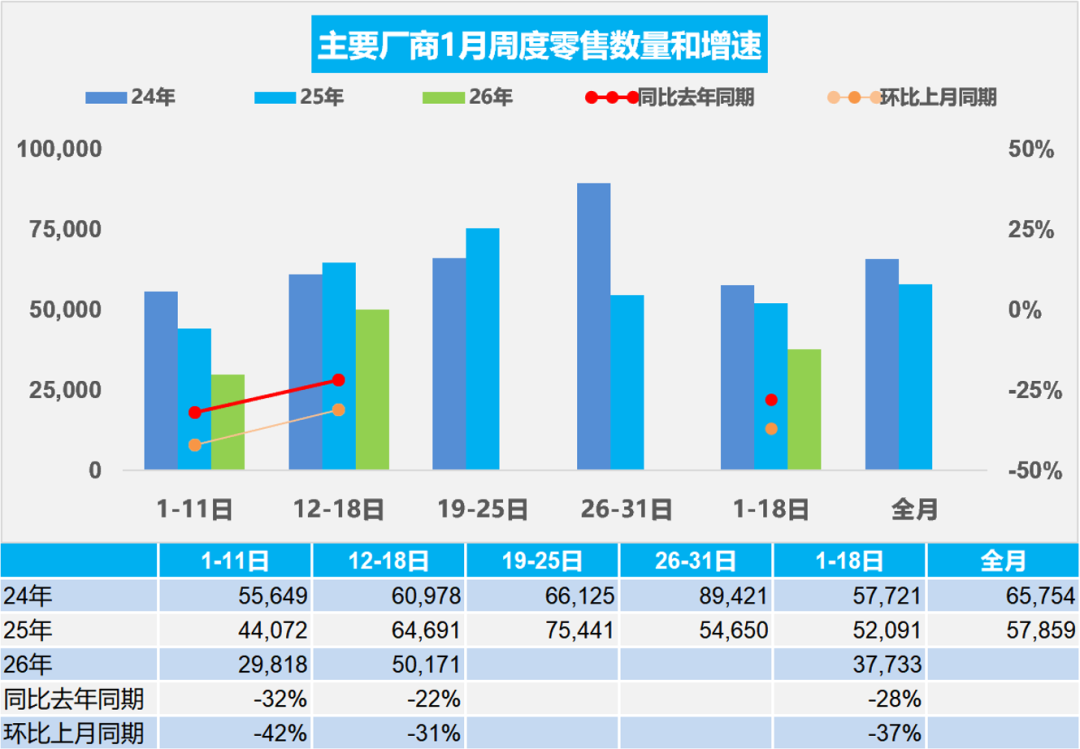
乘联分会:1月1日—18日全国乘用车市场零售67.9万辆,同比下降28%
Zheng Quan Shi Bao Wang· 2026-01-21 11:09
人民财讯1月21日电,据乘联分会官微消息,1月1日—18日,全国乘用车市场零售67.9万辆,同比去年1 月同期下降28%;全国乘用车新能源市场零售31.2万辆,同比去年1月同期下降16%。 ...
乘用车板块1月21日跌0.72%,上汽集团领跌,主力资金净流出6.59亿元
Zheng Xing Xing Ye Ri Bao· 2026-01-21 08:53
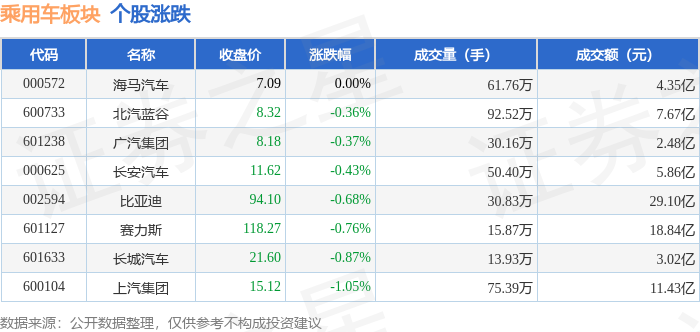
Core Viewpoint - The passenger car sector experienced a decline of 0.72% on January 21, with SAIC Motor leading the drop, while the Shanghai Composite Index rose by 0.08% and the Shenzhen Component Index increased by 0.7% [1] Group 1: Market Performance - The closing price for SAIC Motor was 15.12, down 1.05%, with a trading volume of 753,900 shares and a transaction value of 1.14 billion [1] - BYD closed at 94.10, down 0.68%, with a trading volume of 308,300 shares and a transaction value of 2.91 billion [1] - The overall passenger car sector saw a net outflow of 659 million from main funds, while retail investors contributed a net inflow of 518 million [1] Group 2: Fund Flow Analysis - GAC Group had a main fund net inflow of 2.196 million, with a retail net outflow of 18.38 million [2] - Changan Automobile experienced a main fund net inflow of 2.188 million, but a retail net inflow of 29.81 million [2] - BYD faced a significant main fund net outflow of 4.37 billion, while retail investors contributed a net inflow of 426 million [2]

乘用车板块1月20日跌1.1%,海马汽车领跌,主力资金净流出18.68亿元
Zheng Xing Xing Ye Ri Bao· 2026-01-20 08:51
从资金流向上来看,当日乘用车板块主力资金净流出18.68亿元,游资资金净流入5.99亿元,散户资金净 流入12.7亿元。乘用车板块个股资金流向见下表: | 代码 | 名称 | 收盘价 | 涨跌幅 | 成交量(手) | 成交额(元) | | --- | --- | --- | --- | --- | --- | | 600104 | 上汽集团 | 15.28 | 0.20% | 78.49万 | 12.00亿 | | 000625 | 长安汽车 | 11.67 | -0.17% | 54.41万 | 6.34亿 | | 601633 | 长城汽车 | 21.79 | -0.91% | 14.79万 | 3.23 Z | | 601238 | 广汽集团 | 8.21 | -0.97% | - 29.61万 | 2.43亿 | | 002594 | 比亚迪 | 94.74 | -1.51% | 38.91万 | 36.99亿 | | 601127 | 赛力斯 | 119.18 | -1.63% | 18.68万 | 22.37亿 | | 600733 | 北汽蓝谷 | 8.35 | -2.91% | 142.34万 ...

