
基础化工

Search documents
连续2日百股涨停!周期成资金“扫货”重点,融资余额节后回升,这些方向热度也大增
Xin Lang Cai Jing· 2026-02-25 09:37
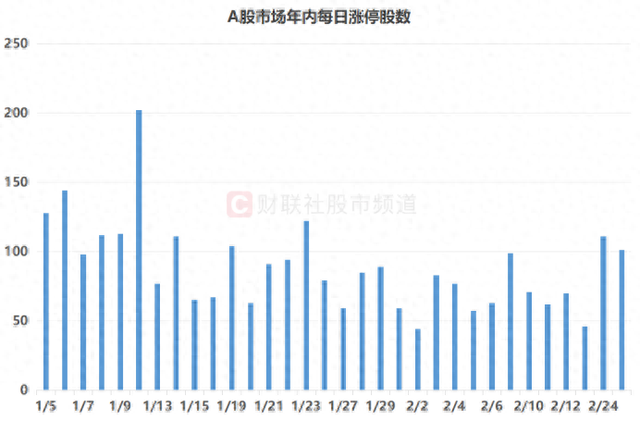
Core Viewpoint - The A-share market has shown significant activity post-holiday, achieving consecutive "limit-up" days, with 26 stocks experiencing continuous gains, indicating a strong bullish sentiment in the market [1][3]. Group 1: Market Performance - The A-share market has seen a continuous rise, with 100 stocks hitting the daily limit-up, a phenomenon not observed since early January [1]. - A total of 26 stocks have achieved consecutive limit-up days, accounting for nearly 14% of the total limit-up stocks [1]. Group 2: Sector Analysis - The basic chemical sector led the market with 32 limit-up stocks, representing 17% of the total limit-up stocks, followed by non-ferrous metals and petroleum sectors, which together contributed to one-third of the limit-up stocks [3]. - In terms of consecutive limit-up stocks, the basic chemical and construction decoration sectors were the primary contributors, with 7 and 5 stocks respectively, indicating a strong focus on cyclical sectors [5]. Group 3: Individual Stock Highlights - Notable stocks among the limit-up performers include Northern Rare Earth, Changfei Fiber, and China Railway, with significant market capitalizations exceeding 1 billion [7]. - China Merchants Energy recorded a continuous limit-up trend, reaching a historical high of 14.75 yuan, with a trading volume of 3.087 billion yuan, marking the highest level in nearly a decade [7]. Group 4: Financing Activity - Post-holiday, the financing balance in the A-share market increased significantly, with a net financing amount of 33.889 billion yuan on February 24, marking the second-highest record this year [10]. - Among the 31 sectors, 26 experienced an increase in financing balance, with electronics and computers being the primary focus for investors [10]. Group 5: Individual Stock Financing - A total of 19 stocks saw net financing exceeding 1 billion yuan, with Zhongji Xuchuang leading at 1 billion yuan, followed by Kingsoft and China Glass [11]. - The financing balance for key sectors such as electronics, power equipment, and non-bank financials remains robust, with several stocks showing significant net buying activity [11].

新春开工领涨!鹏华周期类ETF矩阵解锁石油化工复苏新机遇
Zhong Jin Zai Xian· 2026-02-25 08:55
Core Viewpoint - The A-share market experienced a strong start to the new year, particularly in the cyclical sectors, with the oil and petrochemical sector leading the gains at 5.53% [1] Group 1: Market Performance - The oil and petrochemical sector topped the Shenwan first-level industry rankings with a 5.53% increase, while the basic chemical sector ranked third with a 3.45% increase [1] - Institutional consensus indicates a positive outlook for cyclical assets post-holiday, with expectations of a market rebound supported by policy expectations and liquidity [1] Group 2: Investment Opportunities - Key investment themes include the "anti-involution" concept driven by improved supply-demand dynamics and industry profit recovery, with a focus on sectors benefiting from price increases such as precious metals, oil and petrochemicals, and basic chemicals [1] - The global landscape shows increased macro risks due to geopolitical tensions and tariff policies, prompting a focus on "weak dollar assets" like precious metals, non-ferrous metals, and oil and gas [1] Group 3: ETF Performance - Penghua Fund's oil ETF (159697) is the first in the market to track the National Oil and Gas Index, covering key companies in the oil and gas industry, with a one-year increase of 31.43% compared to the 19.34% rise of the CSI 300 index [2] - The chemical ETF (159870) tracks a refined chemical industry index, achieving a one-year growth of 51.79%, effectively capturing structural opportunities in the transition from traditional capacity to high-end and new energy materials [2] Group 4: Liquidity and Market Acceptance - As of February 13, 2026, the oil ETF (159697) and chemical ETF (159870) ranked first in their respective categories with sizes of 1.828 billion and 35.533 billion, indicating strong liquidity and market recognition [3] - These ETFs provide investors with low-cost, high-transparency, and risk-diversified investment tools, addressing the complexities and risks associated with direct investments in cyclical stocks [3]
粤开市场日报-20260225
Yuekai Securities· 2026-02-25 07:45
证券研究报告 | 策略点评 2026 年 02 月 25 日 投资要点 分析师:孟之绪 执业编号:S0300524080001 电话: 邮箱:mengzhixu@ykzq.com 投资策略研究 粤开市场日报-20260225 今日关注 指数涨跌情况:今日 A 股主要指数普遍收涨。截止收盘,沪指上涨 0.72%,收 报 4147.23 点;深证成指涨 1.29%,收报 14475.87 点;创业板指涨 1.41%, 收报 3354.82 点;科创 50 指数涨 0.54%,收报 1473.28 点。总体上,全天个 股涨多跌少,Wind 数据显示,全市场 3742 只个股上涨,仅 1609 只个股下跌, 127 只个股收平。沪深两市今日成交额合计 24625 亿元,较上个交易日放量 2605 亿元。 行业涨跌情况:今日申万一级行业涨多跌少,钢铁、有色金属、建筑材料、 房地产、基础化工等行业领涨,涨幅分别为 4.69%、3.48%、2.75%、2.53%、 2.16%,仅有传媒、银行领跌,跌幅分别为 1.15%、0.46%。 概念板块涨跌情况:今日涨幅居前的概念板块为稀土、稀有金属精选、磷化 工、小金属、稀土永磁、 ...
化工行业周报20260225:国际油价大幅上涨,分散染料迎来第四轮涨价
Bank of China Securities· 2026-02-25 07:20
基础化工 | 证券研究报告 — 行业周报 2026 年 2 月 25 日 强于大市 化工行业周报 20260225 国际油价大幅上涨,分散染料迎来第四轮涨价 二月份建议关注:1、低估值行业龙头公司;2、"反内卷"对相关子行业供给端影响;3、下游需求旺 盛,自主可控日益关键背景下的电子材料公司。 行业动态 相关研究报告 《染料价格上行,一体化企业有望受益》 20260211 《化工行业周报 20260208》20260208 《化工行业周报 20260201》20260202 中银国际证券股份有限公司 具备证券投资咨询业务资格 证券分析师:余嫄嫄 (8621)20328550 yuanyuan.yu@bocichina.com 证券投资咨询业务证书编号:S1300517050002 证券分析师:范琦岩 qiyan.fan@bocichina.com 证券投资咨询业务证书编号:S1300525040001 投资建议 风险提示 ◼ 地缘政治因素变化引起油价大幅波动;全球经济形势出现变化。 ◼ 本周(02.17-02.24)均价跟踪的 100 个化工品种中,共有 33 个品种价格上涨,8 个品种价格下跌, 59 个品 ...
化工行业周报20260225:国际油价大幅上涨,分散染料迎来第四轮涨价-20260225
Bank of China Securities· 2026-02-25 06:56
国际油价大幅上涨,分散染料迎来第四轮涨价 二月份建议关注:1、低估值行业龙头公司;2、"反内卷"对相关子行业供给端影响;3、下游需求旺 盛,自主可控日益关键背景下的电子材料公司。 行业动态 基础化工 | 证券研究报告 — 行业周报 2026 年 2 月 25 日 强于大市 化工行业周报 20260225 相关研究报告 《染料价格上行,一体化企业有望受益》 20260211 《化工行业周报 20260208》20260208 《化工行业周报 20260201》20260202 中银国际证券股份有限公司 具备证券投资咨询业务资格 基础化工 证券分析师:余嫄嫄 (8621)20328550 yuanyuan.yu@bocichina.com 证券投资咨询业务证书编号:S1300517050002 证券分析师:范琦岩 qiyan.fan@bocichina.com 证券投资咨询业务证书编号:S1300525040001 投资建议 风险提示 ◼ 地缘政治因素变化引起油价大幅波动;全球经济形势出现变化。 ◼ 本周(02.17-02.24)均价跟踪的 100 个化工品种中,共有 33 个品种价格上涨,8 个品种价格下跌, ...
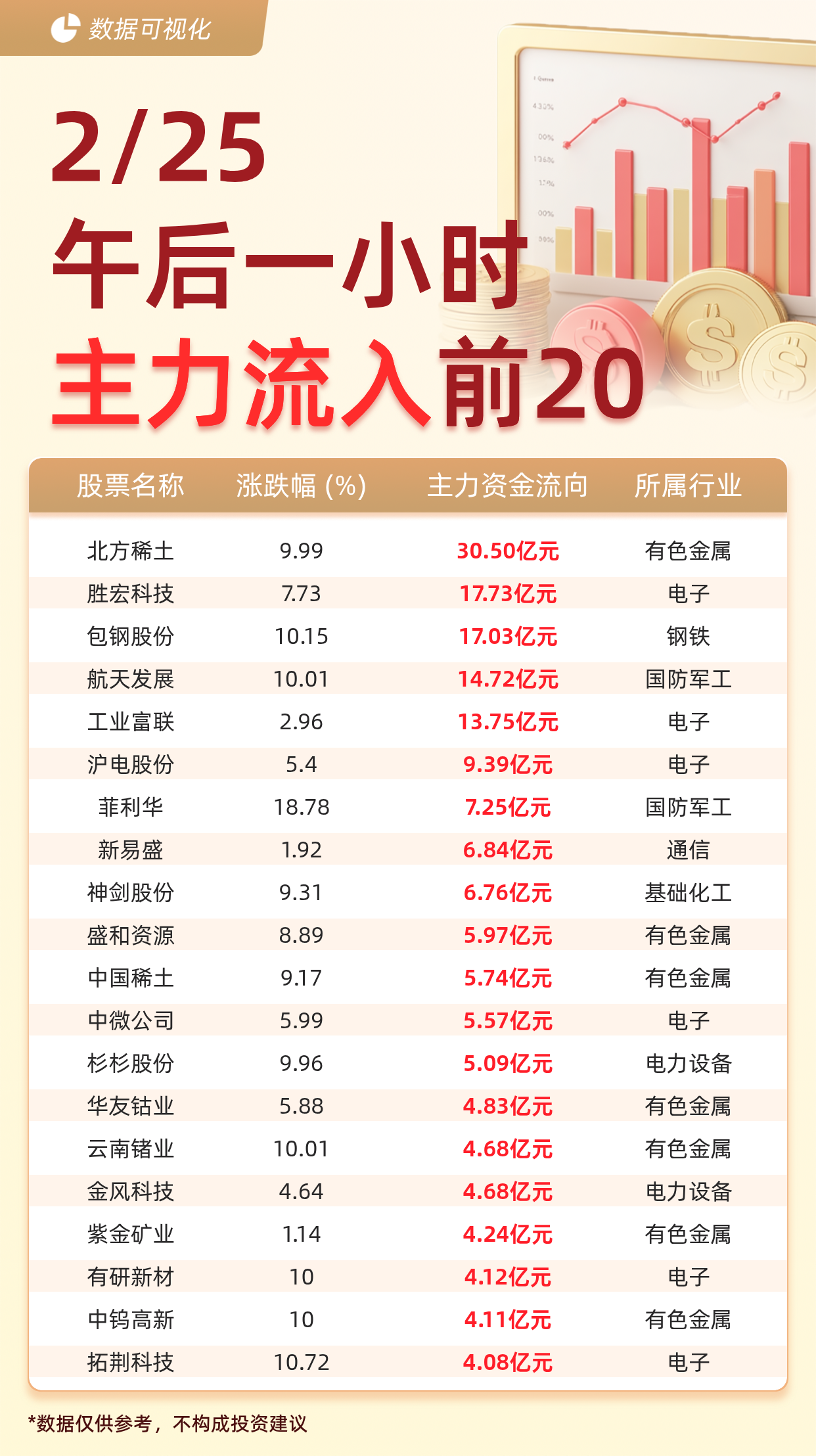
主力资金流入前20:北方稀土流入30.50亿元、胜宏科技流入17.73亿元
Jin Rong Jie· 2026-02-25 06:34
Group 1 - The main stocks with significant capital inflow include Northern Rare Earth (30.50 billion), Shenghong Technology (17.73 billion), and Baosteel (17.03 billion) [1] - Northern Rare Earth saw a price increase of 9.99%, while Baosteel increased by 10.15% [2] - Other notable stocks with substantial inflows are Aerospace Development (14.72 billion) and Industrial Fulian (13.75 billion) [1][2] Group 2 - The electronics sector is represented by companies like Shenghong Technology, Industrial Fulian, and Huadian Shares, with inflows of 17.73 billion, 13.75 billion, and 9.39 billion respectively [2] - The defense sector includes Aerospace Development and Feilihua, with inflows of 14.72 billion and 7.25 billion respectively [2] - The non-ferrous metals sector has significant representation with Northern Rare Earth, Shenghe Resources, and China Rare Earth, attracting inflows of 30.50 billion, 5.97 billion, and 5.74 billion respectively [1][3]






化工新周期开启,石化ETF(159731)布局机会凸显
Mei Ri Jing Ji Xin Wen· 2026-02-25 05:50
石化ETF(159731)及其联接基金(017855/017856)紧密跟踪中证石化产业指数,从申万一级行业分 布来看,基础化工行业占比为60.02%,石油石化行业占比为32.43%,能够分享下游化工品的利润修 复。伴随行业格局优化和供需结构调整,行业中长期叙事改善。 (文章来源:每日经济新闻) 截至2月25日13:35,石化ETF(159731)涨1.80%,持仓股川发龙蟒、云天化、和邦生物等涨幅居前。 从资金净流入方面来看,石化ETF(159731)近20个交易日资金净流入总计12.39亿元。石化ETF最新份 额达17.62亿份,最新规模18.58亿元。 受到原油春节期间上涨的提振,化工价格普遍出现了开门红。从景气度最高的聚酯产业链来看,终端企 业2026年春节后普遍开工比往年更早,CCF报道,绍兴中国轻纺城和广州国际轻纺城市场分别于正月初 八和正月初十开市,往年通常是正月十五才会开工。 据中信期货分析,春节期间化工品普遍出现了累库,例如聚烯烃两油库存较节前攀升104%;纯苯、苯 乙烯、乙二醇等品种也均出现累库。然而即使累库,在节后下游和终端复工复产的预期下,化工仍可能 延续震荡格局,等待需求格局的明朗化 ...
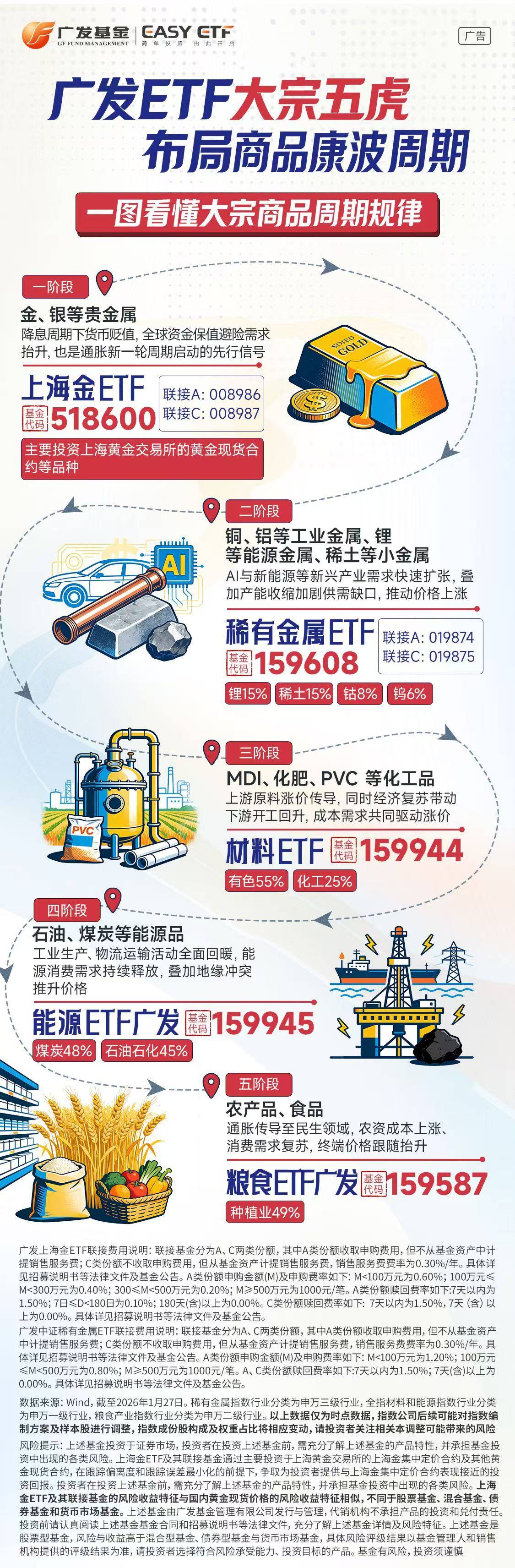
AI带动上游关键战略金属涨价,锂钴钨合计占比约30%居同类第一的稀有金属ETF(159608)涨超6%,广发大宗五虎一键布局大宗康波周期
Sou Hu Cai Jing· 2026-02-25 05:29
2026年2月25日,A股三大股指小幅高开,磷化工、锂矿概念、小金属概念股、稀土永磁等涨幅居前。2月24日,百川盈孚数据显示,稀土产品价格加速上 涨。氧化镨钕等主要稀土产品价格近期持续走高,现货供应紧张,下游磁材企业存在备货采购需求,共同推动价格上涨。 海外消息,近日特朗普官员初步将OPEN的AI定价模型聚焦于锗、镓、锑和钨四种关键矿产,随后将逐步扩大覆盖范围,此举揭示了特朗普政府试图主动介 入关键矿产定价的路径,消息公布后,外盘有色金属出现明显涨幅。现货方面,当前市场仍处于节后恢复初期,锡锭库存季节性累增中,预计短期锡价仍以 高位震荡偏强为主。 锗方面,作为光纤的关键材料,海外锗价突破4000美元/kg。锗目前已被多个国家列为战略性保护矿产资源。展望未来,供给端,中国作为最大的锗生产 国,近年来持续加强对锗的出口管制,全球范围内的锗供应量或继续受限。需求端,随着军事红外、低轨卫星、通信、光伏等领域的景气提升,对锗的需求 量预计将持续增长。东莞证券认为,尽管目前高位的锗价使得下游企业的购买热情有所退却,但供弱需强的局面奠定了锗价上行的基础,预计未来锗价将再 度开启上升通道。 此外,全球能源转型正从政策驱动迈向 ...
多数保险机构对2026年A股市场持较乐观态度,计划小幅增配A股
Jin Rong Jie· 2026-02-25 03:58
Group 1 - The core viewpoint of the articles indicates that insurance institutions are optimistic about domestic investments in stocks and securities investment funds for 2026, with a tendency to slightly increase stock investments [1] - Most insurance institutions plan to maintain their allocation ratios for bank deposits, bonds, securities investment funds, and other financial assets similar to 2025, with some intending to moderately increase stock investments [1] - In the bond market, insurance institutions hold a neutral outlook for 2026, favoring high-grade corporate bonds, perpetual bonds, subordinated debt, and convertible bonds, primarily focusing on bonds with maturities between 10 to 30 years [1] Group 2 - Regarding the A-share market, insurance institutions are generally optimistic for 2026, favoring indices such as the Sci-Tech Innovation 50, CSI 300, and ChiNext, and industries like electronics, non-ferrous metals, and pharmaceuticals [1] - The main factors influencing the A-share market are expected to be corporate profit recovery and liquidity conditions, with most insurance institutions planning to slightly increase their allocation to A-shares [1] - In terms of fund investments, insurance asset management institutions prefer equity funds, secondary bond funds, and mixed equity funds, with nearly half planning to slightly increase their allocation to public funds [2] Group 3 - For overseas investments, Hong Kong stocks are the most favored by insurance institutions for 2026, with gold and US stocks also receiving attention [2] - About half of the insurance asset management institutions plan to slightly increase their allocation to Hong Kong stocks, while 40% of insurance companies intend to maintain their current allocation levels [2]
周期板块点评:周期资源品配置正当时
Bank of China Securities· 2026-02-25 03:18
Core Insights - The report emphasizes that the current environment is favorable for allocating resources in cyclical sectors, particularly in the first quarter of 2026, due to rising overseas uncertainties and the expected resumption of domestic activities after the Spring Festival [1][2]. Group 1: Market Performance - The cyclical sector performed well, with significant gains in industries such as oil and petrochemicals, construction materials, basic chemicals, non-ferrous metals, and coal, driven by geopolitical tensions, U.S. tariff policy uncertainties, and domestic supply-demand expectations [2]. - The escalation of the U.S.-Iran situation has led to rising oil prices, with global crude oil prices reaching a six-month high during the Spring Festival, positively impacting the domestic oil and petrochemical sector [2]. - Uncertainties surrounding tariffs have provided strong support for precious metal prices, with international gold prices continuing to rise amid renewed global trade uncertainties [2]. Group 2: Supply Constraints and Price Expectations - Coal prices are expected to recover due to supply constraints, with domestic coal inventories at major ports dropping to low levels and signals of reduced coal supply from Indonesia, which may create price space for domestic coal [2]. - The resumption of work after the Spring Festival is anticipated to boost demand expectations, further supporting coal prices [2]. Group 3: Strategic Outlook - The report reiterates that the first quarter is a critical time for resource allocation, with the recent rise in overseas uncertainties likely to catalyze a new round of resource price movements [2]. - The evolution of the U.S.-Iran situation will be a significant factor influencing oil and precious metal prices, while the restart of U.S. trade policy uncertainties may provide strong support for precious metals [2]. - Domestic construction activity and macroeconomic policy developments ahead of the Two Sessions will significantly impact the sustainability of the coal sector and other domestic resource prices [2].