
操作系统

Search documents
前三季度GDP增长5.2%,联合国面临破产危机 | 财经日日评
吴晓波频道· 2025-10-21 00:21
Economic Overview - China's GDP for the first three quarters reached 10,150.36 billion yuan, with a year-on-year growth of 5.2% [2] - The growth rates for the three sectors were: primary industry at 3.8%, secondary industry at 4.9%, and tertiary industry at 5.4% [2] - The retail sales of consumer goods totaled 3,658.77 billion yuan, showing a year-on-year increase of 4.5% [2] - The per capita disposable income of residents was 32,509 yuan, with a nominal growth of 5.1% [2] Real Estate Market - In September, the housing prices in major cities showed a month-on-month decline, with first-tier cities down by 1% [4] - Fixed asset investment (excluding rural households) was 3,715.35 billion yuan, a year-on-year decrease of 0.5% [4] - Real estate development investment fell by 13.9% year-on-year, with residential investment down by 12.9% [4][5] Monetary Policy - The Loan Prime Rate (LPR) remained unchanged for five consecutive months, with the one-year LPR at 3.00% and the five-year LPR at 3.50% [6] - The central bank has not indicated any plans for interest rate cuts, focusing instead on liquidity management [6][7] Consumer Spending Initiatives - Various provinces, including Hunan and Zhejiang, are launching new rounds of consumption vouchers totaling 1 billion yuan to stimulate consumer spending [10] - The focus of these vouchers is on daily necessities, aiming to enhance consumer habits rather than just providing one-time subsidies [11] Technology Development - Huawei is set to release HarmonyOS 6, which integrates AI capabilities into the system, marking a significant advancement in its operating system development [12] - The new framework aims to enhance cross-device collaboration and improve user experience [12][13] Fund Market Trends - As of August, the total scale of money market funds reached approximately 14.81 trillion yuan, reflecting a growth of 1.2 trillion yuan from the end of last year [14] - The decline in deposit rates has made money market funds an attractive option for savers, despite a decrease in their yields [14][15]


从课堂到产业:是什么让学生也能成为开源鸿蒙的共建者
36氪· 2025-10-18 13:34
Core Viewpoint - The article emphasizes the significant role of universities in the development of the OpenHarmony ecosystem, showcasing how student involvement in practical projects bridges the gap between academia and industry, transforming students from learners to contributors [3][21]. Group 1: OpenHarmony Ecosystem Development - The OpenHarmony project has grown from 7 million lines of code to over 130 million lines, with more than 1,300 software and hardware products passing compatibility tests and attracting over 9,300 code contributors and 400 partners [3]. - The establishment of OpenHarmony technology clubs in 38 universities across China has engaged thousands of students and faculty, facilitating the transition of domestic operating systems from laboratory concepts to industrial applications [3][9]. Group 2: Student Experiences and Contributions - Students at Hunan University have developed robots and AI-integrated devices using OpenHarmony, highlighting the system's unique capability to support multiple device interconnectivity [6][8]. - The experience gained through these projects has significantly enhanced students' resumes, with many receiving recognition from mentors for their practical skills and teamwork [8][9]. - At Shanghai Jiao Tong University, students have engaged in critical security kernel development, contributing to the successful implementation of OpenHarmony in the power industry, achieving CCRC EAL5+ security certification [11][13]. Group 3: Educational Transformation - The OpenHarmony clubs encourage interdisciplinary collaboration, allowing students from various backgrounds to work together on projects, thus fostering innovation and practical application of theoretical knowledge [9][18]. - Beijing University of Aeronautics and Astronautics has developed a comprehensive talent cultivation system that integrates research projects, competitions, and teaching, ensuring students can apply their learning effectively [16][18]. - The clubs have shifted the educational paradigm, enabling students to participate in real-world engineering challenges, thus preparing them to become key contributors to the national technology landscape [14][19]. Group 4: Future Implications - The collaborative efforts of these universities illustrate a new model of education where students are not just passive learners but active contributors to the development of a domestic operating system [21]. - The article concludes that the ongoing engagement of students in the OpenHarmony ecosystem is crucial for sustaining innovation and growth, positioning them as the future leaders in technology [22].

鸿蒙5.1升级“灾难”:兼容性崩塌,华为如何应对?
Xin Lang Cai Jing· 2025-10-18 10:24
Core Viewpoint - The recent upgrade of Huawei's HarmonyOS from version 4.3 to 5.1 has faced significant backlash due to compatibility issues with mainstream applications, leading to user frustration and data loss during the downgrade process [1][3][4]. Group 1: User Experience and Compatibility Issues - Users have reported that after upgrading to HarmonyOS 5.1, many applications became incompatible, resulting in a chaotic desktop layout and the need to reinstall and log into existing applications, increasing operational costs [3][4]. - Core functionalities of popular applications like WeChat and Douyin have failed, causing disruptions for content creators and users alike [3][4]. - The lack of a user-friendly downgrade mechanism has forced users to seek professional help to revert to the previous system, often resulting in data loss [4]. Group 2: Market Position and Competition - Huawei has regained a leading position in the Chinese smartphone market, achieving a market share of 18.1% with 12.5 million units shipped in Q2 2025, despite an overall market decline [5][6]. - The HarmonyOS ecosystem is still small on a global scale, with only 4% market share compared to Android's 79% and iOS's 17% as of Q2 2025 [7][8]. Group 3: Development and Future Challenges - Huawei has invested heavily in R&D, with expenditures reaching 96.95 billion yuan in the first half of 2025, accounting for 22.7% of its revenue, indicating a strong commitment to developing the HarmonyOS ecosystem [7]. - The transition to a "pure" HarmonyOS from a compatible Android system presents significant compatibility challenges, as seen in the recent upgrade issues [10][11]. - Building a developer ecosystem remains a critical challenge, as the user base is primarily domestic, making it difficult to attract international developers to invest in the platform [10][11]. Group 4: Strategic Outlook - The HarmonyOS has the potential for growth in various markets, including PC operating systems, mobile application development, and IoT, with significant market sizes projected [10]. - However, the path to achieving a competitive stance against Android and iOS globally is fraught with challenges, including the need for improved application quality and timely updates [10][11].
智通港股解盘 | 祭出“王炸”特朗普态度软化 反制概念走势坚挺
Zhi Tong Cai Jing· 2025-10-13 12:18
Market Overview - China's recent rare earth policy has led to a significant drop in the US stock market, with the Nasdaq falling by 3.56% and the S&P 500 by 2.72%, indicating a strong impact on technology stocks and a spike in the VIX fear index above 31% [1] - The new policy effectively closes loopholes in rare earth exports, which are crucial for semiconductor manufacturing, particularly for companies like TSMC, which relies heavily on rare earth materials from China [1] - The US's dependency on Chinese rare earths for chip production raises concerns for major tech companies like Nvidia and Apple, potentially crippling their operations if strict enforcement occurs [1] Trade Relations - Despite the US's threats to impose 100% tariffs on Chinese goods, China's exports have shown resilience, with a reported 8.3% year-on-year increase in September, leading to a trade surplus of $90.5 billion [2] - The US administration's stance appears to soften, with indications that both countries prefer to avoid economic recession and are open to dialogue [3] Industry Impact - The recent tensions have prompted a shift in attitudes from other countries, such as Canada, which is reconsidering its tariffs on Chinese electric vehicles due to the negative impact on bilateral trade [4] - The market's reaction to the geopolitical situation has led to a rise in gold prices, with spot gold reaching a historical high of over $4060 [4] Semiconductor Sector - The semiconductor industry is witnessing advancements, with upcoming events like the Bay Area Semiconductor Industry Expo expected to showcase significant developments [5] - Companies involved in semiconductor manufacturing, such as Huahong Semiconductor and SMIC, have seen stock price increases, reflecting market optimism [5] Software and Domestic Alternatives - The cessation of support for Windows 10 by Microsoft is expected to boost the market share of domestic operating systems, with projections indicating a 15% share in the PC market by mid-2025 [6] - Companies like Kingsoft are benefiting from this trend, with significant stock price increases following the announcement of domestic software alternatives [6] Cobalt Market Dynamics - New export quotas for cobalt from the Democratic Republic of Congo have led to supply tightening and increased costs, benefiting companies like Luoyang Molybdenum and China Molybdenum [7] - The concentration of export rights among a few large companies enhances their bargaining power within the supply chain [7] Company Performance - Shanghai Fudan reported a revenue of 1.839 billion yuan for the first half of 2025, a year-on-year increase of 2.49%, although net profit saw a decline of 44.38% [8] - The company is positioned as a leading FPGA supplier, with a focus on advanced chip development and a positive outlook for revenue growth in various product lines [9]
A股收盘:科创50指数低开高走,稀土永磁板块掀涨停潮
Di Yi Cai Jing· 2025-10-13 07:51
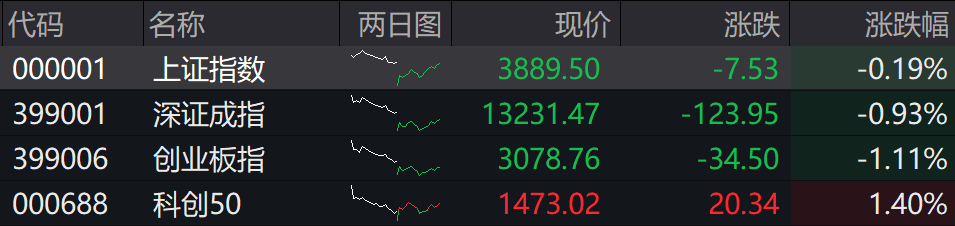
Core Viewpoint - The A-share market experienced a mixed performance with the Shanghai Composite Index declining by 0.19%, while the STAR Market Index rose by over 1% [1][2]. Market Performance - The Shanghai Composite Index closed at 3889.50, down by 7.53 points or 0.19% [2]. - The Shenzhen Component Index closed at 13231.47, down by 123.95 points or 0.93% [2]. - The ChiNext Index closed at 3078.76, down by 34.50 points or 1.11% [2]. - The STAR 50 Index closed at 1473.02, up by 20.34 points or 1.40% [2]. Sector Performance - The self-controlled industrial chain saw a significant surge, particularly in the rare earth permanent magnet sector, with multiple stocks hitting the daily limit [2]. - Key sectors that performed well included photolithography machines, lithium batteries, rare metals, and operating systems, while sectors like robotics, consumer electronics, and auto parts generally declined [2][3]. Trading Volume and Market Sentiment - The total trading volume in the Shanghai and Shenzhen markets was 2.35 trillion yuan, a decrease of 160.9 billion yuan compared to the previous trading day [4]. - Over 3600 stocks in the market experienced declines [4]. Capital Flow - Main capital inflows were observed in the steel, banking, and non-ferrous metal sectors, while outflows were noted in consumer electronics, auto parts, and battery sectors [6]. - Specific stocks with net inflows included Baogang Steel (1.758 billion yuan), China Software (959 million yuan), and Northern Rare Earth (724 million yuan) [6]. - Stocks facing net outflows included BYD (1.424 billion yuan), Luxshare Precision (1.103 billion yuan), and Seres (1.098 billion yuan) [6]. Institutional Insights - Guotai Junan noted that recent market fluctuations do not alter the long-term positive outlook for the stock market, viewing external shocks as opportunities to increase holdings in the Chinese market [7]. - The firm emphasized that the current trade risks are clearer compared to previous shocks, suggesting a balanced investment approach focusing on technology growth, finance, and certain cyclical sectors [7]. - Guoyuan Securities highlighted that the rare earth sector is experiencing short-term rotations, with mid-term value reassessment driving upward volatility [8].
粤开市场日报-20251013
Yuekai Securities· 2025-10-13 07:47
Market Overview - The A-share market saw a majority of major indices decline today, with the Shanghai Composite Index down by 0.19% closing at 3889.50 points, the Shenzhen Component down by 0.93% at 13231.47 points, and the ChiNext Index down by 1.11% at 3078.76 points. The STAR 50 Index, however, increased by 1.40% to 1473.02 points. Overall, there were 1682 stocks that rose while 3628 stocks fell, with a total trading volume of 23547 billion yuan, a decrease of 1609 billion yuan from the previous trading day [1][2]. Industry Performance - Among the 31 first-level industries, only a few sectors such as non-ferrous metals, environmental protection, steel, national defense and military industry, banking, and computing saw gains, with respective increases of 3.35%, 1.65%, 1.49%, 0.86%, 0.74%, and 0.22%. Conversely, the automotive, home appliances, beauty care, media, and pharmaceutical industries experienced the largest declines, with decreases of 2.33%, 1.74%, 1.58%, 1.54%, and 1.47% respectively [1][2]. Concept Sectors - The leading concept sectors in terms of gains today included rare earths, rare earth permanent magnets, photoresists, semiconductor silicon wafers, rare metals, SMIC, lithium battery electrolytes, wafer industry, small metals, operating systems, semiconductor materials, gold and jewelry, continuous boards, pre-increase, and cobalt mines [2][11].
攻克“卡脖子”,无惧打压勇攀登(评论员观察)
Ren Min Ri Bao· 2025-10-12 22:10
Core Viewpoint - The article emphasizes the importance of technological innovation as a foundation for China's modernization and high-quality development, highlighting significant achievements during the "14th Five-Year Plan" period [1]. Group 1: Technological Breakthroughs - Breakthroughs in "bottleneck" technologies have enhanced national confidence and resilience, showcasing a collective spirit of perseverance and determination [2][4]. - The "Zuchongzhi No. 3" supercomputer is reported to be 15 orders of magnitude faster than the current fastest supercomputer, marking a significant advancement in computing power [2]. - The development of domestic operating systems and high-end bearings has strengthened key industries such as digital economy and aerospace [3]. Group 2: Strategic Autonomy - Addressing "bottleneck" issues has allowed China to gain strategic autonomy in development, reducing reliance on foreign technologies [3][4]. - The domestic lithium battery industry has seen a resurgence due to breakthroughs in manufacturing techniques, enabling a shift from dependence to self-sufficiency [3]. - The successful development of laser radar technology lays a foundation for intelligent driving, further enhancing China's technological capabilities [3]. Group 3: Systematic Innovation Efforts - A coordinated effort from top to bottom is necessary to tackle key technological challenges, emphasizing the importance of a national strategic approach [4]. - Reforms in the technology system, including the removal of barriers and the promotion of innovation, are crucial for unleashing the potential of technological advancements [4]. - The resilience of China's industrial and supply chains is highlighted by the ability to adapt and thrive despite external pressures, as seen in the case of Zhejiang Yiwu's export growth [4]. Group 4: Global Innovation Standing - According to the World Intellectual Property Organization, China has entered the top ten of the Global Innovation Index for the first time, reflecting its growing influence in global development and civilization [6].
智墨晨读:10月9日
Sou Hu Cai Jing· 2025-10-09 07:40
Group 1 - The U.S. has provided $21.7 billion in military aid to Israel over the past two years amid the ongoing Israel-Palestine conflict, highlighting the importance of U.S. weapons in Israeli military operations [2] - The Palestinian group Hamas is negotiating a ceasefire with Israel in Egypt, demanding an end to the occupation of Gaza and linking the release of Israeli captives to Israel's withdrawal [2] - The global stock markets experienced a rally during the recent holiday period, with major indices showing positive performance, particularly in Japan and South Korea, where the Nikkei 225 index rose by 6.24% [4] Group 2 - The tourism industry in China saw a significant increase in long-distance travel during the recent "Golden Week," with domestic long-distance travel orders rising by 3 percentage points compared to last year, and average spending per trip increasing by 14.6% [3] - The prevalence of hypertension among Chinese adults has risen to 31.6% in 2021-2022, an increase of 8.4% from 2012-2015, with obesity and sleep quality identified as contributing factors [3] - China's advanced manufacturing sector is experiencing rapid growth, with a 10.2% increase in the value added of large-scale equipment manufacturing in the first half of the year, as part of the country's push for modernization and innovation [4]

“中国创造”,勇立潮头
Xin Hua Wang· 2025-10-06 23:27
Group 1 - China's new energy vehicle production and sales rank first in the world, and the native Hongmeng operating system has become the third largest mobile operating system globally [1] - The number of "lighthouse factories" in China ranks first globally, showcasing the country's advancements in technology and industry innovation [1] - The strong investment in R&D and the growth of innovation platforms highlight the increasing role of enterprises in technological innovation and the transformation of research outcomes into industrial applications [1] Group 2 - The third-generation autonomous superconducting quantum computer "Benyuan Wukong" has completed 500,000 computing tasks for 143 countries and regions within just over a year, breaking foreign monopolies in high-density microwave interconnection module technology [2] - Over the past five years, China has improved the institutional arrangements for enterprises as the main body of technological innovation, with over 77% of R&D investment coming from enterprises [2][5] - The number of high-tech enterprises in China exceeds 500,000, and the number of invention patent applications from industrial enterprises has increased from 907,000 at the end of the 13th Five-Year Plan to 1,244,000 in 2024 [2] Group 3 - Enterprises are increasingly becoming the main force in the transformation and application of scientific and technological achievements, with a multi-layered technology transaction network being formed [5][6] - The total transaction amount of technology contracts in China has risen from 2.8 trillion yuan in 2020 to 6.8 trillion yuan in 2024, with the industrialization rate of invention patents increasing from 44.9% to 53.3% during the same period [5] Group 4 - Small and medium-sized enterprises (SMEs) have become a backbone in the innovation landscape, with over 400,000 new SMEs added annually since the 14th Five-Year Plan, and more than 10,000 specialized and innovative SMEs established [7] - The average annual growth rate of the added value of industrial SMEs has reached 6.4%, indicating a robust contribution to the economy [7] Group 5 - As China stands at the historical intersection of the 14th and 15th Five-Year Plans, enterprises are reaching new heights in innovation, contributing significantly to the global technology landscape [8]
开源鸿蒙技术大会2025在长沙举办
Xin Hua Wang· 2025-09-29 07:50
Core Insights - The OpenHarmony Technology Conference 2025 was held in Changsha, showcasing the advancements in the OpenHarmony project and the release of version 6.0, emphasizing the future direction of intelligent terminal operating systems [1][2] Group 1: OpenHarmony Development - OpenHarmony has gathered over 9,200 community contributors, contributing more than 130 million lines of code, and has launched over 70 industry-specific distributions [1] - The project has seen significant adoption, with over 1,700 applications and services available, and more than 1.7 million devices running the HarmonyOS 5 by September 2025 [1][2] Group 2: Technological Innovations - The OpenHarmony project has maintained a rapid iteration pace, releasing a major version annually, with version 6.0 enhancing system capabilities and application development efficiency [2][3] - The integration of AI with operating systems is highlighted as a key area for future development, addressing challenges such as robustness, security, and efficiency [3] Group 3: Ecosystem Growth - The next five years are seen as a critical opportunity for the rapid growth of the OpenHarmony ecosystem, with expectations of exponential increases in device and application numbers [4] - OpenHarmony is actively enhancing cross-platform framework compatibility to improve application development efficiency and user experience [5] Group 4: Educational Initiatives - The establishment of the OpenHarmony Education Committee aims to explore new pathways for talent development in operating systems [5] - The project has published over 60 technical challenges to drive collaboration between academia and industry, fostering high-level research across various technical fields [5]