小家电

Search documents
杰克逊霍尔:不止放鸽,还有政策框架修订
GOLDEN SUN SECURITIES· 2025-08-25 00:53
Group 1: Macro Insights - The export performance remains strong, with August exports expected to exceed expectations, while second-hand housing sales show slight improvement but remain weak overall [5][6] - The Jackson Hole meeting indicated a dovish stance from Powell, with a high probability of interest rate cuts in September and two cuts expected within the year [6][7] - The food and beverage sector has finally seen a daily-level increase, while the oil and petrochemical sectors have also reversed previous downtrends [7][11] Group 2: Company-Specific Insights - Jackson Hole's policy framework revisions suggest a shift away from the "average inflation target," which may limit long-term rate cuts if inflation remains high [6] - Xiaomi Group reported record revenue and profit in Q2 2025, driven by high-end product offerings and growth in IoT and automotive sectors [32][33] - The construction company Lianjian Technology is expected to see significant growth due to successful mergers and acquisitions, with projected net profits increasing substantially from 0.70 billion to 1.66 billion from 2025 to 2027 [20] - Angel Yeast is anticipated to enter a multi-year upward cycle, with projected net profits of 16.4 billion to 21.9 billion from 2025 to 2027, reflecting a strong recovery [21] - Weilai Transmission, a leader in wind power precision transmission, is expected to turn profitable in 2025, with significant growth in net profits projected for the following years [22] - Muyu Group's pig production volume increased by 44.8% in H1 2025, with a focus on cost reduction, aiming to lower costs to 11 yuan/kg by year-end [41][42]
ST德豪:8月22日召开董事会会议
Mei Ri Jing Ji Xin Wen· 2025-08-24 08:45
Company Overview - ST Dehao (SZ 002005) announced its eighth board meeting on August 24, 2025, to review the 2025 semi-annual report and its summary [1] - As of the report, ST Dehao has a market capitalization of 4.6 billion yuan [1] Revenue Composition - For the first half of 2025, ST Dehao's revenue composition is as follows: small home appliances account for 54.91%, LED industry accounts for 42.45%, and other businesses account for 2.65% [1]

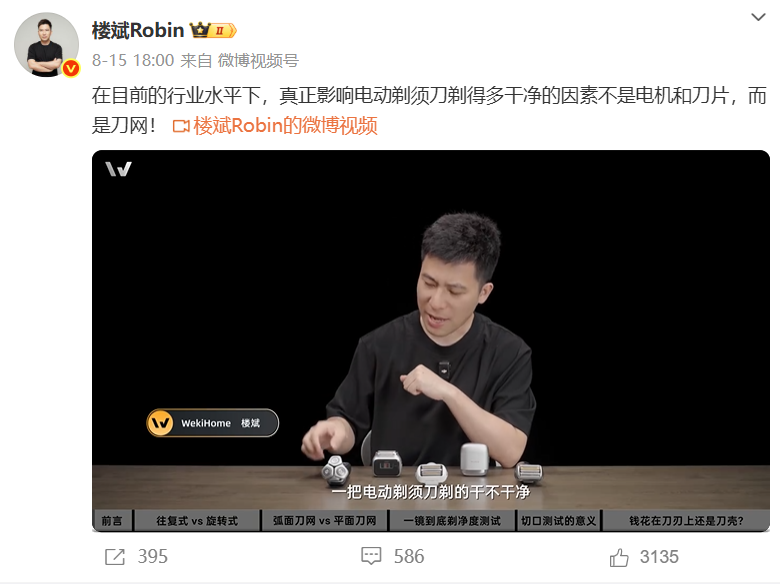
因一个测评视频,CEO亲自下场与前员工隔空论战,品牌曾是“中产平替首选”
2 1 Shi Ji Jing Ji Bao Dao· 2025-08-22 14:10
Core Viewpoint - The recent controversy surrounding electric shavers has highlighted competitive pressures in the small appliance industry, particularly for the brand Leifen, as its CEO publicly challenged a product review that favored a competitor's product over Leifen's [1][2][5]. Group 1: Company Response - Leifen's CEO, Ye Hongxin, directly responded to a review video that claimed a competitor's shaver was superior, indicating potential bias from the reviewer [2][5]. - Ye accused the reviewer, Lou Bin, of being influenced by personal connections to a former Leifen employee, suggesting a conflict of interest [5]. - The public dispute concluded with Ye stating that he would move on from the controversy, indicating a desire to refocus on broader business goals [5]. Group 2: Market Context - Leifen's electric shaver is a new product line, launched in May 2023, and is not the company's core offering, which has historically been high-speed hair dryers [8]. - The brand has previously positioned itself as a cost-effective alternative to high-end products, but the recent review challenges this positioning [8][9]. - The market for high-speed hair dryers has become saturated, with increased competition from brands like Xiaomi and Panasonic, which has pressured Leifen's market share [9][12]. Group 3: Industry Trends - The electric shaver market is experiencing significant growth, with retail sales expected to increase by 10.5% year-on-year by mid-2025, driven by trends towards portability and premium product offerings [11]. - The average price of electric shavers has risen by 23.7%, indicating a shift towards higher-end products in the market [11]. - Despite the potential for growth, Leifen faces challenges in transitioning from hair dryers to shavers due to differing consumer demographics and product requirements [12]. Group 4: Strategic Considerations - Leifen's strategy to expand into new product categories is seen as essential for growth amid increasing competition in its traditional markets [10]. - The company has invested significantly in the development of its shaver line, indicating a commitment to innovation and market penetration [13]. - To succeed in the electric shaver market, Leifen must leverage its strengths in cost control and product performance while addressing the unique demands of male consumers [13].

倍轻松(688793):Q2盈利水平下滑,期待“产品+服务”新业态加速发展
GOLDEN SUN SECURITIES· 2025-08-22 13:12
Investment Rating - The report maintains a "Buy" rating for the company [3][6] Core Views - The company reported a significant decline in revenue and net profit for the first half of 2025, with revenue at 380 million yuan, down 36.2% year-on-year, and a net loss of 40 million yuan, down 238.2% year-on-year [1] - The gross margin improved slightly, attributed to a higher proportion of high-margin service business and new product launches, with gross margins at 62.6% for H1 2025 and 64.1% for Q2 2025 [2] - The company is accelerating the development of a new business model combining "technology products + effective massage" in its stores, transitioning from solely selling products to offering services as well [2] Financial Performance Summary - For H1 2025, the company experienced a net profit margin of -9.4% and -18.2% for Q2 2025, reflecting a significant decline in profitability [2] - The company expects a gradual recovery in net profit, forecasting net profits of 5 million yuan in 2025, 22 million yuan in 2026, and 44 million yuan in 2027, with year-on-year growth rates of -51%, +347.8%, and +94.5% respectively [3] - The financial projections indicate a revenue of 1.089 billion yuan for 2025, with a slight increase from the previous year [5]

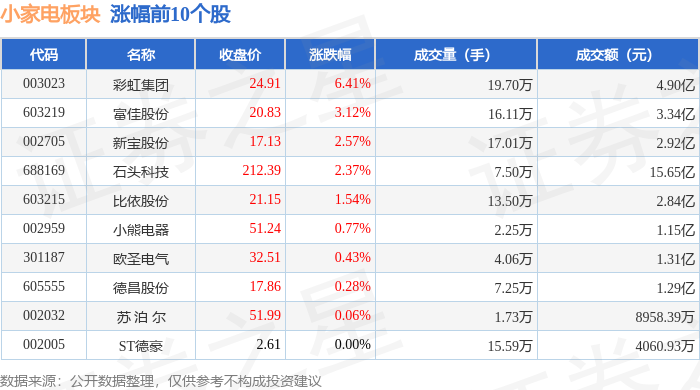
小家电板块8月22日涨0.62%,彩虹集团领涨,主力资金净流入866.86万元
Zheng Xing Xing Ye Ri Bao· 2025-08-22 08:39
| 代码 | 名称 | 收盘价 | 涨跌幅 | 成交量(手) | 成交额(元) | | --- | --- | --- | --- | --- | --- | | 603355 | 莱克电气 | 24.40 | -1.33% | 2.95万 | 7212.60万 | | 688793 | 倍轻松 | 34.50 | -1.32% | 2.32万 | 7976.75万 | | 870199 | 倍詰康 | 42.59 | -1.00% | 2.21万 | 9406.10万 | | 870726 | 湾智科技 | 17.59 | -0.90% | 1.21万 | 2135.79万 | | 301332 | 德尔玛 | 11.15 | -0.89% | 4.84万 | 5389.81万 | | 002403 | 爰仕达 | 15.66 | -0.82% | 14.91万 | 2.33亿 | | 002242 | 九阳股份 | 10.31 | -0.77% | 5.91万 | 6083.71万 | | 603486 | 科沃斯 | 66'06 | -0.49% | 6.12万 | 5.54亿 | | 300272 | ...

欧圣电气(301187):2025年中报点评:关税带来短期影响,养老产品入选工信部试点
Guoxin Securities· 2025-08-22 07:40
Investment Rating - The investment rating for the company is "Outperform the Market" [4][26]. Core Views - The company experienced a revenue decline in Q2 due to tariff impacts, with Q2 revenue at 350 million, down 14.6% year-on-year. However, H1 revenue was 878 million, up 18.9% year-on-year. The net profit for H1 was 115 million, up 18.5% year-on-year, while Q2 net profit was 54 million, down 1.4% year-on-year. The inventory at the end of Q2 was 368 million, a 91% increase year-on-year [1][2]. - The company's profitability improved in Q2, with a gross margin of 38.33%, an increase of 4.99 percentage points, attributed to changes in product and channel structure. The Malaysian factory is ramping up production, with a designed output value of 2 billion, which is expected to stabilize gross margins despite tariff challenges [1][2]. - The company’s subsidiary, Illinois, has a nursing robot project that was selected for a pilot program by the Ministry of Industry and Information Technology and the Ministry of Civil Affairs, which may enhance the company's growth in the elderly care sector [2]. Financial Summary - The company forecasts revenue growth from 1,216 million in 2023 to 3,941 million in 2027, with annual growth rates of -5.3%, 45.0%, 41.0%, 29.6%, and 22.2% respectively. Net profit is expected to grow from 175 million in 2023 to 549 million in 2027, with growth rates of 8.4%, 44.9%, 29.7%, 31.5%, and 27.1% respectively [3][24]. - The projected earnings per share (EPS) are expected to increase from 0.96 in 2023 to 2.15 in 2027, with corresponding price-to-earnings (PE) ratios of 33.8, 23.3, 25.2, 19.2, and 15.1 [3][24].
倍轻松(688793):25Q2业绩转负,“轻松一刻”门店有望带来增量
Shenwan Hongyuan Securities· 2025-08-22 06:42
Investment Rating - The report maintains an "Outperform" investment rating for the company [2][7]. Core Views - The company's performance in H1 2025 was below expectations, with total revenue of 385 million yuan, a year-on-year decline of 36%, and a net profit attributable to shareholders of -36 million yuan, indicating a negative turnaround [7]. - The decline in performance is attributed to a drop in online revenue and decreased foot traffic in offline stores, coupled with high fixed costs [7]. - The company is diversifying its sales channels, with the "Light and Easy Moment" brand expected to contribute incremental growth, and is actively expanding into overseas markets [7]. - The gross margin improved to 64.09% in Q2 2025, up by 3.17 percentage points year-on-year, primarily due to the higher margin from "Light and Easy Moment" stores [7]. - The report slightly lowers the profit forecast for 2025-2027 but maintains a positive outlook with projected net profits of 49 million, 78 million, and 93 million yuan for 2025, 2026, and 2027 respectively, reflecting year-on-year growth rates of 374%, 60%, and 20% [7]. Financial Data and Earnings Forecast - Total revenue for 2025 is estimated at 984 million yuan, with a year-on-year decline of 9.3% [6]. - The net profit for 2025 is projected to be 49 million yuan, a significant recovery from the previous year's loss [6]. - The earnings per share (EPS) for 2025 is expected to be 0.57 yuan, with a projected price-to-earnings (P/E) ratio of 62 [6]. - The company’s gross margin is forecasted to improve gradually, reaching 64.4% by 2027 [6].
欧圣电气(301187):2025年中报点评:关税带来短期影响,养老产品入选工信部点
Guoxin Securities· 2025-08-22 05:37
Investment Rating - The investment rating for the company is "Outperform the Market" [4][26]. Core Views - The company experienced a revenue decline in Q2 due to tariff impacts, but it is expected to return to growth once the tariff policies stabilize. The revenue for H1 2025 was 878 million, up 18.9% year-on-year, while Q2 revenue was 350 million, down 14.6% year-on-year [1][2]. - The company's profitability improved in Q2, with a gross margin of 38.33%, an increase of 4.99 percentage points, attributed to changes in product and channel structure [1][2]. - The company’s subsidiary has been selected for a pilot project by the Ministry of Industry and Information Technology and the Ministry of Civil Affairs, focusing on a nursing robot for the elderly, which is expected to enhance the company's growth in the elderly care sector [2]. Financial Summary - The company forecasts a net profit of 329 million for 2025, representing a year-on-year growth of 29.7%, with projected profits of 432 million in 2026 and 549 million in 2027 [3][24]. - The revenue projections for the company are 2.488 billion in 2025, 3.226 billion in 2026, and 3.941 billion in 2027, with growth rates of 41.0%, 29.6%, and 22.2% respectively [3][24]. - The company maintains a strong financial position with a projected return on equity (ROE) of 21.1% in 2025, increasing to 32.2% by 2027 [3][24].
JS环球生活(01691)下跌5.33%,报2.13元/股
Jin Rong Jie· 2025-08-22 02:44
Group 1 - JS Global Life's stock price dropped by 5.33% to 2.13 HKD per share, with a trading volume of 22.03 million HKD as of 10:14 on August 22 [1] - The company reported a revenue of 574 million USD from its ongoing operations in the first half of 2023 [1] - JS Global Life is included in several indices such as the Hang Seng Composite Index, MSCI Hong Kong Small Cap Index, Hang Seng ESG 50 Index, and Hang Seng Sustainable Development Enterprises Index [1] Group 2 - For the fiscal year ending 2024, JS Global Life's total revenue was 11.455 billion HKD, with a net profit of 44.6328 million HKD [2] - The company is set to disclose its mid-year report for the fiscal year 2025 on August 29 [3]
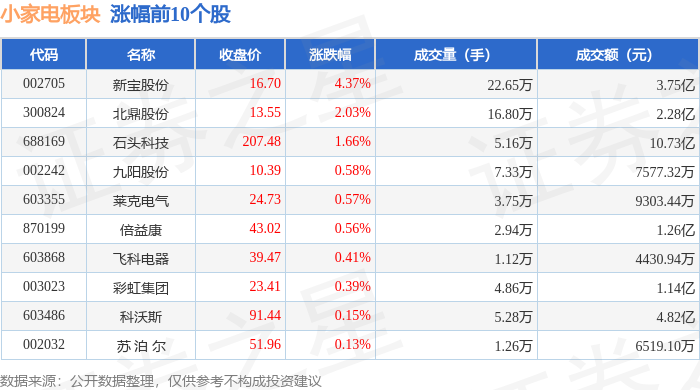
小家电板块8月21日涨0.34%,新宝股份领涨,主力资金净流出1.18亿元
Zheng Xing Xing Ye Ri Bao· 2025-08-21 08:30
证券之星消息,8月21日小家电板块较上一交易日上涨0.34%,新宝股份领涨。当日上证指数报收于 3771.1,上涨0.13%。深证成指报收于11919.76,下跌0.06%。小家电板块个股涨跌见下表: | 代码 | 名称 | 主力净流入(元) | 主力净占比 游资净流入(元) | | 游资净占比 散户净流入 (元) | | 散户净占比 | | --- | --- | --- | --- | --- | --- | --- | --- | | 002705 | 新宝股份 | 1704.48万 | 4.54% | 1516.74万 | 4.04% | -3221.21万 | -8.59% | | 688169 | 石头科技 | 1394.33万 | 1.30% | -1041.41万 | -0.97% | -352.92万 | -0.33% | | 300824 北鼎股份 | | 1303.71万 | 5.72% | 1004.91万 | 4.41% | -2308.63万 | -10.12% | | 603355 | 莱克电气 | 661.88万 | 7.11% | 363.24万 | 3.90% | -102 ...