智能汽车

Search documents
车主酒后用辅助驾驶睡20多分钟被拘役,华为高管:说明我们的系统非常好
Qi Lu Wan Bao· 2025-09-30 03:28
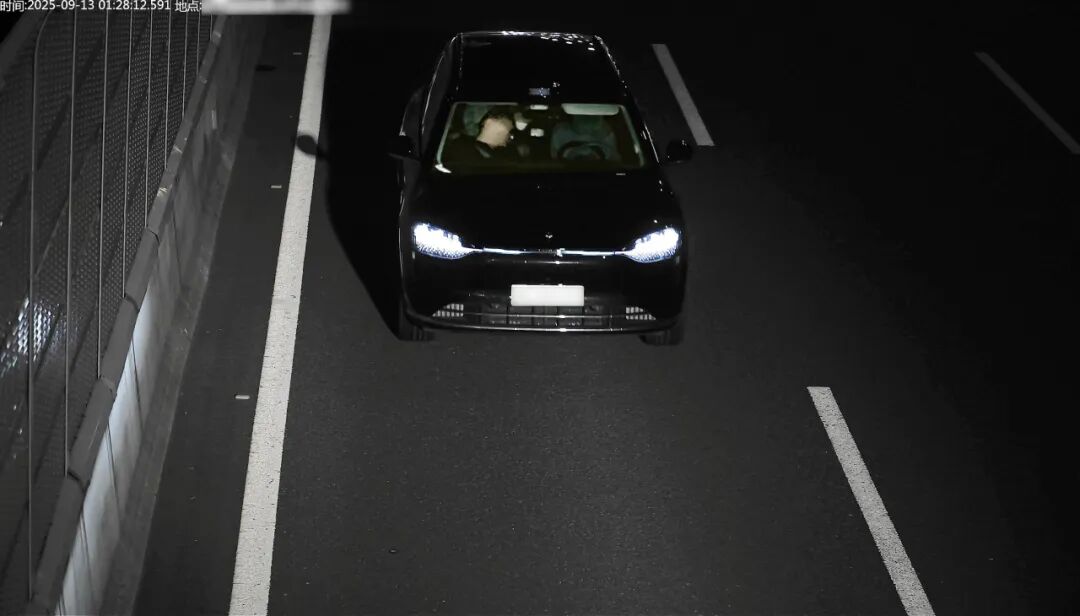
Core Viewpoint - The incident involving a user misusing Huawei's assisted driving system highlights both the effectiveness of the technology and the urgent need for responsible usage, especially regarding alcohol consumption while driving [1][2]. Group 1: Incident Overview - On September 13, a driver in Hangzhou used Huawei's assisted driving system while intoxicated, resulting in the vehicle driving for over 20 minutes without anyone in the driver's seat before stopping [3][5]. - The driver, identified as Wang, was found to have a blood alcohol content of 114.5 mg/100ml and was subsequently charged with dangerous driving, leading to a sentence of 1.5 months in detention and a fine of 4000 yuan [5][6]. Group 2: Legal and Safety Implications - This case marks the first instance of dangerous driving involving an intelligent assisted driving system in the region, emphasizing that the driver remains legally responsible even when using such technology [6][9]. - Legal experts assert that the use of assisted driving systems does not transfer responsibility from the driver, and intoxicated driving still constitutes a violation of the law [8][9]. Group 3: Technology and Industry Impact - The incident raises concerns about the misuse of devices like the so-called "smart driving gadgets" that deceive vehicle monitoring systems, potentially compromising safety and data integrity [7][9]. - Industry professionals warn that such modifications not only endanger individual safety but also hinder the overall development and reliability of assisted driving technologies [7][8].

115亿!赛力斯向华为支付完毕购买引望股权的全部对价
Xin Lang Cai Jing· 2025-09-30 02:07
Core Viewpoint - The company, Seres, announced the acquisition of a 10% stake in Shenzhen Yingwang Intelligent Technology Co., Ltd. from Huawei for a total of 11.5 billion yuan, solidifying their partnership in the smart automotive sector [1][4]. Group 1: Transaction Details - Seres' wholly-owned subsidiary, Seres Automotive, will pay a total of 11.5 billion yuan for the 10% stake in Yingwang [1]. - The payment for the acquisition is structured in three phases, with the third payment condition met, and a total of 34.5 billion yuan already paid [1]. - The first payment was 2.3 billion yuan, and the second was 5.75 billion yuan, with the transfer of shares expected to be completed by March 31, 2025 [1]. Group 2: Company Background and Performance - Yingwang was established in January 2024 with a registered capital of 1 billion yuan, aiming to become a diversified platform for automotive electrification and intelligence [2]. - Seres has reported a revenue of 62.402 billion yuan for the first half of 2025, a decrease of 4.06% year-on-year, while net profit increased by 81.03% to 2.941 billion yuan [4]. - The company sold approximately 172,100 new energy vehicles in the first half of 2025, with the Wanjie series accounting for over 80% of deliveries [4]. Group 3: Market Reaction - On September 30, Seres' stock opened higher, with an increase of 3.81%, reaching 165.26 yuan per share, resulting in a market capitalization of 269.9 billion yuan [5].

青春力量传递中非友好
Ren Min Ri Bao Hai Wai Ban· 2025-09-30 00:53
Core Insights - The event "The 9th China-Africa Youth Gala" showcased China's advancements in smart manufacturing and clean energy to African youth representatives, emphasizing the importance of cultural exchange and collaboration between China and Africa [1][3]. Group 1: Smart Manufacturing - The Xiaomi automobile factory in Beijing, covering an area of 718,000 square meters, features high levels of automation with minimal human labor, showcasing advanced technologies such as robotic arms and automated guided vehicles [2]. - Visitors were impressed by the clean and quiet environment of the factory, highlighting the innovative production processes that transform raw materials into vehicles in a short time [2]. - The exhibition area displayed 1:1 replicas of core components and models, demonstrating Xiaomi's capabilities in automotive manufacturing, with particular praise for the smart cockpit features [2]. Group 2: Clean Energy - The visit to the solar power facility in Qinghai allowed African representatives to observe China's innovations in clean energy, with hopes of applying similar practices in their home countries [3]. - The discussions emphasized the potential for ecological and industrial synergy, reflecting a shared vision for sustainable development between China and Africa [3]. - The event served as a platform for cultural dialogue, fostering cooperation and friendship among the youth from both regions, aiming for a more inclusive and sustainable world [3].

四维图新 2.5 亿入股鉴智,后者管理层暂不调整
晚点LatePost· 2025-09-30 00:30
Core Viewpoint - The article discusses the strategic investment by Siwei Tuxin in Jianzhihui, aiming to enhance their capabilities in intelligent driving solutions through a merger that will create "New Jianzhihui" [5][9]. Group 1: Investment and Merger Details - Siwei Tuxin announced a cash investment of 250 million yuan and the transfer of 100% equity of Siwei Tuxin Zhijia (Beijing) Technology Co., Ltd. to Jianzhihui, resulting in Siwei Tuxin holding 39.14% of Jianzhihui's shares, making it the largest shareholder but not the controlling shareholder [5]. - The merger will integrate the intelligent driving teams and business of both companies, with the combined workforce expected to reach around 1,000 employees [5][8]. - The product offerings of "New Jianzhihui" will be expanded to include intelligent driving solutions based on Horizon J6 series and Qualcomm series chips [5][6]. Group 2: Business Transformation and Market Position - Siwei Tuxin, established in the early 2000s, has transitioned from being a leading automotive map supplier to focusing on intelligent driving, high-precision maps, and vehicle networking, forming four business segments: Zhiyun, Zhichuang, Zhixin, and Zhijia [7][8]. - The company has faced challenges in its transformation, with its revenue heavily reliant on the map products segment, which accounted for 70% of total revenue, while the intelligent driving and cockpit segments combined only contributed 11% [8]. - The competitive landscape for intelligent driving suppliers is becoming increasingly concentrated, with established players rapidly capturing market share, leaving limited opportunities for new entrants like Siwei Tuxin [8][9]. Group 3: Strategic Collaboration and Future Outlook - The collaboration with Jianzhihui is seen as a way to leverage existing resources and accelerate transformation, as Jianzhihui has developed mid-tier intelligent driving solutions based on Horizon J6E chips [9]. - The intelligent driving industry is evolving towards cost optimization and standardized technology routes, with Siwei Tuxin's long-standing customer relationships and investments being crucial for its continued presence in the market [9].

赛力斯推出中期分红预案拟10派3.1元受让引望10%股权全部款项已支付完毕
Xin Lang Cai Jing· 2025-09-29 21:05
Core Viewpoint - The company aims to enhance its dividend levels and frequency to better reward investors and improve their sense of gain, as evidenced by its profit distribution plan for the first half of 2025 [1] Financial Performance - For the first half of 2025, the company reported operating revenue of 62.402 billion yuan, which remained essentially flat year-on-year [1] - The net profit attributable to shareholders reached 2.941 billion yuan, marking a significant increase of 81.03% year-on-year [1] - The net profit after deducting non-recurring items was 2.474 billion yuan, reflecting a growth of 72.14% [1] - Earnings per share stood at 1.87 yuan [1] Corporate Actions - The company will hold its second extraordinary general meeting of shareholders on October 15 to review the proposed profit distribution plan [1] - Additionally, the company disclosed progress on a major asset acquisition, indicating that its wholly-owned subsidiary has completed the payment of 3.45 billion yuan for the third tranche of the transfer of a 10% stake in Shenzhen Yingwang Intelligent Technology Co., Ltd. from Huawei Technologies Co., Ltd. [1]
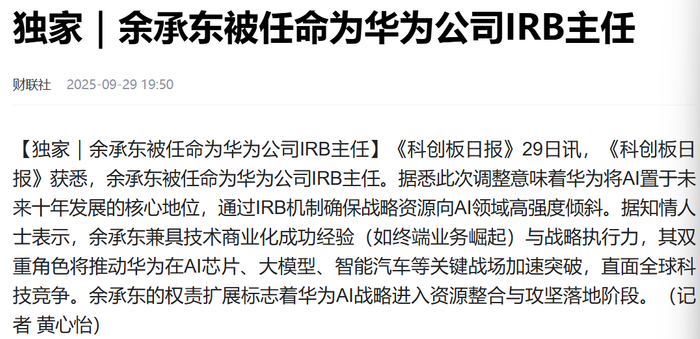
突发!余承东重大任命!
Xin Lang Cai Jing· 2025-09-29 19:14
Core Viewpoint - Huawei has appointed Yu Chengdong as the head of the Investment Review Board (IRB), a move seen as a strategic push to strengthen its artificial intelligence (AI) initiatives and focus on core business breakthroughs [1][3]. Group 1: Appointment and Responsibilities - Yu Chengdong will continue as Huawei's Executive Director and Chairman of the Terminal Business Group (BG), while also leading the IRB, which is crucial for evaluating resource allocation for major strategic directions [1][3]. - The IRB is responsible for key decisions regarding resource investment, project approvals, and budget management, ensuring that resources are effectively aligned with Huawei's strategic goals [3]. Group 2: Strategic Focus on AI - The primary mission for Yu Chengdong as IRB head is to lead Huawei in winning the "key battle" in AI, indicating that AI will be central to the company's development over the next decade [3]. - The IRB mechanism will ensure a significant allocation of strategic resources towards AI, including AI chips, large models, and smart vehicles, as Huawei aims to enhance its global competitiveness in technology [3][5]. Group 3: Background and Achievements - Yu Chengdong has a long history with Huawei, starting as a technician in 1993 and later transforming the terminal business into a leading global player, achieving the highest domestic sales and second globally in smartphones [6]. - Under his leadership, Huawei has also entered the automotive market, with significant sales figures reported for its smart vehicle offerings, indicating a successful expansion into AI-related sectors [6].
四维图新 2.5 亿入股鉴智,后者管理层暂不调整
晚点Auto· 2025-09-29 16:00
Core Viewpoint - Four-dimensional Map New (四维图新) is investing in JianZhi Robotics (鉴智机器人) through a cash increase of 250 million yuan and acquiring 100% equity of JianZhi, becoming its largest shareholder with a 39.14% stake, but not a controlling shareholder [4][5][6] Group 1: Investment and Business Integration - The integration of Four-dimensional Map New's intelligent driving business with JianZhi will create a new entity called "New JianZhi," which will enhance product offerings and combine resources from both companies [4][5] - The new entity will have a workforce of around 1,000 employees, combining teams from both companies [4][6] Group 2: Product Development and Market Position - "New JianZhi" will offer a comprehensive product line covering the Horizon J6 series and Qualcomm chip-based solutions, enhancing its competitive edge in the intelligent driving market [5][6] - Four-dimensional Map New has previously launched low-level intelligent driving solutions based on the Horizon J6B chip, while JianZhi has developed mid-level solutions based on the J6E/M chips, with high-level solutions based on J6P awaiting mass production [5][6] Group 3: Industry Context and Challenges - Four-dimensional Map New has faced intense competition in the automotive navigation sector, leading to a strategic pivot towards high-precision maps, autonomous driving, and vehicle networking [6][7] - The company aims to transform into a Tier 1 supplier for intelligent driving, but faces challenges due to increasing competition and a market that is rapidly consolidating around established players [6][7] - As of 2023, Four-dimensional Map New's revenue from its intelligent driving and cockpit segments remains low, with the mapping segment still accounting for 70% of total revenue [7]
10万亿智能汽车的未来,被千里科技用 AI 画出来了
Tai Mei Ti A P P· 2025-09-29 12:58
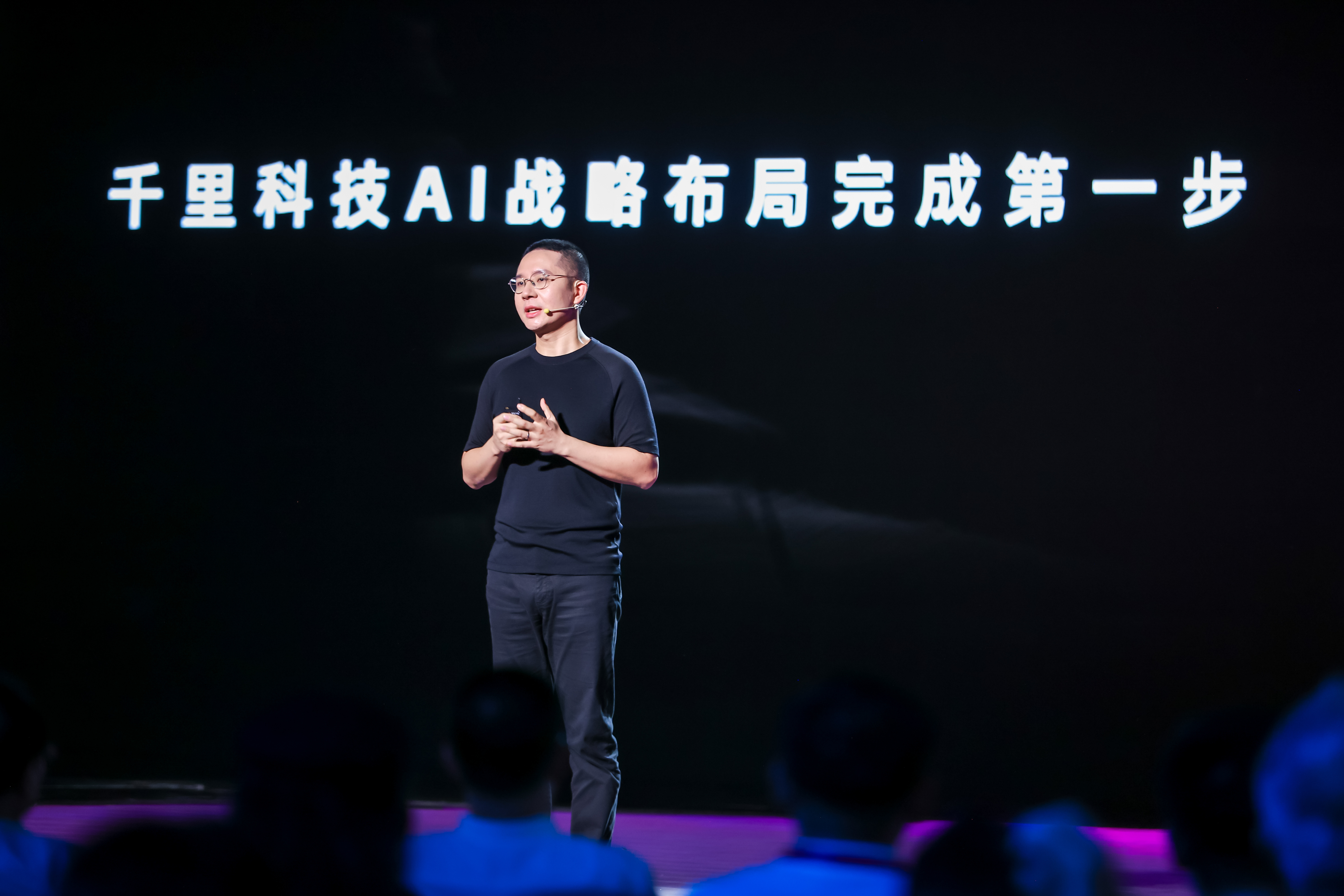
Core Insights - The article highlights the rapid integration of generative AI into the automotive industry, with over 50 domestic car brands equipping more than 130 models with AI large models by mid-2025, achieving an installation rate of nearly 16% [4] - The global smart connected vehicle market is projected to reach $1.5 trillion (approximately 10.6 trillion RMB) by 2025, with expectations to grow to $6.7 trillion by 2032 [5] - Qianli Technology announced its strategic focus on "AI + Car," aiming to develop intelligent driving, smart cockpit, and smart mobility solutions, transitioning from L2+ to L4 level intelligent vehicles [5][10] Company Strategy - Qianli Technology's chairman emphasized that future vehicles will evolve into intelligent robotic carriers, marking the beginning of a significant transformation in the automotive industry [10] - The company reported a revenue of 4.184 billion RMB in the first half of 2025, a year-on-year increase of 40.04%, driven by strong sales in its automotive and motorcycle segments [11] - Qianli Technology plans to launch its first public offering of H-shares on the Hong Kong Stock Exchange [12] Product Development - Qianli Technology introduced the "Qianli Intelligent Driving 1.0" platform, which includes various configurations to meet different vehicle needs, with the flagship version offering up to 700 TOPS of computing power [14] - The company aims to release the L3 level intelligent driving solution, "Qianli Intelligent Driving 2.0," by the end of this year, redefining the standards for intelligent driving technology [14] - Qianli Technology is developing a universal AI intelligent driving solution that does not rely on high-precision maps, enabling seamless driving in complex environments [17] Market Trends - The penetration rate of new passenger cars equipped with combined driving assistance systems in China reached 62.6% in the first seven months of 2025, an increase of 40 percentage points compared to the same period in 2021 [29] - The article suggests that the next three years will be crucial for the development of autonomous driving technologies, with significant changes expected in the industry landscape [29] - By 2028, the overall scale of the "AI + Car" market is expected to exceed 21.2 million units [32]

吉利李书福谈投资千里科技:与“聪明人”印奇“相见恨晚、一拍即合”
Zhong Guo Jing Ying Bao· 2025-09-29 05:46
Group 1 - The core viewpoint of the article emphasizes the importance of AI in transforming the automotive industry, with a focus on collaboration and innovation to enhance safety and efficiency [2][3]. - Geely Holding Group's chairman, Li Shufu, highlighted the significance of finding intelligent leaders like Qian Li Technology's chairman, Yin Qi, to drive the company's mission towards a broader future [2]. - The event marked the launch of Qian Li Technology's "AI +" blueprint, known as the "Afari Plan," which signifies the company's commitment to intelligent and international development [3]. Group 2 - Li Shufu pointed out the necessity for traditional automotive companies to integrate AI technology to achieve significant advancements, suggesting a future where vehicles seamlessly connect with low-altitude flying and watercraft [2]. - Qian Li Technology aims to capitalize on the upcoming three-year period for the popularization of Robotaxi, planning to complete a full-chain layout within 18 months, including L4 autonomous driving development and collaboration with Geely [3]. - The company targets to deploy over 1,000 Robotaxis in each of the ten global cities as part of its operational strategy [3].
华为车BU靳玉志:L3级自动驾驶将在2027年规模放量
Ju Chao Zi Xun· 2025-09-29 02:59
Core Insights - The automotive industry is undergoing three phases: electrification (2015-2022), intelligence (2022-2027), and automation (from 2027) [2] - Huawei's intelligent driving solution, QianKun, has been integrated into 28 vehicle models from various manufacturers, with a cumulative installation exceeding 1 million units [2] Phase Development - The electrification phase laid the foundation for the automotive industry by reducing travel costs through the gradual replacement of fuel with electricity [2] - The intelligence phase will see algorithms replacing drivers, significantly enhancing safety and user experience [2] - The automation phase will redefine safety and experience standards, with Level 3 (L3) autonomous driving expected to scale by 2027 [2] Technological Advancements - Huawei's QianKun Intelligent Driving ADS 4 system was launched, featuring four versions, including the flagship ADS Ultra, which supports L3 conditional autonomous driving [3] - The ADS 4 system utilizes a WEWA architecture, enhancing the system's ability to handle extreme road conditions and improving efficiency by 20% [3] Safety and Performance Metrics - The HUAWEI XMC digital chassis engine introduces a centralized control architecture, improving vehicle safety and stability [4] - As of July 31, 2025, QianKun has achieved 4.05 billion kilometers of assisted driving and avoided 2.54 million potential collisions [4] Market Expansion - Huawei's technology is not only widely adopted by domestic brands but is also making inroads into joint venture brands, exemplified by the launch of the SAIC Audi A5L Sportback [4] - The recognition from international automotive brands signifies Huawei's technical strength and lays the groundwork for the global development of intelligent vehicles [4] Future Outlook - Huawei's continuous innovation in the intelligent automotive sector is expected to enhance safety, convenience, and efficiency for consumers [5] - The company aims to lead the wave of intelligent automotive development and contribute significantly to the global automotive industry's progress [5]