
玩具

Search documents
异动盘点1015|老铺黄金涨超5%,泡泡玛特涨超3%;特斯拉跌超1%,沃尔玛涨近5%
贝塔投资智库· 2025-10-15 04:26
Group 1: Hong Kong Stocks - Lao Pu Gold (06181) rose over 5%, with Morgan Stanley reaffirming an "overweight" rating due to clear brand value enhancement trends [1] - Pop Mart (09992) increased over 3%, as Apple CEO received a special gift, and Labubu is expected to become a world-class cultural IP brand [1] - Jitu Express-W (01519) rose over 3%, reporting strong growth in parcel volume in Southeast Asia and new markets for Q3 2025 [1] - Guoquan (02517) surged over 10%, with improved restaurant sentiment and expectations for Q4 store openings [1] - Geely Automobile (00175) increased over 4%, with Geely Holding Group's quarterly sales surpassing 1 million units for the first time [1] - Rongchang Bio (09995) rose over 3%, as the application for the marketing of Tai Tasi Pi for IgA nephropathy treatment was accepted and prioritized for review [1] - Mixue Group (02097) rose over 6%, with Mixue Ice City beer trending on Weibo, and institutions optimistic about the company's brand expansion [1] - Jinli Permanent Magnet (06680) fell over 1%, despite a projected net profit increase of over 157% for the first three quarters [1] - Bilibili-W (09626) rose over 3%, officially launching a "Double 11" promotion and achieving deep data integration with Alibaba and JD [1] Group 2: US Stocks - Navitas Semiconductor (NVTS.US) surged 26.08%, with advancements in 800VDC GaN and SiC power devices [3] - Ericsson (ERIC.US) rose 20.56%, reporting a net profit of 11.15 billion SEK for Q3, nearly doubling year-on-year and exceeding analyst expectations [3] - Tesla (TSLA.US) fell 1.53%, as the NHTSA announced an investigation into approximately 2.88 million Tesla vehicles equipped with "full self-driving" systems [3] - PayPal (PYPL.US) rose 0.42%, but Goldman Sachs downgraded its rating to "sell" due to margin pressures and a slowing growth path for 2026 [3] - BP (BP.US) fell 1.75%, with expectations of increased profitability driven by upstream production growth and refining margins [3] - Intel (INTC.US) dropped 4.27%, as Bank of America downgraded its rating from "neutral" to "underperform," maintaining the target price at $34 [3] - Target (TGT.US) rose 1.85%, with D.A. Davidson lowering the target price from $115 to $108 while reiterating a "buy" rating [4] - Albertsons (ACI.US) surged 13.63%, reporting Q2 FY2025 revenue of $18.9158 billion and adjusted EPS of $0.44, exceeding expectations [4] - Arm (ARM.US) fell 2.20%, as OpenAI announced a strategic partnership with Broadcom to develop custom AI chips and network systems [4] - Walmart (WMT.US) rose 4.98%, collaborating with OpenAI to allow consumers to browse and purchase Walmart products directly through ChatGPT [4]




通许县序鹏玩具有限公司成立 注册资本10万人民币
Sou Hu Cai Jing· 2025-10-15 03:25
天眼查App显示,近日,通许县序鹏玩具有限公司成立,法定代表人为杨斌,注册资本10万人民币,经 营范围为一般项目:玩具销售;木制玩具销售;玩具、动漫及游艺用品销售;日用杂品销售;宠物食品 及用品批发;文具用品批发;互联网销售(除销售需要许可的商品);教学用模型及教具销售;纸制品 销售;办公用品销售;文具用品零售(除依法须经批准的项目外,凭营业执照依法自主开展经营活 动)。 ...
资金动向 | 北水大举猛抛芯片股,连续7日加仓小米!
Ge Long Hui· 2025-10-14 12:08
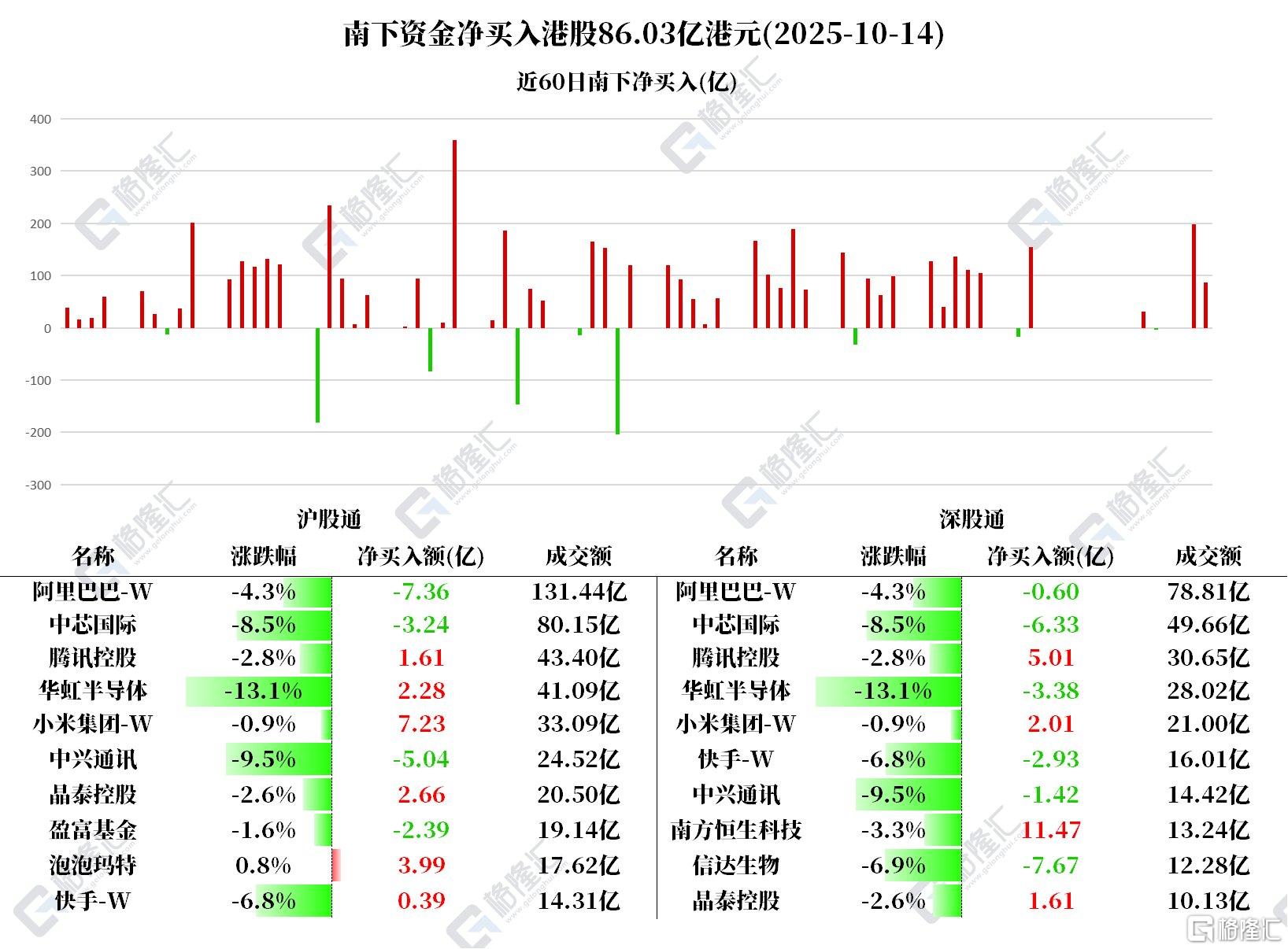
Group 1: Market Activity - Southbound funds net bought Hong Kong stocks worth 8.603 billion HKD on October 14, with notable purchases in Southern Hang Seng Technology (1.147 billion HKD), Xiaomi Group-W (0.923 billion HKD), Tencent Holdings (0.662 billion HKD), and others [1] - Continuous net buying of Xiaomi for 7 days, totaling 5.63234 billion HKD [4] - Continuous reduction in holdings of SMIC and Alibaba for 4 days, amounting to 6.58659 billion HKD and 4.97935 billion HKD respectively [5] Group 2: Company Performance and Predictions - Tencent Holdings is expected to report stable performance for Q3 on November 13, with projected revenue and profit growth of 13.5%, 20.9%, and 16.9% year-on-year, driven by strong gaming performance and AI-driven advertising technology [5] - Crystal Technology is recognized as a pioneer in the frontier technology sector, with projected revenues of 0.781 billion, 1.093 billion, and 1.496 billion CNY from 2025 to 2027, indicating significant growth potential [6] - Alibaba's capital expenditure forecast for FY2026-28 has been significantly raised to 460 billion CNY, with expectations of AI cloud computing breakthroughs and international expansion contributing to stock price growth [7] Group 3: Sector Insights - The Chinese government's export controls on rare earth elements are seen as beneficial for local semiconductor companies, including SMIC, as they push for domestic alternatives [7] - The impact of tariffs on Chinese innovative pharmaceutical companies is expected to be limited, with a focus on licensing and overseas company setups to navigate international markets [8]
浙江义乌第六代市场亮相 港澳商人争相“探市”
Zhong Guo Xin Wen Wang· 2025-10-14 11:19
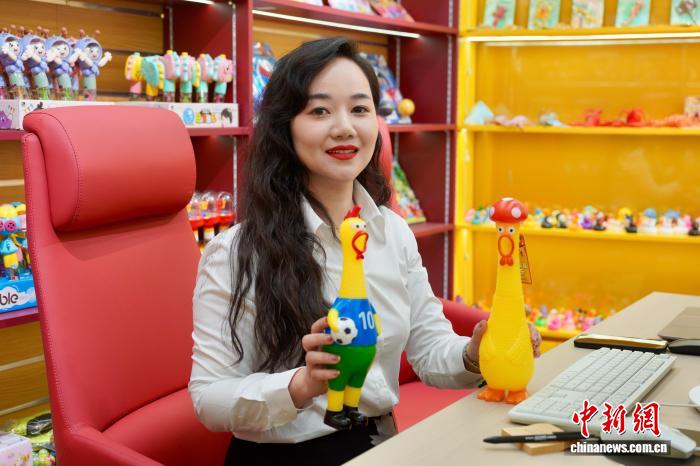
浙江义乌第六代市场亮相 港澳商人争相"探市" "从今年年初开始,很多客户和朋友就不断打听项目情况、行业分布、投资利好等信息。这些年,义乌 给了港澳商人很大的发展空间,当好推荐官是发自内心的事情。"吴国术说。 据悉,义乌港澳总商会自2021年成立以来,已组织多场经贸对接、青年交流活动。今年7月,该商会与 义乌官方联合举办港澳青年商贸实训班,吸引一批香港高学历人才参与。 10月14日,义乌港澳总商会监事、玩具行业从业者周玲玲展示店内热销产品。董易鑫 摄 "全球数贸中心不仅是义乌的新地标,也为港澳企业对接国际市场提供了更广阔的舞台。"义乌港澳总商 会会长、香港国际玩具科技有限公司董事长洪俊伟表示,包括他在内,不少港澳商人已签约入驻,还有 香港商人专程来义乌,只为第一时间"探市"。 "我们看中的是义乌市场的创新速度,更是它连接世界的能力。"洪俊伟说。 中新社义乌10月14日电 (董易鑫)浙江义乌第六代市场标志性项目全球数贸中心10月14日正式开业。 "前几天,我用AI(人工智能)辅助拍摄了多语种介绍新店的短视频,不少外籍合作商看到后都预约来店 看样,从今天开始就陆续抵达。"义乌港澳总商会监事、玩具行业从业者周玲玲说, ...
北水动向|北水成交净买入86.03亿 北水继续抛售芯片股 逢低抢筹小米(01810)超9亿港元
智通财经网· 2025-10-14 09:57
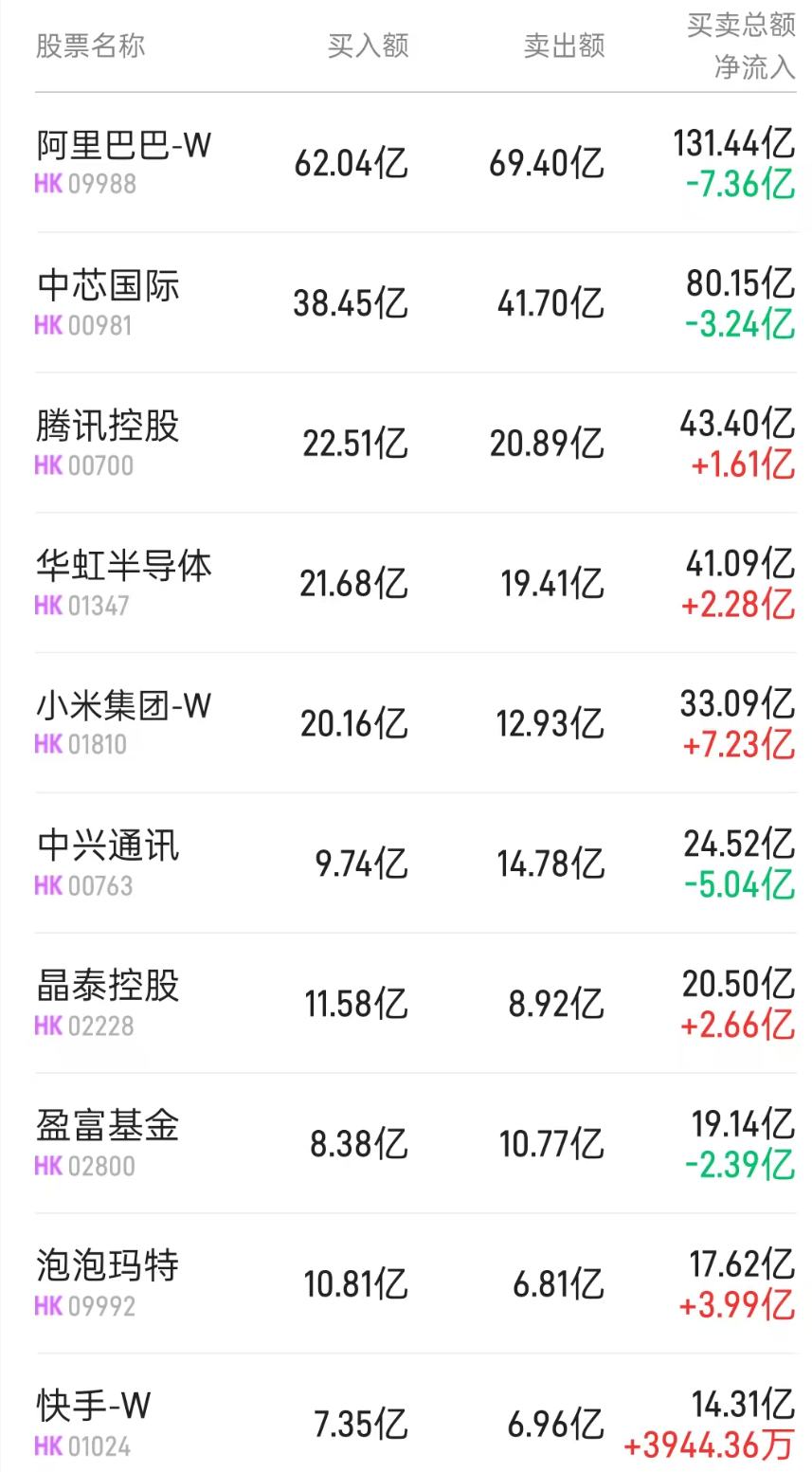
Summary of Key Points Core Viewpoint - The Hong Kong stock market experienced significant net inflows from northbound trading, with a total net buy of 86.03 billion HKD on October 14, 2023, indicating strong investor interest in certain stocks while others faced selling pressure [1]. Group 1: Stock Performance - The top net bought stocks included Southern Hang Seng Technology (03033), Xiaomi Group-W (01810), and Tencent (00700) [1]. - The most sold stocks were Semiconductor Manufacturing International Corporation (00981), Alibaba Group-W (09988), and Innovent Biologics (01347) [1]. - Alibaba Group-W had a net outflow of 7.36 billion HKD, while Semiconductor Manufacturing International Corporation saw a net outflow of 3.24 billion HKD [2]. Group 2: Trading Activity - Northbound trading through the Shanghai Stock Connect accounted for a net buy of 49.73 billion HKD, while the Shenzhen Stock Connect recorded a net buy of 36.31 billion HKD [1]. - Notable net inflows included 11.47 billion HKD for Southern Hang Seng Technology and 6.62 billion HKD for Tencent, while Alibaba faced a net sell of 7.95 billion HKD [4]. Group 3: Company-Specific News - Xiaomi Group-W faced scrutiny after a fire incident involving its vehicle, leading to a net buy of 9.23 billion HKD, while the company also repurchased 400 million shares for 1.97 billion HKD [5]. - Crystal Technology Holdings (02228) received a net buy of 4.26 billion HKD, with analysts highlighting its potential in robotics and AI pharmaceuticals [5]. - Semiconductor stocks, including Hua Hong Semiconductor (01347) and Semiconductor Manufacturing International Corporation (00981), faced significant selling pressure, with net outflows of 1.1 billion HKD and 9.57 billion HKD, respectively [6][8].




火山泉水、大马士革玫瑰……全球品牌备战中国双11
Yang Zi Wan Bao Wang· 2025-10-14 05:18
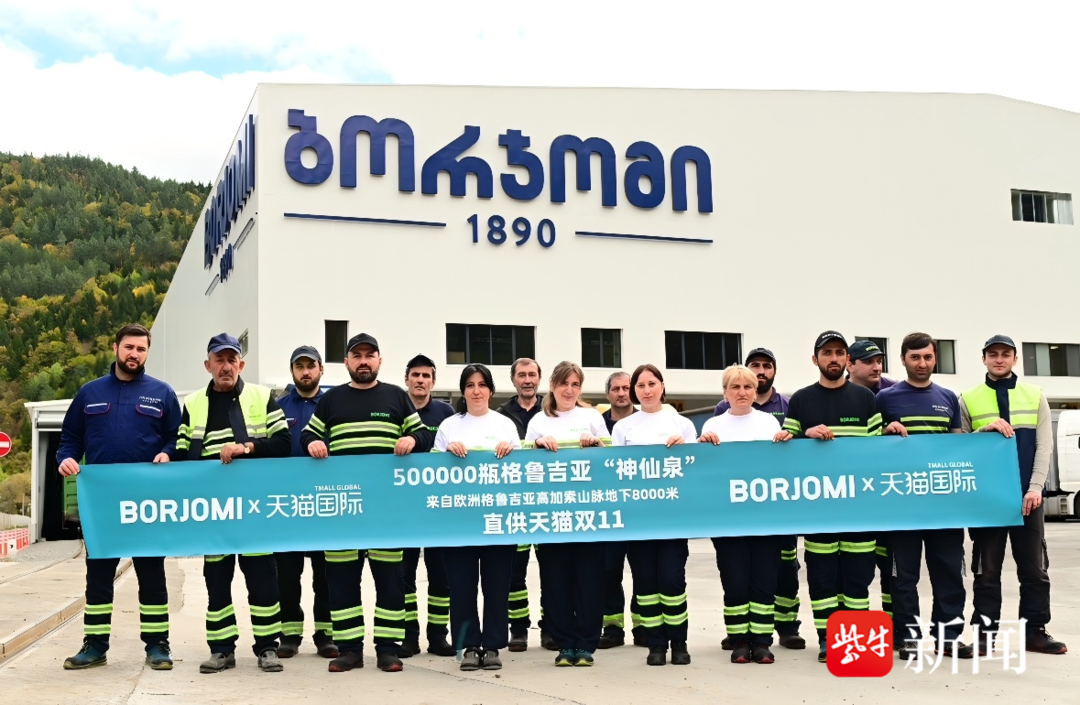
Group 1 - The upcoming Double 11 shopping festival has prompted global brands to ramp up their preparations and production to meet increased demand from Chinese consumers [1][3][5] - Borjomi, a mineral water brand from Georgia, is participating in Double 11 for the first time, hiring over 50 temporary workers to produce and package 500,000 bottles of water within two weeks [3][5] - In Bulgaria, the Lema family has prepared 300,000 kilograms of rose raw materials for Double 11, requiring the harvesting of over 10 million Damascus roses [3][5] Group 2 - Clearwater, a seafood company in Canada, has processed Arctic clams within 45 minutes of being caught, with 300,000 bags prepared for Double 11 [5][7] - Happy Village, an organic agriculture project in Turkey, has coordinated over 3,000 farmers to produce fresh figs, ensuring timely delivery to China despite logistical challenges [5][7] - Tmall International reports that nearly 200 million overseas imported products are ready in bonded warehouses, with over 50,000 brands from more than 110 countries participating in the event [9]
大行评级丨建银国际:预计关税对纺织品、家电及IP玩具影响有限 纯内需消费股具备估值支持
Ge Long Hui· 2025-10-14 03:07
Core Viewpoint - The report from Jianyin International indicates that President Trump's announcement of an additional 100% tariff on Chinese imports is expected to have limited impact on textiles, home appliances, and IP toys, while domestic consumption stocks are supported by valuation [1] Group 1: Impact of Tariffs - The newly announced tariff policy is anticipated to affect market sentiment but to a lesser extent compared to April [1] - The impact on pure domestic stocks is expected to be limited, with valuation support for companies in this category [1] Group 2: Beneficiaries - Companies such as Anta Sports, Li Ning, Jiangnan Buyi, Nongfu Spring, Master Kong, Mixue Group, China Resources Beer, Mengniu, and Yili are likely to benefit from the current market conditions [1] Group 3: Economic Outlook - The potential slowdown of the U.S. economy remains a primary downside risk, although the likelihood of this occurring is currently considered low [1]
布鲁可现涨超5% 公司发布多款全新品类系列 花旗看好目标客群扩大
Zhi Tong Cai Jing· 2025-10-14 02:36
Core Viewpoint - The company Brikoo (00325) has launched new product lines at the WF2025 exhibition, showcasing its commitment to a diverse product ecosystem and global strategy [1] Group 1: Product Launch and Strategy - Brikoo's new product categories include "Building Cars" and "Building Figures," with three new series: "Natural Collection," "Miracle Q Version," and "Encounter Version," along with over 40 new building figures catering to various consumer needs [1] - The launch reflects Brikoo's strategy of "full demographics, full price range, and globalization," aiming to meet the demands of different players worldwide [1] Group 2: Market Reaction and Analyst Insights - The stock price of Brikoo increased by over 5%, reaching 102.5 HKD, with a trading volume of 83.96 million HKD [1] - Citigroup has initiated a positive catalyst observation for Brikoo, setting a target price of 128 HKD and rating it as "Buy," indicating confidence in the company's expanding target customer base [1] - The expectation is that Brikoo will introduce more new products at the upcoming 2025 China Toy Expo [1]
港股异动 | 布鲁可(00325)现涨超5% 公司发布多款全新品类系列 花旗看好目标客群扩大
智通财经网· 2025-10-14 02:33
Core Viewpoint - The company Brikoo (00325) is experiencing a positive market response following the launch of new product lines at the WF2025 exhibition, indicating a strong commitment to expanding its product ecosystem and global reach [1] Group 1: Product Launch and Strategy - Brikoo has introduced three new product series: "Natural Collection," "Miracle Q Version," and "Encounter Version," along with over 40 new figurines catering to various consumer needs and price points [1] - The launch of these products reflects Brikoo's strategy of "full demographic, full price range, and globalization," aimed at meeting the diverse demands of global consumers [1] Group 2: Market Performance and Analyst Outlook - The stock price of Brikoo rose over 5%, reaching 102.5 HKD, with a trading volume of 83.96 million HKD [1] - Citigroup has initiated a positive catalyst observation for Brikoo, setting a target price of 128 HKD and rating the stock as "Buy," citing the expansion of the target customer base due to the new product launches [1] - The expectation is that Brikoo will unveil more new products at the upcoming 2025 China Toy Expo [1]
港股异动 | 泡泡玛特(09992)早盘涨超5% 苹果CEO库克现身上海泡泡玛特 大摩称公司受关税影响低
Zhi Tong Cai Jing· 2025-10-14 01:52
Core Viewpoint - Pop Mart (09992) experienced a significant increase of over 5% in early trading, attributed to the presence of Apple CEO Tim Cook at the company's exhibition in Shanghai and a favorable report from Morgan Stanley regarding the company's exposure to tariffs [1] Group 1: Company Performance - Pop Mart's stock rose by 4.6%, reaching 273 HKD, with a trading volume of 1.343 billion HKD [1] - The presence of Tim Cook at the Pop Mart exhibition is seen as a positive endorsement for the company [1] Group 2: Market Analysis - Morgan Stanley's report indicates that Pop Mart is expected to be minimally affected by tariffs, maintaining an "overweight" rating [1] - The report highlights that approximately 75% to 80% of toy imports to the U.S. come from China, suggesting that even with higher tariffs, Pop Mart's competitive advantage remains intact [1]