消费

Search documents
这轮牛市跟哪一轮比较像?|投资小知识
银行螺丝钉· 2025-08-24 13:53
Core Viewpoint - The article discusses the cyclical nature of the A-share market, highlighting the similarities and differences between past market conditions (2013-2017) and the current situation (2023-2024), emphasizing the importance of fundamental recovery for future market performance [2][6][9]. Group 1: Market Trends and Historical Context - In 2015, the A-share market experienced a significant rise due to loose control over leveraged investments, with the index soaring from around 2000 points to over 8000 points, followed by a sharp decline in the second half of the year [2]. - The period from 2016 to 2017 saw a recovery in the fundamentals of A-share listed companies, leading to a slow bull market for value stocks, which outperformed after a period of underperformance [3][4]. - The market dynamics from 2013 to 2017 included phases where large-cap, small-cap, growth, and value stocks all had their moments, but many investors suffered losses due to chasing trends [5]. Group 2: Current Market Conditions and Future Outlook - The current market environment in 2023-2024 is characterized by low fundamentals and declining corporate profits, similar to the conditions seen in 2015-2016 [6][9]. - With the Federal Reserve's first interest rate cut in September 2024, and corresponding domestic policies, the market is expected to see an initial rise, particularly in sectors like securities and insurance [8]. - By 2025, growth sectors such as small-cap, technology, and pharmaceuticals are anticipated to lead the market, while value and consumer sectors may remain subdued [8]. - The potential for a market uptrend hinges on the recovery of corporate fundamentals, with historical precedents suggesting that economic recovery can lead to significant market rallies [9].


牛市的规律与洼地
Tianfeng Securities· 2025-08-24 10:44
Group 1: Market Insights - The report analyzes the current valuation distribution of the A-share market compared to previous bull markets, indicating that during bull markets, the market acts as a "voting machine" while in bear markets, it functions as a "weighing machine" [1][11][12] - The valuation dispersion coefficient for the entire A-share market is currently at 0.805, which is above the historical median of 0.794, suggesting a general upward trend in the market [12][14] - The report identifies a continuous decline in the proportion of undervalued stocks since September 2024, with the P/B distribution curve shifting downwards over time [33][34] Group 2: Domestic Economic Indicators - In July, fiscal revenue showed a year-on-year increase, with tax revenue rising by 5%, marking a new high for the year, while non-tax revenue continued to decline [43][44] - The report notes a slight cooling in land transactions, with government land use rights revenue dropping to 7.16% year-on-year in July [50][51] - Industrial production indices have shown signs of recovery, particularly in sectors like soda ash and polyester filament, indicating a rebound in industrial activity [57][58] Group 3: International Economic Context - The report highlights that market expectations for interest rate cuts have increased following comments from Federal Reserve Chair Powell, with a 75% probability of a 25 basis point cut by September 2025 [4][61] - Ongoing geopolitical tensions, including developments in the Russia-Ukraine conflict and Middle East tensions, are monitored as they may impact market conditions [4][61][62] Group 4: Industry Allocation Recommendations - The report suggests focusing on three main investment themes: breakthroughs in AI technology, recovery in consumer stock valuations, and the rise of undervalued dividend stocks [5][37] - It emphasizes the importance of the AI industry’s progress, which is crucial for the performance of undervalued dividend stocks [5][37]
Is the Vanguard Mega Cap ETF the Simplest Way to Invest in the Top S&P 500 Stocks?
The Motley Fool· 2025-08-23 20:05
Core Viewpoint - The Vanguard Mega Cap ETF offers a low-cost investment option for those looking to gain exposure to large-cap stocks, potentially outperforming traditional S&P 500 ETFs due to its concentrated holdings in mega-cap companies [1][13]. Cost Comparison - The Vanguard Mega Cap ETF has an expense ratio of 0.07%, slightly higher than the 0.03% of the Vanguard S&P 500 ETF, resulting in a $4 difference for every $10,000 invested [2]. Holdings Concentration - The Vanguard Mega Cap ETF holds 185 stocks, significantly fewer than the 504 stocks in the Vanguard S&P 500 ETF, indicating a higher concentration in its top holdings [5][8]. - The top 20 holdings in the Vanguard Mega Cap ETF account for 57.2% of the fund, compared to 48.3% for the S&P 500 ETF [7]. Performance Metrics - The Mega Cap ETF has achieved a total return of 308.1% over the last decade, outperforming the S&P 500 ETF's 284.2% total return [10]. Sector Focus - The Mega Cap ETF is more growth-oriented, with significant weightings in technology and consumer discretionary sectors, where major companies like Nvidia, Microsoft, and Amazon dominate [9][10]. Investment Strategy - The Vanguard Mega Cap ETF is suitable for investors seeking low-cost, diversified exposure to the largest U.S. companies, and can be effectively paired with smaller-cap individual stocks for enhanced diversification [11][12].

港股,最新调整!
券商中国· 2025-08-23 15:21
Core Viewpoint - The Hong Kong stock market is undergoing significant adjustments with the inclusion of new companies in major indices, reflecting a positive outlook from various financial institutions towards the market's future performance [2][4][14]. Index Adjustments - The Hang Seng Index will increase its constituent stocks from 85 to 88, adding China Telecom, JD Logistics, and Pop Mart [2][4]. - The Hang Seng China Enterprises Index will include Pop Mart while removing Jitu Express, maintaining a total of 50 stocks [8]. - The Hang Seng Biotechnology Index will see a reduction in constituent stocks from 50 to 30, with several companies being removed [8]. - The Hang Seng Composite Index will add 24 new stocks, increasing its total from 502 to 504, while removing 22 stocks [8]. - The Hang Seng Sustainable Development Enterprises Index will maintain 30 stocks after adding three new companies and removing three others [8][9]. Market Performance - On August 22, major Hong Kong indices experienced a collective rise, with the Hang Seng Index up by 0.93% and the Hang Seng Technology Index soaring by 2.71% [12]. - Specific sectors such as semiconductor chips, media entertainment, and telecommunications equipment showed significant gains, with notable increases in stocks like Hua Hong Semiconductor and SMIC [12]. Future Outlook - Analysts from Guoyuan Hong Kong express optimism about the market's structural rally, supported by increased southbound capital inflows and potential domestic demand recovery [13]. - According to招商证券, the overall earnings outlook for Hong Kong stocks is positive, with a high earnings forecast rate, particularly for "new economy" sectors [13]. - Franklin Templeton, a U.S. fund management company, highlights the attractiveness of the Hong Kong stock market due to its reasonable valuations and improved earnings predictability [14][15]. - The average price-to-earnings ratio for Hong Kong stocks is approximately 10.8 times, slightly above the 10-year average of 10.4 times, indicating potential investment opportunities compared to higher valuations in U.S. indices [15].

[8月22日]指数估值数据(大盘回到4.3星,部分品种摸到高估;有一笔资金,该如何投资呢;抽奖福利)
银行螺丝钉· 2025-08-22 13:55
Core Viewpoint - The article discusses the current state of the A-share market, highlighting the recent upward trend and the potential investment strategies for different market conditions. Market Performance - The overall market has risen, returning to a rating of 4.3 stars [1] - Large, medium, and small-cap stocks have all increased, with large-cap stocks showing slightly more growth [2] - Growth style stocks are currently performing strongly [3] - The Science and Technology Innovation Board (科创50) has risen over 8%, while the ChiNext (创业板) has increased over 3% [4] - Both the Science and Technology Innovation Board and ChiNext were undervalued for a long time last year [5] - Since reaching a rating of 5.9 stars, the Science and Technology Innovation Board has nearly doubled in value [6] - Following today's surge, the Science and Technology Innovation Board is now considered overvalued [7] - Upcoming second-quarter reports may lead to a decrease in valuations if companies report profit growth [8] - As the market rises, the number of overvalued stocks is expected to increase [9] - There will be opportunities for profit-taking in certain portfolio segments as the market evolves [10] Investment Strategy - The A-share market often experiences structural trends [11] - This year has seen significant increases in small-cap and growth style stocks, with small-cap growth indices reaching overvalued levels first [12] - While growth styles are strong, value styles remain relatively weak, with only slight increases in value stocks today [13][14] - The A-share market exhibits clear style rotation, often on a daily basis [15] - Frequent trading in this environment can lead to missed opportunities, suggesting a need for patience [16] Hong Kong Market Insights - The Hong Kong stock market has also risen, led by technology stocks [17] - Recently, the Hong Kong market has outperformed the A-share market by over 10% this year [18] - However, recent fluctuations in overseas markets have affected the Hong Kong market, which has seen lower gains compared to A-shares this week [19][20] Valuation Overview - A summary of Hong Kong stock indices and their valuations is provided, including metrics such as P/E ratios, dividend yields, and ROE percentages [21] - The H-share index has a P/E ratio of 13.85, while the Hang Seng Index has a P/E ratio of 13.57 [21] - The Hong Kong small-cap index has a higher P/E ratio of 21.30, indicating a different valuation landscape [21] Investment Timing and Strategy - The article suggests that the best investment opportunities were during the 5-star rating periods, particularly from 2022 to 2024, which marked the longest bear market in the last decade [24] - Investors are advised to consider their investment horizon and risk tolerance when allocating funds, with a recommended stock allocation of "100 minus age" [26] - Current market conditions still present opportunities for investing in undervalued stocks, but full allocation is not recommended [34] - If the market rating drops to 3 stars, investing in stocks may become less suitable [36] Conclusion - The article emphasizes the importance of understanding market cycles and maintaining a disciplined investment strategy to navigate the current market conditions effectively [45]
国投证券策略首席林荣雄:年内A/H股轮动上涨,港股科技会跟上来
Di Yi Cai Jing Zi Xun· 2025-08-22 11:49
Core Viewpoint - The current market conditions suggest that a liquidity-driven bull market is forming, with the potential for further support from fundamental improvements and sector rotations [4][5]. Group 1: Market Dynamics - The Shanghai Composite Index has recently surpassed the 3800-point mark, indicating strong market performance and raising questions about the onset of a bull market [4]. - The driving forces behind the current market rally include significant inflows from various investor types, including public funds, foreign capital, and retail investors, driven by a favorable external environment and improved risk appetite [4][5]. - The market is characterized by a three-pronged bull market approach: liquidity-driven, fundamental-driven, and the transition between old and new economic drivers [5][6]. Group 2: Sector Focus - The third quarter is expected to be pivotal for the ChiNext Index and technology sectors, which are anticipated to lead the market's performance [6]. - There is a potential for traditional consumer sectors to experience a resurgence, although they are currently viewed as lagging behind in the market cycle [10]. - A rotation between A-shares and H-shares is anticipated, with Hong Kong technology stocks expected to see a rebound in performance [11].

港股,重大调整
Zheng Quan Shi Bao· 2025-08-22 11:41
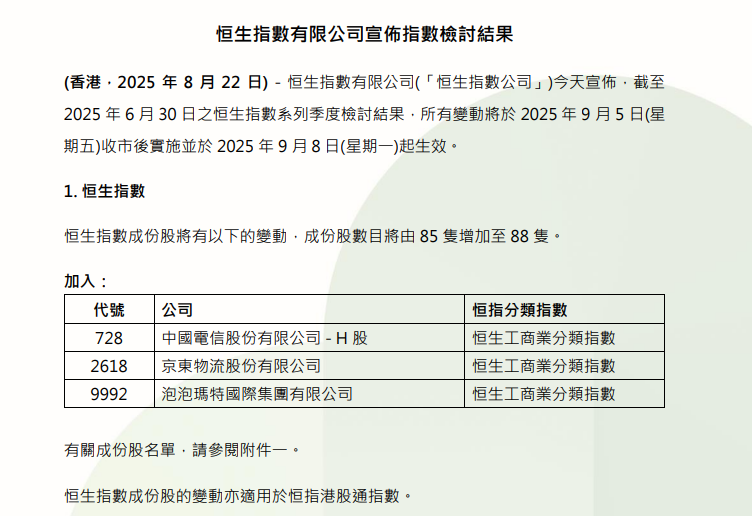
Group 1 - The Hang Seng Index will increase its constituent stocks from 85 to 88, adding China Telecom, JD Logistics, and Pop Mart [5][3] - The Hang Seng Composite Index will also expand from 502 to 504 constituent stocks [2] - The changes will take effect after the market closes on September 5, 2025, and will be implemented on September 8, 2025 [9][3] Group 2 - The Hang Seng China Enterprises Index will maintain 50 constituent stocks, adding Pop Mart and removing J&T Express [8] - The Hang Seng Biotechnology Index will decrease from 50 to 30 constituent stocks, adding InnoCare Pharma and removing 21 stocks including Hutchison China MediTech [8] - The Hang Seng Composite Index will see an addition of 24 stocks including China Foods, Hengrui Medicine, and Boleton, while 22 stocks will be removed [8] Group 3 - The Hong Kong stock market has shown relatively weak performance compared to the A-share market, with the Hang Seng Index rising by 0.27% this week [11] - Notable stock performance includes Anta Sports rising by 11.53% and several other stocks increasing over 5%, while some stocks like China Resources Power and Zijin Mining fell over 5% [11] - Southbound Stock Connect funds have shown strong interest in Hong Kong stocks, with net purchases exceeding HKD 50 billion on August 22, and cumulative net purchases of approximately HKD 900 billion in August [12]
国投证券策略首席林荣雄:年内A/H股轮动上涨,港股科技会跟上来
第一财经· 2025-08-22 10:25
Core Viewpoint - The current market is experiencing a liquidity-driven bull market, with the Shanghai Composite Index breaking through the 3800-point mark, indicating potential for further growth if supported by fundamental improvements [6][11]. Group 1: Market Dynamics - The bull market is primarily driven by liquidity, with banks playing a crucial role in the first half of the year, transitioning to a broader market participation in the second half [6][7]. - There is a notable shift in risk appetite across various investor types, including public funds, foreign capital, and retail investors, contributing to a synchronized inflow of funds [6][8]. - The market is expected to see a rotation between A-shares and H-shares, with Hong Kong technology stocks likely to experience a rebound [11]. Group 2: Investment Focus - The third quarter is critical for the performance of the ChiNext Index and technology sectors based on industrial logic, which are seen as key indicators for market direction [7][11]. - The market is undergoing a process of eliminating undervalued stocks as new capital flows in, indicating a structural change in the bull market compared to previous cycles [7][8]. Group 3: Risks and Opportunities - Potential risks include uncertainties in the U.S. economy, which could impact global equity markets and the fundamental logic of the Chinese market [8][9]. - Traditional consumer sectors may lag behind in performance, but there is potential for a rotation and rebound as liquidity expands [10][11].

济安金信点名嘉实两基金:绿色主题、文体娱乐遭“不予评价”
Sou Hu Cai Jing· 2025-08-22 10:11
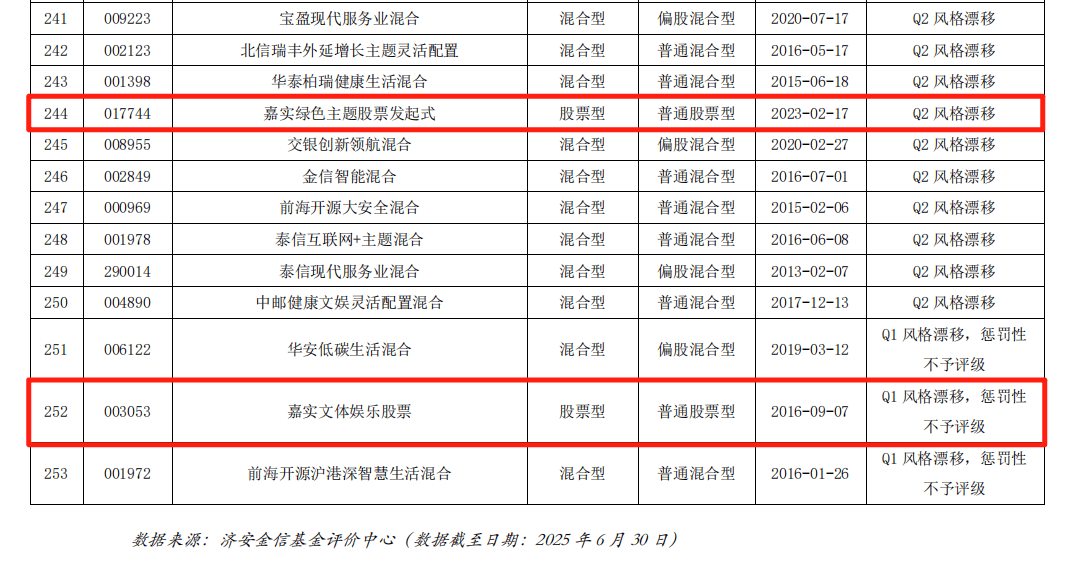
Core Viewpoint - The article highlights the performance issues of two funds under the Jiashi brand, specifically Jiashi Green Theme Stock A and Jiashi Cultural and Entertainment Stock A, which have been flagged for "style drift" and "punitive non-rating" due to significant deviations from their benchmarks in the second quarter [1][3][7]. Fund Performance - Jiashi Green Theme Stock A reported a net value growth rate of -1.11% in Q2, lagging its benchmark by 2.72 percentage points, resulting in a loss of 485,000 yuan for A shares and 4.77 million yuan for C shares [3]. - Jiashi Cultural and Entertainment Stock A achieved a net value growth rate of 8.94% in Q1, outperforming its benchmark by 3.87 percentage points, but its sector allocation showed a heavy concentration in technology, with 46.55% in information transmission and software services, while only 13.21% in cultural and entertainment sectors [5][11]. Investment Strategy - Jiashi Green Theme Stock A's strategy focuses on the semiconductor industry, with increased concentration in stocks like 澜起科技 and 思特威, leading to a significant style drift as it became heavily weighted in high-beta technology stocks [3][5]. - Jiashi Cultural and Entertainment Stock A's portfolio reflects a dual focus on technology and entertainment, with top holdings in semiconductor and media stocks, indicating a shift away from its stated theme [5][7]. Market Context - The overall market for active equity funds has shown a strong recovery, with over 98% of funds reporting positive returns year-to-date as of August 21, 2023, highlighting a broad market uptrend [1][8]. - Jiashi New Consumption Stock A, another fund, has underperformed with a return of -2.87%, indicating challenges in the consumer sector despite a general market rebound [8][11].
港股科技板块回暖,恒生科技ETF易方达(513010)、港股通互联网ETF(513040)等产品近日连获净流入
Mei Ri Jing Ji Xin Wen· 2025-08-22 05:16
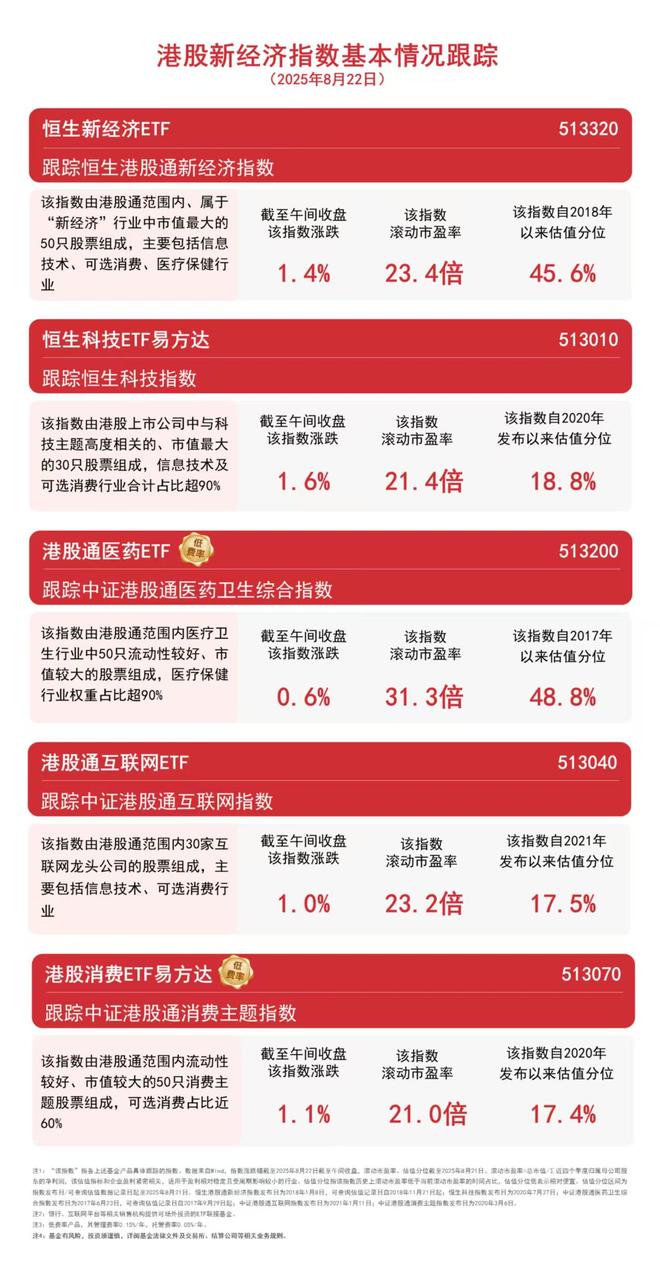
Group 1 - The Hang Seng Technology Index rose by 1.6%, while the Hang Seng Hong Kong Stock Connect New Economy Index increased by 1.4% as of midday close [1] - The CSI Hong Kong Stock Connect Consumer Theme Index and the CSI Hong Kong Stock Connect Internet Index saw gains of 1.1% and 1.0% respectively, with the CSI Hong Kong Stock Connect Pharmaceutical and Health Comprehensive Index up by 0.6% [1] - Recent data from Wind indicates that the Hong Kong Stock Connect Internet ETF (513040) and the Hang Seng Technology ETF (513010) attracted net inflows of 950 million yuan and 2.39 billion yuan over the past month [1] Group 2 - The Hong Kong Stock Connect Consumer ETF (513070) tracks the CSI Hong Kong Stock Connect Consumer Theme Index, which consists of 50 large-cap consumer stocks with nearly 60% in discretionary consumption [4] - The rolling price-to-earnings ratio of this index is 21.0 times, with a valuation percentile of 17.4% since its inception in 2020 [4]