种业

Search documents
我国“十四五”种业振兴行动阶段性任务顺利完成
Yang Shi Xin Wen· 2025-11-15 00:21
Core Insights - The core viewpoint of the article emphasizes the significant advancements in China's seed industry during the "14th Five-Year Plan" period, highlighting the successful completion of key tasks in the seed revitalization initiative [1] Group 1: Agricultural Resource Management - China has conducted the largest and most comprehensive national agricultural germplasm resource survey since its founding, establishing a solid foundation of resources and creating three national germplasm banks for crops, livestock, and marine fisheries, with total resource preservation ranking first in the world [1] - The self-breeding varieties of crops account for over 95%, while domestic seed sources for livestock and aquatic products have market shares exceeding 80% and 85%, respectively, ensuring overall agricultural seed safety and manageable risks [1] Group 2: Technological Innovation - The seed industry has entered the world's top tier in technological innovation, with the development of significant new varieties such as high-resistance wheat to Fusarium head blight, rice resistant to rice planthoppers, and high-yield soybeans tolerant to herbicides [1] Group 3: Seed Supply Capacity - The seed supply capacity has significantly improved, with the national seed supply guarantee rate reaching 80%, an increase of 10 percentage points compared to 2020, supported by key breeding bases in Gansu, Sichuan, Heilongjiang, and Hainan [1]
中金 | 深度布局“十五五”:农业农村现代化篇
中金点睛· 2025-11-15 00:07
Core Viewpoint - The modernization of agriculture is driven by technological advancements and brand enhancement, which are essential for the transformation and upgrading of the modern agricultural industry chain [1]. Group 1: Agricultural Production Capacity Enhancement - The key to enhancing agricultural production capacity lies in agricultural technology modernization, with global food production increasing by 379% from 1961 to 2023, where yield growth contributed 75% [2]. - In China, the single crop yield for corn and soybeans in 2023 was only 59% and 57% of the levels in the United States, indicating significant room for improvement [2][4]. - The strategy of "storing grain in the land and technology" is crucial for ensuring food security, emphasizing the importance of land protection and quality improvement [2]. Group 2: Agricultural Technology Modernization - Agricultural technology modernization is vital for improving comprehensive agricultural production capacity, with a focus on seed technology and equipment technology [6]. - The 2025 Central Document No. 1 emphasizes the need for collaborative efforts in agricultural technology and the development of new agricultural productivity [6]. - The seed industry is experiencing a revival driven by strengthened intellectual property protection and technological advancements, with R&D investment by leading listed seed companies increasing from 40 million to 980 million yuan from 2010 to 2024 [7]. Group 3: Smart Agriculture - The continuous increase in policy support for smart agriculture is expected to drive long-term industry development, with land transfer areas rising from 450 million mu in 2015 to 590 million mu in 2023 [10]. - The penetration rate of smart agriculture in China is approximately 9%, compared to about 60% in Europe and the U.S., indicating significant future growth potential [10]. - The 2025 Central Document No. 1 and various action plans highlight the importance of smart agriculture in modern agricultural development [10]. Group 4: Intelligent Agricultural Equipment - The trend of urbanization has led to a decrease in agricultural labor supply, with the number of agricultural workers dropping from 330 million in 2005 to 160 million in 2023, resulting in rising labor costs [11]. - Technological advancements in intelligent agricultural equipment have improved efficiency across various agricultural operations, marking a turning point for "machine substitution" in agriculture [11][14]. - The cost of intelligent agricultural equipment is gradually decreasing, enhancing the competitiveness of machine-based operations over manual labor [11]. Group 5: Brand Agriculture - The high-quality development of the agricultural industry chain requires collaboration between upstream and downstream sectors, with a focus on enhancing the quality of agricultural products and processed foods [14]. - The development of brand agriculture is crucial for upgrading the overall value chain of agricultural products, with examples from kitchen foods and tea demonstrating successful practices [14][15]. - The kitchen food sector benefits from order agriculture, which ensures standardized and large-scale supply, while brand positioning enhances product value [15][19]. Group 6: Tea Industry - The tea industry faces challenges due to non-standardization and high trust costs, making brand positioning and channel layout critical for success [19]. - High-end brand positioning can effectively reduce consumer recognition difficulties and enhance brand value [19]. - The evolution of offline channels in the tea industry aims to strengthen customer experience and brand trust through differentiated services [19].


前三季度出口增速全省第一 解锁济源外贸背后的服务密码
He Nan Ri Bao· 2025-11-14 23:32
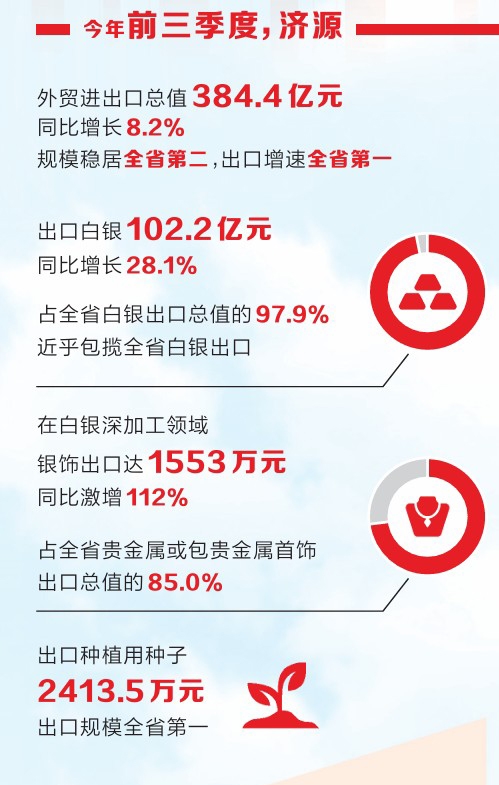
Group 1 - The total import and export value of Jiyuan in the first three quarters reached 38.44 billion yuan, a year-on-year increase of 8.2%, ranking second in the province, with the highest export growth rate in the province [2] - Jiyuan exported silver worth 10.22 billion yuan, a year-on-year increase of 28.1%, accounting for 97.9% of the province's total silver exports [2] - The export of silver jewelry reached 15.53 million yuan, a significant increase of 112% year-on-year, representing 85.0% of the province's total exports of precious metal or semi-precious metal jewelry [2] Group 2 - Jiyuan's export of planting seeds amounted to 2.4135 million yuan, ranking first in the province, with Qingyin Seed Industry becoming a key player in "Jiyuan Good Seeds" [2] - Jiyuan Sunshine Food Co., Ltd. received official registration approval from the EU, achieving a breakthrough in rabbit meat exports to the EU, with an additional export value of 2.51 million yuan this year [2] Group 3 - The impressive foreign trade performance is attributed to Jiyuan's focus on characteristic development and optimized industrial layout, along with the Jiyuan Customs' precise support for local advantageous industries [3] - Jiyuan Customs has implemented customized services for key agricultural industries, reducing average customs clearance time by over 30% and resolving over 20 export-related issues for agricultural enterprises this year [3] - For the silver industry, Jiyuan Customs has tailored solutions to enhance customs efficiency, helping enterprises transition from raw silver to high-end jewelry for international markets [3] Group 4 - The 20th Central Committee of the Communist Party of China emphasized expanding high-level opening-up and creating a new situation of win-win cooperation, which Jiyuan Customs aims to implement by optimizing regulatory services and supporting more "Jiyuan-made" products to enter the global market [4]
国家级种业基地供种保障率达80%
Ren Min Ri Bao Hai Wai Ban· 2025-11-14 22:03
Core Insights - The core viewpoint of the article highlights the significant improvements in China's seed industry over the past five years, particularly in seed source security and self-sufficiency in crop varieties [1] Group 1: Seed Source Security - The national seed supply guarantee rate has reached 80%, an increase of 10 percentage points since 2020 [1] - The domestic self-breeding crop varieties account for over 95%, with domestic seed market shares for livestock and aquatic products exceeding 80% and 85% respectively [1] Group 2: New Varieties Development - A number of urgently needed new varieties have been developed, including disease-resistant wheat and rice, high-yield soybeans, and corn suitable for machine harvesting [1] - The area of self-bred corn varieties has increased from 91% in 2020 to 94% currently, while vegetable varieties have risen from 87% to 91% [1] Group 3: Seed Supply Capacity - The seed supply capacity of national seed bases has significantly strengthened, ensuring that "Chinese grain" primarily uses "Chinese seeds" [1] - National and provincial disaster relief seed reserves have achieved full coverage, with nearly 22 million kilograms of national reserve seeds utilized over the past five years, supporting over 11 million acres of disaster-affected farmland [1]
新华全媒头条|用更多好种子守护美好生活——种业振兴行动五年间
Xin Hua She· 2025-11-14 16:43
Core Insights - The article highlights the significant progress made in China's seed industry over the past five years, emphasizing the importance of self-reliance in seed technology and the cultivation of domestic seed varieties to ensure food security [1][3][7]. Group 1: Seed Industry Development - The proportion of independently bred crop varieties has reached over 95%, with domestic seed sources for livestock and aquaculture exceeding 80% and 85% respectively [1]. - The national seed supply guarantee rate has improved to 80%, an increase of 10 percentage points since 2020, indicating a stronger reliance on domestic seeds for food production [3]. - New varieties such as disease-resistant wheat and high-yield soybeans have been developed, enhancing the overall safety and quality of agricultural seeds in China [3][10]. Group 2: Agricultural Practices and Innovations - Farmers in Jilin province have reported significant yield increases due to the adoption of new dense-planting corn varieties, achieving over 3,000 pounds per hectare [2]. - In Hubei province, local farmers have transitioned from relying on imported cabbage seeds to cultivating multiple domestically bred varieties, resulting in a production area exceeding 110,000 acres and an annual output of around 500,000 tons [5]. - The integration of breeding chips and big data technology has led to the successful development of disease-resistant fish species, showcasing innovation in aquaculture [6]. Group 3: Future Directions and Goals - The "14th Five-Year Plan" emphasizes the need for continued innovation in the seed industry, with a focus on improving the competitiveness of domestic seed varieties and enhancing the overall quality of agricultural products [8][10]. - The goal is to achieve a 60% identification rate of genetic resources by 2030, with current identification at 35%, indicating a need for accelerated efforts in resource management and breeding innovation [9]. - The Ministry of Agriculture aims to strengthen the role of enterprises in seed innovation, promoting collaboration between industry and research institutions to enhance the development of competitive seed varieties [10].
敦煌种业:截至2025年三季度末公司股东总户数为54206户
Zheng Quan Ri Bao· 2025-11-14 13:36
证券日报网讯敦煌种业11月14日在互动平台回答投资者提问时表示,截至2025年三季度末,公司股东总 户数为54,206户。如需查询其他特定时点的股东人数,请向公司提供证明其持股情况的书面文件,公 司经核实股东身份后将予以提供。 (文章来源:证券日报) ...

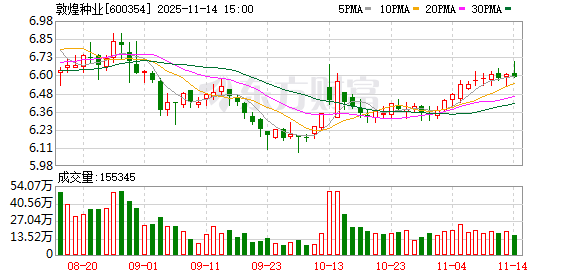
敦煌种业:海南经济特区敦种作物种子研究院有限公司为公司的二级子公司
Zheng Quan Ri Bao· 2025-11-14 13:36
Group 1 - The core viewpoint of the article is that Dunhuang Seed Industry confirmed that its subsidiary, Hainan Economic Special Zone Dunzhong Crop Seed Research Institute Co., Ltd., focuses on the breeding and development of new corn varieties, and that the closure of Hainan will not impact the company's related business [2] Group 2 - The subsidiary is primarily engaged in the research and development of new corn varieties [2] - The company reassured investors that the recent developments in Hainan will not affect its operations [2]
农林牧渔行业双周报(2025/10/31-2025/11/13):加快实现种业科技自立自强-20251114
Dongguan Securities· 2025-11-14 12:31
Investment Rating - The report maintains an "Overweight" rating for the agriculture, forestry, animal husbandry, and fishery industry [48]. Core Viewpoints - The SW agriculture, forestry, animal husbandry, and fishery industry outperformed the CSI 300 index, rising by 4.87% from October 31, 2025, to November 13, 2025, exceeding the index by approximately 5.04 percentage points [11]. - All sub-sectors within the industry recorded positive returns during the same period, with notable increases in agricultural product processing (9.03%), fishery (8.12%), animal health (5.57%), planting (4.57%), breeding (2.94%), and feed (2.45%) [12]. - Over 90% of individual stocks in the industry achieved positive returns, indicating strong overall market performance [13]. - The industry valuation has rebounded, with the overall price-to-book (PB) ratio at approximately 2.94 times as of November 13, 2025, which is still relatively low compared to historical levels [17]. Industry Important Data - **Pig Farming**: The average price of external three yuan pigs decreased from 12.52 CNY/kg to 11.74 CNY/kg during the reporting period. The cost of corn and soybean meal showed fluctuations, with corn priced at 2260.39 CNY/ton and soybean meal at 3072 CNY/ton as of November 13, 2025 [21][23]. - **Profitability**: As of November 14, 2025, self-breeding pig farming reported a loss of 114.81 CNY per head, while purchasing piglets resulted in a loss of 205.64 CNY per head, indicating a decline in profitability [26]. - **Poultry Farming**: The average price of broiler chicks was 3.49 CNY per chick, slightly down from the previous week, while the average price of white feather broilers increased to 7.12 CNY/kg, with a loss of 0.95 CNY per bird [28][31]. Industry Important News - The Ministry of Agriculture and Rural Affairs emphasized accelerating the self-reliance and controllability of seed technology during a recent meeting, highlighting the importance of domestic seed sources and innovation in the seed industry [35]. Company Important News - Key companies to watch include Muyuan Foods (002714), Wens Foodstuff Group (300498), and others, which are positioned to benefit from industry trends and potential recovery in profitability [48][49].


结构工具仍是接下来货币政策发力重点|宏观晚6点
Sou Hu Cai Jing· 2025-11-14 10:21
Group 1 - The core viewpoint is that the decline in investment growth is a result of multiple factors, including both investment主体 factors and structural factors [1] - External environment is complex and severe, leading to cautious investment decisions from market entities due to declining investment returns [1] - The real estate sector has a significant share in overall investment, and its adjustment has a noticeable downward effect on investment growth [1] Group 2 - From January to October, national fixed asset investment decreased by 1.7% year-on-year, with the decline expanding by 1.2 percentage points compared to January to September [2] - Infrastructure investment saw a year-on-year decline of 0.1%, a drop from a 1.1% increase in the previous period [2] - Real estate development investment fell by 14.7% year-on-year, with the decline widening by 0.8 percentage points compared to the previous period [2] - Manufacturing investment grew by 2.7% year-on-year, a decrease of 1.3 percentage points from the first nine months [2]
崖州湾国家实验室研究论文登上Cell封面
生物世界· 2025-11-14 10:00
Core Insights - The article discusses the domestication, global dissemination, and improvement trajectories of soybean, highlighting its significance as a major source of protein and oil for human consumption and animal feed [3][4][7]. Group 1: Research Findings - The research utilized genomic information from 8,105 soybean accessions, covering wild types, local varieties, and modern cultivated varieties, to conduct a systematic comparative genomic analysis [4][7]. - Key genes related to soybean adaptability and improvement were identified, providing insights that could guide future breeding efforts and sustainable agricultural development [7][8]. - The study revealed that black soybean serves as a crucial intermediate type in the domestication process, with two independent domestication centers identified in China: the Huang-Huai-Hai region and the Northwest region [7][9]. Group 2: Implications for Breeding - The research highlights the temporal changes in breeding focus for soybean in China, shifting from high-protein varieties in the early years to an emphasis on high yield, high oil content, and stress resistance in recent years [8][9]. - An online database was established, including a high-density soybean genome variation map and quantitative trait nucleotide (QTN) library, to facilitate global research collaboration [8][9]. Group 3: Institutional Background - The Yanzhou Bay National Laboratory, established in September 2022, focuses on major scientific and technological issues related to national food security and seed industry innovation [11].