家具

Search documents
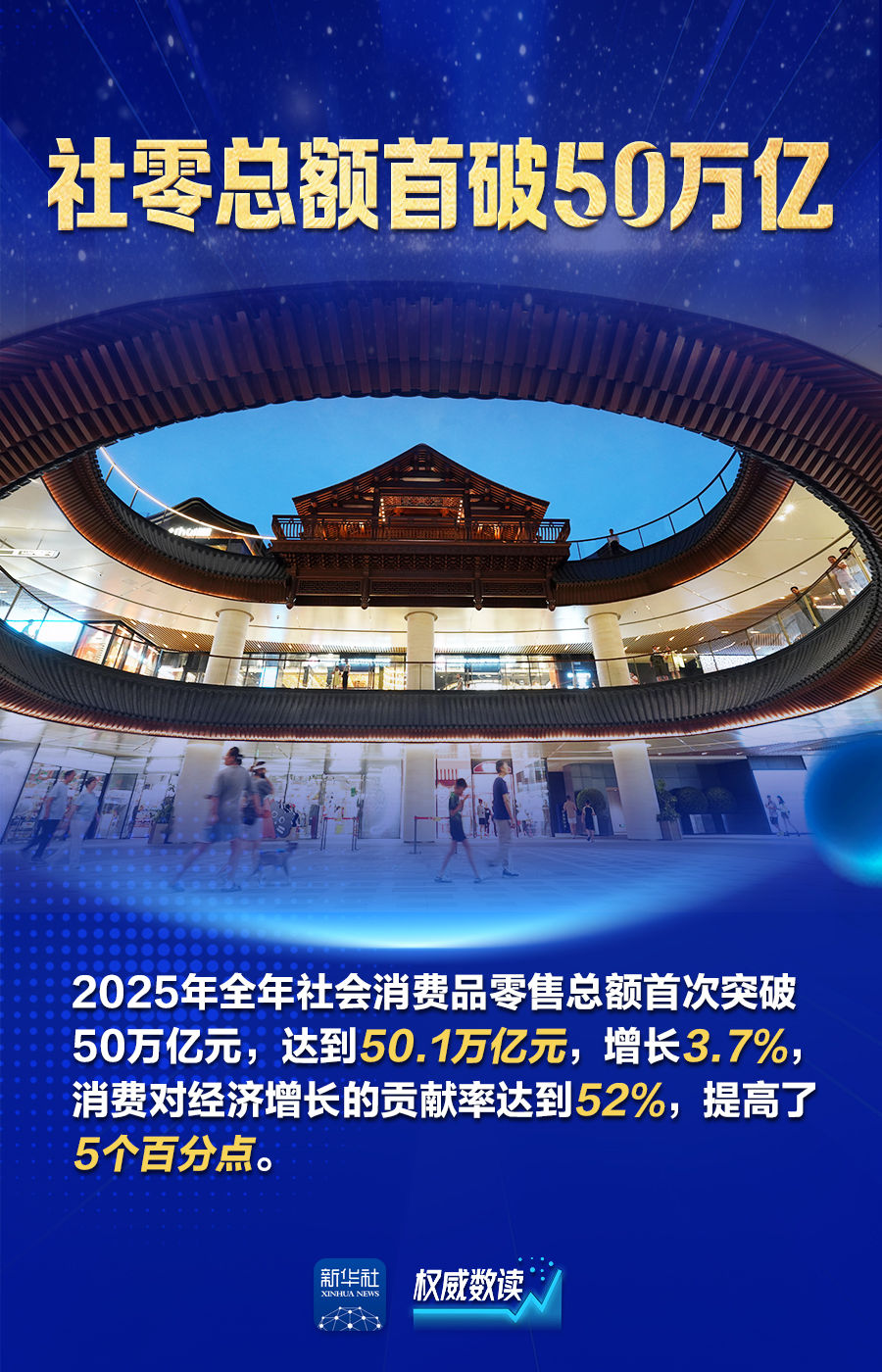
社零总额首破50万亿元 2025年提振消费加力显效
Xin Hua Wang· 2026-01-27 00:37
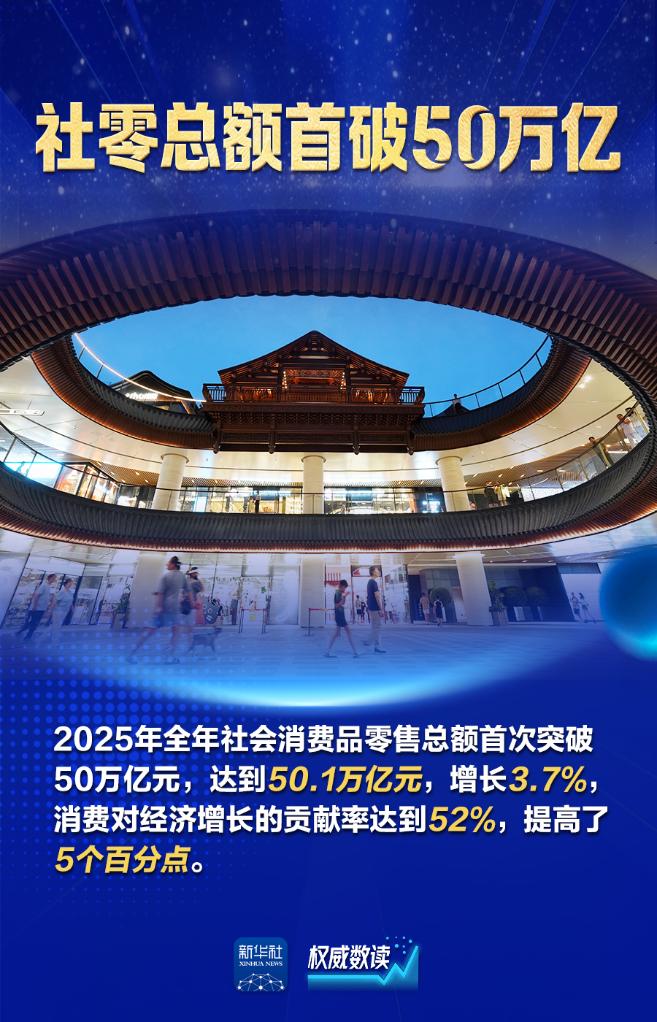
Group 1 - The core viewpoint of the article highlights the robust vitality of China's consumer market in 2025, with the total retail sales of consumer goods exceeding 50 trillion yuan for the first time, reaching 50.1 trillion yuan, and contributing 52% to economic growth, an increase of 5 percentage points [3] - The implementation of the "old-for-new" policy has significantly boosted sales in related sectors, with sales of automobiles, home appliances, and mobile phones reaching 2.61 trillion yuan, benefiting 366 million people [7] - The retail sales of services increased by 5.5% year-on-year, with per capita spending on services rising by 4.5%, accounting for 46.1% of total per capita consumption expenditure [11] Group 2 - New consumption trends such as digital, green, and health consumption are gaining momentum, with online retail sales of physical goods growing by 5.2%, and the market penetration rate of new energy passenger vehicles reaching 53.9% [17] - Rural retail sales of consumer goods reached 6.8 trillion yuan, growing by 4.1%, outpacing urban growth by 0.5 percentage points [19] - The popularity of "China Travel" and "China Purchase" continues to rise, with sales of tax-refunded goods for outbound travelers nearly doubling, and the implementation of a 240-hour visa-free transit policy leading to a nearly 30% increase in foreign visitors [22]

海外网红带莞货 独辟蹊径抢流量 潮玩电子出海热
Nan Fang Du Shi Bao· 2026-01-26 23:15
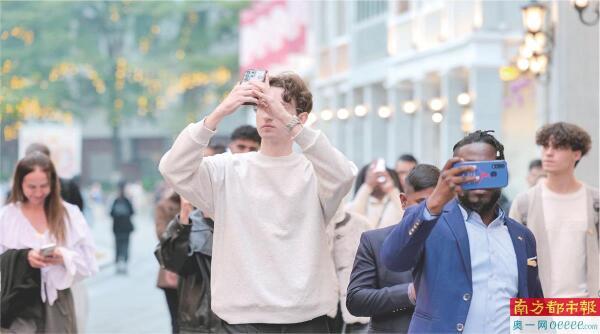
Core Viewpoint - Dongguan is transforming its export strategy by leveraging social media influencers to enhance the global presence of its manufacturing brands, moving from a focus on product output to brand output [6][10][15]. Group 1: Economic Performance - Dongguan's foreign trade import and export value reached 1.44 trillion yuan in the first 11 months of 2025, marking a 14.3% year-on-year increase, leading the nation among cities with over 1 trillion yuan in foreign trade [7]. - The total import and export value for the year is expected to exceed 1.56 trillion yuan, potentially setting a historical record [7]. - Dongguan has maintained a growth trend for 20 consecutive months, indicating a robust economic performance [7]. Group 2: Industry Transformation - Dongguan is known for its strong manufacturing base, producing nearly 85% of the country's trendy toys and maintaining a leading position in various sectors such as electronics, apparel, and furniture [6]. - The city is facing pressure to transition from a traditional OEM model to developing its own brands and expanding into global markets due to increasing complexities in the global trade environment [7][8]. Group 3: New Marketing Strategies - The "Three Hundreds" campaign aims to connect 100 influencers, 100 enterprises, and 100 business associations to promote Dongguan products globally through social media [9][11]. - Influencer marketing is seen as a cost-effective way to reach target audiences and gather market feedback, especially for small and medium-sized enterprises [10][11]. - The campaign will initially focus on light industrial products such as bags and shoes to minimize exploration costs [11]. Group 4: Long-term Goals - The initiative is set to run for three years, with the short-term goal of increasing brand exposure and the long-term ambition of establishing internationally recognized Dongguan brands [12][14]. - The strategy includes expanding into emerging markets and enhancing the service infrastructure for enterprises looking to go global [14][15]. - Dongguan aims to reshape its image from a "world factory" to a city known for its manufacturing aesthetics and innovation [15].
权威数读|社零总额首破50万亿元!2025年提振消费加力显效
Xin Hua She· 2026-01-26 12:20
Group 1 - The core viewpoint of the article highlights the robust vitality of China's consumer market in 2025, with total retail sales of consumer goods exceeding 50 trillion yuan for the first time and consumption contributing 52% to economic growth [1] - The "old-for-new" policy and initiatives like "China Purchase" and "Guochao Culture" have become prevalent, indicating a shift in consumer behavior and preferences [1] - The article emphasizes that consumption continues to play a pivotal role as the main engine of economic development, providing significant opportunities for countries worldwide [1] Group 2 - The sales revenue of related products under the "old-for-new" policy, including automobiles, home appliances, and mobile phones, reached 2.61 trillion yuan [4] - Retail sales of household appliances, communication equipment, and furniture increased by 11%, 20.9%, and 14.6% respectively, while passenger car retail volume rose by 3.8% [11] - The online retail sales of physical goods grew by 5.2%, and the market penetration rate of new energy passenger vehicles reached 53.9% [14] Group 3 - Per capita service consumption expenditure increased by 4.5%, accounting for 46.1% of total per capita consumption expenditure, with sectors like leisure, tourism, and transportation showing double-digit growth [8] - Rural retail sales of consumer goods reached 6.8 trillion yuan, growing by 4.1%, outpacing urban growth by 0.5 percentage points [17]
百年商脉续新章! “广货行天下·中山百货进上海”即将启幕
Nan Fang Du Shi Bao· 2026-01-26 09:25
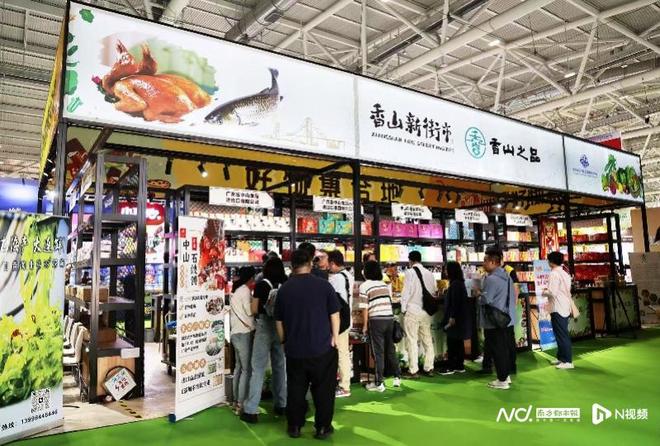
Group 1 - The event "Guanghuo Xing Tianxia: Zhongshan Department Store Enters Shanghai" will take place from January 31 to February 2 in Shanghai, showcasing Zhongshan's quality products and cultural charm, continuing the century-old commercial relationship between Xiangshan and Shanghai [1][7] - The event is guided by the Guangdong Provincial Department of Industry and Information Technology and hosted by the Zhongshan Municipal Government, featuring three days of exhibitions, interactions, performances, and investment promotion activities [3][5] - The exhibition will highlight various categories including home appliances, furniture, consumer electronics, clothing, daily chemicals, food, and cultural tourism, showcasing the latest achievements in Zhongshan's urban image, technological innovation, and quality of life [3][5] Group 2 - Zhongshan has a strong manufacturing base with 38 national-level industrial bases and 18 provincial-level specialized towns, emphasizing its robust real economy and active private sector [5] - The event will include interactive activities such as consumer lotteries, photo opportunities, and performances of traditional Guangdong music, enhancing the cultural atmosphere [5] - Online marketing efforts will be coordinated through major e-commerce platforms like Tmall and Douyin, promoting Zhongshan's industrial products and increasing brand influence [5]
商务部:2025年乡村消费品零售额达6.8万亿元 增长4.1%
Yang Shi Wang· 2026-01-26 08:48
Core Insights - The 2025 consumer market in China has achieved significant growth in both scale and quality, with total retail sales of consumer goods reaching 50.1 trillion yuan, marking a historic milestone of surpassing 50 trillion yuan. The contribution of consumption to GDP growth has reached 52%, reinforcing its role as a key driver of economic development [1] Group 1: Consumer Trends - Durable goods consumption has seen rapid growth, driven by the "old for new" policy, with retail sales of major appliances, communication devices, and furniture increasing by 11%, 20.9%, and 14.6% respectively, while passenger vehicle retail volume rose by 3.8% [1] - New types of consumption are thriving, with digital, green, and health-related consumption gaining momentum. The online retail sales of physical goods grew by 5.2%, and the market penetration rate of new energy passenger vehicles reached 53.9% [1] Group 2: Regional and International Consumption - Rural consumption has shown active performance, with the retail sales of consumer goods in rural areas reaching 6.8 trillion yuan, growing by 4.1%, outpacing urban growth by 0.5 percentage points [2] - The heat of inbound consumption is rising, supported by the expansion of visa-free countries and the optimization of tax refund policies for outbound travelers. Sales of tax refund goods have nearly doubled, and the implementation of the 240-hour visa-free transit policy has led to a nearly 30% increase in foreign visitors [2]
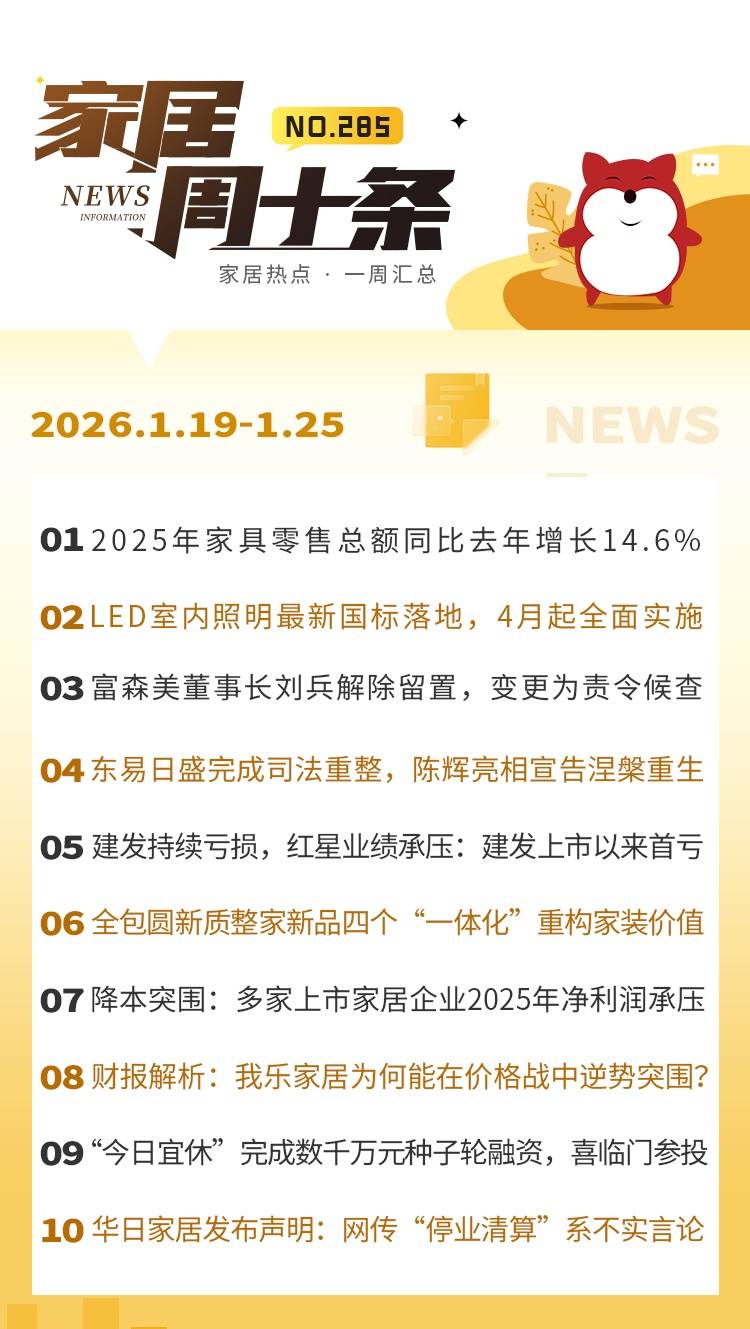
家居周十条 | 2025年家具零售总额增长14.6%、富森美董事长刘兵解除留置、多家上市家居企业2025年净利润承压 …
Sou Hu Cai Jing· 2026-01-26 07:03
Group 1: Furniture Retail and Market Trends - In 2025, the total retail sales of furniture in China increased by 14.6% year-on-year, reflecting a strong demand in the sector [1] - The overall retail sales of social consumer goods reached 501,202 billion yuan, with a growth of 3.7% compared to the previous year [1] - The per capita disposable income of residents in 2025 was 43,377 yuan, showing a nominal growth of 5.0% [1] Group 2: Industry Standards and Regulations - The new national standard for LED indoor lighting, GB/T 31831-2025, will be implemented starting April 1, 2026, replacing the 2015 version [2] - The updated standard includes significant improvements in energy efficiency, health lighting, and smart control features [2] Group 3: Company Performance and Developments - Fujian's company, Jindong, announced its first-ever annual loss since its listing, primarily due to pressures in its real estate and home operation businesses [3] - Dongyi Risheng, a prominent home decoration company, has completed its judicial reorganization, marking a significant recovery after facing debt issues [4] - Iole Home is projected to see a net profit increase of 72.73% to 95.76% in 2025, attributed to its focus on design and experience upgrades amidst industry challenges [5][6] Group 4: Financing and Investments - "Today Yixiu," a new company founded by former Xiaomi executive Wang Teng, has completed a seed round financing of several million yuan, with plans to launch a series of sleep-related smart products [7] Group 5: Market Reactions and Miscommunications - Huari Home's CEO addressed rumors regarding the company's alleged liquidation, clarifying that the auction of receivables is related to historical debts and does not affect current operations [8]

环球家居周报:以旧换新统一补贴标准,2025年家具类零售额同比增长14.6%,富森美刘兵解除留置……
Huan Qiu Wang· 2026-01-26 03:52
Group 1: Industry Developments - The Chinese government is implementing a unified subsidy standard for the "old-for-new" consumption policy, targeting various categories including automobiles and home appliances, while cracking down on fraudulent subsidy claims [1] - The furniture retail sector in China is projected to reach a total retail sales of 209.2 billion yuan by 2025, reflecting a year-on-year growth of 14.6% [2] - Multiple furniture projects have recently commenced in Nankang, Jiangxi, including a 6 billion yuan investment in a new furniture expo center [13] Group 2: Company News - Yunfeng Moganshan has submitted a listing application to the Hong Kong Stock Exchange, with annual revenues exceeding 3 billion yuan, aiming to expand its business [3] - Jianfa Co. has issued its first-ever profit warning, citing losses primarily due to its real estate and home retail businesses [4] - Meike Home's controlling shareholder has had all shares frozen due to a debt of 44 million yuan, although the company reports normal operations [7] - Dongyi Yisheng has undergone a change in actual control, with Zhang Jianhua becoming the new actual controller following a restructuring plan [8] - Fusenmei's chairman has had his detention lifted and is now under a "responsible inquiry" status, with the company stating normal operations [9] - IKEA has launched an instant retail service in collaboration with JD.com, marking a strategic shift towards immediate home delivery services [10] - Vanke Home has partnered with Alipay to introduce a fund custody service aimed at enhancing consumer trust in home renovation projects [11][12]
2025年湖南“以旧换新”相关商品零售额增长26.4%
Jin Rong Jie· 2026-01-26 03:33
今日,2025年度全省经济社会发展情况新闻发布会在长沙举行。发布会介绍,2025年,湖南聚焦效益与 结构,全方位扩大内需,需求结构持续改善。全省社会消费品零售总额21204.59亿元,同比增长 3.6%。"以旧换新"相关商品零售额增长26.4%、比上年加快14.7个百分点,其中家具类零售额增长 24.9%、家电类零售额增长23.1%、 新能源 汽车零售额增长9.0%。 ...
逛非遗品年俗 解锁新春新体验
Xin Lang Cai Jing· 2026-01-24 04:11
Core Viewpoint - The local cultural and tourism bureau is organizing a showcase of traditional crafts and cultural products, emphasizing the integration of local heritage with modern consumer experiences [1] Group 1: Event Organization - The event will feature high-quality traditional crafts such as cloisonné and flower silk inlay, along with folk art related to the "New Year" culture, including flower lanterns, fabric art, and paper-cutting [1] - Various performances of national and provincial intangible cultural heritage projects will be held, including traditional activities like dragon dances and stilt walking, highlighting the city's rich cultural heritage [1] Group 2: Product Showcase and Promotions - Over 200 products from 25 selected projects, including intangible cultural heritage and creative cultural products, will be displayed and sold during the event [1] - Promotional activities such as limited-time discounts and blind box lotteries will be offered, allowing consumers to win tickets to local attractions and cultural gifts, enhancing the shopping experience [1] Group 3: Community Engagement - The local literary federation will organize daily calligraphy events during the festival, where renowned calligraphers will write spring couplets for the public [1] - A themed leisure exhibition space will be created in Xianghe County, showcasing local furniture industry characteristics while providing a comfortable resting area for citizens, merging sales and service functions [1]
小赛道,才有大机会
创业家· 2026-01-23 10:27
Core Insights - Successful companies in China should focus on niche markets where they can excel, as these small tracks offer significant opportunities [1] - Companies should avoid spending in areas where they cannot win and be willing to take bold risks in areas where they can succeed [1] Industry Trends - The efficiency of Chinese manufacturing has reached its peak, and mere cost advantages can no longer support brand growth. By 2026, Chinese brands will face challenges not just in production but in occupying industry ecological positions and selling brand value [4] - The next decade is seen as a golden era for lifestyle brands, particularly in sectors like beauty, home, dining, and fashion, where global markets are ripe for engagement [4] - Many Chinese companies struggle with price increases, consumer discount mentality, and lack of compelling brand narratives, which contrasts with the enduring success of European brands that leverage cultural empathy and scarcity [4] Learning Objectives - The three core elements of enduring European brands are: 1. Scarcity narrative: Transitioning from "selling products" to "selling dreams" [5] 2. Supply chain control: Defining industry gold standards [7] 3. Lifestyle definition: Redefining spaces and sensory experiences through design and innovation [9] Educational Experience - The program includes visits to prestigious institutions and brands such as LVMH, Kering, and L'Oréal, focusing on how they maintain their market positions through storytelling, craftsmanship, and technological innovation [6][13][15] - Participants will learn about the importance of brand origin stories and how to create an unassailable competitive moat [15] - The curriculum emphasizes the significance of standardization and globalization in culinary arts, as exemplified by Le Cordon Bleu, and how this can be applied to brand cultural output [16] Practical Applications - Insights from Loro Piana and other top suppliers will illustrate how controlling scarce resources can grant ultimate industry authority [20] - The program will also explore how design-driven manufacturing can elevate products from mere utility to art, achieving significant price premiums and profit margins [21]