
棉花种植

Search documents
非洲成为孟加拉最大棉花供应地区
Shang Wu Bu Wang Zhan· 2025-12-23 03:29
Core Viewpoint - Bangladesh is set to import 8.05 million bales (approximately 1.77 million tons) of cotton in the 2024-2025 period, making it the largest cotton importer globally, surpassing Vietnam and China [1] Group 1: Cotton Import and Supply - Approximately 41% of Bangladesh's cotton imports will come from Africa, totaling around 3.3 million bales (approximately 726,000 tons), establishing Africa as the largest cotton supply region for Bangladesh [1] - Major African countries exporting cotton to Bangladesh include Benin, Cameroon, Burkina Faso, and Mali [1] Group 2: Textile Industry Overview - Bangladesh has a highly developed cotton processing and textile industry, with around 4,500 factories employing 4 million people [1] - The annual cotton consumption in Bangladesh ranges between 8.5 million to 15 million bales [1] - The total export value of ready-made garments from Bangladesh is projected to be approximately $39.3 billion, covering various textile products such as pants, T-shirts, knitwear, sweaters, shirts, and underwear [1] Group 3: Value Addition Efforts - Some African countries are working to enhance the value of cotton exports; for instance, Benin plans to establish around 28 textile processing units in the Glo-Djibé industrial zone by 2032, aiming to process most of its cotton into finished or semi-finished products to increase industry chain value and economic benefits [1]
国内促消费政策再发力 国内棉价继续上涨
Xin Lang Cai Jing· 2025-12-22 15:52
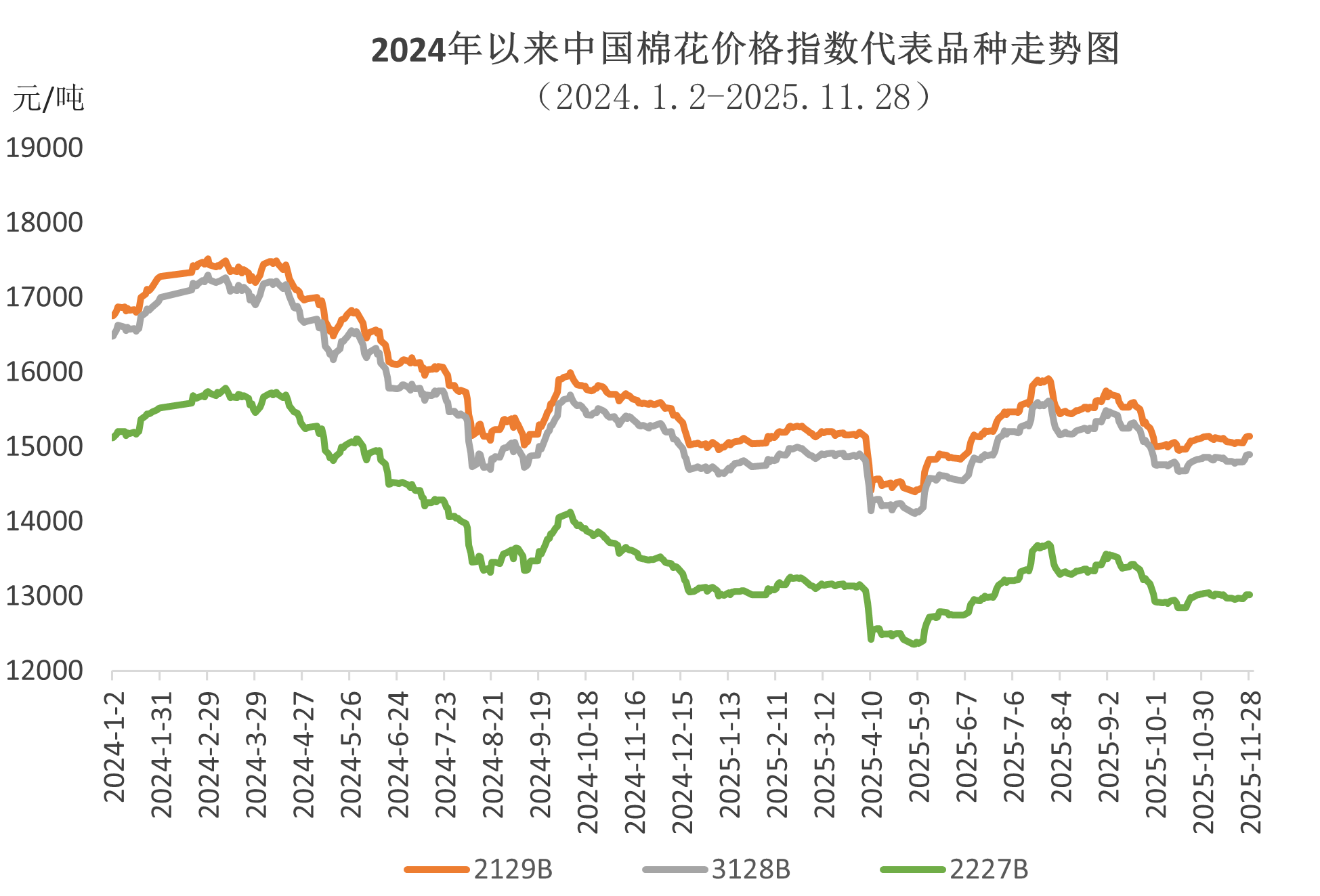
一、价格回顾 国内方面,新棉加工、销售加速推进,纺企刚需补库为主,最新发布的11月纺服类内销数据保持增长, 同时本周多部门明确未来将更大力度提振消费,改善消费预期、提振市场信心,推动国内棉价延续涨 势,郑棉最高涨至14100元/吨,达到2025年8月底以来最高水平。本周郑州棉花期货主力合约结算均价 13957元/吨,较前周上涨163元/吨,涨幅1.2%;代表内地标准级皮棉市场价格的国家棉花价格B指数均 价15081元/吨,较前周上涨121元/吨,涨幅0.8%。 (来源:锦桥纺织网) 来源:锦桥纺织网 【概要】本周,国内促消费政策继续发力,最新公布的11月纺服内销数据呈稳增态势,提振市场消费信 心,国内棉价延续涨势;受北半球棉花集中供应、美棉出口销售持续疲软等因素影响,外棉价格重心继 续下移,内外棉价差扩大至2021年10月以来最高水平。 宏观方面,美国通胀数据低于预期,增加美联储未来降息概率。美国11月消费者物价同比上涨2.7%, 涨幅低于预期的3.1%,受此影响,美股等金融市场普遍上涨。日本央行加息政策落地,市场反应相对 平淡。12月19日日本央行将政策利率上调25个基点至0.75%,达到30年来新高,这是 ...
长江期货棉纺产业周报:震荡偏强-20251219
Chang Jiang Qi Huo· 2025-12-19 12:26
Report Industry Investment Rating - The investment rating for the cotton textile industry is "Oscillating Bullish" [3] Core Viewpoints - Cotton prices are expected to be oscillating bullish in the near term due to a balanced supply - demand pattern and potential changes in Xinjiang's cotton planting policy in the new year. The spot market for Xinjiang cotton is strong, and yarn - end procurement is proceeding as usual [6]. - The cotton yarn market is under pressure, with many inland textile enterprises facing cash - flow losses. The industry needs to continue monitoring the trend of Zhengzhou cotton futures and downstream restocking [6]. Section Summaries 01. Weekly Summary - Cotton: Futures and spot prices are oscillating upwards. The supply - demand pattern shows both supply and demand increasing, with no prominent contradictions. There are expectations of significant changes in Xinjiang's cotton planting policy, which may reduce output. The Xinjiang cotton spot market is strong, and yarn - end procurement is steady. Cotton prices are expected to be oscillating bullish [6]. - Cotton Yarn: Many inland textile enterprises face cash - flow losses. Although Xinjiang's textile enterprises maintain high operating loads, the industry as a whole is under pressure. Attention should be paid to the trend of Zhengzhou cotton futures and downstream restocking [6]. 02. Market Review - Cotton: The domestic cotton market has limited changes. Supply pressure is not significant, and the demand for cotton raw materials from spinning enterprises is resilient. The upper half of the week saw good procurement, which weakened in the lower half. Spot prices rose, and the basis of some high - basis contracts was adjusted downwards [9]. - Cotton Yarn: The overall trading in the pure - cotton yarn market is weak, with few new orders. Prices are temporarily stable after the previous increase, but most downstream customers are reluctant to accept the price hikes. Xinjiang spinning enterprises maintain high operating rates, while inland ones continue to decline [9]. 03. International Macroeconomics - The report presents a series of economic data from the US and the Eurozone, including manufacturing PMI, employment, GDP, CPI, and interest rates, which can impact the cotton market through currency exchange rates and global economic demand [11]. 04. Domestic Macroeconomics - Key domestic economic data such as foreign exchange reserves, CPI, PPI, M2 money supply, social financing scale, and fixed - asset investment are provided, which can influence the domestic cotton textile industry [13]. 05. Global Supply - Demand Balance Sheet - According to the USDA's December report, the global cotton output and consumption in the 2025/26 season are both adjusted downwards, while the ending inventory increases slightly due to an increase in the beginning inventory. The main adjustment is in the US, while other countries' production and consumption data remain relatively stable [16]. - In China, the total supply in the 2025/26 season is expected to increase by 260,000 tons to 1.504 million tons, mainly due to an increase in production. The total demand is expected to increase by 130,000 tons to 858,000 tons, resulting in an increase in the ending inventory by 130,000 tons to 646,000 tons [20]. 07. US Cotton Exports - As of November 20, 2025, the US has cumulatively signed contracts to export 1.306 million tons of cotton for the 2025/26 season, reaching 49.16% of the expected annual export volume, and has shipped 520,000 tons, with a shipping rate of 39.80%. China has signed contracts to import 39,000 tons, accounting for 2.98% of the signed volume, and has shipped 15,000 tons [23]. 08. Industrial and Commercial Inventories Start to Increase - As of the end of November, the industrial inventory of cotton in textile enterprises increased steadily, reaching 939,600 tons. The commercial inventory of cotton in China reached 4.6836 million tons, a significant increase from the previous month and slightly higher than the same period last year [26]. 09. November Cotton and Cotton Yarn Imports Both Increase - In November 2025, China's cotton imports were 120,000 tons, a 34.4% increase from the previous month and a 9.4% increase from the same period last year. Cotton yarn imports were 150,000 tons, a 25% increase from the same period last year and a 7.14% increase from the previous month [29]. 10. November Cotton Yarn Production Increases Year - on - Year and Month - on - Month - In November, the sales of pure - cotton yarn were relatively good in the first half but weakened in the second half. The comprehensive operating rate of pure - cotton spinning enterprises was stable. The estimated output of pure - cotton yarn in November was 493,000 tons, a 12.9% increase from the same period last year and a 3.7% increase from the previous month [30]. 11. US Cotton Growth - As of September 28, the boll - opening rate of US cotton was 67%, 4 percentage points slower than last year and 2 percentage points slower than the five - year average. The harvest rate was 16%, the same as the five - year average but 3 percentage points slower than last year. The good - quality rate was 47%, 16 percentage points higher than last year and 8 percentage points higher than the five - year average [36]. 12. US Cotton Weather - As of the week of November 15, 2025, the average temperature and precipitation in the US cotton - growing areas and Texas were significantly lower than the previous year. Since the harvest is in the middle - to - late stage, the dry weather has limited impact [40]. 13. Xinjiang Cotton Inspection - As of December 18, 2025, 1,083 cotton processing enterprises in China have processed and inspected 25,039,991 bales of cotton, weighing 5.6524 million tons [42]. 14. Textile Industry Inventory - In October, the inventory of the textile industry was 406.4 billion yuan, a month - on - month increase of 0.8 billion yuan and a year - on - year increase of 38 billion yuan. The inventory of textile products was 218 billion yuan, with corresponding increases of 6 billion and 16 billion yuan. The inventory of textile and clothing decreased both month - on - month and year - on - year [45]. 15. Domestic Demand Remains Strong - In November 2025, the total retail sales of consumer goods were 4.3898 trillion yuan, a 1.3% year - on - year increase. The retail sales of clothing, footwear, and textiles were 154.2 billion yuan, a 3.5% year - on - year increase [50]. 16. External Demand Exports Weaken - In November 2025, China's textile and clothing exports were 23.869 billion US dollars, a 5.12% year - on - year decrease. Textile exports increased by 1.03% year - on - year, while clothing exports decreased by 10.86% year - on - year [53]. 17. US Clothing and Apparel Retail Sales in September 2025 - In September 2025, US clothing and apparel retail sales (seasonally adjusted) were 27.043 billion US dollars, a 6.65% year - on - year increase but a 0.72% month - on - month decrease. Retailer inventories decreased both year - on - year and month - on - month, and the inventory - to - sales ratio also declined [58]. 18. US Textile and Apparel Imports in September 2025 - In September 2025, US textile and clothing imports decreased both year - on - year and month - on - month in terms of volume, while the import amount decreased year - on - year but increased month - on - month. Cotton product imports showed a slight decrease in volume year - on - year but an increase in amount month - on - month [62]. 19. Warehouse Receipts Continue to Decrease - As of December 18, the number of warehouse receipts was 3,619, with 3,924 valid forecasts, a total of 7,543, an increase of 612 from the previous week [64]. 20. Non - Commercial Long Positions Decrease - As of December 2, the net long positions of non - commercial futures and options in the ICE cotton futures market increased by 2,444, and the net long positions of non - commercial futures alone increased by 2,707. The net long positions of commodity index funds decreased by 479 [68]. 21. Load Changes - As of December 19, the load index of pure - cotton spinning mills, human - made cotton yarn mills, and pure - polyester yarn mills all decreased, indicating a weakening trend in the yarn and fabric loads [71]. 22. Industrial Chain Inventory - Textile enterprises' cotton inventory increased by 0.9 days compared to last week, cotton yarn inventory remained flat, and the inventory of pure - cotton grey fabric increased by 0.5 days. Inventory is starting to accumulate as the consumption season enters a slow period [74]. 23. Industrial Chain Profit - This week, the sales situation in Xinjiang and inland areas differed significantly. Xinjiang's spinning enterprises had better sales, while inland ones slowed down. The narrowing of the cotton - yarn price spread due to the increase in Zhengzhou cotton futures has put pressure on spinning enterprises, leading to a decrease in the operating rate of inland spinning enterprises [79].
棉花(纱)市场周报-20251219
Rui Da Qi Huo· 2025-12-19 09:22
瑞达期货研究院 「2025.12.19」 棉花(纱)市场周报 研究员:王翠冰 期货从业资格号F03139616 期货投资咨询从业证Z0021556 关 注 微信客 服 号 添加客服 业务咨询 目录 「 周度要点小结」 行情回顾:本周郑棉主力2601合约价格上涨,周度涨幅约1.19%。 美棉市场 行情展望:据美国农业部(USDA)报告显示,11月27日止当周,2025/26年度美国陆 地棉出口销售净增13.59万包,较前周减少8%,较前四周均值减少23%。2025/26年 度美国陆地棉出口装运量12.21万包,较前周增加1%,较前4周平均水平减少5%。 当周美国棉花出口签约量减少、装运量环比小增。国内市场:供应端,当前全国棉 花公检量已超550万吨,预计商业库存加速增长。另外,11月棉花进口量环比小幅增 加,预计进口港口库存维持增长趋势,据海关统计,2025年11月我国棉花进口总量 约12万吨,环比增加3万吨,同比增幅9.4%。需求端,下游纺企旺季采购结束,纺 企淡季特征逐渐现象,市场出货速度偏慢,预计短期棉价震荡为主。 3 图1、CFTC美棉净持仓与ICE美棉活跃合约价格走势 1、周度要点小结 2、期现市场 ...
寒意渐浓时,用伽师棉花温暖整个冬日|疆品上新⑫
Nan Fang Nong Cun Bao· 2025-12-19 03:04
Core Viewpoint - The article highlights the significance of Kashi cotton, particularly its quality and production in Kashi County, Xinjiang, as a key contributor to the local economy and a source of warmth during winter [9][11][30]. Group 1: Kashi Cotton Production - Kashi County is a major production area for Xinjiang long-staple cotton, benefiting from a unique climate with over 2800 hours of sunshine annually and a frost-free period of about 233 days, which enhances cotton fiber maturity [13][14]. - The cotton planting area in Kashi County has steadily increased, reaching over 1.6 million acres by 2025, with a total output exceeding 220,000 tons [18][17]. - The introduction of advanced agricultural technology, including partnerships with research institutions, has led to the development of high-yield cotton varieties, such as AW05, which can produce up to 577.44 pounds per acre [21][22]. Group 2: Technological Advancements - Modern agricultural practices have transformed cotton production in Kashi County, utilizing unmanned aerial vehicles for pest control and precision planting techniques to enhance efficiency and reduce water usage [24][25]. - The cotton industry in Kashi has moved from traditional manual harvesting to mechanized processes, significantly improving productivity [23]. Group 3: Textile Industry Development - Kashi County is actively building a textile processing industry chain, attracting leading companies like Hengbang Textile and Jiaxin Textile, achieving an annual spinning capacity of approximately 550,000 spindles [27][28]. - The production process encompasses the entire supply chain from raw cotton to finished products, including socks, scarves, and quilts, thereby providing warmth to many households [29][30]. Group 4: Market Expansion - The "Xinjiang Products Southward, Guangdong Products Northward" initiative has facilitated the entry of Kashi cotton products into the Guangdong market, enhancing their availability during the winter season [31][32].


供增需减施压棉价 宏观利好支撑反弹
Sou Hu Cai Jing· 2025-12-18 15:37
Group 1 - The domestic cotton market experienced fluctuations in November, characterized by a decline followed by a rebound, with domestic prices showing strength while international prices remained weak [1][2] - The China Cotton Price Index decreased from 14,859 CNY/ton to a low of 14,779 CNY/ton in early November, before rebounding to a month-end high of 14,896 CNY/ton, resulting in a month average of 14,831 CNY/ton, which is an increase of 67 CNY compared to the previous month but a decrease of 497 CNY year-on-year [2] - The futures market showed greater volatility than the spot market, with the main contract for Zheng cotton dropping from 13,640 CNY/ton to 13,380 CNY/ton before recovering to 13,725 CNY/ton, resulting in a month average settlement price of 14,543 CNY/ton, which is an increase of 94 CNY month-on-month and 536 CNY year-on-year [4] Group 2 - The demand for long-staple cotton remained stable, with prices holding steady; the price for 137-grade long-staple cotton was 25,000 CNY/ton at the end of the month, unchanged from the previous month, while the month average transaction price increased by 1,800 CNY/ton year-on-year [6] - The international cotton price faced downward pressure due to concerns over economic slowdown and increased global production forecasts, with the average price of imported cotton at 74.11 cents/pound, a decrease of 0.4% month-on-month [7] - Domestic cotton yarn prices slightly rebounded in November, with the average price for domestic 32-count cotton yarn at 20,564 CNY/ton, an increase of 95 CNY month-on-month, while polyester and viscose staple fibers continued to decline due to weak downstream demand [10][11]
金色田野上的“棉中白金”(第一现场) ——探访埃及长绒棉产业
Ren Min Ri Bao· 2025-12-18 00:43
每年金秋时节,就到了埃及长绒棉的收获季。灿烂阳光透过稀薄的云雾,洒在埃及乡下无垠的棉田上, 仿佛为大地披上一层耀眼的金纱。记者踏入这片神奇土地,耳边是微风拂过棉叶的沙沙声,眼前是棉农 们忙碌喜悦的身影,他们正手工采摘着一朵朵承载希望的"白色黄金"。 下午2时,棉农赛义德的胶鞋踩过还带着湿气的土壤,指尖轻触饱满的棉桃,裂开的果壳里,雪白的棉 絮泛着珍珠般的光泽。"这是尼罗河的馈赠,也是埃及的骄傲。"他边说边摘下一朵棉花,棉花长长的纤 维在午后的阳光中拉出细长的银丝。沿着尼罗河三角洲的棉田一路探访,埃及长绒棉从土地到市场的全 图景在记者眼前徐徐展开。 土地的馈赠:"棉中白金"历史悠久 在东方省法库斯镇阿达伊达蒙村的棉田里,有着30多年种植棉花经验的赛义德蹲下身子,拨开棉株根部 的土壤,向记者展示说,"你看这土,是尼罗河每年泛滥留下的肥沃黑土,攥在手里能感觉到油性。"他 的话印证了埃及长绒棉的生长奇迹:这片被尼罗河滋养的河谷与三角洲地带,藏着埃及长绒棉的生长密 码。 赛义德解释说,每年尼罗河定期泛滥,洪水退去后,会在两岸留下一层厚厚的肥沃淤泥和砂质壤土,含 有丰富的钾、磷等矿物质和其他营养成分,其中钾含量为普通棉田 ...
金色田野上的“棉中白金”(第一现场)
Ren Min Ri Bao· 2025-12-17 22:11
每年金秋时节,就到了埃及长绒棉的收获季。灿烂阳光透过稀薄的云雾,洒在埃及乡下无垠的棉田上, 仿佛为大地披上一层耀眼的金纱。记者踏入这片神奇土地,耳边是微风拂过棉叶的沙沙声,眼前是棉农 们忙碌喜悦的身影,他们正手工采摘着一朵朵承载希望的"白色黄金"。 下午2时,棉农赛义德的胶鞋踩过还带着湿气的土壤,指尖轻触饱满的棉桃,裂开的果壳里,雪白的棉 絮泛着珍珠般的光泽。"这是尼罗河的馈赠,也是埃及的骄傲。"他边说边摘下一朵棉花,棉花长长的纤 维在午后的阳光中拉出细长的银丝。沿着尼罗河三角洲的棉田一路探访,埃及长绒棉从土地到市场的全 图景在记者眼前徐徐展开。 在当地棉花研究所,研究员穆斯塔法向记者介绍,由于品种优良、质地坚韧、抗皱性强,埃及长绒棉被 誉为"棉中白金",主要品种有吉萨45、吉萨70和吉萨86,其中吉萨70占总产量的75%左右。赛义德 说:"每公斤原棉都要经过12次筛选,才能达到吉萨70的标准要求。"据介绍,精选的原棉纤维长度一般 在33—43毫米之间,有的可达到45毫米以上,是普通棉花的1.5倍,干断裂强力比普通棉高20%—30%, 韧性足以承受高支纱;即便反复洗涤,仍能保持相当的光泽和柔软度。 "众多品牌 ...
美国保持越南最大棉花供应国
Shang Wu Bu Wang Zhan· 2025-12-17 16:44
Core Insights - Vietnam's cotton import volume exceeded 1.5 million tons with a total import value surpassing $2.6 billion in the first 11 months of 2025, showing a year-on-year volume increase of 13% but a 1% decrease in value [1] Group 1: Cotton Imports - The United States remains Vietnam's largest cotton supplier, with imports reaching 723,000 tons valued at $1.27 billion, marking a volume increase of approximately 130% and a value increase of about 94% year-on-year, accounting for nearly 47% of Vietnam's total cotton imports [1] - Brazil is the second-largest cotton supplier to Vietnam, with imports of approximately 414,000 tons valued at $714 million in the same period [1] Group 2: Textile Industry Overview - Vietnam's annual cotton consumption is around 1.5 million tons, making it the world's third-largest cotton importer [1] - The country ranks sixth globally in fiber exports and third in textile exports, following China and Bangladesh [1] - According to the Vietnam Textile and Apparel Association (VITAS), Vietnam's textile and apparel export value reached approximately $40 billion in the first 11 months of 2025, reflecting a year-on-year growth of 6% [1]
棉花:多重利好共振下价格中枢或抬升
Hong Ye Qi Huo· 2025-12-17 06:36
1. Report Industry Investment Rating No relevant content provided. 2. Core Viewpoints of the Report - In 2026, the cotton planting area in the US may remain stable with a slight decline, and attention should be paid to whether the planting area in the Southern Hemisphere will decrease [2][105]. - There is uncertainty about the cotton planting area under policy guidance. Although the market speculates that the policy may lead to a decline in the planting area in 2026, it remains unknown whether the policy will be implemented as speculated and whether the implementation intensity can actually reduce the area [2][111]. - The international economic and trade environment is gradually improving, and the phased easing of Sino - US trade relations reduces export tariffs, improving the export outlook for textiles. Coupled with the continuous expansion of Xinjiang's cotton textile production capacity, it is beneficial for domestic cotton consumption [2][111]. - The cotton price was at a low level for a long time in the 2024/2025 season, and the current valuation is in a historically low range. As the supply - demand pattern improves and market sentiment recovers, valuation repair will be an important driving force for price increases [2][111]. 3. Summary According to the Table of Contents 3.1 Market Review - **ICE Narrow - Range Fluctuation**: In 2025, the US cotton production decreased year - on - year. Due to continuous Sino - US tariff conflicts and China's small volume of signing US cotton contracts, the ICE US cotton continuous contract showed a fluctuating trend, mostly in the range of 65 - 68 cents. After the US government's record - breaking shutdown, the price center of ICE US cotton moved down since the third quarter, generally maintaining in the range of 63 - 66 cents [10]. - **ZCE First Declined and Then Rose, with Overall Low Valuation**: Supported by the downstream raw material replenishment and order - grabbing expectations, Zhengzhou cotton rose moderately at the beginning of the year. Affected by tariffs, it started to decline in late February, especially after the US announced the so - called "reciprocal tariffs" at the beginning of April, Zhengzhou cotton tumbled. After the Geneva talks between China and the US in early May, Zhengzhou cotton soared. With the marginal weakening of the negative impact of tariffs and concerns about the supply before the new cotton was listed, Zhengzhou cotton continued to rise until late July. However, due to the uncertainty of Sino - US trade relations and the expectation of new cotton production increase, the overall increase was not significant [10][11]. 3.2 Global Cotton Output Increased Slightly Year - on - Year, Focus on the Cotton Planting Area in the Southern Hemisphere - **Global Cotton Ending Stocks Increased, with Overall Low Pressure**: According to the December USDA report, compared with the previous month, the global cotton beginning stocks estimate increased by 120,000 bales, the production estimate decreased by 290,000 bales, and the consumption estimate decreased by 270,000 bales, with the ending stocks estimate increasing by 40,000 bales. In the 2025/26 season, the global cotton beginning stocks estimate increased by 1.21 million bales year - on - year, the production estimate increased by 510,000 bales, the consumption estimate decreased by 320,000 bales, and the ending stocks estimate increased by 1.36 million bales, but the overall pressure was not great [12]. - **Improved Import Demand for Textiles and Clothing in Europe and the US**: - **Consumer Confidence**: In November, the US Michigan consumer confidence index was 51, down 2.6 points month - on - month and had been declining for three consecutive months, rising to 53.3 in December. The EU consumer confidence index was - 13.6 in November, basically flat month - on - month, and - 12.4 in December, down 1.2 points month - on - month and up 5.1 points year - on - year, remaining at the highest level in the same period in the past three years since March [14]. - **Import Volume**: In September, the EU's textile and clothing imports from China, Vietnam, Bangladesh, and the US were 5.66 billion euros, up 380 million euros month - on - month and slightly up 50 million euros year - on - year. From January to September, the EU's cumulative imports from these four countries were 43.675 billion euros, up 4.213 billion euros year - on - year. In September, the US imported a total of $10.582 billion worth of textiles and clothing, down $1.161 billion year - on - year, a decrease of 9.89%. From January to September, the US's cumulative imports were $90.413 billion, down $210 million year - on - year. China's share in the US market dropped significantly, with cumulative imports from China being $16.912 billion, down $6.352 billion year - on - year, and the market share dropping by 6.96 percentage points compared with the same period last year [16]. - **开机率 in Southeast Asia**: The开机率 of Indian and Vietnamese spinning mills showed a downward trend, while that of Pakistani spinning mills showed an upward trend and was at the highest level in the same period in the past three years, performing the best [22][26]. - **Slow Progress of US Cotton Export Sign - ups**: - **High Ending Stocks and Limited Production Adjustment Space**: In December, compared with November, the US cotton production estimate decreased by 150,000 bales, the consumption estimate decreased by 100,000 bales, and the ending stocks estimate increased by 200,000 bales to 4.5 million bales. The 2025/2026 US cotton planting area was expected to be 9.3 million acres, the harvested area was estimated to be 7.37 million acres, the yield per acre was estimated to be 929 pounds, and the total production was 14.268 million bales, down 145,000 bales year - on - year [29]. - **Slow Overall Sign - ups and a Sharp Drop in China's Sign - ups**: As of the week of November 13, the weekly sign - up of 2025/26 US upland cotton was 42,600 tons, down 36% week - on - week, up 10% from the four - week average, and up 22% year - on - year. The total sign - up volume of US cotton in the 2025/26 season was 1.2706 million tons, accounting for 49% of the annual predicted total export volume, 12 percentage points slower than the same period last year. China's total sign - up volume was 37,000 tons, a significant decrease of 74% compared with the same period last year [37][42]. - **Slow US Cotton Inspection**: As of the week of December 5, 2025, the cumulative inspection volume of US upland cotton + Pima cotton was 2.0085 million tons, accounting for 65.7% of the estimated US cotton production for the year, 11% slower year - on - year. Considering the 10% production reduction this year, the inspection speed was comparable to that of last year [45]. - **Supply - Demand Situation in Other Cotton - Producing Countries**: - **Accumulated Inventory in India**: In the 2025/26 season, India's cotton beginning stocks increased by 710,000 bales year - on - year, the export volume estimate was basically flat year - on - year, the import volume estimate decreased slightly by 240,000 bales year - on - year, and the ending stocks estimate increased by 500,000 bales year - on - year to the highest level in the past three years [50]. - **Divergent Estimates of Brazilian Cotton Production**: Brazilian institutions had different forecasts for the increase or decrease of Brazilian cotton production in 2025/26, but the market expected that the cotton planting area in Brazil would be difficult to increase this season. The USDA report showed that the Brazilian cotton production estimate for the 2025/26 season was 18.75 million bales, a 10% increase year - on - year [58][60]. - **Probable Decrease in Australian Cotton Production**: Affected by factors such as insufficient irrigation water supply, poor soil moisture during the sowing period, rising planting costs, and better returns from competing crops, Australia's cotton planting area was expected to decline significantly in the 2025/26 season. The latest USDA report showed that Australia's cotton production estimate for the 2025/26 season was 4.5 million bales, a 2.3% decrease year - on - year [62]. 3.3 Domestic Market Supply - Demand Situation - **Substantial Increase in Production**: - **Increased Production and Low Imports**: In the 2025/26 season, China's cotton production estimate increased by 1.5 million bales year - on - year to 33.5 million bales, reaching a new high since 2013, and consumption decreased slightly by 500,000 bales to 38.5 million bales. Imports were expected to remain stable with a slight increase, and the ending stocks estimate increased by 320,000 bales year - on - year to 351.62 million bales, at a high level in the past five years [64]. - **Non - Concentrated Pima Cotton Costs and Faster Sales**: As of December 11, the national Pima cotton processing rate was 84%, 2.2 percentage points higher year - on - year, and the sales rate was 41.6%, 23.5 percentage points higher year - on - year [68]. - **Flat Commercial Stocks Year - on - Year**: As of the end of November, the domestic cotton commercial inventory was 4.68 million tons, a significant increase of 1.753 million tons month - on - month due to the listing of new cotton, and basically flat year - on - year, at the highest level in the same period in recent years [72]. - **First Decline and Then Rise in the Domestic - Foreign Price Difference and a Sharp Drop in Cotton Imports**: In October, China imported 90,000 tons of cotton, down 10,000 tons month - on - month and 20,000 tons year - on - year. From January to October, the cumulative cotton imports were 770,000 tons, a significant decrease of 1.6 million tons year - on - year, a decrease of 67.5% [76]. - **Moderate Recovery in Domestic Demand and Poor Exports**: - **Recovery of Cotton Spinning PMI in the Fourth Quarter**: In November, the China Cotton Textile Industry Purchasing Managers' Index (PMI) decreased slightly by 2 points month - on - month, and the decline was significantly narrower than in the same period of last year and the year before. The overall trend of cotton spinning PMI was similar to that of last year, not as good as in 2023, and the peak - season characteristics were not obvious [86]. - **Poor Overall Spinning Mill Operation**: The domestic spinning mill operation load was basically at the lowest level in the same period in the past three years this year, showing a trend of high in the front and low in the back, and the peak - season characteristics were not obvious. As of this week, the spinning mill operation load index was 51, and the finished - product inventory was 27.6 days. The cloth mill operation rate reached a phased high in early April and then fluctuated and declined, and started to recover in August. As of this week, the cloth mill operation load index was 51.7, and the finished - product inventory was 31.2 days [87]. - **Moderate Recovery in Domestic Demand**: In October, the domestic retail sales of textiles and clothing were 147.08 billion yuan, a 6.3% year - on - year increase. From January to October, the cumulative retail sales were 1.20528 trillion yuan, a 3.5% year - on - year increase, and the growth rate was 2.4 percentage points higher than in the same period last year [95]. - **Slight Year - on - Year Decline in Textile and Clothing Exports, with Overall Declines in Exports to the US and ASEAN**: In November, domestic textile and clothing exports were $23.87 billion, a 5.1% year - on - year decrease, and the decline was 7 percentage points narrower than in the previous month. From January to November 2025, the cumulative textile and clothing exports were $267.79 billion, a slight 1.9% year - on - year decrease. Exports to ASEAN and the US decreased significantly, while exports to the EU market remained stable [97]. 3.4 Future Outlook - **Possible Stable but Slightly Declining US Cotton Planting Area, Focus on Whether the Southern Hemisphere's Area Will Decrease**: Based on the soybean/cotton and corn/cotton price - ratio trends, the current price ratios are significantly higher than last year. Judging from the price ratios alone, the US cotton planting area in 2026 is likely to remain stable with a slight decline compared to 2025. The Brazilian cotton planting area is expected to be difficult to increase this season, and the Australian cotton planting area is expected to decline significantly in the 2025/26 season [2][105]. - **Uncertainty about the Cotton Planting Area under Policy Guidance**: In 2026, a new cotton target price will be formulated. The market speculates that the policy may lead to a decline in the cotton planting area in 2026, but it remains unknown whether the policy will be implemented as speculated and whether the implementation intensity can actually reduce the area [111].