电力行业

Search documents
周期行业周度观点汇报
2025-10-27 00:31
Summary of Key Points from Conference Call Records Industry Overview Green Low-Carbon Industry - The green low-carbon industry is expected to grow significantly over the next five years due to policy support and market demand. The implementation of debt clearance policies will improve the financial conditions of environmental companies, while state-owned asset management reforms will enhance economic efficiency, creating investment opportunities for environmental enterprises [1][3]. Power Industry - The development trend in the power industry is focused on clean energy, with wind and solar power as key areas. The construction of new power systems and the absorption of green electricity are critical. The demand for green fuels, such as bio-jet fuel, is substantial, driven by EU mandates for blending ratios, which will promote market growth [1][6]. Building Materials Sector - Leading companies in the building materials sector are achieving growth through shifts in downstream demand, product structure adjustments, and supply-side changes. For instance, Huaxin Cement has seen both volume and price increases in overseas markets, with a net profit margin significantly higher than domestic levels [1][8]. Fiberglass Industry - China Jushi, a leader in the fiberglass industry, has achieved revenue and performance growth through product structure adjustments and growth in its electronics division, benefiting from increased demand for copper-clad laminates and PCBs [1][13]. Consumer Building Materials - Sankeshu has improved profitability and cash flow through channel reforms. In the industrial coatings sector, Meijia Xincai has benefited from growth in wind power coatings and is expanding into ship coatings and overseas markets, indicating potential future growth [1][14][15]. Silver Dragon Co. - Silver Dragon Co. is experiencing high growth due to demand for high-strength products and R&D investments, with expectations for continued performance growth in the coming years [1][16]. Real Estate Market Insights Market Recovery - The real estate market is showing signs of a moderate structural recovery, with improvements in sales, construction starts, and completions in September. Attention is recommended on leading national developers like China Merchants Shekou and Poly Group, as well as park-type real estate developers, which are showing early-cycle recovery signs [2][17][21]. Investment Opportunities - In the current market environment, there are multiple investment opportunities for environmental companies, including the improvement of balance sheets due to debt clearance policies and accelerated asset securitization processes. High-dividend utility assets remain attractive in a liquid market [4]. Future Trends - The future of the real estate market is influenced by various factors, including the recovery of demand post-Golden Week, with significant improvements in sales, construction starts, and completions observed in September. The overall sales situation for the fourth quarter is expected to exceed expectations [20]. Recommendations - For the fourth quarter, it is advisable to focus on leading national developers, especially state-owned enterprises, which have shown early-cycle recovery signs after the last market adjustment. Additionally, attention should be given to park-type real estate developers that have performed well during previous uptrends [21].
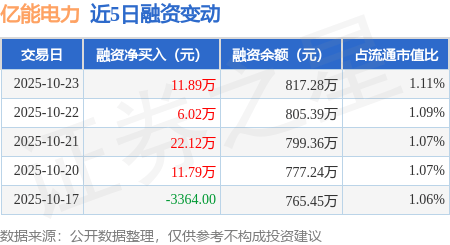
亿能电力:10月23日融资净买入11.89万元,连续3日累计净买入40.03万元
Sou Hu Cai Jing· 2025-10-24 02:41
Core Insights - The company YN Power (亿能电力) has seen a net financing purchase of 118,900 yuan on October 23, 2025, with a total financing balance of 8,172,800 yuan, indicating a positive market sentiment towards the stock [1][2][3] Financing Activity Summary - On October 23, 2025, YN Power had a financing buy of 268,800 yuan and a financing repayment of 150,000 yuan, resulting in a net financing purchase of 118,900 yuan [1] - The financing balance increased by 1.48% from the previous day, reflecting a growing interest in the stock [3] - Over the past three trading days, the cumulative net financing purchase reached 400,300 yuan, indicating sustained buying interest [1] Market Sentiment Analysis - The financing balance as a percentage of the circulating market value was 1.11% on October 23, 2025, suggesting a moderate level of leverage in the market [2] - The increase in financing balance over the last few days suggests a strengthening bullish sentiment among investors [4]

中泰国际每日晨讯-20251022
ZHONGTAI INTERNATIONAL SECURITIES· 2025-10-22 01:34
Market Overview - The Hang Seng Index closed at 26,028 points, up 0.7%, while the Hang Seng China Enterprises Index rose 0.8% to 9,303 points[1] - Total trading volume in Hong Kong stocks was HKD 264.7 billion, an increase from HKD 239.2 billion on Monday, indicating investor contention[1] - Key sectors: Industrial (+1.4%), Consumer Discretionary (+1.2%), Financials (+1.1%); Consumer Staples (-0.1%), Telecoms (-1.0%), Utilities (-0.1%)[1] Stock Performance - China Life (2628 HK) and BYD Electronics (285 HK) led gains, rising 6.0% and 3.8% respectively[1] - Pop Mart (9992 HK) and China Resources Mixc Lifestyle (1209 HK) were the biggest losers, falling 8.1% and 1.9% respectively[1] Gold Price Trends - Gold prices peaked above USD 4,300 before retreating to around USD 4,100, with expectations of continued consolidation due to already priced-in U.S. rate cut factors[1] Global Economic Factors - U.S. Treasury Secretary may hold trade talks with China's Vice Premier, potentially easing U.S.-China tensions[1] - European leaders expressed support for Trump's stance on a ceasefire in Ukraine, indicating a stabilization of geopolitical risks[1] U.S. Market Update - The Dow Jones Industrial Average closed at 46,925 points, up 0.5%, while the Hang Seng Index futures settled at 25,919 points, down 109 points[2] Japanese Economic Update - The Japanese yen depreciated to approximately 151.8 against the USD, down from 149.5 the previous week following the election of new Prime Minister[3] Industry Insights - Pop Mart reported Q3 revenue growth of 245%-250%, with domestic revenue up 185%-190% and overseas revenue up 365%-370%, despite a stock price drop of 8.1%[4] - The healthcare sector saw a slight increase of 0.3%, with major companies showing minimal volatility[4] - New energy and utilities stocks experienced fluctuations, with notable gains in nuclear and thermal power sectors[4]
绿色金融丨绿色乡村振兴债发行提速,助力乡村全面振兴——可持续债券季报(2025年三季度)
Xin Lang Cai Jing· 2025-10-21 10:14
Core Insights - The total issuance of various sustainable bonds in China's domestic market reached approximately 10.07 trillion yuan by the end of Q3 2025, with a total issuance of 337.6 billion yuan in Q3, reflecting a quarter-on-quarter decrease of 11.83% [4][7][10]. Sustainable Bonds Overview - The cumulative issuance of labeled green bonds in China reached 4.93 trillion yuan by the end of Q3 2025, with an outstanding balance of 2.32 trillion yuan. In Q3 2025, the issuance of green bonds totaled 257.69 billion yuan, down 18.03% quarter-on-quarter but up 17.24% year-on-year [7][10][11]. - Green financial bonds were the most significant category, accounting for 50.49% of the total green bond issuance in Q3 2025 [10]. - The primary funding targets for green bonds were the clean energy industry (54.06%) and infrastructure green upgrades (26.88%) [21]. Transition Bonds - By the end of Q3 2025, the cumulative issuance of transition bonds in China was 273.13 billion yuan, with a balance of 171.88 billion yuan. In Q3 2025, the issuance of transition bonds totaled 22.88 billion yuan, representing a quarter-on-quarter increase of 43.9% [2][42]. - The issuance included 20 sustainable-linked bonds totaling 16.37 billion yuan and 8 low-carbon transition-linked bonds totaling 5.4 billion yuan [42]. Other Sustainable Development Bonds - Other sustainable development-themed bonds reached a cumulative issuance of approximately 4.87 trillion yuan by the end of Q3 2025, with a total issuance of 57.03 billion yuan in Q3, reflecting a quarter-on-quarter increase of 8.4% [2][47]. - This category included 73 regional development bonds totaling 47.17 billion yuan and 4 social project bonds totaling 2.53 billion yuan [47]. Innovation Practices - The first sustainable bond from a local state-owned enterprise was successfully issued on the London Stock Exchange, marking a significant milestone for cross-border financing [50]. - The first dual-labeled credit bond in the rail industry, combining "carbon-neutral green" and "rural revitalization," was issued by the Jinhua Rail Transit Group [51]. - The first low-carbon transition-linked bond supporting small and micro enterprises was successfully issued on the Shenzhen Stock Exchange [53]. Policy Developments - The People's Bank of China and other regulatory bodies released the "Green Finance Support Project Directory (2025 Edition)," which standardizes the recognition criteria for various green financial products [54][55]. - A joint opinion was issued to enhance financial support for new industrialization, emphasizing the role of green finance in promoting low-carbon transitions in manufacturing [57]. - The Green Bond Standards Committee published a notification regarding the application of the new project directory for green bonds, ensuring a smooth transition from the previous standards [56].

科创债ETF最新规模2469亿,增持新券
HUAXI Securities· 2025-10-19 13:56
1. Report Industry Investment Rating No relevant content provided. 2. Core Viewpoints of the Report - The scale of science - innovation bond ETFs has been fluctuating around 250 billion yuan in the past three weeks, with the latest scale on October 17th being 246.9 billion yuan, and 15 out of 24 ETFs having a scale of over 10 billion yuan [1]. - The weekly issuance of science - innovation bonds has picked up, but the trading volume remains low. The net issuance reached its peak in the first week of July and then declined. The net issuance from October 13th - 17th was 45.9 billion yuan, an increase of 32.8 billion yuan compared to the previous week before the holiday [1]. - This week, science - innovation bond ETFs continued to increase their holdings of new bonds issued in September 2025, mainly in the power, energy, and brokerage sectors, with maturities concentrated between 2 - 3 years. The bonds with relatively large reductions in holdings are from diverse industries, and the reduction behavior is more dispersed [2]. - The buying power of science - innovation bond ETFs has created a spread between non - component bonds and component bonds of the same issuer. As of October 17th, the central spread was 10.9bp, slightly down 0.4bp from October 10th. Attention should be paid to bonds with relatively high or low spreads [3]. 3. Summary by Related Content Science - innovation Bond ETF Scale and Issuance - As of October 17th, the total scale of science - innovation bond ETFs was 246.9 billion yuan, a decrease of 5.2 billion yuan from last Friday. Among the two batches of 24 science - innovation bond ETFs, 15 had a scale of over 10 billion yuan [1][13]. - The net issuance of science - innovation bonds reached its peak in the first week of July and then fluctuated downward. From October 13th - 17th, the net issuance was 45.9 billion yuan, an increase of 32.8 billion yuan compared to the previous week before the holiday, mainly due to the concentrated bond issuance of central enterprises [1]. Science - innovation Bond ETF Trading Volume - The trading volume of science - innovation bonds reached its peak in July and then cooled down. The trading volume this week was relatively low but still higher than before the listing of science - innovation bond ETFs. In the first week of the ETF listing (July 14th - 18th), the trading volume of science - innovation bonds and the trading volume of component bonds of science - innovation bond ETFs accounted for 18% and 14% of credit bonds respectively, and in the past three weeks, they have fluctuated around 10% and 5% [1]. Science - innovation Bond ETF Holdings Adjustment - This week, the increase in holdings of science - innovation bond ETFs continued the pattern of the previous week before the holiday, mainly focusing on new bonds issued in September 2025, involving industries such as power, energy, and brokerage, with maturities concentrated between 2 - 3 years. Among the top 15 component bonds with increased holdings this week, 9 were new bonds issued in September 2025, and 2 were new bonds issued in August 2025 [2]. - The component bonds with relatively large reductions in holdings are from diverse industries such as industrial investment, ports, brokerage, automobiles, and construction, with maturities concentrated between 2 - 3 years. The reduction behavior is more dispersed compared to the increase in holdings [2]. Spread between Non - component Bonds and Component Bonds - The buying power of science - innovation bond ETFs has led to a spread between non - component bonds and component bonds of the same issuer. As of October 17th, the central spread was 10.9bp, slightly down 0.4bp from October 10th. The spread was not obvious before the issuance of the first batch of science - innovation bond ETFs (end of June), only 0 - 2bp, and then increased to 10.0bp after listing (July 18th), narrowed to 9bp at the end of July, and increased again to 9.9bp when the second batch of ETFs started the application process (August 8th), and has since fluctuated around 10bp [3]. - In terms of the term difference of the spread, the spreads for bonds with maturities of 0 - 1 year and over 5 years are relatively low, with a central spread of around 8bp, while the spreads for bonds with maturities of 1 - 5 years are relatively high, ranging from 10 - 13bp [3]. - In terms of individual bond strategies, attention should be paid to bonds with relatively high or low spreads between non - component bonds and component bonds. As of October 17th, 7 issuers had spreads higher than 20bp, indicating that their component bonds were over - bought and the cost - effectiveness of non - component bonds increased. 4 issuers had spreads lower than 8.5bp, suggesting that the valuation of component bonds may still have room for compression [3][4].
信用债周度观察(20251013-20251017):信用债发行量环比增长,各行业信用利差整体下行-20251018
EBSCN· 2025-10-18 09:17
1. Report Industry Investment Rating No relevant content provided. 2. Core View of the Report - Credit bond issuance volume increased month - on - month, and the credit spreads of various industries generally declined [1] 3. Summary by Directory 3.1 Primary Market 3.1.1 Issuance Statistics - From October 13 to October 17, 2025, a total of 379 credit bonds were issued, with a total issuance scale of 433.329 billion yuan, a month - on - month increase of 206.54% [1][11] - In terms of issuance scale, 177 industrial bonds were issued, with a scale of 237.725 billion yuan, a month - on - month increase of 270.37%, accounting for 54.86% of the total credit bond issuance scale; 164 urban investment bonds were issued, with a scale of 101.634 billion yuan, a month - on - month increase of 132.16%, accounting for 23.45%; 38 financial bonds were issued, with a scale of 93.970 billion yuan, a month - on - month increase of 181.35%, accounting for 21.69% [1][11] - The average issuance term of credit bonds was 2.30 years, among which industrial bonds had an average issuance term of 1.86 years, urban investment bonds 2.87 years, and financial bonds 1.93 years [2][16] - The average issuance coupon rate of credit bonds was 2.20%, among which industrial bonds had an average issuance coupon rate of 2.09%, urban investment bonds 2.37%, and financial bonds 1.94% [2][20] 3.1.2 Cancellation of Issuance Statistics - Four credit bonds cancelled their issuance during the period [3][24] 3.2 Secondary Market 3.2.1 Credit Spread Tracking - The overall industry credit spreads declined. Among Shenwan primary industries, for AAA - rated industries, the largest upward spread was in agriculture, forestry, animal husbandry and fishery (8.2BP), and the largest downward spread was in electronics (9.8BP); for AA + - rated industries, the largest upward spread was in non - ferrous metals (2.9BP), and the largest downward spread was in electrical equipment (25.4BP); for AA - rated industries, the largest upward spread was in real estate (10.1BP), and the largest downward spread was in machinery (12.9BP) [3][26] - The credit spreads of coal and steel both declined. The credit spreads of AAA and AA + - rated coal declined by 1.7BP and 7.7BP respectively, and those of AAA and AA + - rated steel declined by 6.8BP and 6.3BP respectively [26] - The credit spreads of urban investment and non - urban investment bonds at all levels declined. The credit spreads of three - level urban investment bonds declined by 3.8BP, 4.7BP, and 4.4BP respectively, and those of three - level non - urban investment bonds declined by 5BP, 4.4BP, and 5.3BP respectively [27] - The credit spreads of state - owned enterprises and private enterprises both declined. The credit spreads of three - level central state - owned enterprises declined by 4.9BP, 3.1BP, and 7.6BP respectively, those of three - level local state - owned enterprises declined by 4.9BP, 4.5BP, and 5.3BP respectively, and the credit spreads of AAA and AA + - rated private enterprises declined by 7.9BP and 8BP respectively [27] - The regional urban investment credit spreads showed mixed trends. In terms of spread levels, for AAA - rated regions, the three regions with the highest credit spreads were Shaanxi, Liaoning, and Jilin; for AA + - rated regions, they were Qinghai, Shaanxi, and Gansu; for AA - rated regions, they were Sichuan, Shaanxi, and Guangxi. In terms of month - on - month changes, for AAA - rated regions, the largest upward spread was in Shaanxi (8.8BP), and the largest downward spread was in Inner Mongolia (9.1BP); for AA + - rated regions, the largest downward spread was in Heilongjiang (9BP); for AA - rated regions, the largest upward spread was in Fujian (8.4BP), and the largest downward spread was in Yunnan (12.9BP) [28] 3.2.2 Trading Volume Statistics - The total trading volume of credit bonds was 1457.824 billion yuan, a month - on - month increase of 70.45%. The top three in terms of trading volume were commercial bank bonds, corporate bonds, and medium - term notes. Specifically, commercial bank bonds had a trading volume of 380.333 billion yuan, a month - on - month increase of 49.20%, accounting for 26.09% of the total credit bond trading volume; corporate bonds had a trading volume of 406.552 billion yuan, a month - on - month increase of 71.21%, accounting for 27.89%; medium - term notes had a trading volume of 361.073 billion yuan, a month - on - month increase of 103.74%, accounting for 24.77% [4][29] 3.2.3 Actively Traded Bonds in the Current Period - The top 20 urban investment bonds, industrial bonds, and financial bonds in terms of trading volume were selected for investors' reference [31]
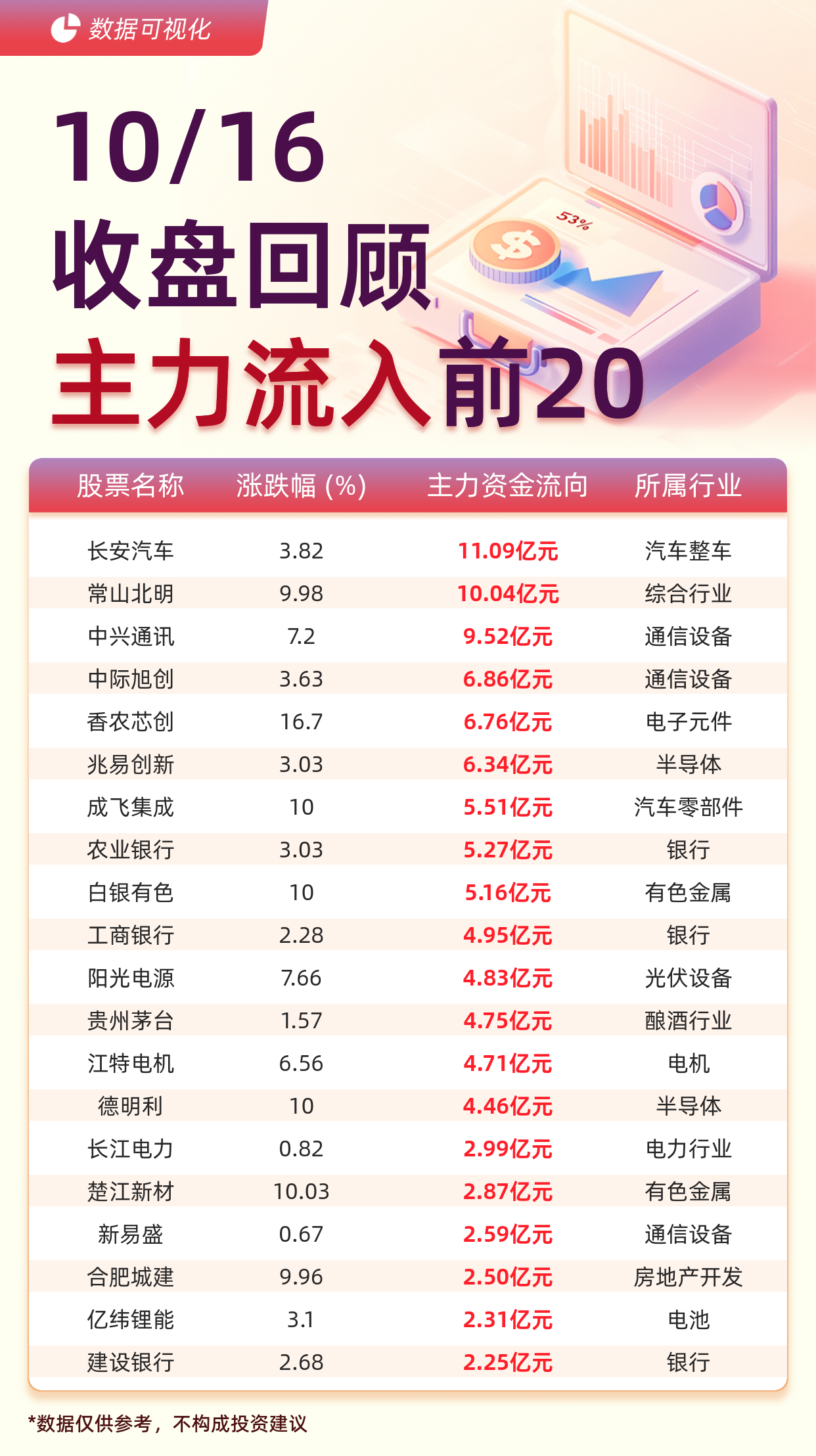
主力资金流入前20:长安汽车流入11.09亿元、常山北明流入10.04亿元
Jin Rong Jie· 2025-10-16 07:15
Core Insights - The main focus of the articles is on the significant inflow of capital into specific stocks as of October 16, with notable amounts recorded for various companies across different sectors [1][2][3] Group 1: Capital Inflows - The top stocks by capital inflow include Chang'an Automobile (¥1.109 billion), Changshan Beiming (¥1.004 billion), and ZTE Corporation (¥0.952 billion) [1] - Other notable inflows were seen in companies such as Zhongji Xuchuang (¥0.686 billion), Shannon Chip (¥0.676 billion), and Zhaoyi Innovation (¥0.634 billion) [1][2] - The banking sector also saw significant inflows, with Agricultural Bank of China receiving ¥0.527 billion and Industrial and Commercial Bank of China receiving ¥0.495 billion [1][3] Group 2: Stock Performance - Chang'an Automobile experienced a price increase of 3.82%, while Changshan Beiming saw a rise of 9.98% [2] - ZTE Corporation's stock rose by 7.2%, and Zhongji Xuchuang's increased by 3.63% [2] - Shannon Chip had the highest increase at 16.7%, indicating strong market interest [2] Group 3: Sector Analysis - The automotive sector is represented by companies like Chang'an Automobile and Chengfei Integration, both showing positive capital inflows and stock performance [1][2] - The banking sector, including Agricultural Bank and Industrial and Commercial Bank, also demonstrated resilience with steady inflows [1][3] - The electronics and communication sectors, represented by companies like ZTE Corporation and Shannon Chip, are attracting significant investment, reflecting a growing interest in technology stocks [1][2]




理响中国丨全国统一大市场的“那些事”
Xin Hua Wang· 2025-10-14 05:35
Core Insights - The construction of a nationwide unified market in China is crucial for countering uncertainties in international circulation by leveraging the certainty of domestic circulation [2][3] - The achievements during the "14th Five-Year Plan" period highlight the acceleration of building a unified market, showcasing the internal circulation advantages of a large economy [3][5] Summary by Sections Importance of the Unified Market - The unified market is essential as it addresses the need for a stable domestic economy amidst changing external conditions, promoting the smooth flow of resources across regions [2][3] - The market resources are identified as a significant advantage for China, which must be fully utilized to support the new development pattern [2] Achievements During the "14th Five-Year Plan" - The construction of the unified market has gained momentum, with significant contributions from both supply and demand sides, enhancing market vitality [3] - The establishment of a unified electricity market has been a notable achievement, with market-based trading accounting for 63% of total electricity consumption by 2024 [5] Infrastructure and Logistics Development - The development of high-standard infrastructure has accelerated, significantly reducing transaction costs across the economy [6] - The logistics network has expanded, with the total operational mileage of the national transportation network increasing by over 300,000 kilometers compared to the previous five-year plan [6] Consumer Market Dynamics - Consumer spending has contributed an average of 56.2% to economic growth during the "14th Five-Year Plan," with retail sales expected to exceed 50 trillion yuan by 2025 [6] - New consumption trends are emerging, including digital consumption and AI-driven purchasing, indicating a shift towards innovative market dynamics [6] Reform and Open Market Strategies - The key to achieving the unified market's goals lies in reforming the relationship between government and market, fostering a fair competitive environment [7] - The government has streamlined market access regulations, reducing the negative list of market entry by one-third, thus enhancing efficiency [7][10] - The focus on high-level institutional openness aims to create a world-class business environment, facilitating international trade and investment [10]
中天科技股价跌5.07%,汇添富基金旗下1只基金重仓,持有7.81万股浮亏损失7.5万元
Xin Lang Cai Jing· 2025-10-14 05:25
Group 1 - The core point of the news is that Zhongtian Technology's stock price dropped by 5.07% to 17.96 CNY per share, with a trading volume of 2.019 billion CNY and a turnover rate of 3.21%, resulting in a total market capitalization of 61.297 billion CNY [1] - Zhongtian Technology, established on February 9, 1996, and listed on October 24, 2002, operates in various sectors including communication, electricity, marine, new energy, new materials, and non-ferrous metal trading [1] - The company's main business revenue composition includes: 41.17% from grid construction, 17.44% from copper products, 16.84% from optical communication and networks, 14.57% from new energy, 7.58% from marine series, and 1.39% from other sources [1] Group 2 - From the perspective of fund holdings, only one fund under Huatai PineBridge has Zhongtian Technology as a top ten holding, specifically the Huatai PineBridge CSI Telecom Theme ETF (560300), which reduced its holdings by 32,900 shares in the second quarter, now holding 78,100 shares, accounting for 1.69% of the fund's net value [2] - The Huatai PineBridge CSI Telecom Theme ETF (560300) was established on December 5, 2023, with a latest scale of 66.9014 million CNY, and has achieved a year-to-date return of 33.36%, ranking 1511 out of 4220 in its category [2] - The fund manager, He Lizhu, has been in position for 211 days, with the fund's total asset size at 5.872 billion CNY, achieving a best return of 48.82% and a worst return of -3.41% during her tenure [3]

中国电力企业联合会党委副书记、副理事长王抒祥接受纪律审查和监察调查
Zhong Yang Ji Wei Guo Jia Jian Wei Wang Zhan· 2025-10-11 09:05
Group 1 - The Deputy Secretary and Vice Chairman of the China Electricity Council, Wang Shuxiang, is under investigation for serious violations of discipline and law [1] - The investigation is being conducted by the Central Commission for Discipline Inspection and the Supervisory Commission of Mudanjiang City, Heilongjiang Province [1]