
教育

Search documents
鹅厂的教育梦:黎明前的清醒者
Sou Hu Cai Jing· 2025-11-03 17:44
Core Insights - The article discusses the evolution of the education sector, highlighting the initial enthusiasm from major internet companies and the subsequent challenges faced as market dynamics shifted [2][3] - Tencent's approach to education is characterized by a strategic pivot towards B2B services, focusing on providing digital solutions rather than competing directly in the education content space [5][12] Group 1: Major Players in Education - Internet giants initially entered the education sector with high ambitions, leveraging their technological strengths to explore growth opportunities [4] - ByteDance adopted an aggressive strategy with significant investments and a commitment to long-term growth, while Alibaba focused on integrating education with its e-commerce ecosystem [4] - Baidu emphasized technological innovation in education, aiming to address personalized learning needs through AI and smart hardware [4] Group 2: Tencent's Unique Position - Unlike other companies that drastically cut back on their education initiatives, Tencent maintained a steady focus on the sector, demonstrating a unique resilience and strategic patience [5][6] - Tencent shifted its focus from consumer-facing products to B2B solutions, integrating its education services with Tencent Cloud to provide comprehensive digital solutions for educational institutions [7][8] Group 3: Strategic Transformation - Tencent's transformation is marked by three key shifts: moving from direct consumer engagement to serving enterprises and institutions, redefining its role from a competitor to an enabler within the education ecosystem, and transitioning from content-driven competition to a technology-driven approach [12][13][14] - The company aims to empower educational institutions by providing stable cloud services and innovative AI capabilities, rather than competing for market share [13] Group 4: Long-term Vision - Tencent's strategy reflects a long-term commitment to the education sector, recognizing that meaningful educational advancements require time and sustained effort [16] - The company’s approach is aligned with the inherent nature of the education industry, which values gradual development over rapid growth [16][17]



方直科技:股东黄晓峰计划减持公司股份不超过752.27万股
Mei Ri Jing Ji Xin Wen· 2025-11-03 12:07
Company Overview - Fangzheng Technology (SZ 300235) announced on November 3 that major shareholder Huang Xiaofeng plans to reduce his stake by up to 7.5227 million shares, representing no more than 3% of the company's total share capital, within a three-month period from November 25, 2025, to February 24, 2026, through centralized bidding and block trading methods [1] Financial Performance - For the first half of 2025, Fangzheng Technology's revenue composition was 93.4% from the education sector and 6.6% from other sources [1] - As of the report date, Fangzheng Technology's market capitalization stood at 4.5 billion yuan [1]

好未来Q2净利翻倍:8.61亿美元营收背后,素质教育+智能学习迎政策红利
Zhong Guo Jing Ying Bao· 2025-11-03 09:30
Core Viewpoint - The report highlights significant revenue and profit growth for TAL Education Group in Q2 of FY2026, driven by advancements in smart education solutions and favorable national policies supporting the education technology sector [1][2]. Financial Performance - In Q2 of FY2026, the company achieved a net revenue of $861 million, a 39.1% increase from $619 million in the same period last year [1]. - Operating profit reached $96.1 million, up approximately 101.8% from $47.6 million year-over-year [1]. - Net profit attributable to TAL was $124 million, representing a 116.1% increase compared to $57.4 million in the previous year [1]. - Non-GAAP net profit, excluding stock-based compensation, was $136 million, reflecting an 82.7% year-over-year growth [1]. - Basic and diluted net profit per ADS were $0.22 and $0.21, respectively, both significantly higher than the previous year's figures [1]. Half-Year Performance - For the first half of the fiscal year, net revenue totaled $1.436 billion, a year-over-year increase of approximately 39.0% [2]. - Operating profit for the half-year was $110 million, showing a substantial growth of about 264.6% [2]. - Net profit attributable to shareholders was $155 million, up 125.7% from the previous year [2]. - Non-GAAP net profit for the half-year was $178 million, a 71.1% increase year-over-year [2]. - Cash and cash equivalents, along with short-term investments, amounted to $3.249 billion, providing a solid financial foundation for ongoing investments in R&D and content development [2]. Industry Background and Policy Drivers - The education sector is transitioning from traditional exam-oriented education to a focus on "capability cultivation, quality education, and technology empowerment" [3]. - National policies explicitly support this transition, emphasizing the need for quality education to foster innovation and practical skills among students [3]. - The "double reduction" policy has led to stricter regulations on extracurricular academic training, pushing the industry towards quality education and smart learning solutions [3]. Market Size and Growth - The Chinese digital education market is projected to reach approximately 468.5 billion yuan in 2024, with a year-over-year growth of about 13.35% [4]. - The user base in the education sector is expected to grow to 355 million by 2024, reflecting an 11.14% increase [4]. - The smart education hardware market is anticipated to reach around 96.2 billion yuan in 2024, with a growth rate of approximately 19.21% [4]. - The "AI + education" sector is expected to grow significantly, with market size projected to reach about 160 billion yuan by 2027 and nearly 180 billion yuan by 2030 [4]. Strategic Opportunities - The favorable policies and market data present two key opportunities for TAL: alignment with the quality education direction and the potential for growth in smart learning hardware and AI-driven educational solutions [5]. - The company's strategy of integrating "content, hardware, and intelligent systems" aligns well with industry trends, positioning it for future growth [5].

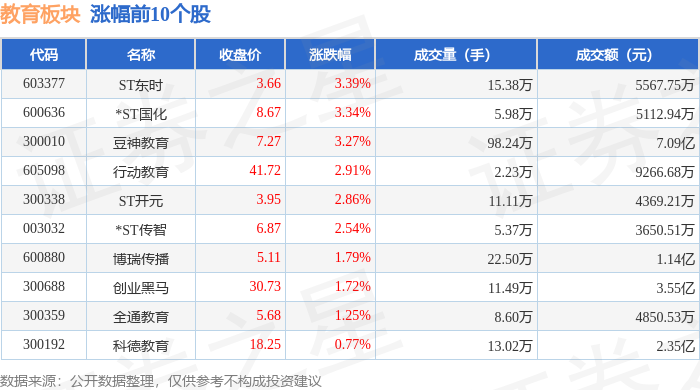
教育板块11月3日涨1.16%,ST东时领涨,主力资金净流出568.43万元
Zheng Xing Xing Ye Ri Bao· 2025-11-03 08:47
Market Overview - The education sector increased by 1.16% on November 3, with ST Dongshi leading the gains [1] - The Shanghai Composite Index closed at 3976.52, up 0.55%, while the Shenzhen Component Index closed at 13404.06, up 0.19% [1] Individual Stock Performance - ST Dongshi (603377) closed at 3.66, up 3.39% with a trading volume of 153,800 shares and a turnover of 55.68 million yuan [1] - *ST Guohua (600636) closed at 8.67, up 3.34% with a trading volume of 59,800 shares and a turnover of 51.13 million yuan [1] - Dou Shen Education (300010) closed at 7.27, up 3.27% with a trading volume of 982,400 shares and a turnover of 709 million yuan [1] - Action Education (605098) closed at 41.72, up 2.91% with a trading volume of 22,300 shares and a turnover of 92.67 million yuan [1] - Other notable stocks include ST Kaiyuan (300338) up 2.86% and *ST Chuan Zhi (003032) up 2.54% [1] Capital Flow Analysis - The education sector experienced a net outflow of 5.68 million yuan from institutional investors, while retail investors saw a net inflow of 9.23 million yuan [2] - The capital flow for individual stocks shows that Dou Shen Education had a net outflow of 32.06 million yuan from institutional investors [3] - Zhong Gong Education (002607) had a net inflow of 16.43 million yuan from institutional investors, indicating a positive sentiment [3]



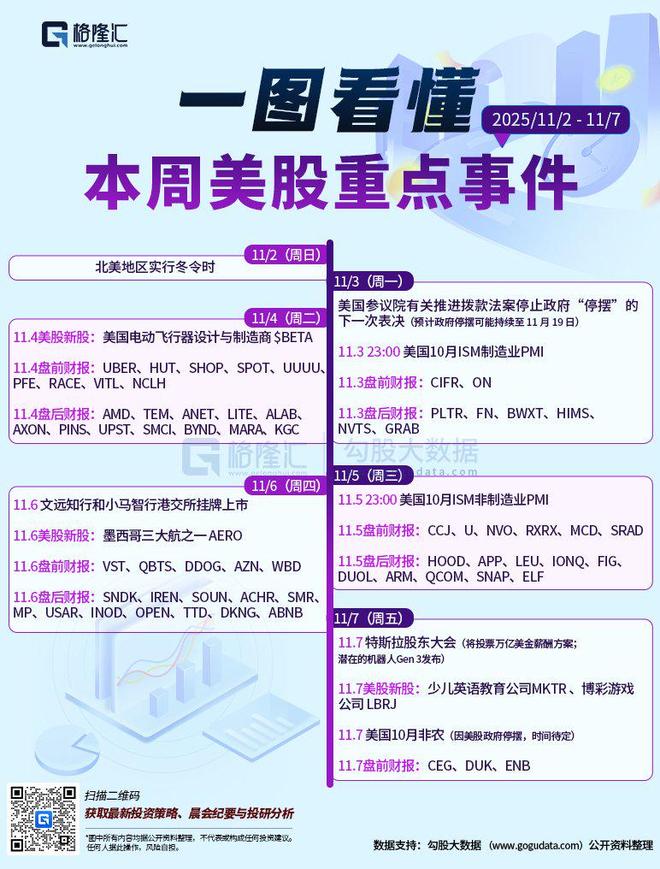
图解丨本周美股重点事件
Ge Long Hui A P P· 2025-11-03 06:30
Core Insights - The article outlines key events in the U.S. stock market for the week of November 2 to November 7, 2025, including significant earnings reports and economic indicators [2]. Group 1: Economic Indicators - On November 3, the U.S. will release the October ISM Manufacturing PMI [2]. - On November 5, the October ISM Non-Manufacturing PMI will be published [2]. Group 2: Earnings Reports - Pre-market earnings reports on November 3 include companies such as CIFR, ON, PFE, RACE, VITL, and NCLH [2]. - Post-market earnings reports on November 3 include PLTR, FN, BWXT, HIMS, AXON, PINS, UPST, SMCI, BYND, MARA, KGC, NVTS, and GRAB [2]. - Pre-market earnings reports on November 5 include CCJ, U, NVO, RXRX, MCD, and SRAD [2]. - Post-market earnings reports on November 5 include HOOD, APP, LEU, IONQ, and FIG [2]. - Pre-market earnings reports on November 6 include VST, QBTS, DDOG, AZN, WBD, DUOL, ARM, QCOM, SNAP, and ELF [2]. - Post-market earnings reports on November 6 include SNDK, IREN, SOUN, ACHR, SMR, MP, USAR, INOD, OPEN, TTD, DKNG, and ABNB [2]. Group 3: New Listings - On November 4, a new stock from the electric aircraft manufacturer $BETA will be listed [2]. - On November 6, two companies, 文远知行 and 小马智行, will be listed on the Hong Kong Stock Exchange [2]. - On November 7, new stocks from children's English education company MKTR and gaming company LBRJ will be listed [2]. Group 4: Significant Events - On November 7, Tesla's shareholder meeting will take place, where a $1 trillion compensation plan will be voted on, and a potential Gen 3 robot release is expected [2]. - The timing for the release of the October non-farm payroll data is pending due to the government shutdown [2].
消费者服务行业周报(20251027-20251031):关注十五五提振消费相关政策-20251103
Huachuang Securities· 2025-11-03 05:24
Investment Rating - The report maintains a "Buy" rating for the consumer services industry, emphasizing the potential for growth driven by government policies aimed at boosting consumption [1]. Core Insights - The report highlights the importance of the "14th Five-Year Plan" which aims to significantly enhance consumer spending through various measures, including increasing public service expenditure and improving consumer rights protection [4]. - It suggests that the current transformation in China's service consumption sector presents a prime investment opportunity, particularly in service consumption platforms, hotel groups with improving margins, and the tourism sector [4]. Industry Overview - The consumer services sector consists of 55 listed companies with a total market capitalization of approximately 498.8 billion yuan and a circulating market value of about 457.1 billion yuan [1]. - The sector's performance over the past month shows a decline of 7.7%, while the 12-month performance indicates a growth of 9.2% [2]. Market Performance - The consumer services industry experienced a weekly increase of 0.45%, outperforming the overall A-share market which rose by 0.39% [7]. - Notable stocks in the sector include Dalian Shengya, Chuangye Heima, and Fangzhi Technology, which showed significant gains [4]. Key Announcements - Major announcements include Meituan's issuance of $2 billion in senior bonds with a subscription rate exceeding 5.7 times, and Guangzhou Restaurant's third-quarter revenue of 2.293 billion yuan, reflecting a year-on-year growth of 4.66% [31][32]. Upcoming Events - Several companies in the sector are scheduled to hold shareholder meetings in November, including Guangzhou Restaurant and Yunnan Tourism, which may provide further insights into their operational strategies and financial performance [35][36]. Industry News - Recent developments include the collaboration between Mixue Ice City and Hainan Airlines to launch a co-branded flight, and the introduction of pet-friendly travel products by Zhongxin Tourism, indicating innovation in service offerings [37][38].



拓展增量 提升效益 畅通循环——锚定三方面重点任务 建设强大国内市场
Zhong Guo Zheng Quan Bao· 2025-11-03 02:39
Core Viewpoint - The "15th Five-Year Plan" emphasizes the importance of a strong domestic market as a strategic foundation for China's modernization, focusing on expanding domestic demand and enhancing the interaction between supply and demand to boost economic resilience [1][2]. Group 1: Consumer Demand - The plan prioritizes boosting consumption as a key task for building a strong domestic market, leveraging the potential of over 800 million middle-income individuals in China [2]. - Measures include increasing public service spending and implementing inclusive policies to enhance consumer capacity, with a focus on improving employment as a fundamental aspect [2][3]. - The strategy involves both demand-side and supply-side efforts to stimulate consumption, with an emphasis on creating a favorable consumption environment through institutional guarantees [3]. Group 2: Investment Focus - The concept of "investing in people" is highlighted as crucial for economic and social structural transformation, with a call for optimizing investment structures and enhancing investment efficiency [4][5]. - The plan suggests increasing investments in public services and human capital, particularly in education, healthcare, and emerging technologies, to support sustainable economic growth [4][5]. - Specific measures include improving government investment management and reforming investment approval processes to ensure effective allocation of resources [5]. Group 3: Market Barriers - The plan aims to eliminate various market barriers to facilitate the efficient aggregation of domestic and international resources, thereby unlocking China's market potential [6][7]. - Significant progress has been made in cleaning up regulations that hinder market unity, with a reduction in market access restrictions and policies obstructing resource flow [6][7]. - The establishment of a unified national market is seen as essential for enhancing market efficiency and promoting coordinated regional development [6][7].
拓展增量 提升效益 畅通循环 锚定三方面重点任务 建设强大国内市场
Zhong Guo Zheng Quan Bao· 2025-11-02 20:39
Group 1: Core Insights - The "15th Five-Year Plan" emphasizes the importance of a strong domestic market as a strategic foundation for Chinese modernization, focusing on expanding domestic demand and enhancing the interaction between supply and demand [1][2][3] - Key tasks include boosting consumption, increasing effective investment, and removing barriers to the construction of a unified national market [1][6] Group 2: Consumption Boosting Strategies - The plan prioritizes boosting consumption, leveraging China's large population and the expected growth of the middle-income group to tap into market potential [2] - Measures include increasing public service spending to enhance consumer capacity and implementing inclusive policies to support livelihoods [2][4] Group 3: Supply-Side Enhancements - The strategy involves leading new supply with new demand, focusing on high-quality, personalized, and green products and services to meet the evolving needs of consumers [3][4] - Institutional guarantees will be established to optimize the consumption environment, encouraging consumer spending [3][5] Group 4: Effective Investment Focus - "Investment in people" is highlighted as a key approach to drive economic and social structural transformation, with a focus on enhancing public service and human capital investment [4][5] - The plan aims to optimize investment structure, improve investment efficiency, and reform the investment financing system to better allocate government funds [4][5] Group 5: Market Barrier Removal - The removal of market barriers is crucial for efficiently aggregating domestic and international resources, facilitating a unified national market [6][7] - The plan outlines systematic deployments to eliminate local protectionism and market segmentation, aiming to create a high-standard market system [6][7]
拓展双向投资合作空间更多细化措施将出台
Zhong Guo Zheng Quan Bao· 2025-11-02 20:16
Group 1 - The core viewpoint of the article emphasizes the importance of expanding bilateral investment cooperation and enhancing foreign investment attraction as key strategies during the "15th Five-Year Plan" period [1][2] - The Ministry of Commerce reported that from January to September this year, 48,921 new foreign-invested enterprises were established, a year-on-year increase of 16.2%, with actual foreign investment amounting to 573.75 billion yuan, reflecting a growth of 11.2% in September alone [1][2] - The focus on high-tech industries is evident, with over one-third of foreign investment directed towards high-tech sectors, including automotive, healthcare, and electronic information [1][2] Group 2 - The article highlights the need to simplify approval processes and ensure both market entry and operational ease for foreign investors, particularly in the service sector [2][3] - The negative list for foreign investment access will be further reduced, particularly in telecommunications, internet, education, culture, and healthcare sectors [3] - The government aims to create a favorable investment environment by enhancing intellectual property protection and providing policy incentives to attract high-tech industries and R&D centers [2][3] Group 3 - The article discusses the significance of optimizing foreign investment management to facilitate China's deeper participation in global industrial division and cooperation [4][5] - In 2024, China's outward direct investment is projected to reach 192.2 billion USD, marking an 8.4% increase from the previous year, maintaining a global share of 11.9% [4] - The establishment of a comprehensive overseas service system is emphasized to support enterprises going abroad, ensuring compliance and enhancing the supply chain's resilience [5]
山东滨州:沉睡资产正焕新
Jing Ji Ri Bao· 2025-11-01 02:21
Core Insights - The transformation of the Huaneng Zhanhua Thermal Power Company into Shandong's largest wind-solar power station demonstrates effective resource revitalization and project upgrades, significantly increasing power generation efficiency [1] - The "government-court linkage" approach in Binzhou combines judicial expertise with government resources to address complex bankruptcy issues, ensuring environmental responsibilities are prioritized during corporate restructuring [1] - The initiative to revitalize dormant state-owned assets in Binzhou aims to clear "sleeping assets" by 2027, with a current asset revitalization rate of 24.2%, exceeding initial targets [2] Group 1 - The Huaneng Shandong Company invested nearly 100 million yuan to initiate a new energy project, transitioning from coal to renewable energy generation [1] - The Binzhou Water Development Group is implementing a transformation model that utilizes idle land and facilities to create a high-end equipment manufacturing park, projected to generate an annual output value of 850 million yuan [2] - The focus on "tailored solutions" for asset disposal allows each asset to find the most suitable path based on its unique conditions, enhancing overall efficiency [3] Group 2 - The Binzhou government has completed asset revitalization worth 3.21 billion yuan, with state-owned enterprises experiencing a year-on-year increase in total assets and operating income of 15.89% and 20.29%, respectively [3] - The transformation of the original wetland restoration technology center into a space for aerospace culture education is expected to attract 1 million visitors annually, generating 50 million yuan in revenue [3] - The ongoing revitalization efforts are characterized as a long-term battle requiring comprehensive coordination and targeted breakthroughs to optimize the layout of state-owned capital [3]