石化

Search documents
弱预期暂未扭转,估值修复尚待时日
Dong Zheng Qi Huo· 2025-09-30 05:43
Industry Investment Rating - Pure Benzene: Sideways [2] - Styrene: Sideways [2] Core Viewpoints - In the fourth quarter, the pure benzene and styrene industry chain may need time to recover. Pure benzene faces dual supply pressures of increased import volume and new capacity ramping up, with downstream profit issues posing potential risks of reduced production. Styrene has a higher potential supply growth rate, and potential stockpiling problems may become a core contradiction. The industry needs to maintain low - profit states for a longer time to reduce supply and achieve a balance [4]. Summary by Directory 1. The biggest change in the industry chain in the third quarter was the rapid decline in styrene profits - In the third quarter, styrene prices weakened, dropping from around 7,600 yuan/ton at the end of June to about 6,900 yuan/ton recently. Pure benzene prices fluctuated less, remaining in the range of 5,800 - 6,000 yuan/ton. The trading focus shifted from compressing pure benzene valuation in the first half of the year to styrene profit decline in the third quarter [13]. - The root cause is the phased strength - weakness transformation of the pure benzene and styrene pattern. High styrene production profits in the first half of the year led to increased supply, resulting in inventory accumulation and a narrowing of the styrene - pure benzene spread [14]. 2. Pure benzene: New capacity launches are not over, and the expected import volume is rising again - From January to August, the total supply of pure benzene was 21.05 million tons, a year - on - year increase of 10.9%. Domestic production was 17.37 million tons (a 6.0% increase), and imports were 3.68 million tons (a 43.7% increase). High supply growth led to the failure of seasonal destocking in the first half of the year [18]. - In the fourth quarter, the import volume of pure benzene may rise again. South Korea's maintenance losses will decrease, and European pure benzene may flow to East Asia. New capacity, such as from Henan Fengli and Hunan Petrochemical, will be released, and planned maintenance may decrease. The monthly average output of petroleum benzene is expected to be around 2.01 million tons [19][22][23]. - Downstream industries are restricted by profit issues, and potential production cuts are a concern. New downstream capacity may not be smoothly implemented due to low profits. For example, caprolactam profits are at a five - year low, and styrene non - integrated device cash - flow profits are negative [26]. 3. Styrene: Pay attention to potential stockpiling contradictions 3.1. Demand resilience cannot match the supply increase, and the recent styrene profit center has significantly declined - The styrene - pure benzene spread has dropped from 2,000 yuan/ton in the middle of the year to around 1,000 yuan/ton, and non - integrated styrene profits have reached the lowest level this year [32]. - Styrene demand is better than expected, with 1 - 8 month production of PS, ABS, and EPS increasing by 10.3%, 24.3%, and 6.1% respectively year - on - year. However, high production profits in the first half of the year led to increased supply, with the average monthly output from July to August reaching 1.6 million tons, and the total output from January to August increasing by 16.6% year - on - year [33]. 3.2. There are concerns about weakening demand in the fourth quarter. Pay attention to whether the divergence between 3S and end - users will converge - In the third quarter, there was a divergence between the 3S开工率 and end - user demand growth. 3S production increased, but white - goods production decreased. In September, the total production of air conditioners, refrigerators, and washing machines decreased by 7.2% year - on - year [41]. - In the fourth quarter, the end - user demand for household appliances is expected to continue to decline, with the total production of three major white - goods in October decreasing by 9.9% year - on - year. Factors such as tariffs and the marginal decline of national subsidy policies affect demand. If end - user demand is weak, 3S enterprises may cut production, weakening styrene demand [45]. 3.3. The core issue for styrene in the future is how to solve potential stockpiling problems - If the 1.2 million tons/year capacity of Jilin Petrochemical and Guangxi Petrochemical is put into production in the fourth quarter, styrene stockpiling may exceed 250,000 tons, potentially leading to stockpiling at the East China main port [57]. - To solve this problem, styrene non - integrated profits need to stay below the break - even point for a long time to force more supply cuts. The industry's operating center may drop to around 70%. Next year, with less new capacity and stable 3S demand growth, the industry may return to a balanced state [57]. 4. Investment suggestions - In the fourth quarter, the pure benzene and styrene industry chain may not improve significantly. Pure benzene will face supply pressures, and styrene may have more prominent potential contradictions. The industry needs to maintain low - profit states to reduce supply, and the industry operating center may drop to around 70% [64]. - The strategy is to short the EB - BZ spread on rallies. The price range of pure benzene is expected to be 5,600 - 6,250 yuan/ton, and that of styrene is 6,500 - 7,350 yuan/ton [65].
亚洲石化行业面临多重挑战
Zhong Guo Hua Gong Bao· 2025-09-30 03:12
Core Insights - The Asian petrochemical industry is facing significant challenges due to weak demand, oversupply, geopolitical fluctuations, and volatile crude oil prices [2][4] - The olefins sector is particularly concerning, with profitability remaining in negative territory for several years, and a potential recovery not expected until after 2030 [2][3] - Capacity reductions are underway in Japan and South Korea, with Japan planning to close three naphtha steam cracking units by 2028, reducing ethylene capacity by approximately 20% [2] - The chemical industry is expected to see long-term demand growth, but short-term challenges are anticipated due to tariff-induced volatility, with a projected 25% decline in chemical demand growth in 2025 [3] Industry Challenges - The current market fundamentals are characterized by weak demand and oversupply, compounded by geopolitical tensions and fluctuating crude oil prices, leading to uncertainty in raw material procurement [2][4] - The olefins market is expected to take 3 to 4 years to address the oversupply issue, with significant capacity reductions needed to impact the global supply landscape [3] - Recent shutdowns of approximately 4 million tons per year of cracking capacity have occurred, but further closures of 20 or more units are necessary for substantial market impact [3] Raw Material Procurement - Geopolitical tensions and trade disputes are exacerbating uncertainty in raw material procurement for Asian petrochemical producers, with crude oil prices dropping from nearly $100 per barrel in 2024 to below $70 recently [4] - The expected oil price for 2026 is around $65 per barrel, prompting producers to be more cautious in their raw material selection [4] Strategic Solutions - One proposed solution is the construction of Crude Oil to Chemicals (COTC) projects, which leverage integration advantages to simplify logistics and reduce costs [5] - COTC facilities allow producers to flexibly switch between fuel and chemical production based on market demand, enhancing operational flexibility [5] - However, the ongoing downturn in the petrochemical sector is impacting downstream investments, making it challenging for new projects to achieve returns in the short to medium term [5] Trade Dynamics - The global trade flow of petrochemical products has shifted significantly over the past five years, with a nearly 35% decline in global trade volume, particularly in aromatics [5] - Asia has emerged as a leader in aromatics production, while the U.S. is focusing on ethylene glycol and polymers, indicating a potential reshaping of global trade patterns [5]
以实干书写奋进篇章
Liao Ning Ri Bao· 2025-09-30 01:05
Core Viewpoint - The recent opening of major transportation infrastructure in Liaoning, including highways and high-speed rail, is seen as a catalyst for regional economic growth and development, reflecting the province's commitment to high-quality development and modernization efforts [1][2][3]. Economic Performance - From January to August 2023, Liaoning attracted investment totaling 764.32 billion yuan, a year-on-year increase of 12.7% [3]. - The province's total import and export volume reached 501.94 billion yuan, with exports at 267.67 billion yuan, marking an 11.6% growth and a historical high [3]. - Actual foreign investment in Liaoning was 2.95 billion USD, up 118% year-on-year [3]. - Liaoning's economy grew by 5.3% in 2023, reversing a decade-long trend of growth lagging behind the national average, with total economic output surpassing 3 trillion yuan [3]. - Projections for 2024 indicate a continued growth rate of 5.1%, with total output expected to exceed 3.26 trillion yuan [3]. Industrial Development - Liaoning is focusing on building a modern industrial system, emphasizing the transformation and upgrading of traditional industries and the development of strategic emerging industries [6]. - The province is constructing four trillion-yuan industrial bases and 22 key industrial clusters, with strategic emerging industries accounting for over one-third of revenues in these clusters [6]. - New industries such as integrated circuits, robotics, and renewable energy are expanding, while future industries like biomanufacturing and quantum technology are being actively developed [6]. Open Economy - Liaoning is enhancing its internal and external openness, with significant improvements in port operations and international trade routes, including new shipping lines to South Africa and Mexico [7]. - The province is integrating into the Belt and Road Initiative, with a focus on trade, investment, and infrastructure development [7]. Social Welfare - Infrastructure improvements, such as the construction of over 1,400 kilometers of rural roads, have significantly enhanced transportation and economic conditions for local communities [8]. - The province has prioritized enhancing the well-being of its citizens, with continuous job creation and income growth aligning with economic development [8]. Business Environment - Liaoning has made substantial progress in optimizing its business environment, which has been a key factor in attracting investment and fostering enterprise confidence [10][11]. - The provincial government has implemented comprehensive reforms to streamline administrative processes and improve service delivery for businesses [12][13]. - The number of business entities in Liaoning reached 5.321 million in 2024, with a growth rate exceeding the national average [14][15]. Conclusion - The ongoing initiatives and developments in Liaoning reflect a robust commitment to economic revitalization, industrial modernization, and improved living standards, positioning the province as a competitive player in the national landscape [9][16].
美股异动|西方石油涨近3%,据报洽谈以至少100亿美元出售石化部门
Ge Long Hui· 2025-09-29 13:55
Core Viewpoint - Occidental Petroleum (OXY.US) is in talks to sell its chemical division, OxyChem, with a deal valued at a minimum of $10 billion, which would be the largest transaction in the company's history and create one of the world's largest independent chemical companies [1] Group 1 - Occidental Petroleum's stock rose nearly 3%, reaching $48.86 [1] - The divestiture of OxyChem is expected to be a significant strategic move for the company [1] - Potential buyers for the chemical division have not been immediately identified, with an official announcement expected in the coming weeks [1]

国林科技(300786.SZ)筹划现金收购凯涟捷石化91.07%股权 预计构成重大资产重组
智通财经网· 2025-09-29 11:06
Core Viewpoint - Company is planning to acquire 91.07% equity of Xinjiang Kailianjie Petrochemical Co., Ltd. ("Kailianjie") from its shareholders through cash payment, which is expected to constitute a major asset restructuring [1] Group 1: Acquisition Details - The funding for the acquisition will be sourced from the company's own funds and supplemented by bank merger loans [1] - Prior to the transaction, the company did not hold any shares in Kailianjie, but will gain control post-transaction [1] Group 2: Target Company Overview - Kailianjie specializes in the production of maleic anhydride, an important basic organic chemical raw material [1] - Maleic anhydride is primarily used to produce various downstream organic intermediates and specialty chemicals, including ethylacrylate, unsaturated polyester resins, fumaric acid, lubricant additives, agricultural chemicals, coatings, and heat-resistant styrene resins [1] Group 3: Strategic Implications - The acquisition is expected to create a synergistic relationship between Kailianjie and the company's existing business, enhancing market expansion opportunities [1]
国内高频指标跟踪(2025 年第 39 期):内需分化,外需偏弱
Haitong Securities International· 2025-09-29 10:12
Consumption - Automotive retail and wholesale volumes continue to rise, but year-on-year growth has marginally declined due to the low base effect from the Mid-Autumn Festival[6] - Service consumption has weakened, particularly in urban areas affected by typhoon weather, leading to a significant drop in subway ridership in first-tier cities[7] - Food and beverage prices have shown a slight recovery, with agricultural product wholesale prices increasing, but the year-on-year decline continues to widen due to high base effects from 2024[6] Investment - As of September 27, 2025, the cumulative issuance of special bonds reached CNY 3.71 trillion, with CNY 446.52 billion issued in September alone, marking the fastest issuance pace since 2020[19] - Real estate sales have seen a slight seasonal improvement, but the absolute values remain at historical lows, with new home sales in 30 cities showing a marginal year-on-year decline[19] - The asphalt construction rate has risen significantly, reaching a yearly high, while cement and steel consumption indicate slower construction progress[19] Trade and Export - Domestic export freight rates have decreased by 2.9% month-on-month, with container freight rates from Shanghai and Ningbo dropping by 7% and 8.5% respectively[27] - The manufacturing PMI readings for the US and Europe in September were 52.0 and 49.5, indicating a slight decline in overseas manufacturing activity, which may weaken demand for imports from China[27] Production and Inventory - Most industries are experiencing a decline in production, with coal consumption in coastal provinces showing a seasonal decrease[29] - Inventory levels are primarily decreasing, with significant reductions in coal inventories at ports due to increased downstream purchasing ahead of the holiday[37] Price Trends - The Consumer Price Index (CPI) has shown a slight recovery, with service prices in transportation, education, and healthcare increasing year-on-year, while clothing and housing prices have declined[42] - Industrial product prices are mixed, with the South China price index falling by 0.3% month-on-month, while cement prices increased by 2.5%[42] Liquidity - The central bank's net cash injection through reverse repos was CNY 640.6 billion last week, with an additional CNY 300 billion in medium-term lending facility (MLF) operations, totaling CNY 880.6 billion to support liquidity[44] - The US dollar index has risen significantly, reflecting a stronger US economy and impacting the USD/CNY exchange rate, which increased from 7.1125 to 7.1345[44]
国林科技:拟现金收购凯涟捷91.07%股权 预计构成重大资产重组
Xin Lang Cai Jing· 2025-09-29 10:05
Core Viewpoint - Guolin Technology (300786.SZ) is planning to acquire 91.07% of Xinjiang Kailianjie Petrochemical Co., Ltd. in a cash transaction, which is expected to constitute a significant asset restructuring [1] Group 1: Acquisition Details - The company currently holds no shares in the target company prior to the transaction [1] - Upon completion of the transaction, the company will gain control over the target company, which will become a subsidiary [1] - The funding for the transaction will be sourced from the company's own funds, supplemented by bank acquisition loans [1]
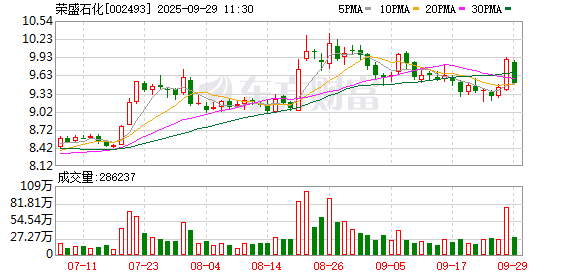
荣盛石化:公司旗下子公司浙石化及中金石化合计拥有硫磺设计产能约121万吨/年
Zheng Quan Ri Bao Wang· 2025-09-29 09:16
Group 1 - The core viewpoint of the article highlights that Rongsheng Petrochemical's subsidiaries, Zhejiang Petrochemical and Zhongjin Petrochemical, have a combined sulfur design capacity of approximately 1.21 million tons per year, ranking among the top in the country [1] Group 2 - The company actively engages with investors through interactive platforms, providing insights into its operational capabilities [1] - The sulfur production capacity is a significant aspect of the company's overall production capabilities, indicating its competitive position in the industry [1]

传西方石油(OXY.US)拟出售石化业务OxyChem 交易估值或超百亿美元
贝塔投资智库· 2025-09-29 05:16
Group 1 - Western Oil is negotiating the sale of its petrochemical subsidiary OxyChem, with an estimated transaction value of at least $10 billion [1] - This divestiture is expected to be the largest in the company's history, potentially creating one of the world's largest independent petrochemical companies [1] - The company has been reducing debt through asset sales, supported by major shareholder Warren Buffett, and the announcement of this sale is anticipated in the coming weeks [1] Group 2 - Western Oil's subsidiary 1PointFive has formed a 50:50 joint venture with Enbridge to develop the Pelican Sequestration Hub and related transportation infrastructure in Louisiana [2] - 1PointFive will be responsible for developing underground carbon dioxide storage facilities, while Enbridge will construct and operate the pipeline from customer locations to the storage hub [2]


荣盛石化:旗下子公司浙石化及中金石化合计拥有硫磺设计产能约121万吨/年,产能位居全国前列
Mei Ri Jing Ji Xin Wen· 2025-09-29 04:07
Core Viewpoint - The company, Rongsheng Petrochemical, has significant production capacity for sulfur and petroleum coke, which has positively impacted its performance due to rising prices in these commodities this year [2]. Group 1: Production Capacity - The company’s subsidiaries, Zhejiang Petrochemical and Zhongjin Petrochemical, have a combined sulfur production capacity of approximately 1.21 million tons per year, ranking among the top in the country [2]. Group 2: Market Impact - The increase in sulfur prices this year has had a positive effect on the company's sulfur business, indicating a favorable market environment [2]. - The company plans to continue monitoring market dynamics and optimize resource allocation in response to these changes [2].