
商用车

Search documents
格林大华期货早盘提示-20250916
Ge Lin Qi Huo· 2025-09-15 23:31
Report Industry Investment Rating - The report recommends a long position for macro and financial index futures (IF, IC, IM, IH) [1] Core Viewpoints - The A-share market is in a "double bottom area" in terms of fundamentals and capital inflows, with improving conditions. The transformation from a structural bull market to a full-fledged bull market hinges on anti-involution. The market is expected to continue grinding at the bottom or improve [1] - The continuous inflow of foreign capital into the Chinese mainland stock market, the significant increase in the OCI assets of major insurance companies, and the potential Fed rate cuts are expected to drive overseas funds into the A-share market. The battery sector has led the ChiNext Index to a new high and also influenced the CSI 300 Index [1][2] Summary by Related Catalogs Market Review - On Monday, the major indices in the two markets showed strong oscillations. The ChiNext Index continued to rise and reached a new high. The total trading volume in the two markets was 2.27 trillion yuan, showing a shrinking trend during the oscillations. The CSI 300 Index closed at 4,533 points, up 11 points or 0.24%; the CSI 500 Index closed at 7,137 points, down 10 points or -0.15%; the CSI 1000 Index closed at 7,415 points, down 7 points or -0.10%; the SSE 50 Index closed at 2,962 points, down 5 points or -0.20% [1] - Among industry and theme ETFs, those with the highest gains were the Gaming ETF, Film and Television ETF, Intelligent Electric Vehicle ETF, Lithium Battery ETF, and Automobile ETF, while those with the highest losses were the Communication ETF, 5G50 ETF, and Telecom ETF Fund. Among the sector indices in the two markets, the Battery, Gaming, Film and Television Theatres, Pork, and Commercial Vehicle indices had the highest gains, while the Aerospace Equipment, Rare Metals, Communication Equipment, Components, and Military Electronics indices had the highest losses [1] - The settlement funds of stock index futures for the CSI 500, CSI 1000, CSI 300, and SSE 50 indices had net outflows of 6.7 billion yuan, 6 billion yuan, 3.5 billion yuan, and 300 million yuan respectively [1] Important Information - In August, the added value of industrial enterprises above designated size increased by 5.2% year-on-year. On a month-on-month basis, it increased by 0.37%. Among the 41 major industries, 31 saw year-on-year growth in added value [1] - In August, the total retail sales of consumer goods reached 3,966.8 billion yuan, a year-on-year increase of 3.4% and a month-on-month increase of 0.17%. Excluding automobile sales, the retail sales of consumer goods were 3,557.5 billion yuan, a 3.7% increase [1] - Shenwan Hongyuan believes that technological industry trends such as AI computing power continue to catalyze, driving a structural market. The core judgment is that the fundamentals and capital inflows of the A-share market are both in the "double bottom area", with only two possibilities in the future: "continuing to grind at the bottom" and "improvement", and the improvement conditions are constantly optimizing. Anti-involution will be the key to the transformation from a structural bull market to a full-fledged bull market [1] - As of the end of June 2025, the total OCI asset scale held by the five major listed insurance companies reached approximately 1.1 trillion yuan, a record high. The growth rate of insurance funds' OCI assets in the first half of the year exceeded 35% [1][2] - Morgan Stanley released a report stating that as CATL makes breakthroughs in the European market and with the current popular solid-state battery technology, CATL's leading position will be maintained, and its valuation has significant attractiveness among its peers, making it the "cheapest in the industry" [1] - As of the end of August, the national commercial housing inventory was 761.69 million square meters, a decrease of 3.17 million square meters from the end of July. Among them, the residential inventory decreased by 3.07 million square meters, and the commercial housing inventory has decreased for six consecutive months [1] - Recently, funds have been increasing their layout in the chemical sector through ETFs. According to Wind data, as of September 11, the Peng Hua CSI Sub - Chemical Industry Theme ETF had the highest net inflow of funds in the past month among all stock - type ETFs in the market [2] - Data released by TrendForce Jibang Consulting shows that the prices in multiple upstream and mid - stream sectors of the photovoltaic industry have risen significantly recently. Analysts believe that the "anti - involution" in the photovoltaic industry has achieved initial results, and the prices of multiple links in the industrial chain are expected to maintain an upward trend [2] - Goldman Sachs maintains its target price forecast of $4,000 per ounce for gold in mid - 2026, believing that central bank gold purchase demand is expected to continue for three years, and the gold allocation ratio of emerging market central banks is still significantly low. A survey by the World Gold Council shows that 95% of central banks expect the global gold holdings to increase in the next 12 months [2] - US President Trump said that he expects the Federal Reserve to announce "substantial interest rate cuts" at this week's meeting. If true, this will be the Fed's first interest rate cut since December last year [2] Market Logic - On Monday, the major indices in the two markets showed strong oscillations, and the ChiNext Index continued to rise and reached a new high. The OCI assets in the accounting accounts of insurance companies are destined to affect the A - share market for many years. As of the end of June 2025, the total OCI asset scale held by the five major listed insurance companies reached approximately 1.1 trillion yuan, a record high. The growth rate of insurance funds' OCI assets in the first half of the year exceeded 35% [1][2] - The latest report from the Institute of International Finance (IIF) shows that in August, there was a net inflow of $39 billion into Chinese bonds and stocks. The momentum of foreign capital allocating to the Chinese mainland stock market has increased. According to EPFR data for the first week of September, foreign capital had a net inflow of $5.02 billion into Chinese mainland market stock funds [2] Future Market Outlook - On Monday, the major indices in the two markets showed strong oscillations, and the ChiNext Index continued to rise and reached a new high. The latest report from the IIF shows that in August, there was a net inflow of $39 billion into Chinese bonds and stocks. As of September 8, the margin trading balance was 2.2975 trillion yuan, with a daily increase of approximately 26.2 billion yuan. The total scale of domestic ETFs has historically exceeded the 5 - trillion - yuan mark, and ETFs have profoundly reshaped the A - share ecosystem. When residents' investment shifts from "speculating in individual stocks" to "allocating to indices", a new investment era defined by ETFs has arrived [2] - As of the end of June 2025, the total OCI asset scale held by the five major listed insurance companies reached approximately 1.1 trillion yuan, a record high. The growth rate of insurance funds' OCI assets in the first half of the year exceeded 35%. The global re - allocation of financial assets to "de - Americanize" is expected to accelerate the inflow of international funds into the A - share market. According to EPFR data for the first week of September, foreign capital had a net inflow of approximately $5.5 billion into the Chinese mainland market, of which the net inflow into stock funds was $5.02 billion. Citigroup expects the Federal Reserve to cut interest rates by a cumulative 125 basis points in the next five FOMC meetings. A storage plan has been released, and the storage installed capacity will double in three years. The battery sector has led the ChiNext Index to a new high and also influenced the CSI 300 Index. With the imminent Fed rate cuts, overseas funds will flow into the A - share market at an accelerated pace [2] Trading Strategies - Stock index futures directional trading: The battery sector has led the ChiNext Index to a new high and also influenced the CSI 300 Index. With the imminent Fed rate cuts, overseas funds will flow into the A - share market at an accelerated pace. Maintain a bullish view on stock indices [2] - Stock index options trading: The major indices are expected to continue to move upward. Seize the opportunity to buy out - of - the - money long - term call options on stock indices [2]
比亚迪商用车累计销量突破6.5万台
2 1 Shi Ji Jing Ji Bao Dao· 2025-09-15 16:02
Core Insights - BYD's commercial vehicle sales have surpassed 65,000 units, indicating strong market demand and growth potential [1] - The company has invested over 14 billion yuan in research and development, showcasing its commitment to innovation in the commercial vehicle sector [1] - The new C11 bus, launched today, features the e-Bus platform 3.0, which incorporates advanced technologies such as a 1000-volt high-voltage architecture and a high-speed tire blowout stability system [1] Summary by Categories Sales Performance - BYD's cumulative sales of commercial vehicles have exceeded 65,000 units, reflecting robust performance in the market [1] Research and Development - The company has made a significant investment of over 14 billion yuan in R&D, highlighting its focus on technological advancement [1] - The engineering team dedicated to commercial vehicle R&D consists of over 7,000 personnel, with a PhD and master's degree ratio of 31%, indicating a highly skilled workforce [1] Product Launch - The newly launched C11 bus is the first to feature the e-Bus platform 3.0, which utilizes a comprehensive 1000-volt high-voltage architecture [1] - The platform includes innovative technologies such as the cloud-based bus control system and the TBC high-speed tire blowout stability system, enhancing safety and performance [1]

如何看2025年8月消费数据
2025-09-15 14:57
Summary of Key Points from Conference Call Records Industry Overview - **Consumer Retail Sector**: In August 2025, the total retail sales of consumer goods grew by approximately 3.4% year-on-year, with offline sales showing resilient growth while online sales remained stable [2][4]. - **Restaurant Industry**: Restaurant revenue increased by 2.1% year-on-year, influenced by factors such as the alcohol ban, improved weather, and a low base from the previous year [1][5]. - **Hotel Industry**: The hotel sector experienced a decline in occupancy rates due to weak summer travel demand and oversupply, but a slowdown in supply may lead to a long-term reversal [1][6]. - **Automotive Market**: The automotive market's retail sales totaled approximately 409.3 billion yuan in August, with a year-on-year growth of 0.8%. Notably, passenger car exports surged by 22% [1][8][9]. Core Insights and Arguments - **Automotive Trends**: The rise of high-end domestic brands, particularly in the 200,000 yuan and above segment, is driving the penetration of new energy vehicles (NEVs), which saw sales of 1.28 million units in August, a 22% increase year-on-year [1][10]. - **New Energy Vehicles**: NEVs accounted for about 50% of total vehicle sales in August, with cumulative sales from January to August reaching approximately 893,000 units, reflecting a 34% year-on-year growth [9]. - **High-End Market Dynamics**: The ultra-luxury car market continues to grow, with brands like Zun Jie performing exceptionally well in deliveries [10][11]. - **Component Sector Focus**: The future of the automotive components sector is centered on smart driving, robotics, and liquid cooling technology, with the latter expected to see a tenfold increase by 2026 [12][13]. Additional Important Insights - **Investment Recommendations**: For the upcoming months, it is suggested to focus on high-performing stocks that may experience pullbacks and to position for stocks with strong earnings visibility in the fourth quarter [4]. - **Household Appliances**: The household appliance sector saw a year-on-year retail growth of 14.3% in August, with significant performance variations across product categories [23][24]. - **Cleaning Products**: The cleaning product category showed remarkable growth, with online sales of robotic vacuums and floor washers increasing by over 80% [25][26]. - **Textile and Apparel Sector**: The textile and apparel industry showed good retail performance in August, with many brands experiencing a rebound, potentially influenced by the stock market's wealth effect [15][16]. Future Trends and Strategies - **Consumer Goods**: The consumer goods sector is expected to continue its recovery, with a focus on companies that can maintain pricing power and cost transfer capabilities [22]. - **Light Industry**: Investment strategies in the light industry should focus on new product penetration and international expansion opportunities [18][19]. - **Food and Beverage Sector**: The food and beverage sector is projected to maintain steady growth, with a focus on high-end brands and those benefiting from supply chain standardization [20][22]. This summary encapsulates the key points from the conference call records, highlighting the performance and trends across various industries, along with strategic insights for future investments.
(活力中国调研行)2021年至2024年江苏实际使用外资1037.4亿美元
Zhong Guo Xin Wen Wang· 2025-09-15 10:23
(活力中国调研行)2021年至2024年江苏实际使用外资1037.4亿美元 中新社无锡9月15日电 (徐珊珊 刘洋)江苏省商务厅副厅长倪海清15日在江苏无锡举行的一场情况介绍会 上表示,"十四五"以来,江苏外贸外资主要指标总体平稳、稳中有进,2021年至2024年全省累计实际使 用外资1037.4亿美元,占全国比重达16.2%。 倪海清表示,"十四五"以来,江苏外资规模始终保持全国首位,近4.3万家外资企业以近1%的户数占 比,贡献了46.6%的进出口额、19.2%的综合税收和8.4%的城镇就业。世界500强企业中的408家在江苏 投资。 作为对外开放前沿和外资集聚高地,江苏通过加大引资稳资力度,促进外资企业深耕发展。倪海清指 出,一批优质制造业项目持续落地,2021年至2024年,江苏累计吸引制造业外资375.8亿美元,占全省 外资比重36.2%。其中,斯堪尼亚成为商用车外资股比限制取消的首批受益者,实现欧洲重卡品牌首次 以独资模式在江苏本土化生产。 目前,江苏入选全国标志性重大外资和重点外资项目分别达17个和96个,数量均居全国首位。2025年以 来,德国、日本、瑞士等对江苏实际投资增幅均超过90%。 江 ...
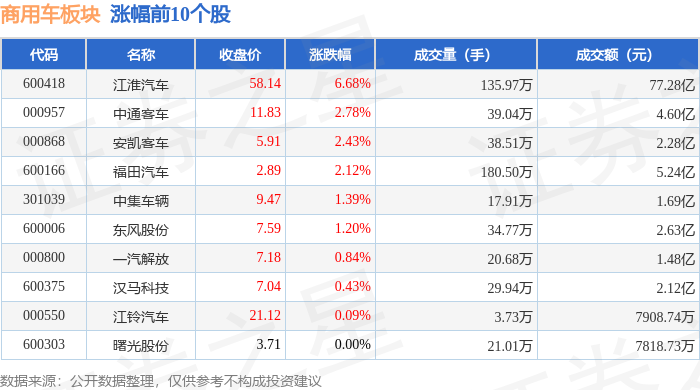
商用车板块9月15日涨2.58%,江淮汽车领涨,主力资金净流入4.05亿元
Zheng Xing Xing Ye Ri Bao· 2025-09-15 08:42
Group 1 - The commercial vehicle sector increased by 2.58% on September 15, with Jianghuai Automobile leading the gains [1] - The Shanghai Composite Index closed at 3860.5, down 0.26%, while the Shenzhen Component Index closed at 13005.77, up 0.63% [1] - Jianghuai Automobile's closing price was 58.14, reflecting a rise of 6.68% with a trading volume of 1.3597 million shares and a transaction value of 7.728 billion [1] Group 2 - The commercial vehicle sector saw a net inflow of 405 million in main funds, while retail funds experienced a net outflow of 108 million [3][4] - Jianghuai Automobile had a net inflow of 423 million in main funds, with a net outflow of 32.3 million in speculative funds [4] - The trading volume and transaction values for other companies in the sector varied, with notable performances from Zhongtong Bus and Ankai Bus, which saw increases of 2.78% and 2.43% respectively [1][3]


汽车周观点:9月第1周乘用车环比-30.0%,继续看好汽车板块-20250915
Soochow Securities· 2025-09-15 01:52
Investment Rating - The report maintains a positive outlook on the automotive sector, suggesting an increase in allocation towards automotive dividend style configurations in the second half of 2025 [4]. Core Insights - The automotive industry is at a crossroads, with the end of the electric vehicle (EV) dividend phase and the dawn of automotive intelligence. The report suggests that structural opportunities may arise similar to previous transitions in 2011 and 2018 [4]. - The report emphasizes the importance of domestic consumption expansion and quality improvement in the automotive sector, as outlined in the "Automotive Industry Stabilization and Growth Work Plan (2025-2026)" issued by eight government departments [51]. - The report forecasts a total vehicle sales target of approximately 32.3 million units for 2025, with a year-on-year growth of about 3%, and expects new energy vehicle sales to reach around 15.5 million units, growing by approximately 20% [51][52]. Summary by Sections Weekly Review - In the first week of September, the total number of compulsory insurance for passenger vehicles was 360,000 units, reflecting a week-on-week decrease of 30.0% [50]. - The report highlights the performance of various segments, with commercial trucks showing the best performance at +4.2%, while passenger vehicles declined by -1.8% [3]. Market Performance - The automotive sector ranked 15th in A-shares and 21st in Hong Kong stocks for the week, indicating a relatively average performance compared to other sectors [8][10]. - The report notes that the overall price-to-earnings (P/E) ratio for the automotive sector has decreased, with specific segments like passenger vehicles trading at 0.94 times the P/E of parts [36][43]. Industry Trends - The report identifies key changes in the industry, including new model announcements and strategic partnerships aimed at accelerating the commercialization of autonomous vehicles [3]. - The report anticipates a significant increase in the penetration of L3 and L2+ intelligent driving technologies by 2025, driven by major players like Tesla and Huawei [55][56]. Investment Recommendations - The report recommends focusing on dividend and quality configurations in segments such as buses, heavy trucks, and two-wheelers, as well as selecting stocks in the AI and robotics sectors [4]. - Specific stocks highlighted for potential investment include Yutong Bus, China National Heavy Duty Truck, and various parts manufacturers [4].
行业深度 | 2025Q2:盈利分化加剧 优质赛道韧性突显【民生汽车 崔琰团队】
汽车琰究· 2025-09-14 11:05
Group 1 - The core viewpoint of the article highlights the differentiation in the passenger car market, driven by scale effects and high-end product offerings, leading to profitability improvements [2] - In Q2 2025, the wholesale sales of passenger cars reached 7.111 million units, a year-on-year increase of 13.0% and a quarter-on-quarter increase of 11.8% [29] - The wholesale sales of new energy passenger cars were 3.629 million units, up 33.9% year-on-year and 26.3% quarter-on-quarter, indicating strong growth in this segment [29] - The revenue of sample enterprises in the passenger car sector reached 673.96 billion yuan, reflecting a year-on-year increase of 13.8% and a quarter-on-quarter increase of 20.2% [42] - The overall gross margin for passenger car companies was 15.0%, showing a slight decline compared to the previous year and quarter, with variations in performance among different companies [2] Group 2 - The automotive parts sector saw revenue growth, with Q2 2025 revenue reaching 266.42 billion yuan, a year-on-year increase of 15.7% and a quarter-on-quarter increase of 14.5% [3] - The gross margin for the parts sector was 18.2%, an increase of 0.6 percentage points year-on-year and 0.7 percentage points quarter-on-quarter, benefiting from scale effects and reduced raw material costs [3] - The net profit growth for the parts sector was 11.9% year-on-year and 18.5% quarter-on-quarter, indicating improved profitability [3] Group 3 - The motorcycle segment experienced significant growth, with Q2 2025 sales reaching 297,000 units, a year-on-year increase of 23.9% and a quarter-on-quarter increase of 44.9% [4] - Revenue for the motorcycle sector was 17.28 billion yuan, reflecting a year-on-year increase of 20.5% and a quarter-on-quarter increase of 20.1% [4] - The gross margin for key motorcycle companies was 23.3%, showing a slight decline year-on-year but an increase quarter-on-quarter [4] Group 4 - Investment recommendations include focusing on high-quality domestic brands in the passenger car sector, such as Geely, Xpeng, Li Auto, BYD, and Seres [4] - In the parts sector, recommendations include companies involved in intelligent driving and smart cockpits, such as Bertel and Jifeng [4] - For motorcycles, leading companies like Chunfeng Power and Longxin General are recommended [7]

1.8万辆爆表!8月新能源重卡渗透率创新高!TOP3均超2000 TA暴涨11倍!| 头条
第一商用车网· 2025-09-14 07:13
Core Viewpoint - The domestic new energy heavy truck market has shown remarkable growth in 2025, with sales consistently exceeding 10,000 units per month and an average year-on-year growth rate of 190% from January to July [1]. Sales Performance - In August 2025, the new energy heavy truck market sold 17,800 units, marking a 7% increase from July and a 182% increase year-on-year, making it the second-highest sales month in the history of the market [3][5]. - The average monthly sales from January to August 2025 reached 13,700 units, with a total of 113,700 units sold, reflecting a 180% year-on-year increase [22][28]. Market Penetration - The penetration rate of new energy heavy trucks reached a record high of 26.61% in August 2025, up from 25.89% in July and significantly higher than the 13.61% for the entire year of 2024 [9][12]. - From January to August 2025, the penetration rate averaged 23.39%, compared to 10.48% in the same period last year [9]. Competitive Landscape - In August 2025, five companies held over 10% market share: XCMG (15.98%), FAW Liberation (15.21%), SANY (14.36%), Shaanxi Automobile (10.91%), and China National Heavy Duty Truck Group (10.04%) [17]. - A total of 14 companies sold over 100 units in August, with three companies exceeding 2,500 units [12]. Company Performance - The top three companies in August 2025 were XCMG (2,839 units), FAW Liberation (2,702 units), and SANY (2,551 units) [13]. - Year-to-date, XCMG and SANY have sold 18,600 and 17,600 units respectively, with year-on-year growth rates of 169% and 164% [22][25]. Future Outlook - The new energy heavy truck market is expected to exceed 180,000 units in total sales for 2025, with over 20 companies already surpassing their total sales from the previous year [28].





前8月欧曼重卡销量飙升63%,载货/新能源增速双冠领跑行业!
第一商用车网· 2025-09-14 07:11
Core Viewpoint - The significant sales growth of Foton's Ouman heavy trucks in August 2025 reflects the company's successful transformation and strategic positioning in the commercial vehicle market, particularly in the context of supportive policies and market recovery [1][4][10]. Sales Performance - In August 2025, Foton's heavy truck sales reached 12,400 units, a year-on-year increase of 172%, marking the sixth consecutive month of sales exceeding 10,000 units [1]. - Cumulatively, from January to August 2025, Foton sold 90,400 heavy trucks, representing a 90% year-on-year increase, with a market share of 12.63%, up 5.02 percentage points from the previous year [1][4]. - Ouman heavy trucks achieved a 62.8% year-on-year sales increase during the same period, outperforming the overall market growth [6][10]. Market Context - The overall heavy truck market in China saw a total sales volume of 91,600 units in August 2025, with a month-on-month increase of 8% and a year-on-year increase of 47% [4]. - From January to August 2025, the cumulative sales of heavy trucks in China reached 715,700 units, reflecting a 14% year-on-year growth [4]. Product Performance - Ouman's traction trucks experienced a 49.7% year-on-year sales increase, with over 35,000 diesel traction trucks sold, ranking third in the industry [6]. - In the market for heavy-duty trucks over 18 tons, Ouman's sales surged by 126.8% year-on-year, securing the second position in the industry and the highest growth rate [6]. - Ouman's new energy heavy trucks saw an impressive 424.8% year-on-year sales growth, leading the industry in growth rate, particularly excelling in the battery swap heavy truck segment [6][12]. Strategic Initiatives - Foton's proactive strategy in the heavy truck sector includes a focus on new energy, internationalization, and smart technology, which has driven significant sales growth [10][12]. - The introduction of the "Galaxy + Star" dual-platform product lineup has been pivotal in enhancing Ouman's competitive edge, with a strong emphasis on both traditional and new energy vehicles [12]. - Future plans include expanding the product matrix in the new energy sector, enhancing operational capabilities, and increasing market competitiveness through improved supply chain management and cost control [12].

汽车行业系列深度十一:盈利分化加剧,优质赛道韧性突显
Minsheng Securities· 2025-09-14 07:09
Investment Rating - The report maintains a positive investment rating for the automotive industry, particularly highlighting opportunities in the passenger vehicle and component sectors [6]. Core Insights - The automotive industry is experiencing a divergence in profitability, with high-quality segments demonstrating resilience amid increasing competition and market pressures [1][2][3]. - The passenger vehicle segment is benefiting from scale effects and a shift towards high-end models, with wholesale sales reaching 7.111 million units in Q2 2025, a year-on-year increase of 13.0% [1]. - The component sector is witnessing sustained revenue growth, particularly in intelligent and lightweight segments, with Q2 2025 revenue at 266.42 billion yuan, up 15.7% year-on-year [2]. - The commercial vehicle sector, especially heavy trucks, is showing signs of recovery, with Q2 2025 wholesale sales of heavy trucks at 274,000 units, a year-on-year increase of 18.3% [3]. - The motorcycle segment is also thriving, with sales of 297,000 units in Q2 2025, reflecting a year-on-year growth of 23.9% [4]. Summary by Sections 1. Industry Overview - The automotive sector's fund holding ratio decreased to 6.25% in Q2 2025, indicating a cautious market outlook despite strong demand [12][19]. 2. Passenger Vehicles - The passenger vehicle segment is driven by policy support and a focus on high-end models, with significant sales growth in new energy vehicles, which saw a 33.9% increase in wholesale sales year-on-year [1][39]. - The average selling price (ASP) is showing divergence, influenced by the product mix and market positioning [1]. 3. Components - The components sector is experiencing robust revenue growth, with intelligent driving and automotive electronics leading the way, and a gross margin of 18.2% in Q2 2025, up from the previous quarter [2][3]. 4. Commercial Vehicles - Heavy trucks are recovering with a 1.0% year-on-year revenue increase, while buses are benefiting from both domestic and export demand, with a 7.6% increase in wholesale sales [3]. 5. Motorcycles - The motorcycle market is thriving, particularly in the mid-to-large displacement category, with a revenue increase of 20.5% year-on-year in Q2 2025 [4]. 6. Investment Recommendations - The report recommends investing in high-quality autonomous brands such as Geely, XPeng, Li Auto, BYD, and others, as well as key players in the component sector focusing on intelligent driving and new energy vehicle supply chains [5].



