
医药生物

Search documents
31股筹码连续3期集中
Zheng Quan Shi Bao Wang· 2025-12-01 09:46
Core Viewpoint - The continuous decline in the number of shareholders for certain companies indicates a trend of increasing concentration of shares, with 31 companies experiencing a decrease for more than three consecutive periods, and some seeing declines for up to nine periods [1][2]. Group 1: Shareholder Trends - A total of 185 companies reported their latest shareholder numbers as of November 30, with 31 companies showing a continuous decline in shareholder numbers for over three periods [1]. - Companies with the longest continuous decline include Zhukebo Design, which has seen a decrease for nine periods, with a total decline of 21.92%, and Huangshanghuang, which has declined for eight periods with a total drop of 18.44% [1][2]. - Other companies with significant declines in shareholder numbers include Yuandong Transmission, Dongsoft Zhaibo, and Jie Jie Microelectronics [1]. Group 2: Market Performance - Among the companies with declining shareholder numbers, 10 have seen their stock prices rise, while 21 have experienced declines, with notable increases for Dadi Ocean (16.40%), George White (8.24%), and Pioneer Electronics (6.92%) [2]. - 32.26% of the companies that experienced a decline in shareholder numbers outperformed the Shanghai Composite Index, with Dadi Ocean, Pioneer Electronics, and George White showing relative returns of 17.43%, 7.95%, and 6.95%, respectively [2]. Group 3: Industry and Institutional Activity - The industries with the highest concentration of companies experiencing declining shareholder numbers include machinery equipment, pharmaceuticals, and construction decoration, with 7, 3, and 3 companies respectively [2]. - In terms of institutional interest, four companies with declining shareholder numbers were investigated by institutions in the past month, with frequent investigations for Boyuan Shares, which was researched twice [2].




A股平均股价13.69元 24股股价不足2元
Zheng Quan Shi Bao Wang· 2025-12-01 08:28
Core Points - The average stock price of A-shares is 13.69 yuan, with 24 stocks priced below 2 yuan, the lowest being *ST Yuan Cheng at 0.58 yuan [1] - Among the low-priced stocks, 9 are ST stocks, accounting for 37.50% of the total [1] - The Shanghai Composite Index closed at 3914.01 points as of December 1 [1] Low-Priced Stocks Summary - The lowest priced stock is *ST Yuan Cheng at 0.58 yuan, followed by *ST Su Wu at 1.24 yuan and Chongqing Steel at 1.47 yuan [1] - In terms of market performance, 10 of the low-priced stocks increased in price, with Shandong Steel, HNA Holding, and Chongqing Steel showing gains of 2.01%, 1.73%, and 1.38% respectively [1] - Conversely, 8 stocks declined, with ST Lingnan, Energy Saving Iron Han, and *ST Hui Feng experiencing drops of 2.72%, 1.50%, and 1.12% respectively [1] Low-Priced Stocks Table - The table lists various low-priced stocks along with their latest closing prices, daily price changes, turnover rates, price-to-book ratios, and industries [1][2]


11月公募机构调研506只个股,电子、机械设备和医药生物行业最受关注
Xin Hua Cai Jing· 2025-12-01 08:18
Core Insights - In November 2025, a total of 154 public fund institutions participated in A-share market research activities, covering 506 stocks across 30 Shenwan primary industries, with a total of 4,298 research instances recorded [1][3]. Company Highlights - Luxshare Precision became the most researched stock in November, with 142 instances of inquiry, focusing on its Q3 operational performance [1]. - Other notable stocks in the electronics sector included Industrial Fulian and Aobi Zhongguang, which were researched 48 and 45 times, respectively [1]. - In the mechanical equipment sector, the top researched stocks were Huichuan Technology (81 times), Boying Special Welding (71 times), Jereh Petroleum Equipment (65 times), and Zhongkong Technology (58 times) [1][3]. - In the biopharmaceutical sector, the key stocks were Baiji Shenzhou and Ruimai Te, researched 51 and 46 times, respectively, with a focus on their recent business developments [2]. Industry Focus - The electronics industry led with 974 research instances, covering 88 stocks, significantly outpacing other sectors [3]. - The mechanical equipment sector followed with 819 research instances across 71 stocks [4]. - The biopharmaceutical sector ranked third, with 403 research instances across 38 stocks [4]. - Other industries with notable research activity included electric power equipment, automotive, basic chemicals, and computers, each with at least 95 research instances [4]. Institutional Activity - Bosera Fund led the research activity in November with 111 instances, focusing primarily on electronics, mechanical equipment, and electric power equipment stocks [4]. - Huaxia Fund followed closely with 101 research instances, also favoring mechanical equipment and electronics [4]. - Guotai Fund ranked third with 93 instances, maintaining a similar focus on mechanical equipment and electronics [4].

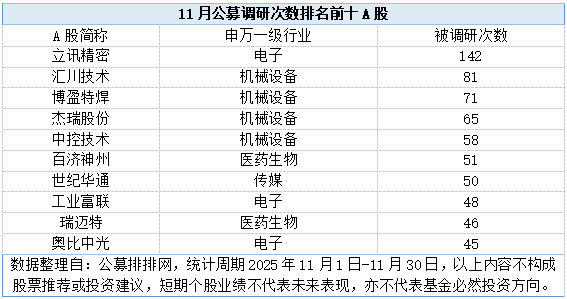
11月公募调研频次逾4200次 电子等行业备受关注
Zheng Quan Shi Bao Wang· 2025-12-01 06:33
Group 1: Market Overview - In November, the A-share market experienced a volatile adjustment, yet public fund institutions maintained high enthusiasm for research activities [1] - A total of 154 public fund institutions participated in A-share market research, covering 506 stocks across 30 Shenwan first-level industries, with a total of 4,298 research instances [1] Group 2: Industry Focus - 17 Shenwan first-level industries received attention from public fund institutions in November, with each industry having no fewer than 50 research instances, and 7 industries exceeding 100 instances [1] - The electronics industry led with 974 research instances, covering 88 stocks, significantly outpacing other industries [1] - The machinery equipment industry followed with 819 research instances across 71 stocks, while the pharmaceutical and biotechnology industry ranked third with 403 instances across 38 stocks [1] Group 3: Key Stocks - Luxshare Precision (立讯精密) was the most researched stock in November, with 142 instances, focusing on electronic connectors and related components [2] - Other notable stocks included Huichuan Technology (汇川技术), Boying Special Welding (博盈特焊), and Jerry Holdings (杰瑞股份), which were among the top researched stocks in the machinery equipment sector [3] - The top ten researched stocks were primarily concentrated in the machinery equipment, electronics, and pharmaceutical industries, with four stocks from the machinery equipment sector [3] Group 4: Company Insights - Luxshare Precision indicated that both traditional hardware brands and domestic and international AI software companies are exploring the integration of AI with hardware, with a significant focus on eyewear and headphones as potential AI carriers [2] - The company anticipates a significant transformation and explosive growth in AI hardware between 2026 and 2027, emphasizing the importance of user-friendly and privacy-conscious products [2] - Public fund institutions focused on the growth drivers and future potential of Huichuan Technology's automation business, the market prospects for Boying Special Welding's waste incineration, and Jerry Holdings' expansion in natural gas equipment [3]

20cm速递|创业板50ETF国泰(159375)涨超1%,估值优势与科技成长逻辑受关注
Mei Ri Jing Ji Xin Wen· 2025-12-01 06:08
中银国际指出,AI产业链景气趋势仍向好,下游需求旺盛,AI基础设施建设短期面临供应端存力与电 力短缺,资源紧缺带来存力与电力投资机会,算力特别是国产算力仍有广阔成长空间。流动性预期及风 险偏好修复,科技成长或最为受益,宽基指数上,创业板有望率先迎来修复。 (文章来源:每日经济新闻) 创业板50ETF国泰(159375)跟踪的是创业板50指数(399673),单日涨跌幅达20%,该指数从创业板 市场中选取流动性优异、市值规模领先的50只证券作为成分股,重点覆盖新能源、医药生物及通信设备 等高成长性新兴产业,旨在反映创业板核心优质企业的整体市场表现。 ...

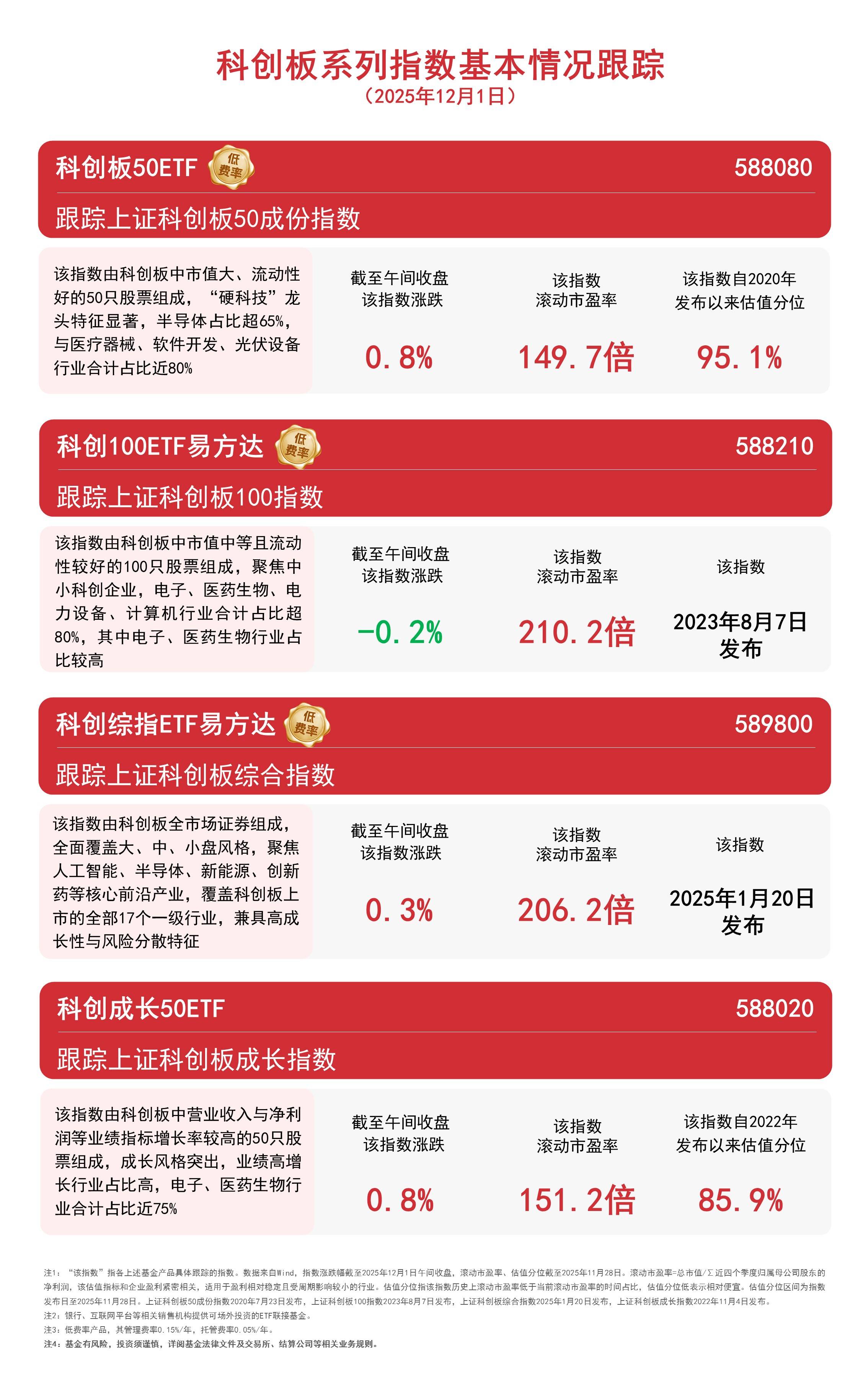
科创板50指数拉升翻红,关注科创综指ETF易方达(589800)、科创板50ETF(588080)等产品投资机会
Sou Hu Cai Jing· 2025-12-01 05:42
Group 1 - Semiconductor hardware stocks faced pressure at the market opening, but leading companies like Cambricon, Haiguang Information, and Lanke Technology saw a rebound, contributing to an increase in related indices [1] - By midday, the STAR Market 50 Index and STAR Growth Index both rose by 0.8%, while the STAR Composite Index increased by 0.3%, and the STAR 100 Index decreased by 0.2% [1] Group 2 - Small innovative enterprises in the sectors of electronics, pharmaceuticals, and power equipment accounted for over 80% of the market, with a significant representation from the electronics and biopharmaceutical industries [5] - The STAR Composite Index ETF, managed by E Fund, tracks the comprehensive index of the STAR Market, covering all market securities and focusing on core industries such as artificial intelligence, semiconductors, new energy, and innovative pharmaceuticals [7] - The STAR Growth 50 ETF tracks the STAR Growth Index, which consists of 50 stocks with high growth rates in operating income and net profit, predominantly from the electronics and biopharmaceutical sectors [7]
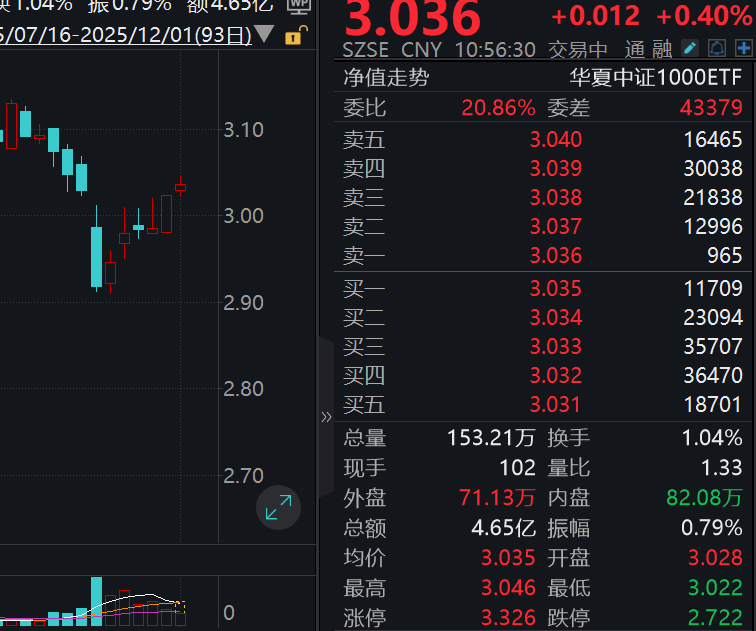
中证1000ETF(159845)上涨0.40%,科技及先进制造仍保持较高增速
Mei Ri Jing Ji Xin Wen· 2025-12-01 04:56
根据央行第三季度货币政策执行报告,关于下一阶段货币政策思路,提及实施好适度宽松的货币政 策,保持社会融资条件相对宽松;综合运用多种货币政策工具,保持流动性充裕。 华龙证券表示,从近期公布的经济数据来看,科技及先进制造领域仍保持较高增速,叠加近期因市场 因素调整后,估值趋于合理,并且仍有望保持较高景气度。可继续关注AI+、自主可控、人形机器人、低空 经济等相关领域。 中证1000ETF(159845)紧密跟踪中证1000指数。中证1000指数由全部A股中剔除中证800指数成份股 后,规模偏小且流动性好的1000只股票组成,综合反映中国A股市场中一批小市值公司的股票价格表现。 每日经济新闻 12月1日临近午盘,A股三大指数集体上涨,其中沪指上涨0.30%。截止10点56分,中证1000ETF (159845)上涨0.40%。其他宽基指数中,上证50涨0.33%,沪深300涨0.60%,中证500涨0.64%。 | שורס 4.0 ₪ ₪.1 970 ₪ 4.0 ₪ 1.0 ₪ 1.0 ₪ 1.1 ₪ | 3.056 | | +0.012 +0.40% | | --- | --- | --- | --- | | ...
从微观出发的五维行业轮动月度跟踪-20251201
Soochow Securities· 2025-12-01 04:06
- Model Name: Five-Dimensional Industry Rotation Model - Model Construction Idea: The model is based on the unique multi-factor stock selection system of Dongwu Securities, starting from the micro-level of individual stocks, and constructs a five-dimensional industry rotation model[8] - Specific Construction Process: - Micro factors are categorized into five major types: volatility, fundamentals, volume, sentiment, and momentum[8] - Using style indicators to classify stocks within the industry based on the common style differences within the industry[8] - Constructing intra-industry dispersion indicators and intra-industry traction indicators based on the style preferences of the major stock selection factors, ultimately obtaining five types of composite industry factors[8] - The final model includes five dimensions: volatility, fundamentals, volume, sentiment, and momentum[8] - Model Evaluation: The model effectively captures the style differences within industries and constructs a comprehensive industry factor system[8] Model Backtesting Results - Five-Dimensional Industry Rotation Model, Annualized Return: 21.31%, Annualized Volatility: 10.79%, IR: 1.98, Monthly Win Rate: 72.80%, Maximum Drawdown: 13.30%[3][12][16] - Five-Dimensional Industry Rotation Model (Long-Only), Annualized Return: 10.48%, Annualized Volatility: 6.53%, IR: 1.60, Monthly Win Rate: 70.40%, Maximum Drawdown: 9.36%[3][16][17] Factor Backtesting Results - Volatility Factor, Annualized Return: 10.45%, Annualized Volatility: 10.35%, IR: 1.01, Monthly Win Rate: 59.23%, Maximum Drawdown: 14.81%[16] - Fundamentals Factor, Annualized Return: 7.31%, Annualized Volatility: 12.05%, IR: 0.61, Monthly Win Rate: 56.92%, Maximum Drawdown: 26.32%[16] - Volume Factor, Annualized Return: 8.32%, Annualized Volatility: 11.70%, IR: 0.71, Monthly Win Rate: 60.00%, Maximum Drawdown: 18.40%[16] - Sentiment Factor, Annualized Return: 7.58%, Annualized Volatility: 12.77%, IR: 0.59, Monthly Win Rate: 63.85%, Maximum Drawdown: 14.79%[16] - Momentum Factor, Annualized Return: 11.29%, Annualized Volatility: 10.52%, IR: 1.07, Monthly Win Rate: 60.47%, Maximum Drawdown: 13.52%[16]
11月28日电子、通信、银行等行业融资净买入额居前
Zheng Quan Shi Bao Wang· 2025-12-01 02:18
| 代码 | 最新融资余额(亿元) | 较上一日增减(亿元) | 环比增幅(%) | | --- | --- | --- | --- | | 电子 | 3577.73 | 15.26 | 0.43 | | 通信 | 1132.76 | 14.55 | 1.30 | | 银行 | 753.49 | 3.84 | 0.51 | | 电力设备 | 2166.99 | 2.98 | 0.14 | | 基础化工 | 1005.22 | 2.04 | 0.20 | | 交通运输 | 422.21 | 1.24 | 0.29 | | 机械设备 | 1271.52 | 0.91 | 0.07 | | 汽车 | 1178.76 | 0.88 | 0.07 | | 房地产 | 356.91 | 0.35 | 0.10 | | 石油石化 | 242.32 | 0.33 | 0.14 | | 轻工制造 | 143.53 | 0.27 | 0.19 | | 纺织服饰 | 81.57 | 0.25 | 0.31 | | 社会服务 | 127.09 | 0.11 | 0.09 | | 综合 | 47.96 | 0.06 | 0.12 | ...
两融余额四连升 149.09亿增量杠杆资金进场
Zheng Quan Shi Bao Wang· 2025-12-01 02:08
两融余额持续回升,最新市场两融余额24735.77亿元,连续4个交易日增加,期间杠杆资金大幅加仓哪 些股票? 证券时报·数据宝统计显示,截至11月28日,沪深北两融余额为24735.77亿元,较上一交易日增加15.32 亿元,其中融资余额24565.00亿元,较上一日增加14.84亿元。分市场来看,沪市两融余额为12548.36亿 元,较上一日增加0.96亿元,深市两融余额12112.14亿元,较上一日增加13.98亿元。北交所两融余额 75.27亿元,较上一日增加3878.76万元。值得注意的是,这已经是两融余额连续4个交易日持续增加,其 间两融余额合计增加149.09亿元。 分行业看,两融余额连续增加的态势下,申万所属的31个行业中,融资余额增加的共有18个行业,电子 行业融资余额增加最多,其间融资余额增加81.51亿元,融资余额增加居前的行业还有通信、电力设备 等;融资余额减少的行业有非银金融、家用电器等。以幅度进行统计,通信行业融资余额增幅最高,达 6.47%,其次是电子、房地产,增幅分别为2.33%、1.64%。 融资余额行业变动 | 行业 | 最新融资余额(亿元) | 融资余额增加额(亿元) | ...


