
工业

Search documents
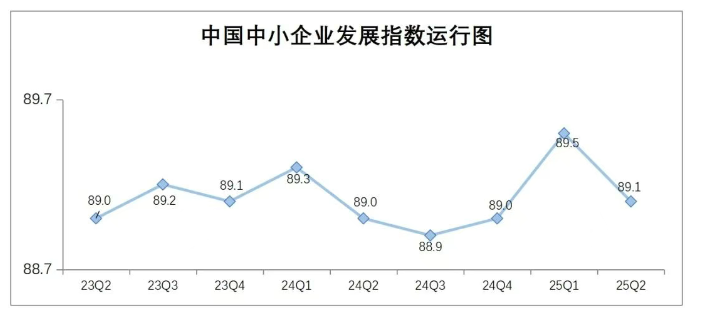
中国中小企业协会:2025年二季度中国中小企业发展指数为89.1 较上季度下降0.4个点
智通财经网· 2025-07-10 12:55
Core Viewpoint - The China Small and Medium Enterprises Development Index (SMEDI) for Q2 2025 is reported at 89.1, a decrease of 0.4 points from the previous quarter, but higher than the levels in 2023 and 2024. Overall, costs for SMEs have slightly decreased [1]. Industry Summary - The wholesale and retail industry index remained stable at 89.0, while seven other industries, including construction, transportation, real estate, social services, information transmission, and accommodation and catering, saw declines in their indices [2][3]. - The overall index for Q2 2025 is 89.1, down from 89.5 in Q1 2025, with all sub-indices showing a decrease, including macroeconomic sentiment, comprehensive operation, market, cost, funding, labor, input, and efficiency indices [4][5]. Regional Summary - The indices for the eastern, central, and western regions are 90.1, 89.7, and 88.6 respectively, all showing declines from the previous quarter, while the northeastern region saw a slight increase of 0.1 points to 81.5 [4]. Key Characteristics of SMEs - Business confidence is low, with the macroeconomic sentiment index at 98.2, down 0.8 points from the previous quarter, reflecting a decline across all surveyed industries [5]. - Market demand is contracting, as indicated by a market index of 81.2, which is a decrease of 0.3 points from the previous quarter [5]. - Funding conditions are tightening, with the funding index at 100.6, down 0.2 points, and six out of eight industries reporting declines in their funding indices [5]. - Labor supply is increasing while demand is decreasing, with the labor index at 105.9, down 0.1 points, and seven industries reporting a drop in labor demand [5]. - Investment willingness among enterprises is declining, with the input index at 82.3, down 0.6 points, particularly in construction, social services, and accommodation and catering sectors [5]. - Costs for enterprises have slightly decreased, with the cost index at 111.8, down 0.2 points, although the wholesale and retail sector saw a slight increase in costs [5]. - Efficiency has also declined, with the efficiency index at 74.2, down 0.3 points, and six industries reporting a decrease in their efficiency indices [6].

诺伟:下半年市场将面临双重压力 需重新审视资产配置策略
Zhi Tong Cai Jing· 2025-07-10 11:12
Core Viewpoint - Nuveen anticipates that the second half of 2025 will face dual pressures of economic slowdown and policy uncertainty, prompting investors to reassess asset allocation strategies focusing on robust fundamentals, defensive characteristics, and spread advantages to enhance return potential and mitigate risks [1][2] Global Economic Outlook - The global investment committee of Nuveen expects potential interest rate cuts by the Federal Reserve in September and December, but inflation driven by tariffs may lead to a pause in easing [1] - The European Central Bank is expected to pause after previous rate cuts, while the Bank of Japan is likely to raise rates once [1] Asset Allocation Strategy - Nuveen recommends focusing on assets driven by spreads and reducing reliance on risk-free rates, with municipal bonds attracting long-term investors due to a steep yield curve [1] - The real estate market is gradually recovering after two years of stagnation, with strong demand observed in medical office spaces, grocery retail properties, and affordable housing [1] Stock Market Insights - Large U.S. tech companies are benefiting from the expansion of AI, increased demand for data centers, and power generation, leading to an upgrade in market positioning [1] - Defensive sectors such as finance and infrastructure are highlighted, while European equities present long-term value; emerging markets are becoming less attractive due to trade policy impacts [1] Investment Strategies - Nuveen advises investors to adopt a broadly diversified and actively managed strategy to navigate policy changes and economic slowdowns [2] - Preferred loans and securities are favored for their attractive valuations and solid credit quality, while investment-grade corporate bonds are viewed less favorably due to narrowing spreads [2] Real Estate Sector Focus - Nuveen continues to explore opportunities arising from demographic and educational diversity, with a positive outlook on medical, industrial, and residential sectors [2] - The office market faces challenges, with vacancy rates expected to improve but recovery still requiring time; real estate bonds currently offer valuation advantages over real estate stocks [2] Infrastructure Investment Preferences - Nuveen prefers public-private projects, particularly in electricity, utilities, and energy storage investments [2] - Agricultural land assets are seen as an inflation hedge, although returns are expected to slow in 2025, especially for grain crops affected by tariff pressures [2]
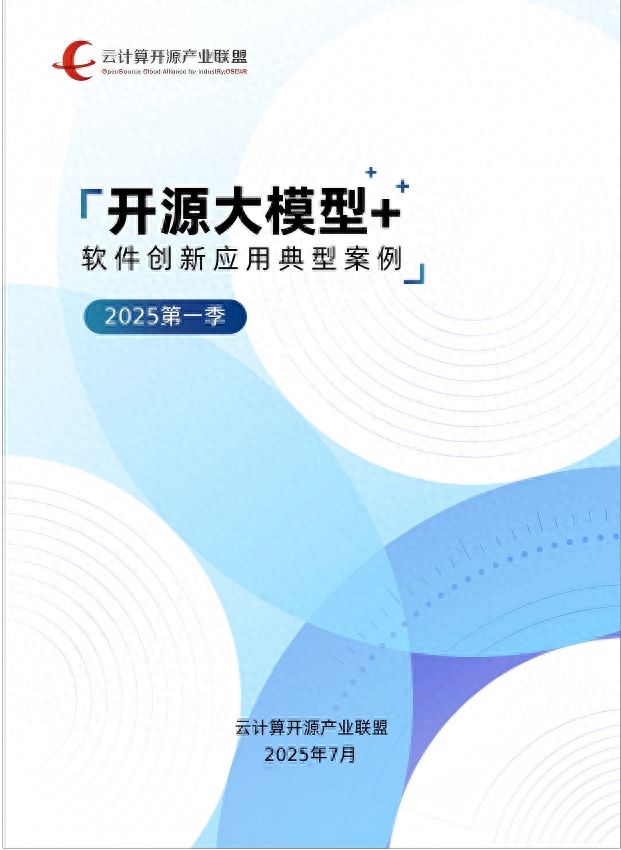
中国信通院“开源大模型+”软件创新应用典型案例入围结果公布
Huan Qiu Wang Zi Xun· 2025-07-10 03:19
Group 1 - The Global Digital Economy Conference recently held a forum to announce the shortlisted cases for the "Open Source Large Model+" software innovation applications [1] - The initiative aims to explore the application potential of open-source large models like DeepSeek across various industries, promoting technological innovation and business upgrades [4] - A total of over 100 typical cases were submitted from across the country, with 68 cases shortlisted after rigorous evaluation based on innovation, technological breakthroughs, and ecological synergy [5] Group 2 - Among the shortlisted cases, 26 were recognized as selected innovative cases due to their technical strength, innovative achievements, and application value [5] - The second round of case collection for "Open Source Large Model+" software innovation applications will begin, with results expected to be announced in the second half of 2025 [5] - The selected innovative cases will be awarded at a future event related to cloud and software security [5]
213只港股获南向资金大比例持有
Sou Hu Cai Jing· 2025-07-10 01:40
Group 1 - The overall shareholding ratio of southbound funds in Hong Kong Stock Connect stocks is 17.83%, with 213 stocks having a shareholding ratio exceeding 20% [1] - As of July 9, southbound funds held a total of 4,482.29 million shares, accounting for 17.83% of the total share capital of the stocks, with a total market value of 51,131.42 million HKD, representing 13.50% of the total market value [1] - The highest shareholding ratio by southbound funds is in China Telecom, with 103.31 million shares held, accounting for 74.43% of the issued shares [1] Group 2 - Southbound funds with a shareholding ratio exceeding 20% are mainly concentrated in the healthcare, industrial, and financial sectors, with 43, 32, and 31 stocks respectively [2] - The top stocks with high shareholding ratios include China Telecom (74.43%), Green Power Environmental (69.92%), and China Shenhua (67.37%) [2][3] - A significant portion of the stocks with high southbound fund holdings are AH concept stocks, with 119 out of 213 stocks (55.87%) having a shareholding ratio over 20% being AH stocks [1]

中证文化产业指数报1881.59点,前十大权重包含利欧股份等
Jin Rong Jie· 2025-07-09 15:24
Group 1 - The core index of the cultural industry, the China Securities Cultural Industry Index, closed at 1881.59 points, showing mixed performance among the three major A-share indices [1] - The China Securities Cultural Industry Index has increased by 4.85% in the past month, 16.46% in the past three months, and 11.27% year-to-date [2] - The index includes companies involved in various cultural sectors such as news publishing, broadcasting, cultural arts, and creative services, reflecting the overall performance of listed companies in the cultural industry [2] Group 2 - The top ten weighted companies in the index include Focus Media (10.15%), Giant Network (5.14%), and Kaiying Network (4.98%), among others [2] - The index's holdings are primarily listed on the Shenzhen Stock Exchange (77.41%) and the Shanghai Stock Exchange (22.59%) [2] - The industry composition of the index shows that communication services account for 95.23%, consumer discretionary for 3.18%, and industrials for 1.59% [2] Group 3 - The index samples are adjusted semi-annually, with adjustments occurring on the next trading day after the second Friday of June and December [3] - Weight factors are generally fixed until the next scheduled adjustment, with special circumstances allowing for temporary adjustments [3] - Companies that are delisted or undergo mergers, acquisitions, or splits are handled according to specific calculation and maintenance guidelines [3]






港交所:同比上升322%!
中国基金报· 2025-07-09 10:15
Core Viewpoint - The Hong Kong Stock Exchange (HKEX) reported a significant increase in total fundraising amount by 322% year-on-year in the first half of 2025, with a total of 44 new listings, reflecting a robust market environment [14][15]. Group 1: Market Performance - The Hang Seng Index fell by 1.06% to 23,892.32 points, while the Hang Seng Technology Index and the Hang Seng China Enterprises Index dropped by 1.76% and 1.28%, respectively [2]. - The total market turnover increased to 2,339 billion HKD, up from 2,132.89 billion HKD in the previous trading day [2]. - Southbound capital recorded a net inflow of 92.56 billion HKD [2]. Group 2: Stock Movements - Major stocks such as Henderson Land Development, Alibaba, and Zijin Mining led the decline, with drops of 8.64%, 3.83%, and 3.38%, respectively [4][5]. - Alibaba had a trading volume of 139.51 billion HKD, making it the most actively traded stock [6]. - Five new stocks listed on the same day all closed higher, with Blue Sky Technology rising over 9% and Fortior increasing over 16% [13]. Group 3: Fundraising and Market Statistics - In the first half of 2025, the total fundraising amount reached 2,808 billion HKD, a 322% increase from 665 billion HKD in the same period last year [15]. - The average daily trading amount for the first half of 2025 was 2,402 billion HKD, up 118% from 1,104 billion HKD year-on-year [15]. - The market capitalization of the Hong Kong securities market was 42.7 trillion HKD at the end of June, a 33% increase from 32.1 trillion HKD a year earlier [15]. Group 4: New Financial Products - The first actively managed ETF was listed in Hong Kong, enhancing the product offerings for local investors and showcasing Hong Kong's competitiveness in attracting overseas ETFs [17].
沪深300基建主题指数报2163.03点,前十大权重包含国电电力等
Jin Rong Jie· 2025-07-09 10:13
Core Points - The A-share market's three major indices closed mixed, with the CSI 300 Infrastructure Theme Index reporting at 2163.03 points [1] - The CSI 300 Infrastructure Theme Index has increased by 0.51% over the past month, 0.96% over the past three months, and has decreased by 2.43% year-to-date [2] Index Composition - The CSI 300 Infrastructure Theme Index is composed of infrastructure-related listed companies selected from the CSI 300 Index, providing investors with a diversified investment option [2] - The index was established on December 31, 2004, with a base point of 1000.0 [2] - The top ten weighted companies in the index are: - China Yangtze Power (14.9%) - China State Construction Engineering (8.74%) - China Telecom (8.45%) - China Mobile (7.25%) - China Unicom (6.01%) - China Nuclear Power (5.51%) - Three Gorges Energy (4.37%) - China Railway (4.19%) - Guodian Power (3.07%) - China Power Construction (3.03%) [2] Market Distribution - The CSI 300 Infrastructure Theme Index has a market distribution of 96.01% on the Shanghai Stock Exchange and 3.99% on the Shenzhen Stock Exchange [2] - The industry composition of the index includes: - Utilities: 42.59% - Industrials: 34.52% - Communication Services: 22.90% [2] Sample Adjustment - The index samples are adjusted semi-annually, with adjustments implemented on the next trading day following the second Friday of June and December each year [3] - Weight factors are adjusted in accordance with sample changes, typically remaining fixed until the next scheduled adjustment [3] - In the event of special circumstances affecting the CSI 300 Index samples, corresponding adjustments will be made to the index samples [3]





沪指重返3500点!这些方向开始领跑
Sou Hu Cai Jing· 2025-07-09 04:54
Group 1 - A-shares have shown a structural market characteristic, with strong performance in consumer sectors such as food and beverage, and retail, as well as certain technology sectors like AI applications and innovative pharmaceuticals [2][4] - The top five performing industries in A-shares include agriculture, media, food and beverage, electrical equipment, and retail, indicating a growing interest in agricultural assets and a recovery in consumer spending [2] - The bottom five performing industries in A-shares are electronics, steel, basic chemicals, non-ferrous metals, and storage chips, with the decline in non-ferrous metals linked to proposed US tariffs on copper [2] Group 2 - In the Hong Kong market, the healthcare sector has seen a rise due to active innovative drug concepts, despite potential US tariffs on pharmaceuticals [3] - The top three performing industries in Hong Kong include healthcare, industrial, and energy, while the bottom three are materials, information technology, and real estate, reflecting external pressures from US tariff policies and global tech supply-demand imbalances [3] - The current market characteristics indicate that A-shares are driven by policy and sectoral improvements, while Hong Kong stocks are more influenced by external factors such as US tariffs and global technology cycles [4] Group 3 - Short-term market hotspots are concentrated around policy-driven sectors and improving industry conditions, with a focus on performance in the upcoming earnings reports [4] - The breakthrough of the Shanghai Composite Index above 3500 points is expected to further boost market confidence, with potential policy signals from the July Politburo meeting influencing capital flows [4]
南粤制造业城市破解十年下滑困局,4.8万亩低效园区改造撬动1862亿投资!
Sou Hu Cai Jing· 2025-07-09 01:26
Core Insights - The manufacturing city in South Guangdong has faced a "decade-long decline" in economic development, with GDP ranking significantly dropping and industrial investment decreasing from 30.74 billion yuan to 28.89 billion yuan from 2012 to 2021 [1][3] Group 1: Economic Challenges - The city experienced a decline in fixed asset investment, with its share falling from over 30% to less than 20% [1] - Land development intensity is close to 40%, with some towns reaching 86.9%, and the highest town has not auctioned industrial land for ten years [3] - Over 11,200 acres of village and town industrial parks are plagued by poor structure, environmental issues, and safety hazards, contributing to the city's development bottleneck [3] Group 2: Transformation Initiatives - From 2022 to 2024, the city plans to upgrade low-efficiency industrial parks, aiming to clear over 48,000 acres of inefficient industrial land and attract over 1,800 enterprises with an expected investment of 186.2 billion yuan [4] - Innovative policies include including low-efficiency industrial land in the "three old" renovation policy, allowing for equal access to city-level incentives [4] - A new model of "single entity return + contiguous rewards" has reduced tax costs by 90%, and the approval process has been streamlined, cutting the time from 20 days to 3 days [4] Group 3: Financing Strategies - The city has explored various financing models to address funding challenges, including a 110 million yuan revolving support fund and a 50 million yuan "industrial renovation" fund, successfully securing 400 million yuan in bank loans [5] - The community of Jidong II in Xiaolan Town has converted collective construction land to state-owned land, facilitating more flexible land market entry for financing [5] - A command center led by top officials has been established to ensure accountability, with nearly 500 outstanding party members dispatched to support local initiatives [5]

2025年下半年全球市场展望报告-美元转向 运筹决胜-渣打银行
Sou Hu Cai Jing· 2025-07-07 16:30
Core Investment Strategies and Asset Allocation - The report recommends an overweight position in global equities, particularly in Asian markets (excluding Japan), due to expected earnings growth, policy support, and attractive valuations [2][19] - Non-USD bonds are to be increased, with emerging market local currency bonds being upgraded to overweight due to the anticipated weakening of the USD and significant room for central bank rate cuts [2][19] - Gold is positioned as a core asset, benefiting from de-dollarization, central bank purchases, and inflation hedging, with a 3-month target price of $3,400 [2][19] Macroeconomic Outlook and Risks - The core scenario anticipates a soft landing for the US economy, supported by trade truce, fiscal stimulus, and a projected 75 basis points rate cut by the Federal Reserve in the second half of the year [3][17] - Key risks include the potential end of the tariff suspension in July, Middle Eastern conflicts possibly driving oil prices above $100, and the implications of the proposed Section 899 tax on multinational investments [3][27] Asset Class Views - The USD is expected to weaken over the next 6-12 months, benefiting the Euro, Yen, and Pound, with specific targets set for currency pairs [4][20] - Gold is projected to have upward potential, with a 12-month target of $3,500, while oil prices are expected to stabilize around $65 per barrel, although geopolitical tensions could cause short-term spikes [4][27] - The stock-bond model has shifted to neutral, indicating a mixed outlook for equities, with emerging market local currency bonds requiring caution due to potential short-term reversals [4][24] Key Events and Outlook - Important upcoming events include tariff negotiations in July, central bank meetings in Europe and the US, and the IMF annual meeting in October [5][17] - The report emphasizes the importance of long-term investment principles, diversification, and balancing liquidity, growth, and protection needs in the context of the dollar's transition [5][19]
