
智能手机

Search documents
凯文?凯利:意外之美|我们的四分之一世纪
Jing Ji Guan Cha Bao· 2025-12-19 10:07
Group 1 - The core theme of the article revolves around the unexpected developments in technology over the past 25 years, categorized into three main insights: "unexpected joy," "unexpected slowness," and "unexpected paths" [2][3] Group 2 - "Unexpected joy" refers to the rapid and extensive adoption of smartphones, which have transformed various industries by integrating multiple functionalities into a single device, driven by technological convergence [3] - The smartphone revolution was not merely a result of a single technological breakthrough but rather a combination of advancements in communication, chips, and software, which collectively met the fundamental human need for instant connectivity [3] Group 3 - "Unexpected slowness" highlights the slower-than-expected development of virtual reality (VR) and autonomous driving technologies, which face challenges beyond mere technical advancements, including societal and regulatory hurdles [4][5] - The article emphasizes that the speed of technology adoption is contingent upon the maturity of the entire system, not just isolated breakthroughs, underscoring the importance of understanding the "wooden barrel principle" [6] Group 4 - "Unexpected paths" discusses the emergence of large language models (LLMs) and the sharing economy, which have disrupted traditional models by leveraging technology in innovative ways that were previously underestimated [7][8] - The article suggests that future breakthroughs are likely to arise from cross-disciplinary innovations or unconventional approaches rather than from optimizing existing paths [8] Group 5 - The article concludes with reflections on Japan's past economic trajectory, suggesting that internal factors, rather than external pressures, can hinder progress, a lesson applicable to China's current position in the global landscape [9][10] - The future growth of China is anticipated to be driven by open-source options, confidence among tech innovators, and a culture that embraces global perspectives and innovation [10][11]
字节跳动正与联想推进AI手机合作
Ge Long Hui A P P· 2025-12-19 07:46
Core Viewpoint - ByteDance is advancing a collaboration with Lenovo to develop AI smartphones, aiming to pre-install AIGC plugins on devices to gain user access and shift the current passive role of AI in execution [1] Group 1: Collaboration Details - Lenovo has maintained close cooperation with ByteDance's subsidiaries such as Doubao and Volcano Engine [1] - The collaboration includes a focus on smart terminal cooperation, particularly with Doubao [1] Group 2: Product Launch - Earlier this month, ByteDance and ZTE launched the "Doubao Phone Assistant," an application that allows users to access services across apps based on voice commands, facilitating tasks like ordering food, booking flights, and responding to messages [1] - This phone has been referred to as the "Doubao Phone," generating significant industry interest regarding the future of AI terminals [1] Group 3: Strategic Intent - ByteDance's strategy is not solely focused on business growth but aims to create new monetization pathways for traffic, involving smartphone manufacturers in revenue from traffic distribution and subscription services [1] Group 4: Market Position - According to IDC, Lenovo's smartphone brand Motorola is projected to reach a shipment volume of 16 million units by Q3 2025, holding a global market share of 4.9% and ranking eighth in the global smartphone market [1] - This collaboration could potentially secure a terminal entry point with an annual shipment volume of around 60 million units [1]

小米集团-W(01810):——小米集团(1810.HK)2025人车家全生态合作伙伴大会点评:Mimo-V2-Flash大模型发布,小米AI战略是耐力赛而非单点冲刺
EBSCN· 2025-12-19 04:11
Investment Rating - The report maintains a "Buy" rating for Xiaomi Group (1810.HK) [5][7]. Core Insights - Xiaomi's AI strategy is characterized as a long-distance race rather than a sprint, with significant investments planned for the next five years, exceeding 200 billion RMB [5]. - The newly released Mimo-V2-Flash model demonstrates industry-leading performance with a lightweight design featuring 309 billion total parameters and 15 billion activation parameters, outperforming competitors in key metrics [2]. - Xiaomi has established the largest consumer hardware platform globally, with 1.8 billion connected devices, including 740 million active mobile users and over 1 billion IoT devices, which provides a robust foundation for AI technology deployment [3]. Summary by Sections AI Model Development - The Mimo-V2-Flash model achieves a 2.0 to 2.6 times increase in inference speed and has a throughput of 5000-15000 tokens per second, significantly enhancing efficiency and cost-effectiveness for large-scale AI applications [2]. - The model is fully open-sourced, with APIs and web experiences available, aiming to attract global developers and create a positive feedback loop for model iteration [2]. Hardware Ecosystem - Xiaomi's hardware ecosystem includes 1.8 billion connected devices, with a focus on personal, automotive, and home devices, which enhances the potential for AI technology applications [3]. Software Infrastructure - The upcoming release of the Pengpai OS 3 in August 2025 will enhance ecosystem collaboration, supporting over 60 applications and 70 scenarios, with a daily active user base of 410 million [4]. - The Vela lightweight system and MINT platform are designed to facilitate AI deployment across various devices, with over 100 open-source partners contributing to the ecosystem [4]. Financial Projections - Revenue projections for Xiaomi indicate a growth trajectory, with expected revenues of 270.97 billion RMB in 2023, increasing to 635.31 billion RMB by 2027, and Non-IFRS net profits projected to rise from 19.27 billion RMB in 2023 to 50.97 billion RMB in 2027 [6][26]. - The report anticipates a significant increase in Non-IFRS earnings per share, from 0.77 RMB in 2023 to 1.96 RMB in 2027, reflecting strong profitability growth [6][26].

正与字节开展AI手机合作?联想内部人士:一直保持密切沟通
Xin Lang Cai Jing· 2025-12-19 03:45
Group 1 - ByteDance is advancing partnerships with hardware manufacturers such as Vivo, Lenovo, and Transsion to develop AI smartphones [1][2] - The collaboration aims to pre-install AIGC plugins on devices to gain user access and shift the current passive position of AI in execution [1][2] - Lenovo has been closely cooperating with ByteDance's subsidiaries like Doubao and Volcano Engine in the smart terminal sector [1][2]
首款可折叠iPhone预计在2026年秋季发布,电子ETF(159997)成交额超1200万元,芯片ETF天弘(159310)盘中溢价
2 1 Shi Ji Jing Ji Bao Dao· 2025-12-19 02:29
Group 1 - The semiconductor sector is experiencing active trading, with the Tianhong Chip ETF (159310) showing a premium trading rate of 0.07% [1] - The electronic ETF (159997) has a trading volume exceeding 12 million yuan and a turnover rate of nearly 1%, focusing on semiconductor, consumer electronics, and AI chip sectors [2] - The index tracked by the Tianhong Chip ETF is expected to see a 37.62% year-on-year growth in net profit attributable to shareholders in the first half of 2025 [2] Group 2 - The semiconductor industry presents opportunities for expansion and localization, with domestic wafer fabs expected to increase production next year [3] - The demand for high-end DRAM, HBM, and enterprise SSDs is being driven by AI computing expansion, indicating a new upward cycle in the storage industry [3] - The upstream price increase trend continues, with supply contraction and structural demand growth providing price upward elasticity for related products [3]



Counterpoint Research:2026年折叠屏智能手机面板出货量预计将增长46%
智通财经网· 2025-12-19 01:28
Core Insights - The report from Counterpoint Research predicts a 46% year-on-year growth in foldable smartphone panel shipments by 2026, driven primarily by Apple's entry into the foldable market with its first foldable iPhone [1][3]. Group 1: Market Growth and Trends - Apple's procurement of panels for its foldable iPhone is expected to significantly boost market demand, reactivating the entire foldable screen market [1]. - The overall shipment of foldable smartphones is projected to grow by 14% in 2025 and by 38% in 2026, with book-style models maintaining a dominant position [3]. - The average selling price (ASP) of foldable panels is anticipated to rise significantly, benefiting companies like Samsung Display, which is expected to surpass a 50% market share [3]. Group 2: Consumer Preferences and Market Dynamics - There is a growing consumer demand for larger screens and enhanced multitasking capabilities, leading to the popularity of book-style foldable designs despite their higher prices [5]. - The book-style foldable smartphones are rapidly gaining traction, with Samsung's Galaxy Z7 series showing that the Fold model's sales have surpassed that of the Flip model during the early sales phase in the second half of 2025 [3].
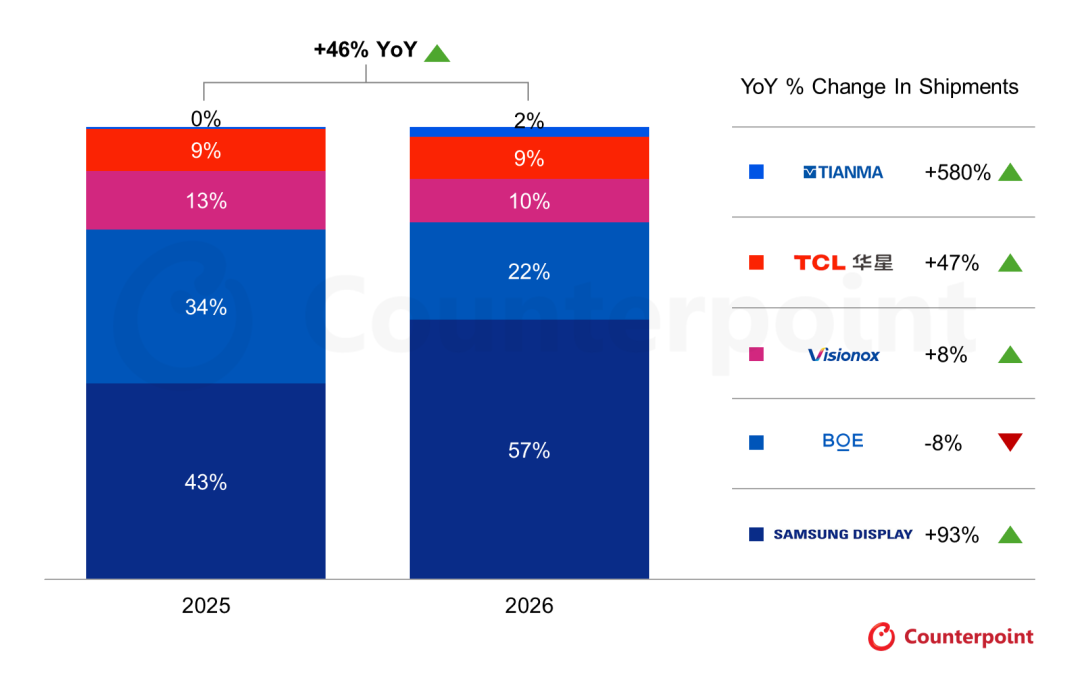
2026 年折叠屏面板出货量将增长 46%;三星显示将成最大赢家
Counterpoint Research· 2025-12-19 01:10
Core Insights - Counterpoint Research predicts a 46% year-on-year growth in foldable smartphone panel shipments by 2026, driven by Apple's entry into the market with its first foldable iPhone [4][5] - The book-style foldable panels are expected to solidify their dominant position, with Samsung Display projected to capture over 50% market share [4][5] - The overall foldable smartphone shipments are forecasted to grow by 14% in 2025 and 38% in 2026, with book-style models leading the market [5][7] Market Trends - The demand for larger screens and enhanced multitasking capabilities is driving consumer preference towards book-style foldable designs, despite their higher price [7] - The global foldable smartphone market is showing signs of recovery, with a 45% year-on-year growth in Q2 2025, setting the stage for explosive growth in 2026 [7] - The introduction of new models, such as the Galaxy Z TriFold, will maintain the market share of multi-fold designs in the low single digits [5][7] Company Overview - Counterpoint Research specializes in technology ecosystem market research, providing services to a wide range of clients from smartphone OEMs to chip manufacturers and large tech companies [8] - The company has a team of experienced analysts covering various sectors, including AI, automotive electronics, consumer electronics, and semiconductors [8]
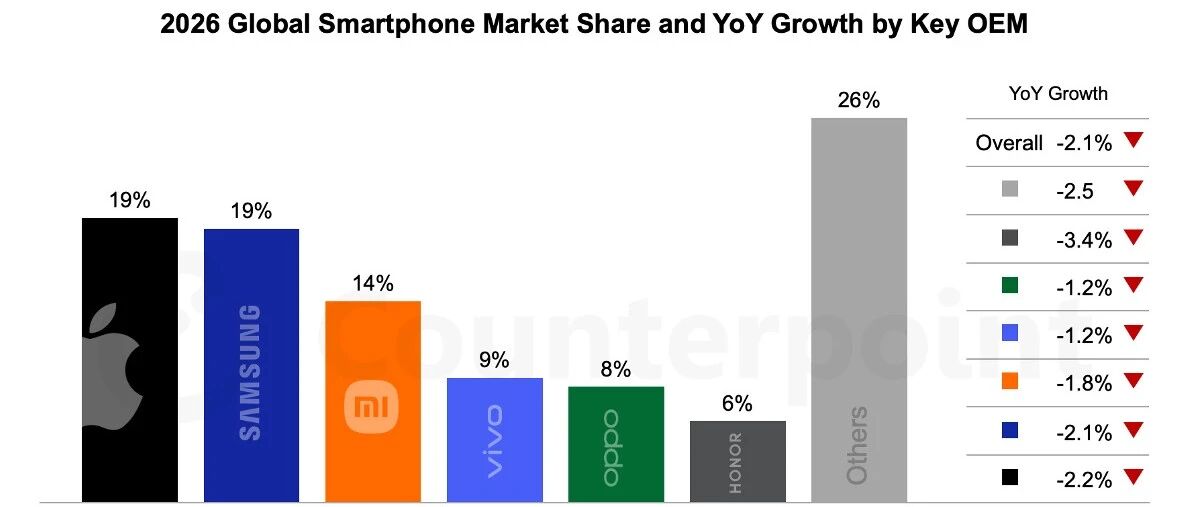
存储成本走高,2026 年智能手机出货预期下滑
Counterpoint Research· 2025-12-19 01:10
Core Insights - The global smartphone shipment volume is expected to decline by 2.1% in 2026 due to rising storage costs, marking a downward revision of 2.6 percentage points from previous forecasts [4][5][7]. Group 1: Market Trends - The increase in component costs is anticipated to impact end-user demand, particularly affecting Chinese OEMs like HONOR, OPPO, and vivo, which have seen significant adjustments in their forecasts [5][7]. - The average selling price of smartphones is projected to increase by 6.9% in 2026, up from a previous estimate of 3.6%, driven by rising Bill of Materials (BoM) costs [7][10]. Group 2: Cost Implications - DRAM prices have risen, leading to an increase in BoM costs by approximately 25% for low-end models, 15% for mid-range, and 10% for high-end models, with further increases expected in the second quarter of 2026 [7][9]. - The cost of storage is projected to rise by about 40% before the second quarter of 2026, further exacerbating BoM costs [9]. Group 3: Strategic Responses - OEMs are likely to adjust their product strategies in response to cost pressures, with some low-SKU models already experiencing reduced shipments [10]. - Companies are adopting various strategies, including adjusting specifications of camera modules, displays, and storage configurations, as well as streamlining product lines to cope with market changes [10].
周受资内部信曝TikTok美国方案;海南封关首日iPhone最高可减2000多元;腾讯辟谣元宝背后由真人运营丨邦早报
创业邦· 2025-12-19 00:08
Group 1 - TikTok CEO Zhou Shuzi announced the establishment of a new joint venture, TikTok USDS Joint Venture LLC, to handle data protection and algorithm security in the U.S. while ByteDance retains control over e-commerce and advertising [1] - The new joint venture is expected to be finalized by January 22, 2026, and will focus on content review and software security [1] Group 2 - Hainan Free Trade Port officially launched its full island closure operation, leading to significant discounts on iPhone products, with prices reduced by over 2,000 yuan for certain models [3] - The iPhone 17 Pro Max 256GB version is priced at 9,299 yuan, which is 700 yuan cheaper than e-commerce platforms [3] Group 3 - OpenAI is in preliminary talks for a new funding round, aiming for a valuation of approximately $750 billion, with potential funding reaching hundreds of billions [3] - This valuation represents a 50% increase from the previous funding round in October 2022 [3] Group 4 - Elliott Investment Management has accumulated over $1 billion in shares of Lululemon and is advocating for a former Ralph Lauren executive to become the new CEO [12] - Lululemon's current market capitalization is around $25 billion [12] Group 5 - Apple announced adjustments to its iOS rules in Japan, allowing developers to use third-party app stores and payment methods, in compliance with new regulations [12] - This change enables developers to add alternative payment options within their apps [12] Group 6 - Honda confirmed a temporary suspension of production at its joint venture factory in China due to supply chain issues, specifically related to semiconductor shortages [16] - The suspension will last for three days starting December 29, 2023 [16] Group 7 - Xiaomi's founder announced the official release of the Xiaomi 17 Ultra next week, following leaked images of the device [7] - The new model is expected to generate significant consumer interest [7] Group 8 - Amazon is restructuring its AI team, integrating chip and model development under a new business unit led by a veteran from its cloud computing division [18] - This move aims to enhance Amazon's capabilities in artificial intelligence and maintain competitiveness in the market [18]





深圳“十四五”交出高质量发展成绩单GDP年均增速居一线城市首位,研发投入强度跃居全国城市第一
Shen Zhen Shang Bao· 2025-12-18 23:55
Core Insights - Shenzhen's economy has maintained a high-speed growth during the "14th Five-Year Plan" period, with an average annual GDP growth rate of 5.5%, leading among first-tier cities in China [2] Economic Performance - Shenzhen's GDP increased from 2.78 trillion yuan in 2020 to 3.68 trillion yuan in 2024, marking a significant growth trajectory [2] - The city's industrial output and added value have ranked first nationally since 2022, with total foreign trade volume rising from 3.05 trillion yuan in 2020 to 4.5 trillion yuan in 2024 [2] Innovation and R&D - The average annual growth rate of Shenzhen's strategic emerging industries exceeded 10%, with their contribution to GDP rising to 42.3% [3] - R&D investment increased from 1510.8 billion yuan in 2020 to 2453.1 billion yuan in 2024, with an annual growth rate of 12.9%, positioning Shenzhen second nationally in total R&D investment [4] - Shenzhen has established 1333 national-level "specialized, refined, and innovative" enterprises, leading all cities in China [3] Social and Public Services - Total public spending on social welfare reached 1.6 trillion yuan, accounting for nearly 70% of fiscal expenditure, with significant increases in education and healthcare facilities [5][6] - The city has developed extensive public amenities, including parks and cultural venues, enhancing the quality of life for residents [6]