
太空光伏

Search documents
“制造强国”实干系列周报-20260112
Shenwan Hongyuan Securities· 2026-01-12 04:41
Group 1: Commercial Aerospace - China has submitted applications for over 200,000 satellite constellations, with the largest being CTC-1 and CTC-2, each comprising 96,714 satellites[6] - The commercial aerospace sector is expected to see significant growth, with a focus on satellite payloads, platforms, and application terminals[3] - Key companies to watch include Xinke Mobile, Fenghuo Communication, and China Satellite Communications[21] Group 2: Space Photovoltaics - The focus from 2024 to 2026 will be on P-type HJT and perovskite tandem batteries, with companies like Dongfang Risen and Junda Co. highlighted for their capabilities[33] - P-type HJT batteries are expected to penetrate low Earth orbit applications due to their superior radiation resistance and cost advantages[40] - The global photovoltaic market is dominated by China, which holds over 90% of the production capacity in polysilicon, wafers, and battery cells[46] Group 3: Controlled Nuclear Fusion - 2025 is projected to be a pivotal year for nuclear fusion development in China, marking the start of significant capital expenditure[51] - Key players in the nuclear fusion sector include Hezhong Intelligent and Lianchuang Optoelectronics, focusing on core components and supporting technologies[51] - The BEST project in Anhui has made significant progress, with key components successfully installed, indicating a shift towards engineering validation[50] Group 4: Robotics and Automation - The CES 2026 showcased advancements in cleaning robots and intelligent lawn mowers, indicating a trend towards embodied intelligence in consumer products[54] - The cleaning robot market is experiencing rapid growth, benefiting from government subsidies, with major players like Ecovacs and Roborock leading the market[60]
太空光伏与"轨道数据中心": 为什么下一代能源与算力的战场,会在800km的高空?
Hua Er Jie Jian Wen· 2026-01-12 04:12
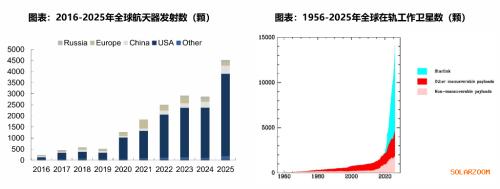
Core Viewpoint - Space photovoltaic technology is evolving from being merely "solar panels on satellites" to becoming a crucial component for the next generation of computing power (space computing/orbital data centers) [1][2] Group 1: Industry Trends - The application for orbital resources and satellite deployment plans is reshaping the supply-demand dynamics of the space industry, with a significant increase in satellite launches expected [2][3] - The number of global spacecraft launches has surged from 237 in 2016 to over 4,300 expected by 2025, reflecting a compound annual growth rate of approximately 34% [3] - The market for solar wings is transitioning from a niche to a mass production model due to the increasing number of satellites [5][6] Group 2: Cost Comparisons - A comparison of costs shows that deploying a data center in space can be significantly cheaper than on the ground, with a projected total cost of approximately $8.2 million in space versus $167 million on the ground over ten years [16] - The primary cost difference arises from energy expenses, where ground energy costs are estimated at $140 million over ten years, while space energy costs are nearly zero after initial deployment [16] Group 3: Technological Developments - The demand for solar wings is driven by the increasing power requirements of satellites, with examples showing significant growth in solar wing area from 22.68 m² to 256.94 m² for different satellite versions [9][12] - The report indicates a shift in technology from gallium arsenide (GaAs) to silicon-based technologies, particularly HJT (Heterojunction Technology), which offers advantages in weight, cost, and flexibility [25][27] Group 4: Market Potential - The solar wing market could reach approximately 200 billion yuan if annual satellite launches reach 10,000, with prices expected to decrease from 1,200 yuan/W to 622 yuan/W [10][11] - The space computing market is defined as deploying modular server nodes on low/mid-orbit satellites, transforming them into orbital data centers with significant computational capabilities [12][14] Group 5: Competitive Landscape - The competition for orbital resources is intensifying, with a total of over 100,000 low-orbit satellites planned globally, including approximately 45,000 from the U.S. and 53,000 from China [6][18] - The choice of technology and materials for solar wings will be influenced by launch costs, with SpaceX's lower costs allowing for different material choices compared to higher-cost Chinese rockets [22][23]

中信建投:投资与需求端利好频出,关注扩内需与高景气细分赛道
Zheng Quan Shi Bao Wang· 2026-01-12 00:13
Group 1 - The core viewpoint of the article highlights that the domestic economic investment and demand in China have shown positive signs since the beginning of the year, supported by government initiatives and policies [1] - The National Development and Reform Commission has issued an early batch of "two heavy" construction project lists and central budget investment plans totaling approximately 295 billion yuan, which is an increase of 95 billion yuan compared to the same period last year [1] - Local special bonds and government bonds are being issued promptly, with concentrated project commencement and policy support providing strong backing for investments [1] Group 2 - On the demand side, the price level has rebounded more than expected, with the Producer Price Index (PPI) increasing by 0.2% month-on-month and the year-on-year decline narrowing to 1.9% [1] - Recent State Council meetings have further deployed a package of fiscal and financial policies to promote domestic demand, focusing on consumption and private investment [1] - It is anticipated that investment growth will significantly rebound in the second half of 2025 due to the impact of a series of policy tools, leading to a notable recovery in social demand [1] Group 3 - The report suggests paying attention to undervalued cyclical sectors such as steel structures and infrastructure [1] - Recent favorable developments in industries like space photovoltaics, nuclear energy, and storage have been noted, with recommendations to focus on nuclear power construction and cleanroom construction companies [1]

北交所策略周报(20260105-20260111):北证2026开门红,关注太空光伏和AI应用主题-20260111
Shenwan Hongyuan Securities· 2026-01-11 12:30
Group 1 - The North Exchange 50 index increased by 5.82%, with average daily trading volume rising by 34.58% [4][12] - The strongest sectors this week included military, TMT, and pharmaceuticals, with the commercial aerospace sector showing significant strength [7][8] - Notable stock performances included Tianli Composite (+35.97%), Huitong New Materials (+23.77%), and Beikang (+45.1%) [4][7] Group 2 - The North Exchange's strong stock ratio increased to 38.7%, indicating potential for continued market momentum [7][11] - The report highlights a shift in market style from small-cap stocks to growth sectors, particularly in AI computing and other emerging technologies [7][8] - The report emphasizes the importance of timing in thematic investments, particularly in the context of the upcoming "14th Five-Year Plan" [7][8] Group 3 - The report identifies key sectors to watch in the upcoming week, including the space photovoltaic industry and AI applications [8] - Specific companies of interest include Liancheng Numerical Control, Optech, and Deepseek V4, among others [8] - The report anticipates a return of absolute return funds in early 2026, with a focus on undervalued stocks [8] Group 4 - The North Exchange had 287 companies listed as of January 9, 2026, with new listings and approvals ongoing [24][28] - This week, five new companies were listed, and five were delisted, with a total planned financing of 221 million yuan [42][44] - The report notes that the North Exchange's PE (TTM) median is 42.05 times, reflecting a positive trend in valuations [12][19]
北交所策略周报:北证2026开门红,关注太空光伏和AI应用主题-20260111
Shenwan Hongyuan Securities· 2026-01-11 11:45
Group 1 - The report highlights a strong start for the North Exchange in 2026, with the North Exchange 50 index rising by 5.82% and daily trading volume increasing by 34.58% [9][14][25] - Key sectors showing significant growth include aerospace, TMT (Technology, Media, and Telecommunications), and pharmaceuticals, with notable performances from companies in the rocket and satellite industry and the space photovoltaic sector [9][10] - The report emphasizes the importance of thematic investments, particularly in the spring season, focusing on the "15th Five-Year Plan" and future industries within the North Exchange [9][10] Group 2 - The North Exchange saw 261 stocks rise and 26 fall, resulting in a rise-to-fall ratio of 10.04, with top performers including BeiYikang and ZhongCheng Technology [34] - The average PE (TTM) for the North Exchange is reported at 86.55 times, with a median of 42.05 times, indicating a favorable valuation compared to other exchanges [22][24] - The report notes that the North Exchange's financing balance increased to 8.383 billion yuan, reflecting a positive trend in market liquidity [26][14] Group 3 - The report outlines upcoming IPOs and approvals, including the subscription of Kema Materials and the upcoming subscription of Aisheren, along with three companies scheduled for review [27][31] - The new three-board market saw five new listings and five delistings, with planned financing of 221 million yuan and completed financing of 83 million yuan [47][49] - The report identifies key companies to watch in the space photovoltaic and AI application sectors, including Liancheng CNC and Optech, as well as others involved in humanoid robotics and advanced packaging [10][10]
国金证券:从高可靠性迈向高性价比,太空光伏超高壁垒铸就蓝海市场
Di Yi Cai Jing· 2026-01-05 00:11
Core Viewpoint - The report from Guojin Securities highlights "space photovoltaics" as one of the strongest new energy themes expected to persist through 2026, driven by solid and urgent investment logic [1] Group 1: Investment Logic - Uniqueness: Photovoltaics are currently the only viable and reliable power supply solution for long-term operation of all spacecraft in orbit, with no alternative technology path available [1] - Urgency: The International Telecommunication Union (ITU) has established a "first come, first served" rule for near-Earth orbit and spectrum resources, making the number of satellite launches and deployment speed critical to national space strategy and commercial initiative, thus driving the urgent demand for high-cost performance and lightweight space solar energy systems [1]

商用航天奠定太空算力基础-太空光伏迎来重要发展机遇
2026-01-04 15:35
Summary of Key Points from the Conference Call Industry Overview - The conference call focused on the commercial aerospace sector, particularly the opportunities in space photovoltaics, which are expected to see significant development due to advancements in technology and cost reductions in satellite launches [3][4]. Core Insights and Arguments - **Investment Opportunities**: The commercial aerospace sector, especially space photovoltaics, presents substantial investment opportunities. The foundation of space computing has been established through reusable rockets and mass satellite manufacturing technologies, significantly lowering launch and satellite costs [3]. - **Cost Reduction**: Companies like SpaceX and China's Zhuque-3 are driving down the cost of launching individual satellites, enhancing the economic feasibility of space computing. It is anticipated that 100 GW of space data centers could be added annually over the next 4-5 years [3][4]. - **Global Initiatives**: - SpaceX plans to integrate communication and computing through its Starlink V3 satellites. - China aims to expand its "Starry Plan" satellite count to 2,800 by 2030, supporting the development of a global integrated computing network [3][4]. - **Technological Advancements**: The commercialization of space photovoltaics is accelerating due to technological iterations and cost optimizations. Silicon solar cells are currently more cost-effective than gallium arsenide cells, with prices around 50 RMB per watt for silicon and 70 RMB per watt for perovskite tandem cells [4]. - **Market Demand**: The AIGC market is increasing demand for stable and reliable power solutions in space. The projected construction of 100 GW of data centers annually indicates a trillion-level market potential for photovoltaic development [4]. Companies with Strategic Layouts - Several companies are making forward-looking investments in the commercial aerospace and space photovoltaic sectors: - **Junda Co., Ltd.**: Engaged in strategic partnerships to advance perovskite technology for space applications [5][6]. - **Dongfang Risheng**: Has delivered small batches of HJT cells, suitable for space environments [8]. - **Tuorui New Energy**: Signed supply contracts with satellite companies, establishing a clear foundation in satellite battery supply [8]. - **Mianyang Intelligent**: Laid out HJT production lines with promising lab efficiency [8]. - Other companies like Jin Feng Technology and Shuangliang Energy are also involved in the industry chain through various means [8]. Emerging Trends in New Energy - **Focus Areas**: In the new energy sector, AIDC power and solid-state batteries are highlighted as key investment areas. The 800V DC architecture is expected to be a significant variable by 2026, with solid-state transformers and high-power PSUs being critical components [9]. - **Storage Market Growth**: By December 2025, Inner Mongolia's energy storage grid connection is projected to reach 10.7 GW, totaling 45 GWh. The global energy storage capacity is expected to exceed 400 GW in 2026, with a year-on-year growth rate exceeding 50% [11]. Conclusion - The commercial aerospace and space photovoltaic sectors are poised for significant growth driven by technological advancements and strategic investments. Companies that are proactively positioning themselves in these areas are likely to benefit from the expanding market opportunities.
这市场,冰火两重天...
Xin Lang Cai Jing· 2025-12-31 01:11
Group 1: Market Overview - The Shanghai Composite Index achieved a rare ten consecutive days of gains, although it closed slightly down, indicating a highly structured market where different investors have vastly different experiences [1][11] - The commercial aerospace and robotics sectors are currently generating significant excitement among investors, driven by new policies that support the commercialization of rocket companies [2][12] Group 2: Commercial Aerospace - The introduction of the "Fifth Set of Listing Standards for Commercial Rocket Enterprises" aims to accelerate the listing of key rocket companies, further fueling market enthusiasm [2][13] - The market is currently valuing commercial aerospace ventures based on future potential rather than current earnings, creating a speculative environment [2][13] Group 3: Solar Energy Sector - The "space solar power" market is projected to reach a trillion-dollar scale, with calculations based on the deployment of 100,000 satellites and additional space capabilities planned by companies like SpaceX [3][14] - A potential threefold increase in market value is anticipated, based on projected revenues from satellite launches and associated profit margins [3][14] Group 4: Robotics Sector - The robotics sector is seeing various developments, including potential contracts with Tesla and discussions around regulatory measures for robotics [4][16] - Speculative narratives are emerging, such as the idea of sending humanoid robots into space, reflecting the sector's imaginative potential [4][16] Group 5: Hong Kong Market Dynamics - The Hang Seng Index has shown slight growth in the second half of the year, but the Hang Seng Tech Index experienced a maximum drawdown of 20% since October, indicating a mixed performance [6][18] - Three main factors affecting the Hong Kong market include reduced capital inflow, valuation adjustments, and disappointing earnings from major companies [19][20] Group 6: Future Outlook - The appreciation of the Chinese yuan is seen as a key variable that could enhance foreign investment in Chinese assets, potentially benefiting the Hong Kong market [21] - There is cautious optimism regarding the pharmaceutical sector, with expectations for increased overseas business development in the coming months [21]
长江电新:太空光伏四问四答
2025-12-30 14:41
Summary of Key Points from the Conference Call on Space Photovoltaics Industry Overview - The conference focuses on the **space photovoltaic industry**, highlighting its strategic importance in global competition among major space-faring nations [13][22]. Core Insights and Arguments 1. **Importance of Developing Space Photovoltaics**: - Space photovoltaics are crucial for powering spacecraft, with energy systems accounting for approximately **22% of costs** and **20-30% of mass** on satellite platforms [15][18]. - The demand for photovoltaic cells is expected to grow rapidly due to the construction of large low-Earth orbit (LEO) satellite constellations driven by military, communication, and commercial applications [15][22]. 2. **Technological Routes for Space Photovoltaics**: - Space photovoltaic technologies can be categorized into three main types: - **Wafer-based cells** (crystalline silicon and III-V semiconductors) - **Commercial thin-film cells** (amorphous silicon, cadmium telluride, and copper indium gallium selenide) - **Emerging thin-film technologies** (perovskite, organic, and quantum dot solar cells) [48][50]. - The **multi-junction gallium arsenide cells** are currently the leading technology, achieving efficiencies over **30%** in orbit [50]. 3. **Market Potential**: - The global gallium arsenide battery market is projected to reach nearly **$3 billion** in 2023, growing from **$214 million** in 2018, with a compound annual growth rate (CAGR) of **13.8%** [75]. - The deployment of large LEO constellations is expected to significantly benefit the space photovoltaic market, with over **100,000 satellites** planned globally [81][90]. - By **2030**, the market for space photovoltaics related to low-Earth satellites is estimated to be around **29.5 billion yuan**, approximately **10 times** the current market size [90]. Additional Important Insights - The **European Space Agency** has initiated the **SOLARIS program**, investing **€60 million** over three years to develop core technologies for solar energy systems in space [30]. - The **Chinese "Zhu Ri Project"** aims to establish a megawatt-level experimental solar power station in geostationary orbit by **2030** and a gigawatt-level commercial station by **2050** [30]. - The **cost of silicon solar cells** has decreased significantly, with prices dropping by **25.7%** for every doubling of production volume, making them competitive again in the space market [60]. Conclusion - The space photovoltaic industry is poised for significant growth driven by technological advancements and increasing demand from satellite constellations. The strategic importance of space energy systems in national security and commercial applications underscores the need for continued investment and innovation in this sector [13][22][90].


太空光伏四问四答
2025-12-29 15:51
太空光伏四问四答 20251229 摘要 太空光伏是航天活动的首选能源,太阳翼成本和质量占比高,低轨卫星 星座建设将快速增长光伏电池需求。中国和欧洲等国家也在迅速跟进巨 型卫星星座计划,展开激烈竞争,为未来卫星发射奠定基础。 AI 数据中心大规模部署对电力需求冲击巨大,太空数据中心利用低成本 太阳能和被动辐射冷却技术,实现全天候发电和低温冷却,且模块化部 署不受地球物理条件限制,太空算力发展依赖太空光伏。 太空发电是太空光伏应用的新场景,克服地面光伏发电的随机性、间歇 性和波动性。欧盟空间局的 Solar Race 计划和中国的逐日计划均基于 太空光伏产业的快速发展。 太空光伏技术路线主要包括晶硅电池、商业薄膜电池和钙钛矿薄膜电池。 砷化镓多节电池是当前性能最佳的太空光伏技术,但成本高。晶硅电池 成本下降且效率提升,有望重回主流。 钙钛矿太阳能板高效、轻质、低成本且易制成柔性结构,适用于 5 年左 右寿命的低轨卫星应用场景。钧达股份通过与上亿光电子战略合作积极 介入钙钛矿领域。 Q&A 为什么要发展太空光伏产业? 太空已经成为各国战略博弈的新战场,美国在这一领域处于领先地位,尤其是 SpaceX 公司,其可回 ...