外卖

Search documents
马云回归阿里,带领AI登上《新闻联播》
Sou Hu Cai Jing· 2025-09-23 16:21
Core Insights - The return of Jack Ma to Alibaba has significantly increased the company's focus on AI technology and investment, marking a pivotal shift in its strategic direction [1][3][9] Group 1: AI Technology Focus - Jack Ma's emphasis on AI has reached unprecedented levels, with reports indicating he has actively sought updates on AI development multiple times in a single day [4][22] - Alibaba's subsidiary, Pingtouge, has developed a new AI chip that surpasses Nvidia's A800 in key performance metrics, indicating Alibaba's competitive strength in the AI chip sector [6][8] - The company plans to invest over 380 billion yuan in cloud and AI infrastructure over the next three years, exceeding its total investment in the past decade [9][11] Group 2: Financial Investments and Growth - In the first quarter of the 2026 fiscal year, Alibaba's capital expenditure surged by 220% year-on-year to 38.6 billion yuan, reflecting the company's unprecedented investment in AI [11] - Alibaba is expanding its global footprint by establishing eight new AI data centers, increasing its total to 95, mirroring Amazon AWS's global strategy [11] Group 3: Strategic Partnerships and Market Expansion - Alibaba has formed a deep collaboration with Apple, integrating its Tongyi Qianwen large model into the iOS system, which is expected to enhance user experience across millions of iPhones [11][22] - The company is also aggressively pursuing growth in the local services sector, responding to competition from JD.com by upgrading its Taobao platform and integrating Ele.me into its e-commerce division [12][14] Group 4: AI in Operational Efficiency - AI technology has been implemented in Alibaba's delivery services, resulting in a 12% increase in delivery efficiency and a near 90% success rate in route optimization [17][22] - The introduction of AI-driven tools has significantly reduced the time required for merchants to set up stores, from three days to just four hours [17] Group 5: International Market Strategy - Alibaba's Southeast Asian platform, Lazada, is now fully open to Tmall merchants, allowing for seamless entry into international markets with AI support for logistics and customer service [20] - This initiative lowers the barriers for brands to expand overseas, as they can leverage Lazada's infrastructure without needing to establish local teams [20]



“桦加沙” 逼近深圳:外卖骑手提前收工,守好民生与安全双防线
第一财经网· 2025-09-23 13:24
Core Viewpoint - The article discusses the impact of Typhoon Haikui on Shenzhen, highlighting the city's response and the measures taken by delivery platforms to ensure safety and service continuity during extreme weather conditions [1][3]. Group 1: Weather Impact and Response - Shenzhen Meteorological Bureau upgraded the typhoon warning to red, indicating a high risk of disaster due to Typhoon Haikui's approach [1]. - The typhoon is expected to bring strong winds and heavy rain, with the most severe conditions anticipated from the night of September 23 to September 24 [1]. Group 2: Delivery Platforms' Measures - Multiple food delivery platforms, including Meituan, suspended services in Shenzhen starting at 6 PM on September 23 to ensure rider safety [1][3]. - Meituan announced that it would exempt riders from penalties related to delayed orders due to the weather and would provide additional weather subsidies to support their income [4]. - JD Logistics implemented plans to reroute deliveries in high-risk areas and reinforced storage facilities to protect goods from extreme weather [4][6]. Group 3: Rider Experiences - Delivery riders reported a decrease in orders, with some noting that while daytime operations remained normal, the volume of orders dropped significantly in the afternoon as businesses closed early [3]. - Riders were instructed to prepare for adverse weather conditions, including ensuring safety measures at delivery stations [3].

多平台宣布:广深外卖派送,暂停
Nan Fang Du Shi Bao· 2025-09-23 12:54
Core Viewpoint - The approach of various food delivery platforms in response to Typhoon "Haikui" approaching Guangdong, leading to the suspension of delivery services in affected areas [1][2][4]. Group 1: Emergency Response Measures - Guangzhou and Shenzhen have implemented a "Five Stops" policy, which includes stopping classes, work, production, transportation, and business operations [2][4]. - Meituan has announced the suspension of delivery services in Guangzhou starting from 21:00 on September 23 and in Shenzhen from 18:00 on the same day, in compliance with government safety measures [2][4][9]. - Other platforms such as Taobao Flash Purchase, Ele.me, and JD Delivery have also confirmed the suspension of services in Shenzhen from 18:00 and in Guangzhou from 21:00 [4][9]. Group 2: Safety Measures for Delivery Personnel - Platforms are prioritizing the safety of delivery personnel by extending delivery times and potentially suspending services based on weather conditions [5][9]. - JD Delivery has stated that it will closely monitor the situation and adjust delivery capacity while ensuring the safety of its riders [9][12]. - Dingdong Maicai has also announced the suspension of order taking in Shenzhen from 18:00 on September 23 to protect frontline workers [12]. Group 3: Communication with Users - Delivery platforms are actively communicating with users about the potential delays and service suspensions due to the extreme weather conditions [5][14]. - Notifications have been sent to users regarding the suspension of services and the importance of safety during the typhoon [9][15].

为防台风,深圳多家外卖平台将于23日18时停止服务
Xin Jing Bao· 2025-09-23 09:46
9月23日下午,深圳多家外卖平台通知称,为做好超强台风防御工作,将于18时停止外卖服务。记者将 外卖平台定位选择在深圳后发现,美团、饿了么平台提示称,将于18时停止服务。记者致电深圳市龙华 区一家餐饮店,工作人员证实18时后将无法配送外卖。深圳市防汛防旱防风指挥部发布消息称,23日下 午在全市范围内实行"五停"。深圳市气象台发布消息称,将于23日18时将全市台风橙色预警信号升级为 红色。 ...
外卖大战“降温”到店之战渐起
Zhong Guo Jing Ying Bao· 2025-09-23 06:50
Group 1 - The takeaway from the article is that the intense competition in the food delivery market is cooling down, with a noticeable reduction in subsidies and promotional activities from major platforms [1][5][6] - Merchants have reported a significant decline in sales, with some experiencing a drop of over one-third in daily revenue compared to the peak months of July and August [1][3] - Delivery riders have also felt the impact, with a decrease in order volume leading to lower earnings, with some reporting daily incomes dropping from over 300 to around 200 [4][5] Group 2 - The article highlights a shift in focus from food delivery to in-store services, with platforms like Alibaba and JD.com launching new initiatives to promote in-store purchases and group buying [2][12] - The introduction of local lifestyle rankings, such as the "Gaode Street Ranking," indicates a strategic move by platforms to enhance their presence in the local service market, competing directly with existing players like Meituan [8][9] - The competition in the in-store segment is still in its early stages, with platforms relying on user reviews and experiences to drive traffic, which is more complex than the food delivery model [13][14] Group 3 - The article discusses the financial implications of the food delivery battle, noting that while the competition has led to increased market share for platforms, it has also negatively impacted profitability [5][6] - The profitability of in-store services is significantly higher than that of food delivery, with operating profit margins for in-store services reaching 45.6% compared to just 6.5% for food delivery [12] - The platforms are expected to avoid large-scale subsidy wars in the in-store segment, focusing instead on sustainable growth and enhancing user experience [14][15]

告别“补贴内卷”的外卖市场 “三分天下”背后是用户需求的转向
Jiang Nan Shi Bao· 2025-09-23 05:19
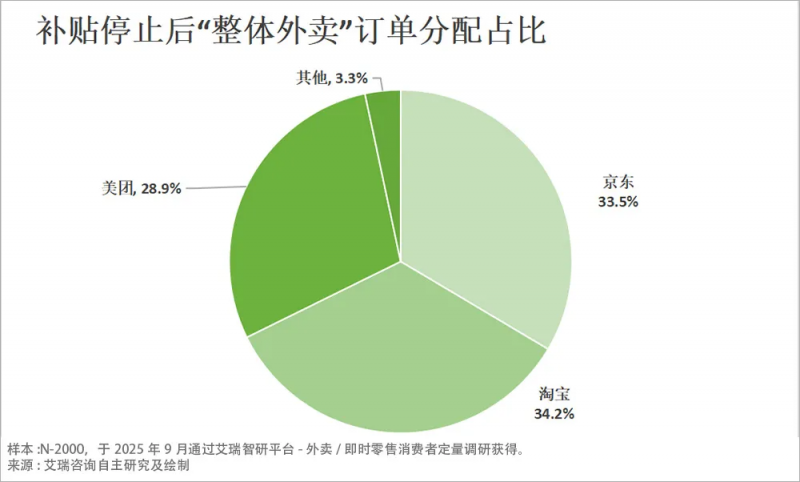
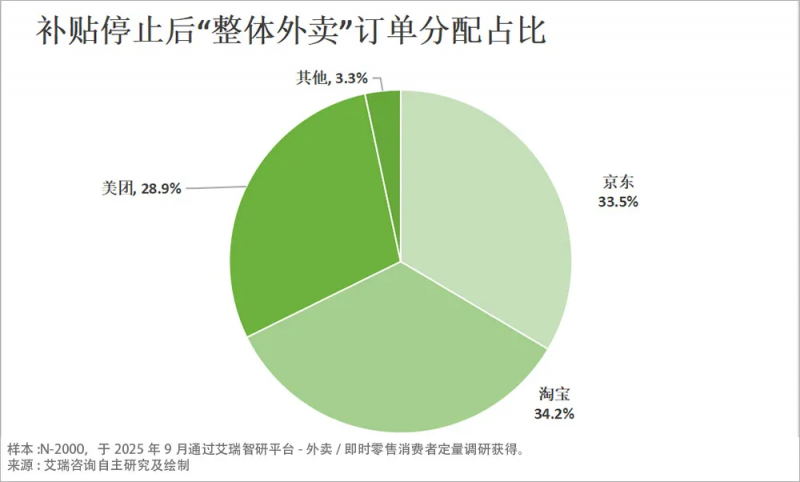
Core Insights - The "subsidy war" in the food delivery industry is losing momentum, leading to a more rational consumer choice and a shift in market competition logic [1][6] - The market is now characterized by a "three-way split," with 34.2% of consumers choosing Taobao Shanguo, 33.5% opting for JD Delivery, and 28.9% selecting Meituan, indicating a balanced market structure [1][3] Market Dynamics - Historically, the food delivery market exhibited a "strong vs. weak" competition, with Meituan dominating due to early user accumulation, while Ele.me struggled to close the market share gap [3] - The end of the subsidy war has shifted competition from "price wars" to "value competition," providing opportunities for new entrants like JD Delivery to establish a foothold [3][6] - JD Delivery has focused on "differentiated competition," leading the quality food delivery segment with a 35.6% future order expectation share, appealing to 26.8% of "value-driven users" who prioritize delivery efficiency and food quality [3][8] Consumer Preferences - Consumer demands for "quality food delivery" have evolved beyond taste to include safety, compliance, and transparency, with trust in merchants becoming a key differentiator [4][6] - Key factors distinguishing "quality food delivery" from regular options include "physical store assurance" (12.5%), "complete qualifications" (11.8%), and "regular hygiene checks" (10.9%) [4] Industry Trends - As consumer expectations for quality rise, the food delivery industry is transitioning from "extensive growth" to "high-quality development," focusing on service upgrades and food safety [6][14] - The shift in consumer behavior due to the subsidy war has led to increased app usage, with Meituan's daily app usage growth at 16.66% in April, followed by JD's 23.87% in May, indicating a reshuffling of market dynamics [10][12] Competitive Landscape - The competition is now defined by the platforms' comprehensive capabilities, with JD and Taobao showing stronger cross-category purchasing tendencies compared to Meituan [12][14] - The cycle of "ordering-cross-buying-retention" reinforces high-frequency consumption and creates synergies with other product categories, marking a shift from "subsidy internal competition" to "value competition" [14]
参照外卖小哥社保模式,快递企业总部该补贴吗?
3 6 Ke· 2025-09-22 23:30
没有社保,不敢生病,不敢出意外,这曾是快递外卖小哥群体的普遍写照。 数据显示,我国灵活就业人员已超2亿,其中只有25%缴纳社会保险。变化始于今年3月,京东率先为骑手"上社保",成为国内首个为全职骑手缴纳五险一 金的平台。 近期,美团、饿了么相继召开恳谈协商会,平台将补贴50%社保费用,覆盖百万小哥。外卖骑手作为占比最大的人群之一,其权益保障的推进,对于快递 行业来说,有着重要的借鉴意义。 美团在福建泉州、江苏南通试点的方案特征是"无前置资格限制、无参保地点限制、无时长单量限制、无跑单类型限制",也就是说,支持骑手自主选择在 户籍地或就业地参保缴费获补;无时长单量限制;面向所有类型骑手开放,不因骑手的熟练度、工作年限而有所区别。 在快递企业中,京东物流成为唯一一家与所有快递小哥签订劳动合同,并缴纳"五险一金"的公司。目前,已有1200多名快递员从京东退休,并领到了退休 金。 正如刘强东所言:"我们也希望他们能长期跟京东走下去,而不是趁着你年轻力壮,跟我干5年,等你老了回老家干不动了,我就不管你了。" 那美团的社保方案,快递企业能否借鉴呢?按照美团的办法,平台对当月收入达到就业地相关缴费基数下限,且近6个月有3个 ...
消费前查黑猫投诉有用吗?怎么查才靠谱?
Xin Lang Cai Jing· 2025-09-22 12:38
Core Viewpoint - The article emphasizes the importance of using the Black Cat Complaint platform as a proactive tool for consumers to avoid potential pitfalls in their purchasing decisions, highlighting its role as a reliable reference guide for consumer rights and service evaluations [1][6]. Group 1: Benefits of Using Black Cat Complaint - Black Cat Complaint is not just a complaint handling platform; it accumulates millions of real complaint data, serving as a "consumer risk manual" that helps users identify service shortcomings and potential issues with merchants [2]. - The platform provides real-time updates on complaint statuses, such as "resolved," "pending response," and "enterprise response rate," allowing consumers to gauge the service quality of merchants before making a purchase [2]. - By searching for specific brands or services on Black Cat Complaint, consumers can uncover common issues like high service fees or poor customer service, which are more informative than traditional advertising [2][7]. Group 2: Effective Search Strategies - To maximize the reference value of Black Cat Complaint, consumers should use precise keywords when searching, avoiding vague terms to find relevant complaint information quickly [3]. - It is crucial to focus on the types of complaints and their resolution outcomes, as this can indicate the severity of issues and the merchant's responsiveness to problems [4]. - Consumers should also consider the merchant's response to complaints, as a lack of engagement may signal poor service quality, while proactive responses indicate a willingness to resolve issues [5]. Group 3: Reliability of Black Cat Complaint - Black Cat Complaint stands out as a reliable consumer reference due to its requirement for users to submit real purchase evidence, ensuring the authenticity of complaints [7]. - The platform publicly shares complaint handling data, such as total complaints, resolution rates, and average handling times, which cannot be manipulated by merchants, providing an objective view of service levels [7]. - Increasingly, consumers are adopting the habit of checking Black Cat Complaint before making purchases, reinforcing its role as a standard practice for informed and rational spending [7][8].
2025年最后100天:如果你熬不下去了,就看看上海住在网约车里的司机
洞见· 2025-09-22 12:35
洞见 ( DJ00123987 ) —— 不一样的观点,不一样的故事, 3000 万人订阅的微信大号。点击标题下蓝字 " 洞见 " 关注,我们将为您提供有价值、有意思的 延伸阅读。 作者:洞见muye 没有谁身上不带伤,没有谁心里不流泪。 ♬ 点上方播放按钮可收听 洞见主播佳音朗读音频 01 在一档街头访谈中,一位上海网约车司机提到,如今许多外地司机为了节省开支,基本上都是以车为家。 他们不租房,每隔几天去价格不高的洗浴中心洗澡、洗衣,生活得很不容易。 这位网约车司机说的是实情。 澎湃新闻采访过一位叫李波的上海网约车司机,他每天都住在车上,睡眠不足7小时。 很多建筑工地都有免费的洗浴间,他给门卫递包烟,每隔两三天去一趟。 无独有偶,北青网也采访过一位叫磊子的网约车司机。 34岁的磊子,后备箱塞满了生活装备:睡觉的被子、牙刷牙膏、洗衣液等。 每天收工后,磊子就找个充电站,趁充电时在车里睡几个小时。 睡车里既节约生活成本,也能随时出车、多挣一些。 车是租来的,每天一睁眼就欠着350元租金,他必须拼命跑,才能勉强为自己攒点钱。 "一天挣到350租车费的话,最少得用8个小时,也就是说,后面8个小时才是给自己挣的。" ...

外卖江湖风云突变 “三分天下” 局势既定
Zhong Guo Shi Pin Wang· 2025-09-22 06:53
Core Insights - The "subsidy war" in the food delivery industry is losing momentum, leading to a more rational consumer choice and a shift in market competition logic [1][6] - The overall food delivery market has reached a "three-way split" with 34.2% of consumers choosing Taobao Shanguo, 33.5% opting for JD Delivery, and 28.9% selecting Meituan, indicating a balanced market structure [1][3] Market Dynamics - Historically, the food delivery market exhibited a "strong vs. weak" competitive landscape, with Meituan dominating early on while Ele.me struggled to close the gap [3] - The end of the subsidy war has shifted competition from "price wars" to "value competition," providing opportunities for new entrants like JD Delivery to establish a foothold [3][6] - JD Delivery has focused on "differentiated competition," leading to a 35.6% expected share in the quality delivery segment, making it the preferred platform for 26.8% of "value-driven users" [3][8] Consumer Preferences - Consumers' demands for "quality delivery" have evolved beyond taste to include safety, compliance, and transparency, with trust in merchants becoming a key differentiator [4][6] - The top three factors distinguishing "quality delivery" from "ordinary delivery" are merchant trust systems, including "physical store guarantees" (12.5%), "complete qualifications" (11.8%), and "regular health inspections" (10.9%) [4] Industry Trends - As consumer expectations for quality rise, the food delivery industry is transitioning from "extensive growth" to "high-quality development," focusing on service upgrades and safety assurances [6][12] - The competition will increasingly center on who can effectively address consumer demands for safety, transparency, and reliability [6][14] Platform Performance - In terms of app usage, Meituan saw a 16.66% increase in daily usage in April, while JD led the industry with a 23.87% growth in May, indicating a shift in consumer behavior [10][12] - Consumers are more likely to engage in cross-category purchases on platforms, with JD and Taobao showing stronger capabilities in retaining users for additional product categories compared to Meituan [12][14] Conclusion - The transition from "subsidy competition" to "value competition" reflects a fundamental shift in consumer needs, emphasizing quality, trust, and service as the new battlegrounds for market players [14]