
家电

Search documents
商务部详解,2026年提振消费新举措
21世纪经济报道· 2026-01-27 00:54
Group 1 - The core viewpoint of the article emphasizes that consumption has become the main engine of economic development, with the total retail sales of consumer goods exceeding 50 trillion yuan for the first time, reaching 50.1 trillion yuan, and contributing 52% to GDP growth [3][5][6]. Group 2 - In 2025, the retail sales of major durable goods showed rapid growth, driven by the old-for-new consumption policy, with retail sales of home appliances, communication equipment, and furniture increasing by 11%, 20.9%, and 14.6% respectively [5]. - New types of consumption, including digital, green, and health consumption, are thriving, with online retail sales of physical goods growing by 5.2% and the market penetration rate of new energy passenger vehicles reaching 53.9% [5][6]. - Rural consumption is becoming increasingly active, with retail sales in rural areas reaching 6.8 trillion yuan, growing by 4.1%, outpacing urban growth by 0.5 percentage points [5][6]. Group 3 - The foreign trade scale reached a historic high of 45.47 trillion yuan, growing by 3.8%, with over 780,000 enterprises engaged in import and export activities, and the share of private enterprises in total foreign trade rising to 57.3% [9][10]. - China is actively participating in global industrial division and cooperation, providing stable and reliable intermediate and capital goods to support the industrial development of other countries, especially developing nations [9][10]. - The export of green products, such as lithium batteries and wind turbines, increased by 26.2% and 48.7% respectively, contributing to global green and low-carbon development [10]. Group 4 - The Ministry of Commerce plans to launch a national-level overseas comprehensive service platform to support enterprises in their overseas investments, providing a one-stop service for policy consultation, business handling, and risk prevention [11][13][14]. - Local governments are also developing their own overseas service platforms to enhance service efficiency and support enterprises in their international expansion [14].


商务部:进一步释放汽车消费潜力 推进有奖发票试点
Zhong Guo Jing Ying Bao· 2026-01-27 00:45
Core Viewpoint - In 2025, consumption continues to play a crucial role as the "main engine" of economic growth in China, with the total retail sales of consumer goods surpassing 50 trillion yuan for the first time, reaching 50.1 trillion yuan, and contributing 52% to GDP growth [1][2]. Group 1: Consumption Market Highlights - Durable goods consumption is experiencing rapid growth, driven by the old-for-new policy, with retail sales of household appliances, communication devices, and furniture increasing by 11%, 20.9%, and 14.6% respectively; passenger car retail volume rose by 3.8% [2]. - New types of consumption are thriving, with digital, green, and health consumption gaining momentum, and new business formats and models emerging; online retail sales of physical goods grew by 5.2%, and the market penetration rate of new energy passenger vehicles reached 53.9% [2]. - Rural consumption is becoming more active, with retail sales of consumer goods in rural areas reaching 6.8 trillion yuan, a year-on-year increase of 4.1%, outpacing urban growth by 0.5 percentage points [2]. - Inbound consumption is on the rise, with the expansion of visa-free countries and the optimization of tax refund policies; sales of tax refund goods nearly doubled, and the number of visa-free foreign visitors increased by nearly 30% within a year of implementing the 240-hour visa-free transit policy [2]. Group 2: Policy and Activity Initiatives - In 2026, there will be an emphasis on enhancing consumer welfare, optimizing the old-for-new policy for durable goods, and promoting automotive consumption through pilot reforms; a trial for prize invoices will be initiated, and practical policies to stimulate the economy will be introduced [3]. - The focus for 2026 will be on three themes: product consumption, service consumption, and consumption scenarios, with over 20 "Buy in China" themed activities planned, and support for local "station" activities to create a vibrant consumption atmosphere [3]. - Efforts will be made to improve the consumption environment, accelerate the cultivation of international consumption center cities, and promote pilot projects for new consumption formats and scenarios, aiming to create attractive new consumption experiences for both domestic and international consumers [3].
券商晨会精华 | A股趋势不变 聚焦三条配置主线
智通财经网· 2026-01-27 00:41
Market Overview - The market experienced fluctuations with significant divergence between large and small indices, with the Shenzhen Component and ChiNext Index opening high but closing down over 1% [1] - The total trading volume in the Shanghai and Shenzhen markets reached 3.25 trillion, an increase of 163 billion compared to the previous trading day [1] - Over 3,700 stocks in the market declined, indicating a broad-based sell-off [1] Sector Performance - The non-ferrous metals sector led the gains, particularly precious metals, with stocks like Sichuan Gold hitting the limit up for four consecutive days [1] - The oil and gas sector also performed well, with China National Offshore Oil Corporation reaching a historical high [1] - The chemical sector saw a rebound, with stocks like Hongbaoli and Chengxing shares hitting the limit up [1] - Conversely, the commercial aerospace and semiconductor equipment sectors faced significant declines, with several stocks hitting the limit down [1] Analyst Insights - Huaxi Securities maintains a "slow bull" trend for the current market, suggesting that the A-share market is still in the mid-stage of the cycle, with ample room for growth [2] - The report highlights that the current risk premium for the CSI 300 index is 5.27%, indicating potential for further market expansion [2] - The focus for investment should be on technology sectors, commodities benefiting from price increases, and industries with high growth forecasts for annual reports [2] Industry-Specific Insights - CITIC Securities anticipates pressure on the home appliance sector in Q4, with a focus on the national subsidy policy that will target core categories and rural markets [3] - The national subsidy policy for home appliances will cover six core categories with a 15% subsidy for first-level energy efficiency, with an initial budget of 62.5 billion yuan [3] - CITIC Jiantou notes the beginning of lithium battery inflation, drawing parallels with the previous photovoltaic cycle, and emphasizes that price trends in rigid capacity segments will be key indicators of demand [4] - The report suggests that while there may be concerns about demand due to price increases, the overall trend will likely lead to simultaneous increases in volume and price across the supply chain [4]
社零总额首破50万亿元 2025年提振消费加力显效
Xin Hua Wang· 2026-01-27 00:37
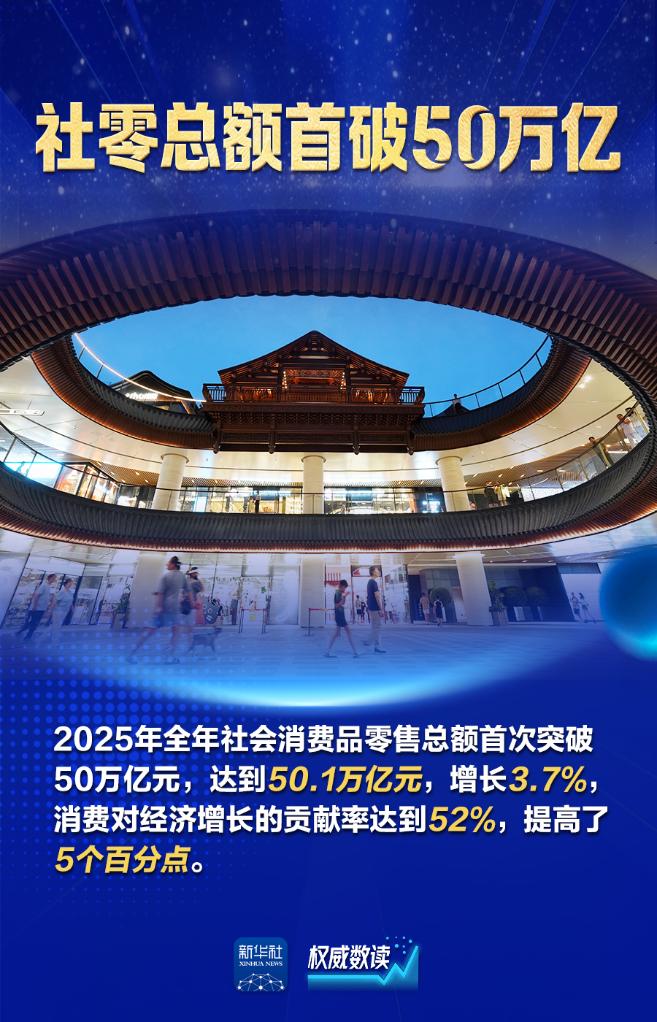
Group 1 - The core viewpoint of the article highlights the robust vitality of China's consumer market in 2025, with the total retail sales of consumer goods exceeding 50 trillion yuan for the first time, reaching 50.1 trillion yuan, and contributing 52% to economic growth, an increase of 5 percentage points [3] - The implementation of the "old-for-new" policy has significantly boosted sales in related sectors, with sales of automobiles, home appliances, and mobile phones reaching 2.61 trillion yuan, benefiting 366 million people [7] - The retail sales of services increased by 5.5% year-on-year, with per capita spending on services rising by 4.5%, accounting for 46.1% of total per capita consumption expenditure [11] Group 2 - New consumption trends such as digital, green, and health consumption are gaining momentum, with online retail sales of physical goods growing by 5.2%, and the market penetration rate of new energy passenger vehicles reaching 53.9% [17] - Rural retail sales of consumer goods reached 6.8 trillion yuan, growing by 4.1%, outpacing urban growth by 0.5 percentage points [19] - The popularity of "China Travel" and "China Purchase" continues to rise, with sales of tax-refunded goods for outbound travelers nearly doubling, and the implementation of a 240-hour visa-free transit policy leading to a nearly 30% increase in foreign visitors [22]
家电业共探供需适配新路径
Zhong Guo Jing Ji Wang· 2026-01-27 00:16
Group 1 - The conference focused on the theme of "Supply and Demand Matching and Deterministic Opportunities," aiming to explore paths for the transformation and innovation of the home appliance industry in the new environment [1] - The core of industrial upgrading is to address structural mismatches in supply and demand, leveraging technological and business model innovations to create sustainable growth paths [2] - The current phase of the home appliance industry is shifting from scale expansion to quality and efficiency, with supply-demand matching being essential for market stability and high-quality development [2] Group 2 - Changes in population structure, living patterns, and digital technology are leading to a more scenario-based, integrated, and health-oriented home appliance consumption, necessitating supply-side innovations to stay ahead of consumer perception changes [3] - Leading manufacturers shared their experiences, emphasizing the importance of meeting cooking needs and providing emotional value through comprehensive solutions [3] - The value of distribution channels is evolving beyond mere sales to include cultural transmission, information hubs, service platforms, and experiential carriers [4] Group 3 - The forum discussed the theme of "Effective Quality Improvement and Reasonable Quantity Growth," highlighting the importance of data-driven supply chain management for sustainable development [5] - Young entrepreneurs emphasized the need to balance sales scale with user satisfaction and long-term value culture [5] - New generation leaders are adopting holistic and dialectical thinking to guide the industry towards healthy development [5] Group 4 - The "2026 Buy in China: Quality Home Appliance Consumption Year" initiative was officially launched at the end of the conference [6]
商务部:进一步释放汽车消费潜力,推进有奖发票试点
Zhong Guo Jing Ying Bao· 2026-01-27 00:16
Core Viewpoint - In 2025, consumption continues to solidify its role as the "main engine" of economic growth in China, with the total retail sales of consumer goods surpassing 50 trillion yuan for the first time, reaching 50.1 trillion yuan, and contributing 52% to GDP growth [2][3]. Group 1: Consumption Market Highlights - The retail sales of durable goods are experiencing rapid growth, driven by the old-for-new consumption policy, with retail sales of home appliances, communication equipment, and furniture increasing by 11%, 20.9%, and 14.6% respectively; passenger car retail volume increased by 3.8% [2]. - New types of consumption are thriving, with digital, green, and health consumption gaining momentum, and new business formats and models emerging; online retail sales of physical goods grew by 5.2%, and the market penetration rate of new energy passenger vehicles reached 53.9% [2]. - Rural consumption is showing active performance, with retail sales of consumer goods in rural areas reaching 6.8 trillion yuan, a year-on-year increase of 4.1%, outpacing urban growth by 0.5 percentage points [3]. - Inbound consumption is on the rise, with the expansion of visa-free countries and the optimization of tax refund policies for outbound tourists; sales of goods eligible for tax refunds nearly doubled, and the number of visa-free foreign visitors increased by nearly 30% within a year of implementing the 240-hour visa-free transit policy [3]. Group 2: Policy and Action Plans for 2026 - The government will enhance support for consumer welfare, optimizing the implementation of the old-for-new consumption policy to promote durable goods consumption, and will conduct pilot reforms in automotive circulation to further unleash automotive consumption potential [4]. - In 2026, over 20 "Buy in China" themed activities will be organized, focusing on product consumption, service consumption, and consumption scenarios, with 15 international consumption environment pilot cities hosting "city-specific" events [4]. - Efforts will be made to improve the consumption environment, accelerate the cultivation of international consumption center cities, and promote pilot projects for new consumption formats, models, and scenarios to create attractive new consumption experiences for domestic and international consumers [4].
中信建投:铜价与汇率冲击再起,对家电龙头盈利的冲击整体可控
Sou Hu Cai Jing· 2026-01-27 00:12
中信建投研报认为,2026年面临铜价中枢上移与人民币升值的双重考验,其对家电龙头盈利的冲击整体 可控。过往经验看,顺价是化解成本压力最为有效的核心手段。国补落地下需求有支撑,元旦后提价存 共识。凭借强大的终端定价权、成熟的成本传导机制以及完善的汇率风险管理体系,龙头企业有能力穿 越周期波动,维持盈利模型的稳健。当前家电板块估值处于历史低位,兼具稳健增长与高分红特性,配 置价值凸显。 ...

为全球经济增长带来更多动力 国际舆论看好中国经济发展前景
Ren Min Ri Bao· 2026-01-26 23:56
Core Viewpoint - In 2025, China's economy demonstrated resilience and growth amid complex domestic and international environments, maintaining its position as the world's second-largest economy and contributing significantly to global economic growth through high-quality development and openness [1][2][3]. Economic Performance - The industrial added value for large-scale industries increased by 5.9% year-on-year, while total goods import and export rose by 3.8% [2]. - Final consumption expenditure contributed over 50% to economic growth, with real disposable income per capita increasing by 5.0%, aligning with economic growth [2]. - China's GDP surpassed 140 trillion yuan for the first time, achieving a year-on-year growth of 5.0% and successfully meeting annual economic growth targets [2][3]. Government Initiatives - The Chinese government implemented various economic stimulus measures, including a trade-in policy for consumer goods like home appliances and automobiles, which boosted retail sales of consumer goods [2][3]. - International organizations, including the International Monetary Fund, have raised their growth forecasts for China, attributing this to effective government measures that stimulated domestic demand and boosted economic confidence [3]. Innovation and Technology - Research and development expenditure intensity reached 2.8%, exceeding the OECD average for the first time, with China ranking in the global top ten for innovation index [4]. - Significant growth was noted in advanced technology sectors, with production increases in civil drones (37.3%), 3D printing equipment (52.5%), industrial robots (28.0%), and new energy vehicles (25.1%) [4]. - China's advancements in green technologies, such as electric vehicles and solar panels, have solidified its position as a global manufacturing hub [4][6]. Global Economic Impact - China's economic growth is projected to contribute approximately 30% to global economic growth, making it one of the most stable and reliable sources of economic momentum worldwide [7]. - The country's governance model, emphasizing cohesion, order, and long-term planning, has been identified as a key factor in its economic success [7][8].
【钛晨报】2026年提振消费怎么干?商务部:出政策、办活动、优场景;全球首次,通用大模型太空在轨部署成功;英伟达与CoreWeave深化合作,斥资20亿美元加速全球AI工厂建设
Sou Hu Cai Jing· 2026-01-26 23:35
Economic Overview - In 2025, the overall business development is stable and progressing, contributing positively to the economic recovery, with total retail sales of consumer goods exceeding 50 trillion yuan, reaching 50.1 trillion yuan, a growth of 3.7%, and consumption contributing 52% to economic growth [2] - Over 70,000 new foreign-funded enterprises were established, marking a growth of 19.1%, with foreign investment absorption reaching 747.69 billion yuan, of which high-tech industries accounted for 32.3% [2] Consumer Market Highlights - The consumer market in 2025 showed four main highlights: 1. Rapid growth in durable goods consumption, with retail sales of home appliances, communication devices, and furniture increasing by 11%, 20.9%, and 14.6% respectively, and passenger car retail volume rising by 3.8% [3] 2. New consumption types, including digital, green, and health consumption, continued to thrive, with online retail sales of physical goods growing by 5.2% and the penetration rate of new energy passenger vehicles reaching 53.9% [3] 3. Active rural consumption, with retail sales in rural areas reaching 6.8 trillion yuan, growing by 4.1%, outpacing urban growth by 0.5 percentage points [3] 4. Increased inbound consumption, with sales of tax refund goods nearly doubling and a 30% increase in foreign visitors due to expanded visa-free policies [3] Policy Initiatives - The Ministry of Commerce plans to implement a special action to boost consumption in 2026, focusing on policy issuance, event organization, and improving consumption scenarios [4] - Key initiatives include optimizing the old-for-new consumption policy, promoting automotive consumption, and launching various promotional activities to enhance consumer atmosphere [4] - The Ministry will also accelerate the cultivation of international consumption center cities and improve the consumption environment through pilot projects [4] Trade and Investment - The Ministry of Commerce aims to innovate and develop digital trade, starting the construction of a national digital trade demonstration zone and promoting the integration of domestic and international standards [18] - Plans to expand service trade include improving the negative list management system for cross-border service trade and establishing national service trade innovation development demonstration zones [18] Corporate Developments - JD Property submitted an A1 application to the Hong Kong Stock Exchange, managing 285 modern infrastructure assets with a total area of approximately 27.1 million square meters and an asset management scale of 121.5 billion yuan [19] - Zijin Mining announced plans to acquire Allied Gold Corporation at a price of 44 Canadian dollars per share, totaling approximately 5.5 billion Canadian dollars (about 28 billion yuan) [19][20]

商务部:今年将出台扩大入境消费政策措施
Zhong Guo Zheng Quan Bao· 2026-01-26 23:25
Group 1: Foreign Investment and Trade Policies - The Ministry of Commerce aims to expand high-level foreign investment and enhance the "Invest in China" brand by reforming the foreign investment promotion system by 2026 [1][3] - The Ministry will implement a "combination punch" of foreign trade policies, including new measures to support enterprises in overseas exhibitions and trade promotion activities [2] - A national-level overseas comprehensive service platform will be launched to provide a one-stop service for enterprises regarding policy consultation, business handling, and risk prevention [3][4] Group 2: Service Trade Development - The Ministry plans to improve the negative list management system for cross-border service trade and promote the opening of service markets [3][4] - There will be a focus on expanding the export of productive services and enhancing the international competitiveness of traditional services such as Chinese medicine and cuisine [3] - The Ministry will support foreign-funded enterprises in extending their value chains and achieving specialized, integrated, and intelligent development [4] Group 3: Consumer Market and Domestic Demand - The retail sales of consumer goods are projected to exceed 50 trillion yuan in 2025, with a growth rate of 3.7% and a contribution rate of 52% to economic growth [5] - In 2026, the Ministry will focus on expanding domestic demand, optimizing the implementation of old-for-new consumption policies, and promoting consumption in durable goods [5][6] - The Ministry will also work on improving the consumption environment by fostering international consumption centers and creating new consumption scenarios [5][6]