
服务业

Search documents
月度前瞻 | 7月经济:涨价的“悖论”?(申万宏观·赵伟团队)
赵伟宏观探索· 2025-08-05 16:04
Group 1: Inflation and Policy Response - The core focus of July's policy is on "anti-involution," with multiple departments addressing the phenomenon of market "involution" [2][11] - The expected inflation rates for July are projected at -3.1% for PPI and 0% for CPI, indicating weak price performance despite rising commodity prices [2][11] - The increase in commodity prices is driven by expectations of supply contraction, but excess supply in downstream sectors limits the transmission of price increases from upstream to downstream [2][24] Group 2: Supply Dynamics - Industrial production remains resilient, with July's industrial value added expected to be around 6.4%, despite a decline in new orders [4][61] - The PMI production index indicates that production is still expanding, with notable increases in sectors like general equipment and black metal rolling [4][55] - The supply situation is characterized by a divergence, where production is better than demand, contrary to market expectations of significant supply contraction [4][48] Group 3: Demand Structure - Demand is showing signs of differentiation, with weak goods demand but stronger service demand, leading to a projected slight decline in actual GDP to 4.9% for July [6][73] - Export performance is expected to exceed expectations in July due to the residual effects of "export grabbing," but there are concerns about a potential decline in exports in September [6][73] - The consumer market is experiencing a potential decline in goods consumption due to a "subsidy gap" in the "old-for-new" program, while service consumption is expected to improve due to increased travel activity [8][89] Group 4: Investment Trends - Investment performance is mixed, with real estate and manufacturing investments likely to decline, while infrastructure and service sector investments may see improvement [8][102] - The acceleration of special bond issuance is expected to support infrastructure investment, with asphalt construction rates showing an upward trend [8][102] - The manufacturing sector faces downward pressure due to the nearing end of equipment renewal demand, while real estate investment is likely to continue weakening [8][102] Group 5: Economic Outlook - The main logic of economic operation in July revolves around "price increases," but the sustainability of these increases is relatively weak due to supply-side production increases and weak demand [9][112] - The overall economic indicators suggest a nominal GDP growth of 3.9% and an actual GDP growth of 4.9% for July, reflecting the current economic conditions [9][112]


欧元区7月PMI小幅回升至4个月新高 但仍难掩经济增长颓势
Zhi Tong Cai Jing· 2025-08-05 09:09
Group 1: Economic Activity and PMI Data - The HCOB Eurozone Composite PMI index rose slightly from 50.6 in June to 50.9 in July, still below the long-term average of 52.4, indicating ongoing economic weakness in the Eurozone [1] - The Eurozone services PMI increased from 50.5 in June to 51.0 in July, but was below the market expectation of 51.2, reflecting a modest improvement in service sector activity [1] - Spain showed the strongest performance among major Eurozone economies, with a composite PMI rising from 52.1 in June to 54.7 in July, while France experienced a contraction with a PMI of 48.6 [1] Group 2: Employment and Business Confidence - Eurozone businesses increased employment for the fifth consecutive month in July, reaching the fastest growth rate in over a year, despite weak demand [2] - Business confidence declined for the first time since April, with optimism waning in both manufacturing and services sectors, leading to overall confidence falling below long-term averages [2] Group 3: Inflation and Monetary Policy - Cost pressures have decreased to the lowest level since October of the previous year, primarily driven by the service sector, while output price inflation slightly increased to a three-month high [2] - The European Central Bank (ECB) may consider further rate cuts in the second half of the year due to easing service sector inflation, despite many officials suggesting insufficient reasons for continued accommodative policies [3] - The recent EU-US trade agreement may negatively impact Eurozone exports and economic growth, raising concerns about the sustainability of the Eurozone's economic recovery [3]
【宏观经济】一周要闻回顾(2025年7月30日-8月5日)
乘联分会· 2025-08-05 08:34
Group 1: Manufacturing PMI Overview - In July, the Manufacturing Purchasing Managers' Index (PMI) was 49.3%, a decrease of 0.4 percentage points from the previous month, indicating a decline in manufacturing activity [3] - Large enterprises had a PMI of 50.3%, down 0.9 percentage points, while medium-sized enterprises saw an increase to 49.5%, up 0.9 percentage points, and small enterprises dropped to 46.4%, down 0.9 percentage points [3] - The production index was 50.5%, a decrease of 0.5 percentage points, indicating continued expansion in manufacturing production, while the new orders index fell to 49.4%, down 0.8 percentage points, suggesting a slowdown in market demand [3][5] Group 2: Non-Manufacturing PMI Overview - In July, the Non-Manufacturing Business Activity Index was 50.1%, a decrease of 0.4 percentage points, remaining above the critical point [5] - The construction industry index was 50.6%, down 2.2 percentage points, and the service industry index was 50.0%, down 0.1 percentage points [5] - The new orders index for non-manufacturing fell to 45.7%, down 0.9 percentage points, indicating a decline in market demand, particularly in the construction sector, which saw a new orders index of 42.7% [5] Group 3: Composite PMI Overview - The Composite PMI Output Index for July was 50.2%, a decrease of 0.5 percentage points, indicating overall expansion in business activities [7] Group 4: Service Trade Performance - In the first half of 2025, China's service trade totaled 38,872.6 billion yuan, a year-on-year increase of 8.0%, with exports at 16,883 billion yuan, up 15.0%, and imports at 21,989.6 billion yuan, up 3.2% [4][9] - Knowledge-intensive service trade grew to 15,025.4 billion yuan, an increase of 6.0%, with significant contributions from other business services and telecommunications [9] - Travel services experienced the fastest growth, reaching 10,802.9 billion yuan, up 12.3%, with exports growing by 68.7% [9]

标普:中国7月服务业活动增速超预期
Huan Qiu Wang· 2025-08-05 06:05
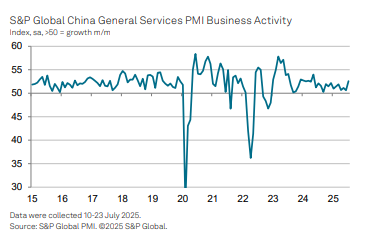
【环球网财经综合报道】据Investing.com等外媒报道,标普全球公布最新数据显示,中国7月标普全球服务业采购经理人指数(PMI)录得52.6,较前值50.6 显著回升,并超出预期。 数据显示,7月标普全球综合PMI为50.8,虽然较前值51.3略有下滑,但仍连续第二个月处于扩张区间。 标普全球报告显示,受访服务业企业普遍表示,新增业务是支撑今年下半年活动量增长的关键因素。新订单的增加速度达到有记录以来最快的一年,企业将 这种回升归因于基础需求条件的改善和整体业务环境的向好。 值得注意的是,服务业外部需求出现三个月来首次回升。旅游活动的增加和贸易条件更加稳定的报告推动新出口业务量实现2月以来最快增长。 在就业方面,随着工作负荷的增加和企业信心的提升,服务业公司在7月积极增聘员工。劳动力产能的扩张也使得积压工作量的增长有所放缓,反映出企业 经营状况的改善。 整体企业信心在7月有所改善,服务业界的乐观度升至四个月来最高水平。企业普遍对未来持积极态度,这种乐观情绪主要源于对更佳经济条件和改善的全 球贸易流将支持未来一年新销售和活动增长的预期。 外媒报道称,中国服务业在充满不确定性的经济形势下仍然是一大亮点。服务 ...

中国7月标普全球服务业PMI升至52.6,为去年5月以来最高
Hua Er Jie Jian Wen· 2025-08-05 02:29
Core Insights - China's service sector accelerated its expansion in July, with new business orders increasing and sales expenses rising for the first time in six months, leading to improved business sentiment at its highest level since March [1][5]. Group 1: Service Sector Performance - The S&P Global Services PMI for July was reported at 52.6, up from 50.6, marking the fastest expansion rate in over a year and remaining in the expansion zone for 31 consecutive months [1]. - The S&P Global Composite PMI for July was 50.8, a slight decline from 51.3, but still indicating expansion for the second consecutive month [3]. Group 2: Business Conditions and Sentiment - Respondents from the service sector indicated that new business supported growth in activity for the second half of the year, with new orders increasing at the fastest rate on record, attributed to improved underlying demand conditions and positive business outlook [5]. - External demand saw its first increase in three months, driven by rising tourism activities and more stable trade conditions, resulting in the fastest growth in new export business in two months [5]. Group 3: Employment and Confidence - Increased workloads and improved confidence led service companies to hire more employees in July, while the expansion of labor capacity resulted in a slowdown of backlog work growth [5]. - Overall business confidence improved, reaching a four-month high, driven by expectations of better economic conditions and improved global trade supporting future sales and activity growth, although still below long-term averages [5]. Group 4: Cost and Pricing Dynamics - The latest survey indicated a rise in sales expenses in July, suggesting enhanced confidence as companies were able to pass on higher costs to customers for the first time in six months [6]. - The performance of the service sector in July contrasted with the slowing trend in manufacturing [6].
全力打造“放心消费在辽宁”品牌
Liao Ning Ri Bao· 2025-08-05 01:06
Core Viewpoint - The province has launched a three-year initiative to enhance the consumer environment, aiming to establish the "Safe Consumption in Liaoning" brand, focusing on building a trustworthy, fair, convenient, and safe consumption environment [1][2] Group 1: Key Actions and Tasks - The initiative includes five major actions and 21 key tasks to improve the convenience, comfort, and satisfaction of the consumer environment across the province [1] - Actions include enhancing the quality of consumer supply, optimizing consumer order, improving consumer rights protection, promoting co-governance of the consumer environment, and leading consumer environment initiatives [2] Group 2: Specific Measures - Quality enhancement actions involve fostering specialized consumer goods industrial towns, implementing trade-in programs, and promoting service consumption contract templates [1] - Order optimization actions include establishing inter-agency consumer rights protection meetings, implementing food safety enhancement projects, and improving product recall management [1][2] - Rights protection measures focus on promoting online dispute resolution mechanisms, encouraging "no-reason return" commitments, and enhancing consumer education and rights service stations [1][2] Group 3: Collaborative Efforts - The initiative promotes a collaborative governance model for consumer rights protection, including compliance systems and dynamic verification of platform operators [2] - It supports the establishment of a mechanism for cross-regional returns and exchanges, and encourages international cooperation in tourism and consumption [2] Group 4: Current Progress - As of now, 3,353 physical stores have committed to "no-reason return" services, and 2,014 units have been developed for online dispute resolution [2] - A total of 630 consumer rights protection service stations have been established to provide localized support for consumers [2]
【环球财经】东京股市周一大跌 日经225指数收跌1.25%
Xin Hua Cai Jing· 2025-08-04 09:11
Market Performance - The Tokyo stock market experienced significant declines, with the Nikkei 225 index closing down 1.25% and the Tokyo Stock Exchange Price Index down 1.10% [1] - The Nikkei index fell by 508.90 points to close at 40,290.70 points, while the Tokyo Stock Exchange index decreased by 32.45 points to 2,916.20 points [2] Influencing Factors - The downturn in the Tokyo stock market was influenced by disappointing U.S. economic data, including lower-than-expected non-farm payrolls and manufacturing indices, which negatively impacted the New York stock market [1] - On the day of the decline, the Nikkei index briefly dropped over 900 points, falling below the 40,000-point mark before recovering slightly in the afternoon session [1] Sector Performance - Most sectors on the Tokyo Stock Exchange saw declines, with banking, mining, and service sectors leading the losses [2] - Conversely, five sectors, including other products, real estate, and precision machinery, experienced gains [2]
【数据发布】2025年7月中国采购经理指数运行情况
中汽协会数据· 2025-08-04 08:23
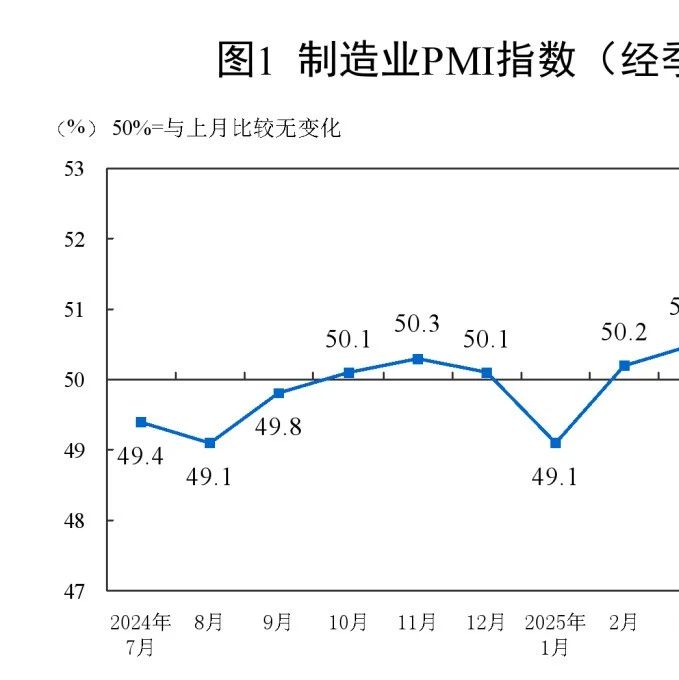
Group 1: Manufacturing PMI Overview - In July, the Manufacturing Purchasing Managers' Index (PMI) was 49.3%, a decrease of 0.4 percentage points from the previous month, indicating a decline in manufacturing activity [1][3] - Large enterprises had a PMI of 50.3%, down 0.9 percentage points, while medium-sized enterprises saw a PMI of 49.5%, up 0.9 percentage points, and small enterprises had a PMI of 46.4%, down 0.9 percentage points [3][4] - The production index was at 50.5%, a decrease of 0.5 percentage points, indicating continued expansion in manufacturing production [3][4] Group 2: Demand and Inventory Indicators - The new orders index was 49.4%, down 0.8 percentage points, suggesting a slowdown in market demand for manufacturing [4] - The raw materials inventory index was 47.7%, down 0.3 percentage points, indicating a continued reduction in major raw material inventories [4] - The employment index was 48.0%, up 0.1 percentage points, showing a slight improvement in employment conditions within the manufacturing sector [4] Group 3: Non-Manufacturing PMI Overview - In July, the Non-Manufacturing Business Activity Index was 50.1%, a decrease of 0.4 percentage points, remaining above the critical point [7] - The construction industry business activity index was 50.6%, down 2.2 percentage points, while the service industry index was 50.0%, down 0.1 percentage points [9] - The new orders index for non-manufacturing was 45.7%, down 0.9 percentage points, indicating a decline in market demand [11] Group 4: Price and Employment Trends in Non-Manufacturing - The input price index was 50.3%, up 0.4 percentage points, indicating an overall increase in input prices for non-manufacturing enterprises [11] - The sales price index was 47.9%, down 0.9 percentage points, suggesting a decrease in overall sales prices [11] - The employment index for non-manufacturing was 45.6%, up 0.1 percentage points, indicating a slight improvement in employment conditions [11] Group 5: Composite PMI Overview - The Composite PMI Output Index was 50.2%, a decrease of 0.5 percentage points, but still above the critical point, indicating overall expansion in production and business activities [15]
瑞士7月服务业PMI 41.8,前值 48.5。
news flash· 2025-08-04 07:38
Core Insights - The Swiss services PMI for July is reported at 41.8, a decrease from the previous value of 48.5 [1] Group 1 - The decline in the services PMI indicates a contraction in the Swiss services sector, as a PMI below 50 signifies a reduction in activity [1]
“反内卷”驱动量价再平衡,关注价格修复的可持续性
China Post Securities· 2025-08-04 03:09
Group 1: Economic Indicators - The manufacturing PMI for July is at 49.3%, a decrease of 0.4 percentage points from the previous month, indicating a marginal decline in manufacturing sentiment[9] - The new orders index for manufacturing PMI is at 49.4%, down 0.8 percentage points, indicating a return to contraction territory[12] - The production index for manufacturing PMI is at 50.5%, a decrease of 0.5 percentage points, but still within the expansion range[15] Group 2: Supply and Demand Dynamics - Both supply and demand have weakened, with the supply-demand gap widening in July[9] - The new export orders index is at 47.1%, down 0.6 percentage points, reflecting a decline in external demand[12] - The marginal consumption propensity of residents is at 65.52%, a decrease of 0.08 percentage points year-on-year, indicating cautious consumer spending[13] Group 3: Policy Impact and Market Outlook - The "anti-involution" policy is expected to marginally improve PPI growth, supporting corporate profit expectations[2] - The BCI profit forecast index for July is at 44.26, an increase of 0.48 points, indicating improved profit expectations[18] - If inflation recovery is sustainable in Q3, the capital market may stabilize and trend positively in August[26] Group 4: Risks and Challenges - Risks include potential escalation of global trade tensions and geopolitical conflicts[27] - The impact of extreme weather on construction and service sectors has been significant, leading to a slowdown in expansion momentum[21][22]