制造业

Search documents
1月资产配置月度报告:跨年行情多点开花,外需韧性超预期
Sou Hu Cai Jing· 2026-01-13 02:57
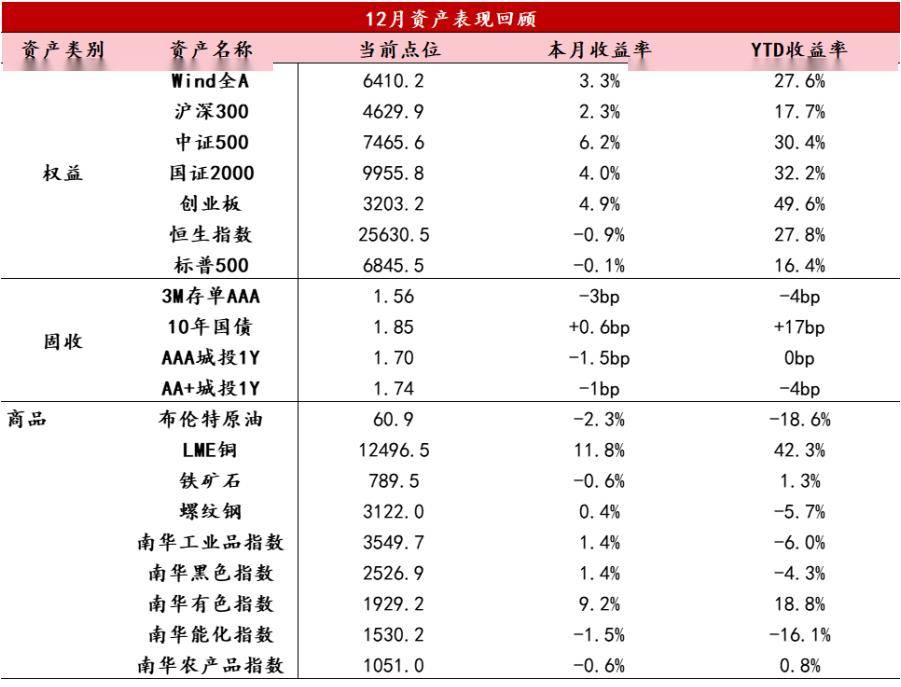
Stock Market Overview - In December, the Federal Reserve's interest rate cut was implemented as expected, leading to fluctuations in future rate cut expectations, while the Nasdaq index experienced volatility [1] - The A-share market showed overall fluctuations, with the Shanghai Composite Index achieving 11 consecutive gains by the end of the month, driven by a positive tone from the Central Economic Work Conference and a declining US dollar index [1] - The Wind All A index recorded a +3.3% increase for the month, with 60% of the Shenwan first-level industries rising, particularly strong performances in defense and military (+17.22%) and non-ferrous metals (+13.68%) [1] Bond Market Overview - The bond market continued to experience wide fluctuations in December, with increased yield volatility and a steeper curve [2] - Despite relatively ample liquidity and the central bank's resumption of bond purchases providing some support, concerns over long-term bond supply and other factors kept the market in a weak oscillation pattern [2] - The 10-year government bond yield ended the month at 1.85%, reflecting an N-shaped trend throughout December [2] Commodity Market Overview - The commodity market showed a bullish atmosphere in December, with precious metals and non-ferrous sectors being the strongest performers [3] - Gold prices fluctuated, with London gold closing at $4318.25 per ounce, up 2.36% from the previous month, while copper prices also saw significant increases [3] - The oil market experienced a downward trend, with Brent crude oil closing at $60.91 per barrel, down 2.26% for the month [3] Macroeconomic Performance - In November, China's exports demonstrated strong resilience, growing by 5.9% year-on-year, driven by a significant increase in machinery and high-tech product exports [5] - However, domestic consumption remained weak, with retail sales growth slowing to 0.3% year-on-year, indicating structural constraints on internal demand [5] - Fixed asset investment continued to decline, with real estate investment adjustments dragging down overall figures, highlighting the challenges in achieving self-sustaining growth [5] Policy Outlook - The Central Economic Work Conference set the tone for macroeconomic policy in 2026, focusing on addressing the structural imbalance of "strong supply and weak demand" [9] - The strategic shift will prioritize investment in human capital and social welfare, aiming to enhance income levels and consumer demand [9] - Fiscal policy is expected to maintain a more active stance, with a nominal deficit rate targeted around 4.0%, while monetary policy will shift focus from total volume to price stability [10][11] Asset Allocation Analysis - In December, net buying in the stock market rebounded to over 2.5 trillion yuan, with significant inflows into equity ETFs [14] - The manufacturing PMI showed a seasonal rebound, indicating improved trade conditions and proactive inventory preparations by companies [15] - Looking ahead to 2026, the market is expected to experience structural trends, with a focus on sectors that demonstrate sustainable performance and profitability [16]

A股科技型企业整体业绩为估值提供支撑——上市公司市值稳步抬
Jing Ji Ri Bao· 2026-01-13 02:50
Group 1: Market Overview - As of the end of 2025, there are 5,469 listed companies in A-shares with a total market capitalization of 123 trillion yuan, reflecting a year-on-year growth of 22.5% for existing companies [1] - The average price-to-book ratio of listed companies increased from 3.3 at the beginning of the year to 4.4 by the end of 2025, indicating a steady rise in overall market valuation [2] Group 2: Sector Performance - Technology-driven sectors, particularly manufacturing and scientific research, saw significant market value increases, with total market capitalization growing by 33.3% and 32.1% respectively, contributing to a 4.2 percentage point and 0.1 percentage point increase in their share of A-share market capitalization [2] - Nearly half of the listed companies in manufacturing and scientific research sectors achieved a net asset return rate greater than 5%, supporting their valuations [2] Group 3: Policy and Governance - The report highlights that market capitalization performance reflects national strategic directions, with notable performance in emerging industries such as integrated circuits, artificial intelligence, and high-end manufacturing [3] - Regulatory bodies have introduced a series of policies to enhance the framework for market capitalization management, including improvements in mergers and acquisitions, cash dividends, and share buybacks [3] - Over 98% of companies held their annual shareholder meetings by June 30, and more than 70% of boards consist of 7 or 9 members, indicating a trend towards improved corporate governance [4] Group 4: Corporate Governance - The governance structure is becoming more standardized, with over 96% of companies having a high attendance rate at board meetings and a low incidence of proposal rejections [4] - More than 99% of companies disclosed their 2024 audit reports and internal control audit reports, with over 96% receiving unqualified opinions [4] - The governance report indicates a positive trend in corporate governance, although attention is needed on issues like related party transactions and internal supervision effectiveness [5]
推动工业经济稳增长,工信部点名这些未来产业
Di Yi Cai Jing· 2026-01-13 02:40
Core Viewpoint - The Chinese government aims to enhance industrial growth and innovation through the implementation of traditional industry revitalization and the development of emerging industries, focusing on technological advancements and new energy sources [2][4]. Group 1: Industrial Growth Strategies - The Ministry of Industry and Information Technology (MIIT) plans to implement actions to revitalize traditional industries and develop emerging industries, enhancing technological innovation capabilities [2][4]. - The industrial economy has shown resilience, with a reported 6% year-on-year growth in industrial added value for large-scale industries in the first 11 months of 2025, and high-tech manufacturing and equipment manufacturing growing by 9.2% and 9.3% respectively [3]. - The MIIT emphasizes stabilizing growth in key industries and regions, which account for 80% of total industrial output, and will support major industrial provinces with policy backing and resource guarantees [3][4]. Group 2: Digital and Intelligent Transformation - The MIIT is focusing on smart manufacturing as a primary direction, promoting the digital, networked, and intelligent transformation of the manufacturing sector, with significant progress noted in the integration of 5G applications across 91 out of 97 major economic categories [5]. - The "14th Five-Year Plan" emphasizes promoting the digital transformation of manufacturing, with initiatives to enhance industrial data collection and support the digital transition of small and medium-sized enterprises [5][6]. - The MIIT aims to implement the "Artificial Intelligence + Manufacturing" initiative, with plans to upgrade at least 50,000 enterprises by 2028 through the integration of AI and industrial internet technologies [6][7]. Group 3: Emerging Industry Development - The government is set to create national demonstration bases for emerging industries, focusing on large-scale applications of new technologies and products in manufacturing [4]. - The acceleration of emerging industries is expected to lead to a development pattern characterized by multiple technological breakthroughs and deep integration across sectors during the "14th Five-Year Plan" period [4][7]. - The integration of AI into manufacturing is seen as crucial for enhancing design, production efficiency, and supply chain management, with a call for foundational innovation and ecosystem development to support this integration [7].
《经济日报》专访工业和信息化部部长李乐成
Jing Ji Ri Bao· 2026-01-13 01:22
Core Viewpoint - The "14th Five-Year Plan" emphasizes the construction of a modern industrial system, focusing on strengthening the real economy and advancing manufacturing towards higher quality and stronger capabilities by 2026 [1]. Group 1: Industrial Economic Development - In the past year, the industrial economy achieved a qualitative improvement and reasonable quantitative growth, with industrial added value above designated size increasing by 6% year-on-year in the first 11 months of 2025 [1]. - High-tech manufacturing and equipment manufacturing saw added value growth of 9.2% and 9.3% respectively, indicating a significant acceleration in industrial upgrading [1]. - The Ministry of Industry and Information Technology (MIIT) will focus on four areas: stability, expansion, innovation, and enhancement to ensure steady industrial economic growth [2]. Group 2: Stability in Key Industries - Stability will be maintained in key industries and regions, which account for 80% of the total industrial output value [2]. - The MIIT plans to implement a new round of growth stabilization plans for ten key industries and support major industrial provinces [2]. Group 3: Expansion of Effective Demand - The strategy includes expanding domestic demand and enhancing supply-demand matching, promoting flexible manufacturing, and accelerating the application of new technologies [2]. - Major engineering projects under the "14th Five-Year Plan" will be initiated to maintain effective investment in manufacturing [2]. Group 4: Innovation and Value Creation - The MIIT aims to promote value creation and quality improvement through traditional industry renewal and the development of emerging industries [3]. - Actions will be taken to enhance competitiveness in traditional sectors like metallurgy and machinery while fostering new pillar industries such as integrated circuits and aerospace [3][5]. Group 5: Enhancing Business Vitality - The MIIT will establish a nurturing system for quality enterprises and support small and medium-sized enterprises in improving cash flow and reducing burdens [3]. - Monitoring and governance of production capacity in key industries will be strengthened to ensure a healthy competitive environment [3]. Group 6: Modern Industrial System Construction - The MIIT will focus on achieving new industrialization, emphasizing high-quality development and the integration of technological and industrial innovation [4]. - Traditional industries will undergo renewal actions, while new industries will be developed as new growth engines [5]. Group 7: Future Industry Layout - The MIIT will enhance forward-looking planning for future industries, including future manufacturing and future health, to seize opportunities in emerging sectors [6]. - Actions will be taken to cultivate high-tech zones and promote innovation in future industries [6]. Group 8: Digital Transformation in Manufacturing - The MIIT will promote the digital transformation of manufacturing, with a focus on building a robust digital foundation and enhancing network connectivity [10][11]. - The integration of artificial intelligence in manufacturing will be prioritized to drive smart upgrades and explore new application scenarios [11].
引导金融机构加力支持扩大内需
Sou Hu Cai Jing· 2026-01-12 23:16
Core Viewpoint - Expanding domestic demand is a strategic foundation for constructing a new development pattern, with a focus on enhancing the domestic market and supporting key areas such as consumption, technological innovation, and small and micro enterprises [1][2]. Financial Support for Domestic Demand - Financial services play a crucial role in supporting the real economy, and the effectiveness of these services directly impacts the success of expanding domestic demand [1]. - The transition from scale-driven financial support to quality and efficiency-driven support is necessary as the economy shifts from high-speed growth to high-quality development [2][3]. Structural Issues in Financial Support - There are structural issues in financial support for expanding domestic demand, including inadequate mechanisms to promote consumer confidence and willingness to spend [4]. - For enterprises, there is a gap in the supply of medium- and long-term funds necessary for effective investment, leading to mismatches in financing needs [5]. - Financial institutions face challenges in lending and risk management, which affects their ability to support consumer and small business loans effectively [6]. Systemic Reforms Needed - Systemic reforms are required to enhance the quality and efficiency of financial services, focusing on long-term support for manufacturing upgrades and innovative consumption scenarios [7]. - Strengthening the collaboration between fiscal and monetary policies is essential to improve the effectiveness of financial support for expanding domestic demand [8]. Enhancing Financial Institutions' Capabilities - Financial institutions need to shift from collateral-based lending to credit-driven models, utilizing comprehensive data systems to create digital credit profiles [9]. - There is a need for innovative financial support mechanisms that integrate with rural revitalization and local economic development [10].
凤桥镇绘就高质量发展新图景
Xin Lang Cai Jing· 2026-01-12 23:09
(来源:嘉兴日报) 转自:嘉兴日报 近年来,"大三星"片区聚焦"土特产筑基、文旅赋能、业态创新"核心方向精准发力,成功落地9个总投 资2.8亿元的重点项目,招引10个特色业态项目,撬动社会资本超2000万元。同时,创新推出"大三星优 选"公共品牌,开发32类特色产品与6条精品文旅线路。截至2025年11月,片区7个村集体经营性收入合 计达1296.96万元,同比增长27.78%,共同富裕的美好图景正逐步铺展。 党建引领不仅激活了乡村产业发展动能,更锻造出一支敢担当、善作为的干部队伍。凤桥镇推行"一线 练兵"机制,启动干部四大提能行动,通过多维度比拼激励机制,充分激发干部队伍的责任担当与实干 精神。"原粮站区域60天实现拔钉清零、威肯西项目30天顺利开工,这些攻坚任务的圆满完成,离不开 党建引领下的团队协作与实干担当。"凤桥镇党建办相关负责人介绍。 依托"桃源先锋"淬炼计划、青年干部成长营等培育载体,5名干部赴市级部门开展融入式锻炼,1名干部 斩获国家级宣讲类荣誉,干部队伍的综合素养与履职能力得到显著提升。 ■撰文 陆欣瑜 冯思家 图片由凤桥镇提供 近日,嘉兴市推进长三角一体化发展典型案例名单公布,南湖区凤桥镇 ...

清华南口国重基地今年将整体建成
Bei Jing Qing Nian Bao· 2026-01-12 17:48
Core Insights - Changping District aims to strengthen its innovation-driven economy and enhance its leading industries by 2026, focusing on building a world-class science city [1][4] Economic Growth - In 2025, Changping's GDP is projected to exceed 191 billion, with a growth rate of over 5.6%, and public budget revenue expected to surpass 16.1 billion, ranking seventh in the city [2] - The district's industrial output value is anticipated to exceed 160 billion, with a growth rate of over 7%, supported by key industries such as healthcare, advanced energy, and advanced manufacturing [2] Industry Development - Changping will focus on enhancing its leading industries, with healthcare, advanced energy, and advanced manufacturing expected to play a crucial role in economic stability [2] - The healthcare sector aims for a revenue growth of 6%, with projects from major companies like Yao Group and Mindray Medical being introduced [2] - Advanced energy projects are expected to generate a revenue increase of 6%, with over 150 related projects planned [2] - Advanced manufacturing is projected to grow by 7%, with initiatives like the SANY Global Innovation Center and Xiaomi Research Center [2] Emerging Industries - Changping plans to implement innovation projects and new momentum actions to promote the commercialization of new technologies and products [3] - The synthetic biology sector aims to attract over 20 companies, targeting a revenue of over 10 billion [3] - The healthcare sector will focus on new medical devices, with plans to attract over 10 projects [3] - The robotics sector aims to generate over 15 billion in revenue by attracting more than 10 companies [3] Innovation and Collaboration - The district will enhance its innovation capabilities by leveraging its G6 Science and Technology Corridor and G45 Industrial Corridor [4] - Changping aims to establish over 10 new companies founded by scientists and promote the construction of key projects like the China National Petroleum Corporation's innovation base [4] - The district will deepen collaboration with local universities to transform academic innovation into regional development [5] Consumer Growth - Changping plans to boost consumption through various initiatives, including cultural and tourism events, with an expected 8.3% increase in tourist numbers by 2025 [6] - The district will implement a special action plan to stimulate consumption, focusing on new retail experiences and entertainment economies [7] - Plans include the development of a new fashion consumption destination and the enhancement of local living environments [7]
【环球财经】哈萨克斯坦2025年GDP增长6.5%
Xin Hua Cai Jing· 2026-01-12 16:58
Core Viewpoint - Kazakhstan's GDP is projected to grow by 6.5% year-on-year in 2025, driven by key sectors such as industry, transportation, construction, and trade [1] Group 1: Economic Growth - The industrial production index in Kazakhstan is expected to increase by 7.4% year-on-year in 2025, with the manufacturing sector maintaining a stable growth rate of 6.4% [1] - The transportation and warehousing sector is projected to grow by 20.4% for the year, attributed to an increase in road and rail freight volumes [1] - The construction industry is anticipated to grow by 15.9% year-on-year, supported by infrastructure and social projects [1] - The trade sector is also expected to show strong development, achieving an annual growth rate of 8.9% [1] Group 2: Government Measures - The Kazakh government is implementing systematic measures to promote economic diversification and growth [1] - Macroeconomic indicators reflect a steady development trend across major economic sectors in Kazakhstan [1]
AI日报丨报告称2026年中国科技巨头指数将首超美股七巨头,英特尔股价大涨超10%
美股研究社· 2026-01-12 13:52
Group 1 - The article emphasizes the rapid development of artificial intelligence (AI) technology, which is creating extensive opportunities in various sectors [3] - Shanghai is focusing on "AI + manufacturing" as a key strategy to drive growth in the next decade, with initiatives aimed at enhancing industrialization through innovative conferences and collaborations [5] - Tsinghua University has developed an AI-driven high-throughput drug virtual screening platform, DrugCLIP, which significantly accelerates new drug screening by a million times and aims to collaborate with industry partners for drug discovery [6] Group 2 - A report indicates that by 2026, the Chinese technology giant index is expected to surpass the profitability of the "seven giants" of the US stock market for the first time since 2022, reflecting a positive outlook for AI-related companies in China [8] - The storage market has entered a "super bull market" phase, with prices expected to rise by 40%-50% in Q4 2025 and Q1 2026, driven by increasing demand from AI and server capacities [9] - Intel's stock surged over 10% following a meeting between its CEO and former President Trump, resulting in a significant increase in the value of the US government's investment in Intel [11]


开润股份:截至2026年1月9日,公司总股本239836247股
Zheng Quan Ri Bao Wang· 2026-01-12 13:41
证券日报网讯1月12日,开润股份(300577)在互动平台回答投资者提问时表示,截至2026年1月9日, 公司总股本239836247股,其中有限售条件股份97671456股,无限售条件142164791股,按照2026年1月9 日公司收盘价21.62元/股计算,公司流通市值约为30.74亿元。根据《深圳证券交易所融资融券交易实施 细则》规定,深交所审核选取可以作为融资融券标的证券的名单,并向市场公布,投资者可以在深交所 网站进行查阅。公司将持续努力提升企业市场表现,增进市场认同。 ...