
智能驾驶

Search documents
汉鑫科技20251014
2025-10-14 14:44
Summary of Hanxin Technology Conference Call Company Overview - Hanxin Technology focuses on intelligent driving and smart manufacturing, leveraging an integrated vehicle-road-cloud layout. The company has established an intelligent connected demonstration road in Yantai and is advancing autonomous driving applications for special vehicles, such as unmanned cleaning and towing vehicles, seeking to implement business models [2][3][4]. Core Business Segments 1. **Smart City Solutions**: - Provides solutions in education, healthcare, government, and other sectors, including domestic adaptation services [3]. - The main revenue source in 2025 is from domestic adaptation orders, followed by education orders [17]. 2. **Intelligent Manufacturing**: - Utilizes AI technology to offer AR industrial vision and AR digital factory products, serving six major industries with over a thousand customer cases [3][10]. - The company has a low-code development platform that enhances development efficiency and data processing capabilities, significantly improving production efficiency and cost control [2][16]. 3. **Intelligent Driving**: - Develops vehicle-road-cloud integrated software and hardware products based on national V2X technology, including cloud control platforms and autonomous driving algorithms [3][5]. - Focuses on specific scenarios with clear business models, such as unmanned cleaning vehicles and logistics vehicles [13]. Market Dynamics and Strategic Insights - The vehicle-road-cloud integration market experienced a significant development phase in 2024, with major investments announced by cities like Beijing and Wuhan. However, the market has cooled down as of 2025 [8]. - Hanxin Technology has been proactive in R&D since 2019, collaborating with Shanghai Jiao Tong University and leading the establishment of intelligent connected demonstration roads in Shandong [8]. - The company is transitioning from regional project integration to a productized AI manufacturing model, which is expected to enhance gross margins and growth potential [4][23]. Financial and Operational Highlights - The company is currently pursuing multiple industrial orders worth millions, including core orders from state-owned enterprises and military sectors, although competition is intense [12]. - The gross margin for domestic adaptation orders is stable due to clear product listings, while other orders depend on specific project budgets and cost control [18]. Future Outlook - Hanxin Technology aims to expand its national strategic layout, having established market representatives in key regions and plans to set up a branch in Beijing to attract talent [20]. - The company is not prioritizing the smart city business for future growth but rather focusing resources on industrial and intelligent driving sectors [19]. - The intelligent driving sector is expected to see substantial order growth in the next two years, with a focus on practical applications [21]. Additional Insights - The ABS (Anti-lock Braking System) policy does not conflict with Hanxin Technology's focus on vehicle-road collaboration, as their products encompass broader functionalities [9]. - The company’s competitive advantages in intelligent manufacturing include a rich project case history, a soft-hard integration strategy, and a strong industrial internet platform [10][14]. This summary encapsulates the key points from the conference call, highlighting Hanxin Technology's strategic focus, market positioning, and future growth prospects.
华鑫证券研究所所长谭倩:三重逻辑共振 科技引领A股行情
Zheng Quan Ri Bao Wang· 2025-10-14 12:52
Core Viewpoint - The A-share market has undergone significant structural changes over the past year, with the technology sector showing remarkable performance, driven by three levels of logical resonance, leading to an optimistic outlook for the future [1][3]. Macro Level - Strong support from national strategies is driving the rapid development of emerging industries, with a focus on breaking through key core technologies and promoting technological innovation through top-level institutional design and financial resource allocation [1][2]. - The State Council has issued opinions to deeply implement the "Artificial Intelligence +" initiative, promoting the integration of AI with various sectors of the economy and society [1]. Meso Level - A new round of technological innovation is catalyzing the revaluation of Chinese technology assets, with notable advancements in AI, robotics, and smart driving, showcasing the emergence of excellent Chinese tech companies [2]. - Examples include DeepSeek achieving performance comparable to ChatGPT at a fraction of the cost, and significant cultural milestones such as the success of "Nezha 2" at the box office [2]. Micro Level - Improvement in liquidity conditions and the influx of incremental capital are supporting the technology market, with foreign capital turning bullish and a rebalancing of domestic and foreign funds [2]. - From January to August, non-bank deposits increased by 5.87 trillion yuan, a historical high for the same period, while margin trading balances and new institutional accounts surged, particularly in the computer and communication sectors [2].
汽车行业四季度策略:重视机器人、客车出口和智驾三大主线投资机会
ZHESHANG SECURITIES· 2025-10-14 10:53
Investment Opportunities - The report emphasizes three main investment opportunities in the automotive industry: robotics, commercial vehicle exports, and intelligent driving technology [1][2][3] Robotics Industry - Tesla's Optimus third-generation prototype is set to be released within the year, with plans for mass production of 1 million units by 2026. The upcoming shareholder meeting on November 6, 2025, will provide updates on this initiative [1][8] - Domestic companies such as Yushun, Zhiyuan, and Matrix Superintelligence are highlighted for their capital progress and order situations, with a focus on their supply chain developments [1][12][13] - The electronic skin technology is identified as a high-barrier sector, with significant advancements in domestic production. The dexterous hand is crucial for precise operations in robotics, with Elon Musk stating that its development accounts for half of the overall engineering effort [1][15][17] Commercial Vehicles - China's bus exports have shown strong growth, with total exports projected to increase from 48,000 units in 2022 to 82,000 units by 2024, reflecting a CAGR of 31%. In the first half of 2025, bus exports reached 47,000 units, a 27% year-on-year increase [1][22] - Major players in the bus export market, including King Long, Yutong, and Zhongtong, reported export figures of 9,239, 8,377, and 4,589 units respectively, with year-on-year growth rates of 27%, 5%, and 3% [2][25] Intelligent Driving - Huawei's ADS 4.0 was officially released in April 2025, with a large-scale rollout beginning in September 2025. This version focuses on architecture optimization, safety enhancement, motion control upgrades, and improved parking experiences [1][18] - The first travel vehicle equipped with Huawei's ADS 4.0, the Xiangjie S9t, has received positive consumer feedback, with pre-orders exceeding 40,000 units shortly after launch [1][19][21] Recommended Stocks - The report recommends focusing on key stocks such as Beiqi Blue Valley, which is enhancing its collaboration with Xiaoma Zhixing and Huawei in the autonomous driving sector [1][19] - Daying Electronics is noted for its strategic partnership with Tianshan Technology to promote tactile perception technology in automotive and robotics applications [1][20] - King Long Motors is highlighted for its strong export performance and growth potential in the commercial vehicle sector [1][22]


求购DJI公司老股;求购强脑科技老股|资情留言板第171期
Sou Hu Cai Jing· 2025-10-14 10:25
Core Insights - The article presents a dynamic asset trading market, highlighting the challenges faced by buyers and sellers in connecting with potential trading partners and market information [1] - It introduces a dedicated column aimed at facilitating quicker connections and reducing unnecessary investments and waste for both parties [1] Asset Transactions - New offerings include the transfer of LP shares in OpenAI, with an expected valuation of $500 billion [1] - The transfer of LP shares in ByteDance is anticipated to have a valuation of $340 billion [2] - There is a request to purchase shares in Changxin Storage, with an expected valuation between $150 billion and $200 billion [3] - The transfer of shares in Space Honor is expected to be valued at $9.6 billion [4] - A request to purchase DJI shares is noted, with an expected valuation of $16 billion to $17 billion [5] Seller and Buyer Profiles - Direct sellers are involved in the transactions, with various asset scales and expected valuations ranging from $500 million to $500 billion [6] - Buyers are seeking shares in companies like Strong Brain Technology and Rokid, with valuations to be negotiated [7] Acquisition Targets - There is a search for acquisition targets in the medical device sector, with a focus on profitable companies within Jiangsu province [8] - The small home appliance sector is also targeted for acquisitions, with a valuation cap of $2 billion [8] Asset Sales and Increases - The article lists several LP shares available for transfer, including those in Huo La La and Wo Fei Chang Kong Technology, with valuations to be negotiated [9][10] - A notable mention includes the transfer of shares in a leading company in the UHMWPE high-strength fiber sector, valued at approximately 3.8 billion RMB [12] Emerging Technologies - The article highlights a company in the semiconductor silicon wafer sector, which is a leading player in China's large-size silicon wafer production [16] - It also mentions a company specializing in quantum instruments, with shares available for transfer [21] Company Profiles - The article emphasizes the strength of the team behind a four-legged robot company, showcasing their academic and practical expertise in robotics [22] - The company has achieved significant technological advancements and holds multiple patents, indicating a strong position in the market [22]
李书福豪赌千里智驾
Hua Er Jie Jian Wen· 2025-10-14 10:24
Core Insights - The article discusses Li Shufu's strategic investments in AI and the automotive industry, particularly focusing on Qianli Technology, which is seen as a pivotal player in the shift towards intelligent vehicles [2][4][6] - The investment by Mercedes-Benz in Qianli Technology highlights the growing interest and competition in the smart driving sector, indicating a significant shift in the automotive landscape [4][12] - Qianli Technology aims to establish itself as a leading independent supplier of intelligent automotive solutions, with ambitious plans for product development and market penetration [5][6][11] Company Developments - Li Shufu publicly endorsed AI talent Yin Qi, expressing confidence in his leadership to drive Qianli Technology towards a promising future [3][4] - Qianli Technology has undergone significant changes, including the appointment of former Huawei executive Wang Jun as co-CEO, and the introduction of the "Qianli Smart Driving 1.0" solution [5][10] - The company has ambitious product development plans, targeting various levels of autonomous driving, with a roadmap that includes L2+ to L4 capabilities [5][6] Financial Performance - Qianli Technology's market capitalization has surged from approximately 25.4 billion yuan at the beginning of the year to over 53 billion yuan, reflecting strong investor interest [6] - The company reported a 40.04% increase in revenue for the first half of 2025, reaching 4.184 billion yuan, driven by growth in automotive and motorcycle sales [12] - Despite revenue growth, the net profit attributable to shareholders saw a decline, primarily due to increased R&D expenditures and asset impairment losses [12] Industry Context - The automotive industry is experiencing a transformative shift towards intelligent and autonomous vehicles, with traditional automakers and tech giants competing fiercely [11][13] - Major players like BYD and Chery are consolidating their smart driving divisions, indicating a trend towards deeper integration of technology within automotive companies [11][12] - The competitive landscape is intensifying, with leading companies like Huawei and Momenta capturing significant market shares in the smart driving solutions sector [13] Strategic Implications - Li Shufu's vision for Qianli Technology is to create a technology-driven empire that can compete with established players like Huawei, aiming to redefine the automotive industry's future [7][10] - The partnership with Mercedes-Benz and the strategic investments signal a shift in how traditional automakers are approaching technology and innovation [4][12] - Qianli Technology's success will depend on its ability to build trust and collaboration with other automakers, as well as its capacity to deliver on ambitious technological promises [16][17]
18亿豪赌!四维图新吞下负资产,搏命智能驾驶新赛道
Bei Ke Cai Jing· 2025-10-14 08:00
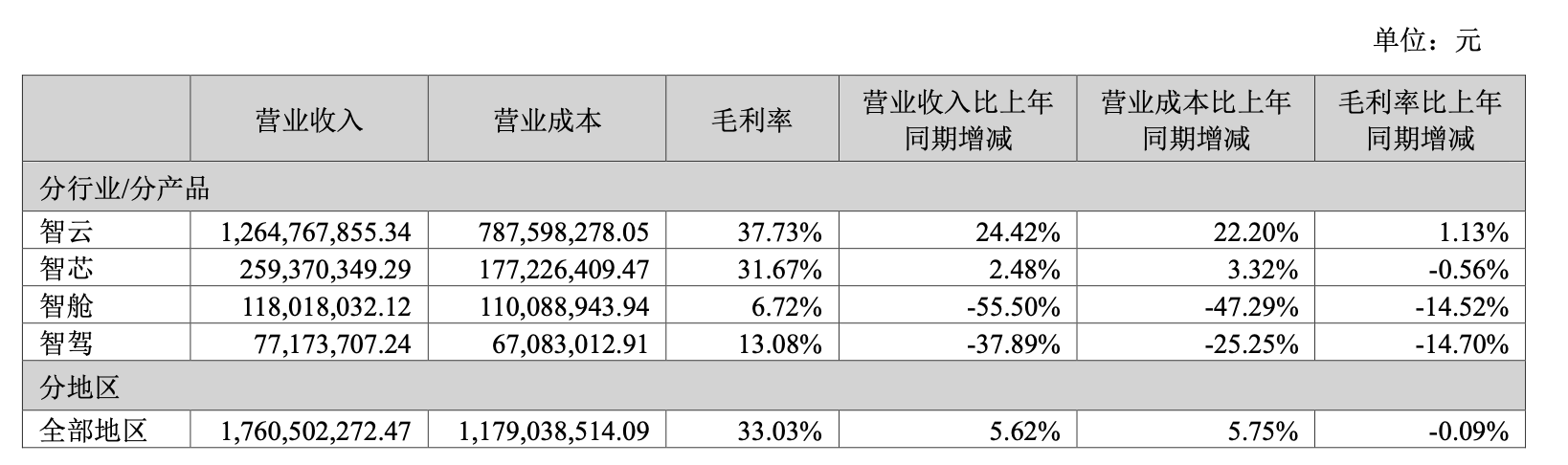
Core Viewpoint - The competition in the intelligent driving sector is intensifying, with Siwei Map's investment of 1.8 billion yuan in a loss-making algorithm company, Jianzhik Cayman, marking a significant strategic move to transform from a traditional map provider to an intelligent driving solution provider [1][2]. Financial Analysis - Jianzhik Cayman reported a revenue of only 599,400 yuan in 2024, with a net loss of 316 million yuan, and projected a revenue of 11.23 million yuan in the first half of 2025, still incurring a net loss of 164 million yuan [2]. - As of June 30, 2025, Jianzhik Cayman had a negative net asset of 821 million yuan, raising questions about its high valuation of 2.959 billion yuan prior to the cash injection [2]. - Siwei Map plans to invest 250 million yuan at a price of 1.8061 yuan per share for preferred shares, leading to a valuation of Jianzhik Cayman that many investors find perplexing given its financial state [2]. Strategic Intent - The transaction aims to create a "New Jianzhik" platform, integrating Siwei Map's engineering capabilities with Jianzhik Cayman's algorithm advantages to cover a full range of intelligent driving products [3]. - Siwei Map's strategic goal is to transition from a single product provider to a comprehensive solution provider, with plans to develop a full-stack service capability encompassing "Smart Cloud, Smart Driving, Smart Cabin, and Smart Core" [3]. Business Performance - In the first half of 2025, Siwei Map's intelligent driving segment saw a significant revenue decline of 37.89% year-on-year, attributed to delays in production schedules from some automotive clients [4]. - The intelligent cabin segment also experienced a 55.50% drop in revenue, influenced by business focus adjustments and the conclusion of certain project cycles [4]. - Despite growth in the intelligent cloud and intelligent core segments, the overall performance indicates challenges in the intelligent driving sector [4]. Market Context - The intelligent driving industry is at a critical turning point, with L3-level autonomous driving entering a commercial phase, and technology rapidly penetrating the mid-to-low-end market [6]. - Siwei Map aims to offer L2+ level assisted driving features in vehicles priced around 100,000 yuan, striving for a "high-end experience at an affordable price" [6]. Competitive Landscape - The intelligent driving sector is crowded with major players, including tech giants like Huawei and Baidu, as well as traditional Tier 1 suppliers and numerous startups [6]. - To maintain competitiveness, Siwei Map must quickly address its shortcomings in intelligent driving algorithms and software [6]. Integration Challenges - The merger of two loss-making entities raises concerns about whether the combined efforts will yield greater benefits, particularly in terms of technology integration and market positioning [7]. - The differing backgrounds and operational styles of Siwei Map and Jianzhik Cayman present potential challenges in aligning their teams and avoiding internal conflicts [7].


ETF收评 | 三大指数尾盘拉升跌幅收窄,稀土板块掀涨停潮,稀土ETF易方达、稀土ETF涨7%,科创半导体ETF涨3.79%
Sou Hu Cai Jing· 2025-10-13 07:40
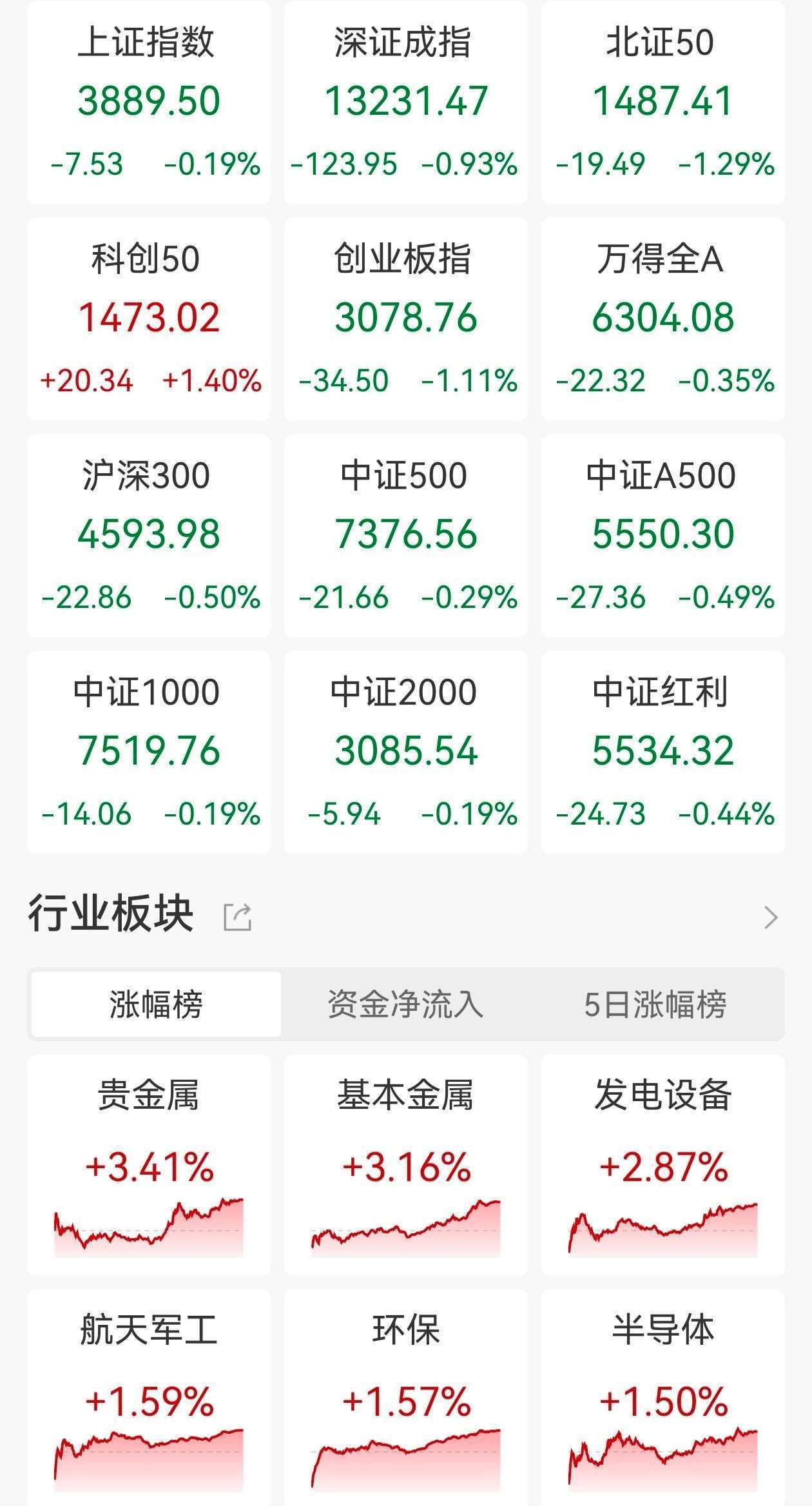
Core Viewpoint - The Shanghai Composite Index opened lower but rebounded, closing down 0.19%, while the Sci-Tech Innovation 50 Index rose by 1.4, indicating a mixed market performance with specific sectors showing strength [1]. Market Performance - Shanghai Composite Index: 3889.50, down 0.19% [2] - Shenzhen Component Index: 13231.47, down 0.93% [2] - Sci-Tech Innovation 50 Index: 1473.02, up 1.40% [2] - Other indices such as the CSI 300 and CSI 500 also showed slight declines [2]. Sector Performance - The self-controlled industrial chain experienced a significant surge, particularly in the rare earth permanent magnet sector, which saw a wave of limit-up trading [1]. - Strong performance was noted in sectors such as photolithography machines, lithium batteries, rare metals, and operating systems [1]. - Concepts related to nuclear fusion and solid-state batteries remained active [1]. - Conversely, sectors like robotics, consumer electronics, auto parts, and CRO concepts generally declined [1]. ETF Performance - The rare earth sector ETFs, such as E Fund and Fuguo Fund, surged over 7% [3]. - The non-ferrous metal sector ETFs also saw significant gains, with Huafu Fund's rare metal ETF rising by 6.82% and Jiashi Fund's by 6.55% [3]. - The semiconductor sector ETFs, including Huaxia Fund's Sci-Tech Semiconductor ETF, increased by 3.79% [3]. - In contrast, the innovative drug sector faced declines, with various healthcare ETFs dropping over 3% [3].
288万辆车被查!特斯拉在全球面临调查诉讼,FSD却迎重大升级,国内车主已开始OTA?
Mei Ri Jing Ji Xin Wen· 2025-10-13 06:53
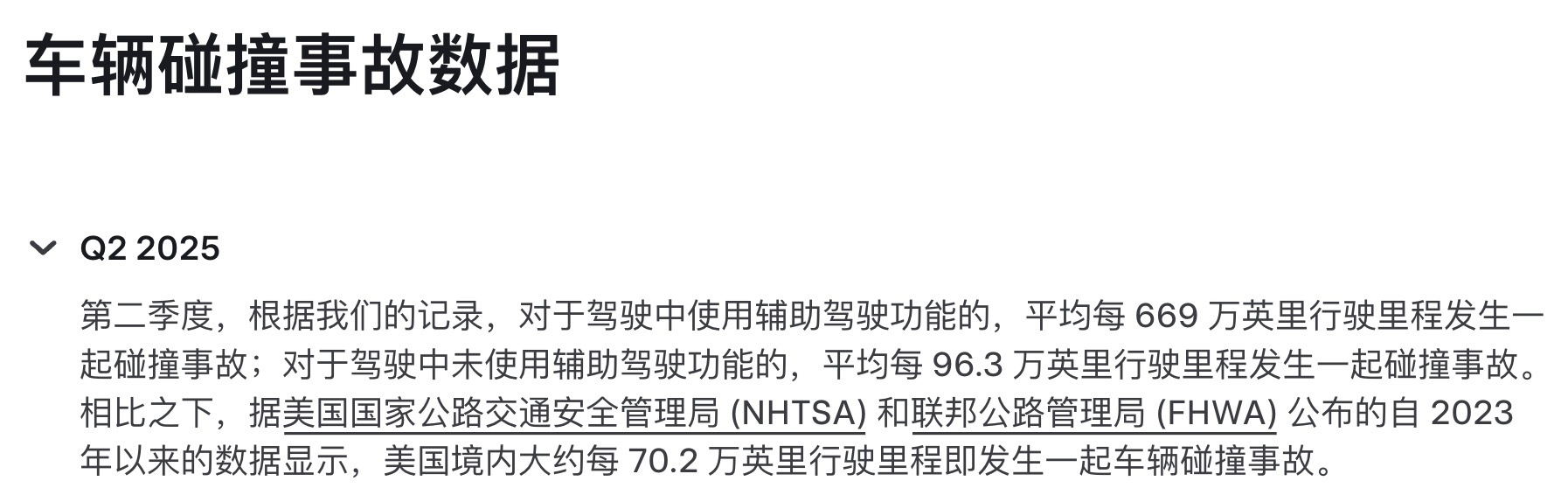
Core Points - The National Highway Traffic Safety Administration (NHTSA) has announced an investigation into approximately 2.88 million Tesla vehicles equipped with the Full-Self Driving (FSD) system due to over 50 reports of traffic safety violations and accidents [1] - The investigation includes 58 reports, with 14 accidents resulting in 23 injuries, raising concerns about the FSD system's ability to recognize traffic signals and stop at red lights [1][2] - Tesla's stock price fell by 5.06% to $413.49 per share, resulting in a market capitalization loss of approximately $7.322 billion following the news [1] Investigation and Legal Challenges - The NHTSA has been investigating Tesla's Autopilot system since August 2021, with at least 322 accidents reported, highlighting "critical safety gaps" [4] - Tesla faces multiple lawsuits globally, including a recent case in Florida where a jury ruled Tesla liable for a 2019 accident, ordering $240 million in damages [4] - In China, Tesla is facing lawsuits related to the FSD feature's marketing and actual performance, with claims of fraud from car owners [4][5] Safety Data and Comparisons - Tesla vehicles using Autopilot or FSD experience an accident every 6.69 million miles, while those not using these features have an accident every 0.963 million miles [2] - In comparison, the NHTSA reports that a vehicle collision occurs approximately every 0.702 million miles in the U.S. [2] FSD System Updates - Tesla has begun rolling out a significant update to the FSD system (version V14.1), which includes ten new features aimed at improving environmental perception and response capabilities [6] - The update is seen as a step towards enhancing the FSD's functionality, despite ongoing scrutiny and legal challenges [6][9] Industry Perspectives - The debate continues regarding Tesla's "pure vision" approach to autonomous driving, which relies solely on cameras and neural networks, as opposed to using lidar for enhanced safety [8] - Experts express concerns about the limitations of vision-only systems in certain conditions, suggesting a mixed approach may be more effective in ensuring safety [8]
国证机器人产业指数半日跌4.5%,机器人ETF易方达(159530)逆势获5500万份净申购
Sou Hu Cai Jing· 2025-10-13 05:13
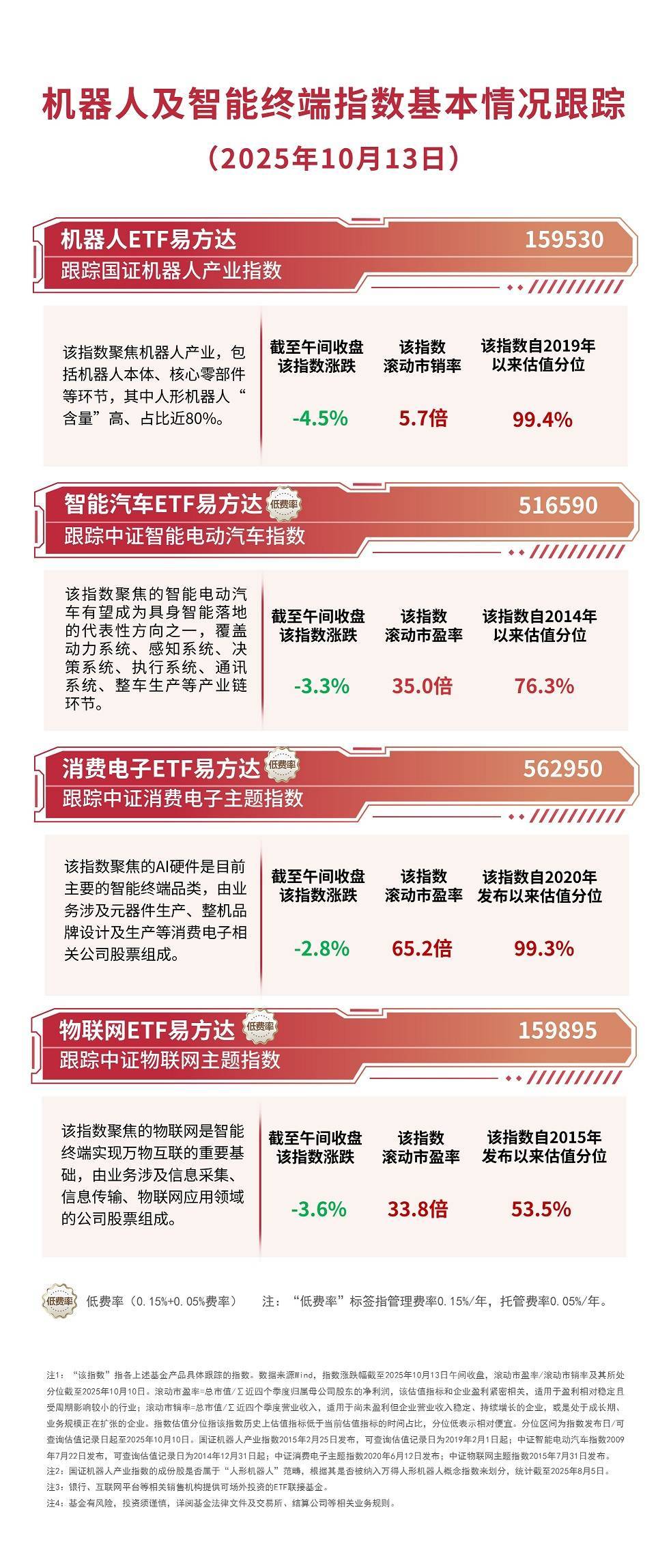
Group 1 - The core focus of the article is on the performance of the Internet of Things (IoT) ETF managed by E Fund, which tracks the CSI Internet of Things Theme Index, highlighting its significance in the smart terminal sector for achieving connectivity among devices [3]. - As of the midday close, the index experienced a decline of 3.6%, with a rolling price-to-earnings (P/E) ratio of 33.8 times, indicating a valuation that is lower than its historical average since its inception in 2015 [3]. - The index comprises stocks from companies involved in information collection, transmission, and IoT applications, emphasizing the diverse nature of the sector [3]. Group 2 - The article notes that the index has a valuation percentile of 53.5%, suggesting that it is positioned around the median in terms of historical valuations [3]. - The IoT ETF has a total market capitalization of approximately 159.895 billion, reflecting the growing investment interest in this sector [3]. - The article provides insights into the overall market sentiment towards IoT-related stocks, which are crucial for the development of smart technologies [3].

OpenAI发布视频与音频生成模型Sora2,腾讯混元图像3.0开源并登顶 | 投研报告
Zhong Guo Neng Yuan Wang· 2025-10-13 01:41
Market Overview - The Shanghai Composite Index experienced a weekly increase of 0.37% from October 9 to October 10, 2025, while the ChiNext Index decreased by 3.86% during the same period [1][2] - The Hang Seng Tech Index fell by 5.48% and the Nasdaq Index dropped by 2.53% from October 6 to October 10, 2025 [1][2] - The Media Index saw a decline of 3.59% from October 9 to October 10, 2025, and the Hang Seng Internet Technology Index decreased by 5.82% during the same week [1][2] AI Developments - OpenAI launched its flagship video and audio generation model Sora2 on September 30, 2025, which can perform complex tasks previously deemed impossible, such as simulating gymnastics movements and creating realistic soundscapes [3][4] - Tencent released its multimodal image generation model HunyuanImage3.0, which has 80 billion parameters, making it the largest open-source model in the industry [3][5] Semiconductor Sector - Dell Technologies updated its long-term financial framework, projecting annual revenue growth of 7-9%, doubling its previous forecast of 3-4% [6] - Nvidia announced a $2 billion investment in xAI to fund the Colossus2 supercomputer's GPUs [6] - TSMC reported a September 2025 revenue of approximately NT$330.98 billion, a 1.4% decrease from the previous month but a 31.4% increase year-over-year [6] Autonomous Driving - Didi Autonomous Driving secured a Series D funding round totaling 2 billion yuan, aimed at enhancing AI research and promoting L4 autonomous driving applications [7] Local Lifestyle - Gaode's "Street Ranking" feature reached over 400 million users within 23 days of launch, with a 300% increase in traffic for featured local shops [8] E-commerce - The 2025 Double Eleven shopping festival commenced, with Douyin reporting an 800% year-over-year increase in brands achieving over 100 million yuan in sales on the first day [9] Smartphone Market - Xiaomi captured a 21.2% market share during the Golden Week from September 29 to October 5, 2025, surpassing Apple to become the top smartphone seller in China [10] Film Industry - The box office for the 2025 National Day holiday reached 1.835 billion yuan, with domestic films accounting for 98.93% of the total [12] Gaming Sector - The game "Ither" launched on September 25, 2025, achieving 317,000 downloads on its first day and topping the iOS free game charts in five out of six targeted markets [13]


