
电子

Search documents
策略专题研究:人民币升值下的行业机会
Guolian Minsheng Securities· 2026-01-23 12:58
人民币升值下的行业机会 ——策略专题研究 分析师:邓宇林、包承超 研究助理:龚嫣然 报告日期:2026年1月23日 证券研究报告 * 请务必阅读最后一页免责声明 02 摘要 ➢ 风险提示:1)全球地缘政治出现重大变化,导致全球市场风险偏好急剧变化。2)市场流动性超预期变化。3)历史数据不代表未来。 证券研究报告 * 请务必阅读最后一页免责声明 1 ➢ 1、人民币升值对于A股有何影响?——在人民币升值周期内,无论人民币是否为被动升值,全A指数普遍呈现上行趋势。行业上,人 民币升值对于多数行业股价均有正向影响,其中钢铁、房地产、轻工和交运等行业靠前。风格上,多数区间成长风格强于价值风格, 大盘和小盘之间无明显占优风格。 ➢ 2、如何寻找人民币升值下的行业机会?——基本面视角。直接来看,人民币升值会降低原材料成本和债务成本,间接来看,人民币升 值会提升人民币购买力。1)进口依赖度高且海外营收占比相对较低的行业,人民币升值或能降低原材料成本,如有色、钢铁、煤炭和 农林牧渔。2)美元借款体量大的行业,人民币升值或能降低债务成本,如电子、交运、建筑装饰和家电。3)对于可选消费行业,人 民币升值或能带动业绩增长。 ➢ 3、 ...
2025Q4基金仓位解析:四季度基金调仓五大看点
GOLDEN SUN SECURITIES· 2026-01-23 12:56
投资策略 四季度基金调仓五大看点——2025Q4 基金仓位解析 1、总体配置:规模回落,仓位调降 2025 年四季度,主动偏股型基金规模小幅回落,其中持股市值规模回落 5.21%至 33843.12 亿元,基金资产总规模回落 3.63%至 40191.1 亿元,流通市值占比也由 2025 年三季度的 3.72%降至 3.44%。与此同时,权益仓位有所下修,其中整体法 视角下的权益仓位降低 1.40%,达到 84.21%;均值法视角下的权益仓位环比下行 0.99%,达到 82.19%。 2、2025 年四季度基金调仓五大看点: 看点 1:整体规模波动收窄,赎回压力转弱。2025 年四季度,市场整体维持高位 震荡,净值波动对基金规模的影响较三季度明显减弱。与此同时,经历了三季度浮 亏转正导致的大幅赎回后,四季度的基金赎回压力已明显转弱,估算结果显示四 季度的赎回拖累幅度较三季度大致环比减半。总体看,四季度基金赎回压力边际 转弱,叠加净值波动收窄,整体规模仅小幅回落。 证券研究报告 | 策略报告 gszqdatemark 2026 01 23 年 月 日 看点 2:创业板获集中加仓,刷新 2017 年以来的新高。2 ...





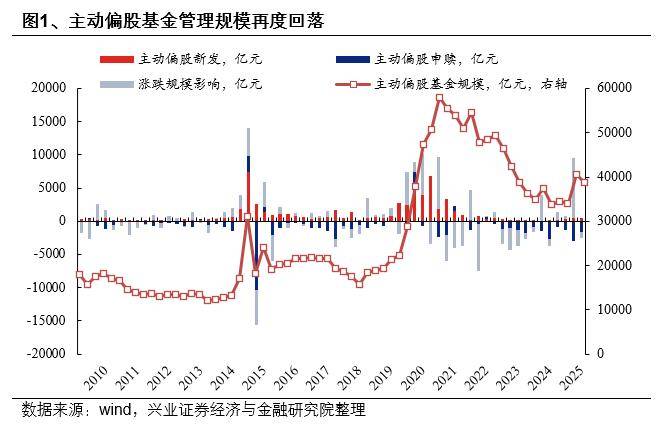
兴证策略:2025年四季度主动权益基金管理规模小幅下降 四季度存量基金的赎回压力仍然较大
Sou Hu Cai Jing· 2026-01-23 12:38
Group 1 - The active equity fund management scale decreased slightly in Q4 2025, primarily due to significant redemption pressure from existing funds, resulting in a net redemption of 165.6 billion yuan [1] - The total management scale of three types of active equity funds (ordinary stock, mixed equity, and flexible allocation) decreased by 189.8 billion yuan, with new active equity fund issuance at 56.2 billion yuan [1] - The active equity fund's position in Q4 2025 decreased by 0.83 percentage points to 86.62%, remaining at the second-highest level in history [2] Group 2 - In terms of sector allocation, the proportion of the ChiNext board increased by 1.24 percentage points to 24.98%, while the main board and Sci-Tech Innovation board saw declines [5][8] - The allocation to the main board decreased by 0.30 percentage points to 58.21%, indicating a further increase in underweight [8] - Active equity funds increased their positions in cyclical and financial real estate sectors while reducing exposure to technology growth and pharmaceuticals [11] Group 3 - The active equity funds increased their allocation in the non-ferrous metals, communication, and non-bank financial sectors, with increases of 2.26 percentage points, 1.85 percentage points, and 0.87 percentage points respectively [13] - The funds reduced their positions in electronics, pharmaceuticals, media, power equipment, and computers, with reductions of 1.72 percentage points, 1.54 percentage points, and 1.16 percentage points respectively [13] - Excluding thematic/sector funds, the active equity funds still increased their positions in non-ferrous metals, communication, and non-bank financial sectors [14] Group 4 - The allocation to the TMT sector slightly decreased in Q4 2025, with the configuration coefficient at 1.48, indicating room for further improvement [29] - Within the TMT sector, active equity funds increased their holdings in communication equipment and components while reducing positions in consumer electronics and semiconductors [32] - The dividend sector's allocation stabilized and increased, with the low-volatility dividend index rising by 1.7 percentage points to 4.3% [37] Group 5 - The top five stocks in active equity funds in Q4 2025 included Zhongji Xuchuang, Xinyi Sheng, Dongshan Precision, China Ping An, and Zijin Mining, with respective increases in holding ratios [43] - The top ten holdings accounted for 4.83%, 4.01%, and 3.97% of the total market value of the funds [46] - The concentration of individual stocks in active equity funds increased slightly, while the concentration of industries showed a mixed trend [49] Group 6 - The Hong Kong stock allocation of active equity funds decreased to 15.98%, down from 19.09%, with a total holding value of 302.9 billion yuan [51] - The funds increased their positions in the healthcare, materials, and energy sectors while reducing exposure to consumer discretionary and information technology sectors [54] - Tencent maintained its position as the largest holding in Hong Kong stocks, with a market value of 57.3 billion yuan [56]





2025年上海规上工业总产值4.07万亿元
Guo Ji Jin Rong Bao· 2026-01-23 12:38
上海市经济和信息化委员会经济运行处(电力处)相关负责人介绍,2025年,上海完成规上工业总 产值4.07万亿元,创历史新高,时隔两年再次迈上4万亿元台阶,规上工业增加值增长5.1%,是近四年 以来的最快增速,较2024年加快2.9个百分点,全市规上工业总产值同比增长4.6%,较2024年加快3.9个 百分点,工业经济规模持续加速扩大。 分行业情况看,2025年,上海装备制造业加快发展,铁路、船舶、航空航天和其他运输设备制造业 产值增长15.8%,电气机械和器材制造业产值增长11.1%,汽车制造业产值增长7.8%,计算机、通信和 其他电子设备制造业增长7.7%。 同时,上海新质生产力持续发力,2025年全年战略性新兴制造业产值同比增长6.5%,快于面上工 业增速1.9个百分点,其中新能源和高端装备实现两位数增长,同比分别增长12.9%和11.1%。 2025年,上海三大先导制造业合计增长9.6%,其中,集成电路、人工智能制造业分别增长15.1%、 13.6%,成为上海工业经济发展的骨干支撑。 上海市主要行业的细分结构持续优化。例如,上海市全年实现汽车规上工业产值7421亿元,占上海 全市规上工业总产值比重达19 ...
电子行业双周报:日系Resonac上调覆铜板产品价格-20260123
Dongguan Securities· 2026-01-23 12:03
2026 年 1 月 23 日 陈伟光 S0340520060001 电话:0769-22119430 邮箱: chenweiguang@dgzq.com.cn 罗炜斌 S0340521020001 电话:0769-22110619 邮箱: luoweibin@dgzq.com.cn 资料来源:iFind,东莞证券研究所 超配(维持) 电子行业双周报(2026/01/09-2026/01/22) 行 业 日系 Resonac 上调覆铜板产品价格 投资要点: 本报告的风险等级为中高风险。 本报告的信息均来自已公开信息,关于信息的准确性与完整性,建议投资者谨慎判断,据此入市,风险自担。 请务必阅读末页声明。 | 一、行情回顾及估值 | | 3 | | --- | --- | --- | | 二、产业新闻 | | 5 | | 三、公司公告 | | 5 | | 四、行业数据 | | 6 | | 五、周观点 | | 6 | | 六、风险提示 | | 7 | | 图 | 1 | :申万电子板块近 | 10 | 年 | PE | TTM(剔除负值)(截至 2026/1/22) | 4 | | --- | --- | --- ...
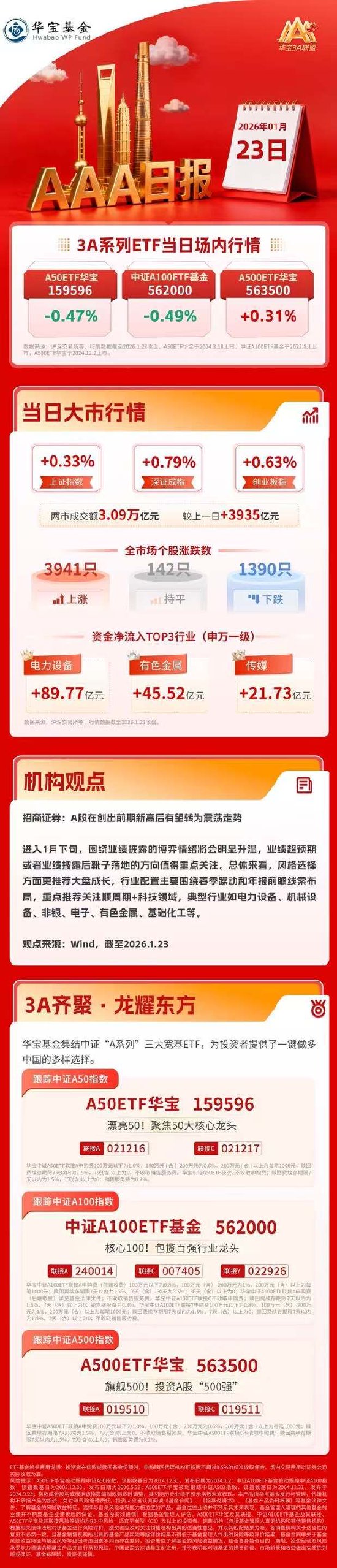
市场成交额重返3万亿元,光伏概念掀涨停潮 | 华宝3A日报(2026.1.23)
Xin Lang Cai Jing· 2026-01-23 11:52
Group 1 - The A-share market is expected to shift to a volatile trend after reaching previous highs, with a focus on earnings disclosures and potential surprises [2][6] - Investment strategies should prioritize large-cap growth stocks, particularly in cyclical and technology sectors, with recommended industries including electric equipment, machinery, non-bank financials, electronics, non-ferrous metals, and basic chemicals [2][6] - The market saw a significant increase in trading volume, with total turnover reaching 3.09 trillion yuan, an increase of 393.5 billion yuan from the previous day [1][6] Group 2 - The Huabao Fund has launched three major broad-based ETFs tracking the CSI A50, A100, and A500 indices, providing investors with diverse options to invest in China [2] - The A50 ETF focuses on 50 leading companies, while the A100 ETF encompasses the top 100 industry leaders, indicating a strategy to capture core market strengths [2] - The MACD golden cross signal has formed, indicating potential upward momentum in certain stocks [4][8]
——25Q4基金季报点评:加周期金融地产,减消费TMT
Huachuang Securities· 2026-01-23 11:44
Group 1 - The report indicates that in Q4 2025, the issuance of actively managed equity funds continued to recover, with a total issuance of 562 billion, which is stable compared to Q3 [1][10] - The report highlights a significant decrease in the redemption of existing funds, dropping to 126.1 billion from 218.4 billion in Q3, reflecting improved market conditions and risk appetite [1][10] - The report notes that the market showed a volatile trend in Q4, influenced by factors such as improved overseas liquidity, the implementation of the "14th Five-Year Plan," and the political bureau meeting [1][10] Group 2 - The report suggests an increase in allocation to cyclical sectors and financial real estate, with the proportion of cyclical stocks rising from 11.9% in Q3 to 15.4% in Q4, and financial real estate increasing from 3.9% to 4.5% [2][22] - Conversely, the report indicates a reduction in allocation to consumer sectors and TMT, with consumer stock allocation decreasing from 20.1% to 18.0% and TMT from 39.8% to 38.0% [2][22] Group 3 - The report identifies that in Q4 2025, the top five industries for increased allocation were non-ferrous metals (up 2.1 percentage points), communication (up 1.8 percentage points), non-bank financials (up 0.9 percentage points), chemicals (up 0.8 percentage points), and machinery (up 0.7 percentage points) [3][30] - The report also highlights that the top five industries for reduced allocation were electronics (down 1.6 percentage points), pharmaceuticals (down 1.6 percentage points), media (down 1.2 percentage points), new energy (down 0.9 percentage points), and computers (down 0.8 percentage points) [3][30] Group 4 - The report states that the concentration of holdings in the top three industries decreased to 46.5% in Q4, down 1.1 percentage points from Q3, while the top five industries accounted for 62.7%, down 0.2 percentage points [4][37] - The report mentions that there were six changes in the top 20 holdings compared to Q3, with new entries including China Ping An, Shengyi Technology, and Haiguang Information, while exits included Yiwei Lithium Energy, Shenghong Technology, and Shenzhen South Circuit [4][40]
天禄科技:TAC膜的需求量2025年有望达到12.29亿平方米
Zheng Quan Ri Bao Zhi Sheng· 2026-01-23 11:42
Core Viewpoint - Tianlu Technology indicates that the demand for TAC film is expected to reach 1.229 billion square meters by 2025, highlighting the growing importance of this material in the display panel industry [1] Industry Summary - Over 70% of the production capacity for the panel segment is located in mainland China, with a similar expectation for the polarizer segment after capacity consolidation [1] - TAC film accounts for over 50% of the cost of polarizer film materials, making it a critical component affecting the profitability of polarizer manufacturers [1] - The TFT-grade TAC film used in mainland China is primarily imported, with Japanese companies Fujifilm and Konica Minolta holding approximately 75% of the global market share [1] Company Summary - In 2023, BOE Technology Group, as a leader in the panel industry chain, has partnered with local polarizer company Sanli Pu to establish a subsidiary, Anhui Jiguang, to engage in the TAC film project [1] - This collaboration aims to break Japan's monopoly on TAC film and enhance the self-sufficiency of China's panel industry chain [1] - The necessity of this project has been further emphasized by current geopolitical relations, with strong support from various industry stakeholders to ensure the project's advancement [1]


2025Q4 基金持仓深度分析:重回正向循环之路
SINOLINK SECURITIES· 2026-01-23 11:39
Group 1: Asset Side and Fund Performance - In Q4 2025, the stock allocation of active equity funds decreased to 86.30%, with A-shares rising to 73.96% and Hong Kong stocks falling to 12.34% [1][9] - The median return of active equity funds turned negative at approximately -0.11%, with about 47.82% of active funds outperforming their benchmarks, a significant drop from 76.71% in the previous quarter [1][15] - The performance of top-performing funds (P10) showed a notable net subscription, indicating an improvement compared to Q3 2025, regardless of previous performance [21][24] Group 2: Fund Flows and Market Dynamics - In Q4 2025, the net outflow of active equity funds significantly narrowed from 2178.52 billion to 1114.41 billion, while passive funds saw an increase in net inflow from 1908.60 billion to 2377.98 billion [1][21] - The concentration of holdings in active equity funds continued to rise, with increased allocations to large/small growth and large/mid-value stocks, particularly in sectors like non-ferrous metals, chemicals, and machinery [2][18] - The overall average floating profit of active equity fund holders continued to rise, suggesting a gradual improvement in redemption pressure [21][25] Group 3: "Fixed Income Plus" Funds - The scale of "fixed income plus" funds continued to rise in Q4 2025, reaching a new high since 2024, with significant net subscriptions and increased allocations to sectors like non-ferrous metals, finance, and public utilities [3][31] - Similar to active equity funds, "fixed income plus" funds also increased their allocations to non-ferrous metals and public utilities while reducing exposure to sectors like pharmaceuticals and electronics [3][31] - The performance of "fixed income plus" funds indicates a potential alignment with active equity funds in terms of sector preferences and market dynamics [3][31]
热点追踪周报:由创新高个股看市场投资热点(第228 期)-20260123
Guoxin Securities· 2026-01-23 11:37
Quantitative Models and Construction Methods 1. Model Name: 250-Day New High Distance Model - **Model Construction Idea**: This model tracks the distance of stock prices or indices from their 250-day high to identify market trends and momentum. It is based on the principle that stocks or indices closer to their recent highs tend to exhibit stronger momentum and potential for future gains[11][19]. - **Model Construction Process**: The 250-day new high distance is calculated as follows: $ 250\text{-day new high distance} = 1 - \frac{Close_t}{ts\_max(Close, 250)} $ Where: - $ Close_t $ is the latest closing price - $ ts\_max(Close, 250) $ is the maximum closing price over the past 250 trading days If the latest closing price reaches a new high, the distance is 0. If the price has fallen from the high, the distance is a positive value representing the percentage drop[11]. - **Model Evaluation**: The model effectively captures momentum and trend-following characteristics, aligning with prior research on the predictive power of stocks near their 52-week highs[11][19]. 2. Model Name: Stable New High Stock Selection Model - **Model Construction Idea**: This model identifies stocks with stable price movements and consistent new highs, leveraging the idea that smoother price paths and sustained momentum yield better returns[27][29]. - **Model Construction Process**: Stocks are selected based on the following criteria: 1. **Analyst Attention**: At least five "Buy" or "Overweight" ratings in the past three months 2. **Relative Strength**: Top 20% in terms of 250-day price performance 3. **Price Stability**: - **Price Path Smoothness**: Measured by the ratio of price displacement to total price movement over the past 120 days - **Momentum Consistency**: Average 250-day new high distance over the past 120 days 4. **Trend Continuation**: Average 250-day new high distance over the past five days Stocks meeting these criteria are ranked, and the top 50 are selected[27][29]. - **Model Evaluation**: The model emphasizes the importance of smooth price paths and consistent momentum, which are less likely to attract excessive attention and thus may yield stronger returns[27]. --- Model Backtesting Results 1. 250-Day New High Distance Model - **Indices' 250-Day New High Distance**: - Shanghai Composite: 0.70% - Shenzhen Component: 0.00% - CSI 300: 1.84% - CSI 500: 0.00% - CSI 1000: 0.00% - CSI 2000: 0.00% - ChiNext Index: 1.15% - STAR 50 Index: 0.00%[12][13][34] 2. Stable New High Stock Selection Model - **Selected Stocks**: 50 stocks were identified, including Jiangbolong, Shengda Resources, and Yuanjie Technology. - **Sector Distribution**: - Cyclical Sector: 23 stocks (e.g., Basic Chemicals) - Technology Sector: 18 stocks (e.g., Electronics)[30][35] --- Quantitative Factors and Construction Methods 1. Factor Name: 250-Day New High Distance - **Factor Construction Idea**: Measures the proximity of a stock's price to its 250-day high, capturing momentum and trend-following characteristics[11]. - **Factor Construction Process**: $ 250\text{-day new high distance} = 1 - \frac{Close_t}{ts\_max(Close, 250)} $ Where: - $ Close_t $ is the latest closing price - $ ts\_max(Close, 250) $ is the maximum closing price over the past 250 trading days[11]. - **Factor Evaluation**: The factor is widely supported by academic research and practical applications, demonstrating strong predictive power for momentum strategies[11][19]. 2. Factor Name: Price Path Smoothness - **Factor Construction Idea**: Quantifies the smoothness of a stock's price movement, as smoother paths are associated with stronger momentum effects[27]. - **Factor Construction Process**: $ Price\ Path\ Smoothness = \frac{Price\ Displacement}{Total\ Price\ Movement} $ Where: - $ Price\ Displacement $ is the absolute change in price over 120 days - $ Total\ Price\ Movement $ is the sum of absolute daily price changes over 120 days[27]. - **Factor Evaluation**: This factor highlights the importance of consistent price movements, which are less likely to attract excessive attention and thus may yield stronger returns[27]. --- Factor Backtesting Results 1. 250-Day New High Distance Factor - **Indices' 250-Day New High Distance**: - Shanghai Composite: 0.70% - Shenzhen Component: 0.00% - CSI 300: 1.84% - CSI 500: 0.00% - CSI 1000: 0.00% - CSI 2000: 0.00% - ChiNext Index: 1.15% - STAR 50 Index: 0.00%[12][13][34] 2. Price Path Smoothness Factor - **Selected Stocks**: 50 stocks were identified, including Jiangbolong, Shengda Resources, and Yuanjie Technology. - **Sector Distribution**: - Cyclical Sector: 23 stocks (e.g., Basic Chemicals) - Technology Sector: 18 stocks (e.g., Electronics)[30][35]