医药生物

Search documents
近千亿元!A股询价转让“井喷”
Zheng Quan Shi Bao· 2025-11-20 08:15
Core Viewpoint - The article highlights the rise of inquiry transfer as a preferred method for shareholders to exit their investments in the context of a recovering market, with nearly 100 billion yuan in inquiry transfers this year, reshaping the A-share reduction ecosystem [1][3]. Group 1: Inquiry Transfer Overview - Inquiry transfer has become a market-oriented and standardized tool for orderly exits, with a cumulative amount of nearly 100 billion yuan this year [1][3]. - The inquiry transfer mechanism allows original shareholders to transfer shares to specific institutional investors through non-public inquiries, primarily used in the Sci-Tech Innovation Board and the Growth Enterprise Market [4][6]. - Since the pilot of the inquiry transfer system in August 2020, 223 companies have conducted 322 inquiry transfers, totaling over 170 billion yuan in market value [4]. Group 2: Market Participation and Demand - A total of 147 companies have conducted 162 inquiry transfers this year, with the largest being from Ningde Times, which alone accounted for approximately 17.2 billion yuan [3][4]. - The average number of institutions participating in inquiry transfers has increased to over 17 this year, indicating heightened interest from institutional investors [7]. - The average subscription multiple for inquiry transfers this year is around 2 times, with the highest reaching nearly 5 times [7]. Group 3: Impact on Market Dynamics - Inquiry transfers are designed to minimize the impact of large reductions on stock prices, with specific rules in place to protect secondary market investors [4][8]. - The average discount rate for inquiry transfers this year is 84%, which is lower than the previous years' averages of 88% and 90% [5]. - The inquiry transfer mechanism facilitates a smoother transition from early investors to long-term investors, thereby alleviating pressure on the secondary market and enhancing investor confidence [6][8].

近千亿元!A股询价转让“井喷”
证券时报· 2025-11-20 08:09
Core Viewpoint - The article discusses the rise of "inquiry transfer" as a preferred method for shareholders to exit their investments in the context of a recovering market, highlighting its market-oriented and standardized characteristics, which have reshaped the A-share reduction ecology [1]. Group 1: Inquiry Transfer Overview - Inquiry transfer has seen a cumulative amount of nearly 100 billion yuan this year, indicating a strong demand for indirect reductions among listed companies [2][4]. - A total of 147 listed companies have conducted 162 inquiry transfers this year, with a total transfer amount of 998.79 billion yuan, showcasing a significant increase in both the number and scale of these transactions [4]. - The inquiry transfer mechanism is designed to minimize the impact of large reductions on stock prices, ensuring that the interests of secondary market investors are protected [7]. Group 2: Case Study - Ningde Times - Ningde Times announced an inquiry transfer at a price of 376.12 yuan per share, which is a 3.75% discount compared to the closing price on November 17, attracting significant interest from institutional investors [3]. - The inquiry transfer involved 45.63 million shares, representing 1% of the company's total share capital, allowing the shareholder to cash out approximately 17.2 billion yuan [3]. - This transaction is noted as the largest single inquiry transfer case this year and has set a record in the history of inquiry transfers in the A-share market [3]. Group 3: Market Dynamics and Institutional Participation - The average number of institutions participating in inquiry transfers has increased to over 17 this year, reflecting a growing enthusiasm among institutional investors [10]. - The average subscription multiple for inquiry transfers is around 2 times, with the highest reaching nearly 5 times, indicating strong demand for these shares [10]. - Inquiry transfers are primarily utilized by companies in emerging industries such as semiconductors, new energy, and biomedicine, which are seeing a shift in investor structure towards long-term investors [10]. Group 4: Regulatory and Structural Implications - The regulatory framework for inquiry transfers has been designed to facilitate a smooth exit for original shareholders while promoting long-term value over short-term cashing out [4][8]. - Inquiry transfers allow for a more efficient reduction process compared to traditional methods like block trades, as they can be completed quickly, often within a day [10]. - The mechanism includes a 6-month lock-up period for the shares acquired through inquiry transfers, which encourages long-term investment and stabilizes market dynamics [11].


今日49只个股涨停 主要集中在化工、农林牧渔等行业
Zheng Quan Shi Bao Wang· 2025-11-20 07:58
(文章来源:证券时报网) Choice统计显示,11月20日,沪深两市可交易A股中,上涨个股有1392只,下跌个股有3632只,平盘个 股有135只。不含当日上市新股,共有49只个股涨停,25只个股跌停。从所属行业来看,涨停个股主要 集中在化工、农林牧渔、电子、轻工制造、医药生物等行业。 ...
聊几位值得关注的基金经理
雪球· 2025-11-20 07:54
Core Viewpoint - The article discusses several noteworthy fund managers and their performance, highlighting their unique investment styles and the potential for future tracking by investors [4]. Group 1: Yang Shijin - Xingquan Multi-Dimensional Value - Yang Shijin has been managing Xingquan Multi-Dimensional Value since July 16, 2021, demonstrating strong investment capabilities with an 18.02% increase in 2021 despite market downturns [5][6]. - The fund has shown resilience during bear markets in 2022 and 2023, maintaining a single-year decline of around 10% [6]. - Yang's investment strategy includes a concentrated position in the electronics sector, with long-term holdings in stocks like Haiguang Information and Tencent Holdings [10][11]. Group 2: Wu Yuanyi - GF Growth Navigator - Wu Yuanyi is recognized for his balanced industry allocation and impressive performance, with the GF Growth Navigator fund achieving a 143.14% increase year-to-date as of November 17 [12][14]. - The fund maintains a maximum industry allocation of 20%, showcasing a diversified approach that has led to strong returns without heavy reliance on specific sectors [14]. - Wu's ability to rotate stocks effectively has contributed to the fund's success, even amidst a challenging market environment [15]. Group 3: Shen Cheng - Huafu New Energy - Shen Cheng has managed Huafu New Energy since December 29, 2021, achieving consistent excess returns relative to its benchmark despite the sector's overall struggles [18][20]. - The fund's annual returns from 2022 to 2025 have outperformed its benchmark, with a notable 76.76% increase in the latest year [20]. - Shen's investment strategy includes holding industry leaders like Ningde Times while also actively trading to capitalize on short-term opportunities [21][22].

两市主力资金净流出近350亿元 有色金属等行业实现净流入
Zheng Quan Shi Bao Wang· 2025-11-20 06:14
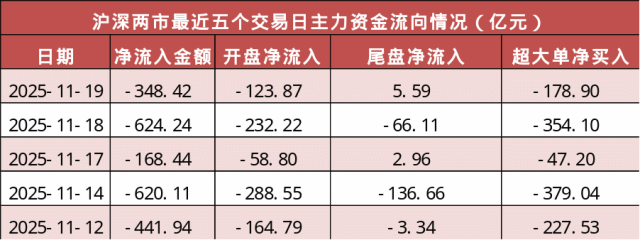
盘后数据出炉。 今日(11月19日),A股市场整体保持震荡走势。截至收盘,上证指数报3946.74点,上涨0.18%;深证成指报13080.09点,微幅下跌;创业板指报 3076.85点,上涨0.25%。两市合计成交17259.08亿元,较上一交易日减少2001.59亿元。 1.两市主力资金净流出近350亿元 | | | 各板块最近五个交易日主力资金净流入数据(亿元) | | | --- | --- | --- | --- | | 日期 | 沪深300 | 创业板 | 科创板 | | 2025- 11- 19 | - 45. 69 | - 118. 03 | - 15. 72 | | 2025- 11- 18 | - 151. 35 | - 217. 99 | - 3. 77 | | 2025- 11- 17 | - 83. 50 | - 75. 05 | - 12. 50 | | 2025- 11- 14 | - 204. 39 | - 257. 80 | - 17. 13 | | 2025- 11- 12 | 75. 60 | 54. 50 | - 17. 09 | | | | 尾盘资金净流入数据(亿元) ...
麦高视野:ETF观察日志(2025-11-19)
Mai Gao Zheng Quan· 2025-11-20 05:45
- The report includes the construction of the RSI (Relative Strength Index) factor, which is calculated using the formula: $ RSI = 100 - 100 / (1 + RS) $, where RS represents the ratio of average gains to average losses over a 12-day period. RSI values above 70 indicate an overbought market, while values below 30 suggest an oversold market [2] - The report also introduces the calculation of net subscription (NETBUY), defined as $ NETBUY(T) = NAV(T) - NAV(T-1) * (1 + R(T)) $, where NETBUY(T) represents the net subscription amount, NAV(T) is the ETF's net asset value on day T, and R(T) is the return on day T [2] - The report tracks various ETFs categorized into "Broad-based" and "Thematic" indices, such as CSI 300, CSI 500, and industry-specific indices like non-bank financials, dividends, and China internet sectors. It provides daily performance metrics, including RSI values, net subscription amounts, and institutional holding percentages [2][4][7] - The RSI factor is evaluated as a useful indicator for identifying market conditions, such as overbought or oversold states, aiding in short-term trading decisions [2] - The net subscription metric is assessed as a valuable measure for understanding fund flows and investor sentiment towards specific ETFs [2] - RSI values for various ETFs range from 11.05 to 77.25, reflecting diverse market conditions across different indices and sectors [4][7] - Net subscription values vary significantly, with some ETFs showing positive inflows while others exhibit outflows, indicating mixed investor sentiment across different funds [4][7]
合富中国涨7.98%,股价创历史新高
Zheng Quan Shi Bao Wang· 2025-11-20 03:06
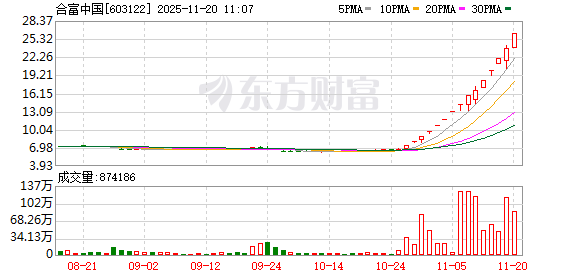
Group 1 - The stock price of HeFu China reached a historical high, increasing by 7.98% to 25.70 yuan, with a trading volume of 78.84 million shares and a transaction amount of 1.974 billion yuan, resulting in a turnover rate of 19.81% [2] - The latest total market capitalization of HeFu China in the A-share market is 10.23 billion yuan, with the same amount for the circulating market capitalization [2] - In the pharmaceutical and biotechnology industry, the overall decline is 0.55%, with 73 stocks rising, including HeFu China, which ranks among the top gainers [2] Group 2 - The third-quarter report indicates that HeFu China achieved an operating revenue of 549 million yuan, a year-on-year decrease of 22.80%, and a net profit of -12.3862 million yuan, a year-on-year decline of 146.65%, with a basic earnings per share of -0.0300 yuan [2]

一图看懂:主动优选基金经理,在2025年3季报里都说了啥?
银行螺丝钉· 2025-11-19 13:56
Core Insights - The article provides an overview of fund managers' perspectives and strategies based on their recent quarterly reports, highlighting different investment styles and market outlooks [1][2]. Group 1: Fund Manager Perspectives - Fund managers express varying views on market conditions, with some maintaining optimism about equity assets due to low interest rates and the potential for corporate earnings recovery [17][18]. - Different investment styles are categorized, including deep value, growth value, balanced, and growth styles, each with distinct characteristics and focus areas [19][35][51]. Group 2: Deep Value Style - Deep value managers focus on low valuation metrics such as low P/E ratios and high dividend yields, primarily investing in sectors like finance, real estate, and energy [10][12]. - Historical performance shows that this style performed well in 2016-2017 and 2021-2024, while underperforming in 2019-2020 [15][16]. Group 3: Growth Value Style - Growth value managers prioritize companies with strong profitability and stable cash flows, often holding stocks for the long term [20][22]. - Concerns about market risks and valuation levels are noted, with some managers highlighting the extreme valuation disparities across sectors [22][24]. Group 4: Balanced Style - Balanced style managers seek a combination of growth and value, focusing on companies with favorable PEG ratios and exploring opportunities across various sectors [35][36]. - They emphasize the importance of maintaining a diversified portfolio while identifying high-quality investment opportunities [40][46]. Group 5: Growth Style - Growth style managers focus on high revenue and earnings growth, often investing in emerging industries such as AI, renewable energy, and technology [51][62]. - The article notes a shift in focus from technology to consumer sectors as the market stabilizes, with an emphasis on identifying companies with strong growth potential [55][58]. Group 6: Market Outlook - The overall market sentiment is cautiously optimistic, with expectations of continued structural opportunities despite potential short-term volatility [40][62]. - Fund managers are adjusting their portfolios in response to macroeconomic conditions, focusing on sectors with strong growth prospects and managing risks associated with high valuations [31][70].

【19日资金路线图】两市主力资金净流出近350亿元 有色金属等行业实现净流入
Zheng Quan Shi Bao· 2025-11-19 12:37
盘后数据出炉。 今日(11月19日),A股市场整体保持震荡走势。截至收盘,上证指数报3946.74点,上涨0.18%;深证成指报13080.09点,微幅下跌;创业板指报3076.85 点,上涨0.25%。两市合计成交17259.08亿元,较上一交易日减少2001.59亿元。 1.两市主力资金净流出近350亿元 今日沪深两市主力资金开盘净流出123.87亿元,尾盘净流入5.59亿元,两市全天主力资金净流出348.42亿元。 | | | 沪深两市最近五个交易日主力资金流向情况(亿元) | | | | --- | --- | --- | --- | --- | | 日期 | | 净流入金额 开盘净流入 | 尾盘净流入 | 超大单净买入 | | 2025- 11- 19 | - 348. 42 | - 123. 87 | 5. 59 | - 178. 90 | | 2025- 11- 18 | -624. 24 | - 232. 22 | - 66. 11 | - 354. 10 | | 2025- 11- 17 | - 168. 44 | - 58. 80 | 2. 96 | - 47. 20 | | 2025- ...
【19日资金路线图】两市主力资金净流出近350亿元 有色金属等行业实现净流入
证券时报· 2025-11-19 12:06
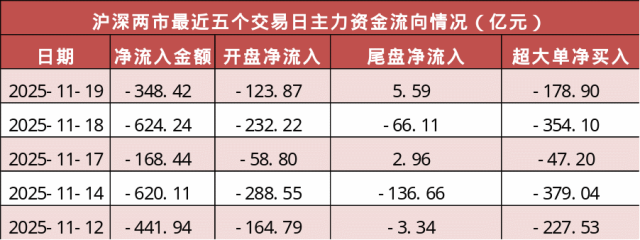
盘后数据出炉。 今日(11月19日),A股市场整体保持震荡走势。截至收盘,上证指数报3946.74点,上涨0.18%;深证成指报13080.09点,微幅下跌;创业板指报3076.85点,上涨 0.25%。两市合计成交17259.08亿元,较上一交易日减少2001.59亿元。 1.两市主力资金净流出近350亿元 今日沪深两市主力资金开盘净流出123.87亿元,尾盘净流入5.59亿元,两市全天主力资金净流出348.42亿元。 | | | 沪深两市最近五个交易日主力资金流向情况(亿元) | | | | --- | --- | --- | --- | --- | | 日期 | | 净流入金额 开盘净流入 | 尾盘净流入 | 超大单净买入 | | 2025- 11- 19 | - 348. 42 | - 123. 87 | 5. 59 | - 178. 90 | | 2025- 11- 18 | - 624. 24 | - 232. 22 | - 66. 11 | - 354. 10 | | 2025- 11- 17 | - 168. 44 | - 58. 80 | 2. 96 | - 47. 20 | | 2025- ...