银行业

Search documents
债市早报:央行2月份买断式逆回购净投放环比增加3000亿元;债市延续向暖,主要期限国债收益率多数下行
Jin Rong Jie· 2026-02-13 03:14
Group 1: Monetary Policy and Market Conditions - The central bank has increased the net injection of reverse repos in February by 300 billion yuan, leading to improved liquidity in the banking system [3] - The central bank will conduct a 1 trillion yuan reverse repo operation on February 13, with a term of 6 months, resulting in a net injection of 500 billion yuan after accounting for maturing repos [3] - The major bond market indices have shown a downward trend in yields, with the 10-year government bond yield decreasing by 1.40 basis points to 1.7720% [10] Group 2: Currency and Exchange Rates - The onshore and offshore RMB against the US dollar both broke the 6.9 mark, reaching a new high before the Spring Festival, with the central bank's midpoint rate set at 6.9457 yuan per dollar [4] - Analysts attribute the RMB's strength to multiple factors, including improved external conditions, a weaker dollar, and increased demand for currency conversion by enterprises [4] Group 3: Corporate News and Credit Events - Kaisa Group announced it would be unable to repay the principal of 400 million USD on its KWGPRO bond due on February 13, 2026 [14] - Moody's confirmed Meituan's issuer rating at "Baa1," changing the outlook from "stable" to "negative" [14] - Jin Hong Holdings reported a debt default of 76 million yuan by its subsidiary [14] Group 4: Real Estate and Housing Market - In the US, January existing home sales saw the largest decline in nearly four years, dropping 8.4% month-over-month to an annualized rate of 3.91 million units, below expectations [5] - The median home price in January increased by 0.9% year-over-year to 396,800 USD, while inventory rose by 3.4% to 1.22 million units [5] Group 5: Commodity Market - International crude oil prices fell, with WTI crude down 2.77% to 62.84 USD per barrel, and Brent crude down 2.71% to 67.52 USD per barrel [6] - COMEX gold futures decreased by 3.06% to 1,942.50 USD per ounce, while NYMEX natural gas prices fell by 0.25% to 3.226 USD per million British thermal units [6] Group 6: Bond Market Dynamics - The bond market showed a warming trend, with the central bank's liquidity support leading to a decrease in yields across various maturities [10] - No new government or policy bank bonds were issued on February 12 [12] - The credit bond market experienced significant price fluctuations, with some bonds deviating over 10% from their previous prices [13]

人民银行将在香港发行500亿元央行票据
Xin Hua Cai Jing· 2026-02-13 02:59
Core Viewpoint - The People's Bank of China (PBOC) is set to issue two new central bank bills in Hong Kong to enhance the availability of high-credit-rated RMB financial products and improve the RMB yield curve in Hong Kong [1] Group 1: Central Bank Bills Issuance - The first phase of the central bank bills will have a term of 3 months (91 days), with a fixed interest rate and a total issuance amount of RMB 30 billion, starting from February 27, 2026, and maturing on May 29, 2026 [1] - The second phase will have a term of 1 year, also with a fixed interest rate, and will issue RMB 20 billion, starting from February 27, 2026, and maturing on February 27, 2027 [1] - Both phases of the central bank bills will have a face value of RMB 100 and will be issued through a Dutch auction method, with the bidding focused on the interest rate [1]
全球金融市场震荡引发贵金属急跌 机构仍看好黄金中长期走势
Huan Qiu Wang· 2026-02-13 02:26
【环球网财经综合报道】据彭博社等外媒报道,受全球金融市场突发波动影响,国际贵金属价格出现显著回调,交易 员抛售贵金属以补充流动性、弥补股市损失。与此同时,市场聚焦美国即将发布的通胀数据,多家国际机构对黄金中 长期走势维持乐观预期。 MKS PAMP SA分析师Nicky Shiels表示,市场波动速度超出预期,即便黄金等传统避险资产,在市场极度紧张时也会 被投资者抛售以换取流动性。 盛宝银行大宗商品策略师称,黄金与白银走势高度依赖市场情绪与交易动能,在市场剧烈波动阶段面临较大压力。此 外,周四金银部分抛售来自前期大涨后的获利回吐,此前投机性买盘推动价格快速上行,积累了一定回调压力。 当前,华尔街交易员密切关注即将公布的美国核心消费者价格指数,以此研判美联储货币政策走向。市场普遍认为, 较低的借贷成本对无息贵金属形成支撑。 尽管短期出现剧烈调整,多家国际银行仍预计黄金将重回上涨趋势,认为支撑本轮金价上行的核心因素未发生改变, 包括地缘政治局势、市场对相关政策与资产配置的判断等。其中,摩根大通私人银行预计年底金价将达到每盎司6000 至6300美元,德意志银行、高盛集团同样维持乐观展望。 在市场避险情绪与流动性需 ...
资讯早班车-20260213
Bao Cheng Qi Huo· 2026-02-13 02:11
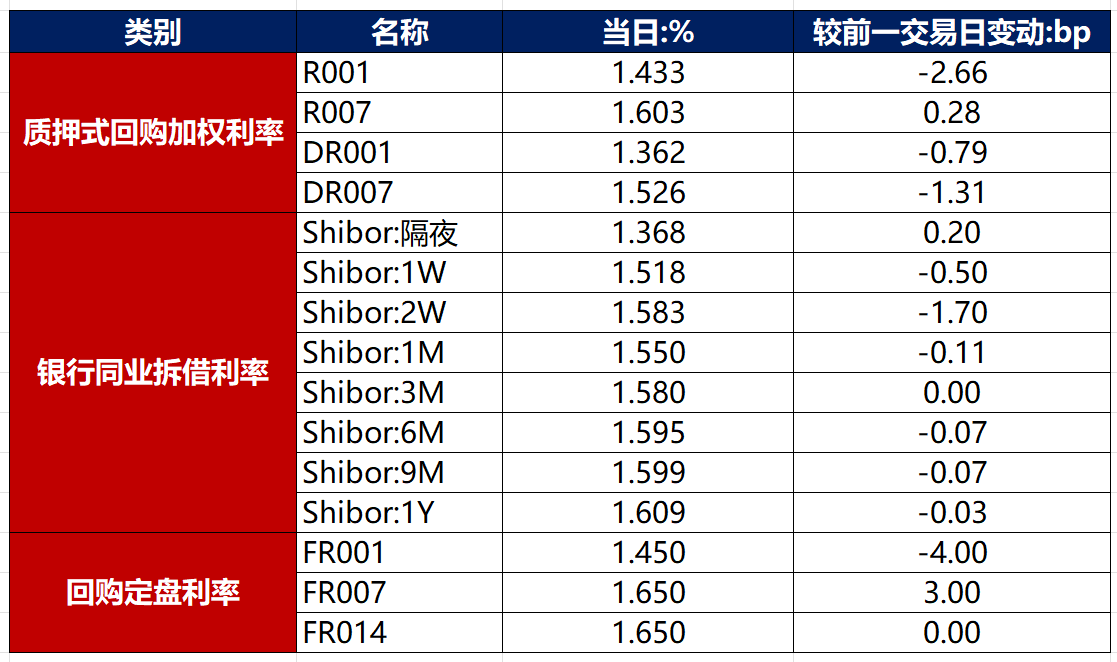
1. Report Industry Investment Rating There is no information about the report industry investment rating in the provided content. 2. Core Views of the Report - The macro - economic data shows a mixed picture. GDP growth slowed down, while some indicators like M1 and M2 had different trends. The manufacturing and non - manufacturing PMIs were below 50, indicating a contraction in the relevant sectors [1]. - In the commodity market, there are various developments such as anti - subsidy tax on EU dairy products, potential changes in Trump's tariff policy, and price movements in different commodities like rare earths and metals [2][6]. - In the financial market, the central bank carried out large - scale reverse repurchase operations, and the bond market showed a mixed performance with different trends in yields and prices [14][23]. - The stock market had a narrow - range consolidation in A - shares, while the Hong Kong stock market declined. Newly - issued public funds had a large scale this year [32][33]. 3. Summary by Directory 3.1 Macro Data - GDP growth in Q4 2025 was 4.5% year - on - year, lower than the previous quarter and the same period last year [1]. - Manufacturing PMI in January 2026 was 49.3%, and non - manufacturing PMI: business activity was 49.4%, both showing a contraction [1]. - Social financing scale in December 2025 was 22075 billion yuan, lower than the previous month and the same period last year [1]. - CPI in January 2026 was 0.2% year - on - year, the same as the previous month but lower than the same period last year; PPI was - 1.4% year - on - year, showing an improvement compared to the previous month and the same period last year [1]. 3.2 Commodity Investment 3.2.1 Comprehensive - From February 13, 2026, anti - subsidy tax will be imposed on imported dairy products from the EU [2]. - Trump's tariff policy faces major uncertainties as the US House of Representatives passed a resolution against his tariff on Canada [2]. - On February 12, 2026, 36 domestic commodity varieties had positive basis, and 31 had negative basis [3]. - CME plans to set up aluminum warehouses in Taiwan and Hong Kong to compete with LME in the Asian market [3]. - Thailand Futures Exchange suspended the temporary online trading of silver futures [4]. - CME plans to launch four South Asian edible oil futures contracts on March 2, 2026, subject to regulatory approval [4]. 3.2.2 Metals - Since the beginning of 2026, rare earth prices have risen strongly. On February 12, the rare earth price index was 290, up 33.64% from December 31, 2025 [6]. - South Africa's gold production in December 2025 increased by 1.1% year - on - year, and the total mining output increased by 2.5% [6]. - On February 11, 2026, copper inventory reached a 9 - month high, while zinc inventory reached a 1 - month low [7]. - Ghana's gold production in 2025 reached a record high of 6 million ounces, and the target for 2026 is 6.5 million ounces, but the royalty plan poses a threat [7]. - As of February 12, 2026, the gold holding of SPDR Gold Trust decreased by 0.48% from the previous trading day [7]. - As of the end of January 2026, China's central bank's gold reserves increased by 1.24 tons month - on - month, and global central banks' net gold purchases in 2025 decreased compared to 2024 [8]. 3.2.3 Coal, Coke, Steel and Minerals - A leading mining company expects the nickel ore export volume from the Philippines to Indonesia to double to 30 million tons this year [10]. 3.2.4 Energy and Chemicals - In 2025, China's new installed capacity of wind and solar power exceeded 430 million kilowatts, and the cumulative installed capacity accounted for 47.3% of the total, exceeding thermal power [11]. - The US controls the sale of Venezuelan oil, with cumulative sales exceeding one billion dollars and expected future income of about five billion dollars [11]. - The US and Venezuela are expected to carry out large - scale cooperation [12]. 3.2.5 Agricultural Products - The Indonesian Palm Oil Association expects the production of crude palm oil in 2026 to increase by 2% - 3% year - on - year [13]. - Brazil's soybean production in the current period is 177.99 million tons, with an increase in yield [13]. - US exporters sold 108,000 tons of soybeans to Egypt for delivery in the 2025/2026 fiscal year [13]. 3.3 Financial News 3.3.1 Open Market - On February 12, 2026, the central bank carried out 1665 billion yuan of 7 - day reverse repurchase operations and 4000 billion yuan of 14 - day reverse repurchase operations, with a net injection of 4480 billion yuan [14][15]. - On February 13, 2026, the central bank will carry out 1 trillion yuan of 6 - month buy - out reverse repurchase operations, with an incremental roll - over of 5000 billion yuan [15]. 3.3.2 Key News - Trump is expected to visit China in early April, and the Sino - US trade "cease - fire" is expected to be extended [16]. - The US House of Representatives passed a resolution against Trump's tariff on Canada [16]. - The Chinese government supports Chinese enterprises in safeguarding their legitimate rights and interests in the case of the Dutch investigation of Nexperia [16]. - The Chinese government will launch a policy package during the Spring Festival to promote consumption, with a focus on trade - in programs [17]. - The market supervision department issued a compliance guide for the automobile industry's price behavior [18]. - Many places require food delivery platforms to stop "involution - style" competition [18]. - In January 2026, the retail sales of passenger cars decreased by 13.9% year - on - year, while the export of new - energy passenger cars increased by 103.6% [18]. - In 2025, commercial banks' net profit was 2.4 trillion yuan, and the banking and insurance industries' assets increased [18]. - In 2025, real estate enterprises' bond financing increased by 5.6% year - on - year [19]. - Shanghai will expand financial opening - up and improve relevant mechanisms [19]. - On February 12, 2026, the on - shore and off - shore RMB exchange rates against the US dollar rose, and the central parity rate was adjusted down [19]. - Shanghai Tongliang Private Fund was severely warned for "self - financing" behavior [20]. - The US Treasury Secretary agreed to transfer the investigation power of the Fed Chairman to the Senate Banking Committee [20]. - The number of initial jobless claims in the US decreased, while the number of continued jobless claims increased [20]. 3.3.3 Bond Market Review - The inter - bank bond market in China was warm, with falling yields of interest - rate bonds and narrow - range fluctuations in bond futures [23]. - In the exchange - traded bond market, some bonds rose while others fell, and the real - estate bond index declined [24]. - The convertible bond index rose, and the money market interest rates showed different trends [25]. - Shibor short - term varieties mostly declined, and the repurchase fixed - rate showed differentiation [26][27]. - European and US bond yields all declined [27]. 3.3.4 Foreign Exchange Market - The on - shore RMB exchange rate against the US dollar rose on February 12, 2026, and the central parity rate was adjusted down [28]. - The US dollar index fell slightly, and non - US currencies showed different trends [28]. 3.3.5 Research Report Highlights - CITIC Securities believes that the RMB is expected to appreciate in 2026, and the loan proportion in Q1 2026 may decline [29]. - CITIC Securities believes that CPI and PPI have a marginal impact on the bond market, and the bond market may show a trend of first falling and then rising in 2026 [30]. - Shenwan Fixed - Income believes that the bond market may enter a stage of narrowing spreads, and there may be a diversion of funds from the bond market to the equity market [30]. 3.3.6 Today's Reminders - On February 13, 2026, 194 bonds will be listed, 4 bonds will be issued, 20 bonds will make payments, and 99 bonds will pay principal and interest [31]. 3.4 Stock Market - On Thursday, A - shares had a narrow - range consolidation, with the Shanghai Composite Index rising 0.05%, and the computing power industry chain and some concept stocks performing strongly [32]. - The Hong Kong Hang Seng Index fell 0.86%, and large - scale technology stocks declined [33]. - The newly - issued scale of public funds this year has exceeded 200 billion yuan, with partial - stock hybrid funds and hybrid FOFs being the most prominent [33].
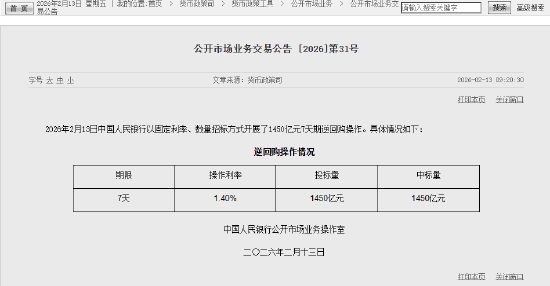
央行今日开展1450亿元7天期逆回购操作
Xin Lang Cai Jing· 2026-02-13 01:31
Group 1 - The People's Bank of China conducted a 7-day reverse repurchase operation amounting to 145 billion yuan on February 13, 2026 [1][2]
金融界财经早餐:央行今日开展万亿买断式逆回购操作,Anthropic完成300亿美元融资,上交所给予双良节能董秘监管警示,1月各类挖掘机销量同比增长49.5%(2月13日)
Jin Rong Jie· 2026-02-13 01:08
Industry Insights - In January 2026, a total of 18,708 excavators were sold, marking a 49.5% year-on-year increase, with domestic sales reaching 8,723 units (up 61.4%) and exports at 9,985 units (up 40.5%) [2] - MiniMax released the M2.5 model, enhancing task decomposition capabilities and token consumption efficiency, which aligns with Agentic AI task requirements, potentially benefiting related AI model and application companies [2] - Yike's cloud computing services are entering a price increase cycle due to surging demand for computing power driven by AI applications, which may benefit companies in the cloud computing and computing power supply chain [2] - Shanghai has launched the "Smart Shanghai" action plan (2026-2028) to integrate AI into information and communication networks, aiming for large-scale access of smart terminals like AI glasses by the end of 2028, presenting growth opportunities for related companies [2] - China successfully launched the world's first AI model satellite aimed at urban sustainable development, which may create development opportunities for companies involved in commercial aerospace and AI satellite applications [2][3] Company Developments - Shuangliang Energy received a regulatory warning regarding its former board secretary Yang Likang [4] - Shuangliang Energy clarified its indirect involvement in commercial aerospace projects, stating it does not have a direct partnership with SpaceX [5] - Zhongnan Culture announced plans to acquire equity in Sulong Thermal Power and will be suspended from trading starting February 13 [6] - Shenghong Technology confirmed the industrialization of its 1.6T optical module PCB [7] - Huitian Technology announced a plan to invest 3.3 billion yuan in a new high-end printed circuit board production project to meet the long-term demand for high-speed computing servers [7] - SMIC reported a supply-demand imbalance in memory and BCD components, leading to price increases [8] - Xianglu Tungsten Industry warned that significant economic fluctuations in its main customer countries could impact market demand for tungsten products and the recovery of accounts receivable [8] - Jiamei Packaging announced that its capital operation plan will be completely independent of the listed company, and it may apply for a trading suspension if stock prices rise abnormally [8] - Tailin Microelectronics disclosed that its third-largest shareholder, the National Integrated Circuit Industry Investment Fund, reduced its holdings by 4.6513 million shares, bringing its stake below 5% [8] - Zhangyue Technology projected that revenue from its AI short drama business will not exceed 1% of its main business revenue for 2025 [9] - International Composite Materials stated that electronic-grade fiberglass is a fundamental raw material for printed circuit boards (PCBs) [9] - Huapei Power announced plans to issue convertible bonds and pay cash to acquire 100% equity of Meichuang Zhiguan, leading to a trading suspension [10] - Jingrui Electric Materials plans to invest 600 million yuan to build a key materials comprehensive base for the integrated circuit manufacturing industry chain in the western region [11] - United Optoelectronics signed a business cooperation framework contract with Lingzhi Cloud Creation to provide assembly and processing services for its robotic products [11]

黄金、白银深夜跳水
新华网财经· 2026-02-13 01:06
往期推荐 多家银行,上调存款利率 雷军:春节期间小米汽车因自身故障抛锚,可报销1500元高铁/机票费和 500元住宿费 现货黄金低开,失守4890美元/盎司,日内跌幅0.68%。 隔夜纽约尾盘,现货黄金下跌3.26%,报4918.36美元/盎司;COMEX黄金期货下跌3.06%,报4942.50美元/盎司。现货白银跌 10.89%,报75.0942美元/盎司。COMEX白银期货跌10.56%,报75.050美元/盎司。 来源:第一财经 关注" 新华网财经 "视频号 更多财经资讯等你来看 ...

央行今日开展1万亿元买断式逆回购操作;氢能19项国家标准征求意见丨盘前情报
2 1 Shi Ji Jing Ji Bao Dao· 2026-02-13 00:59
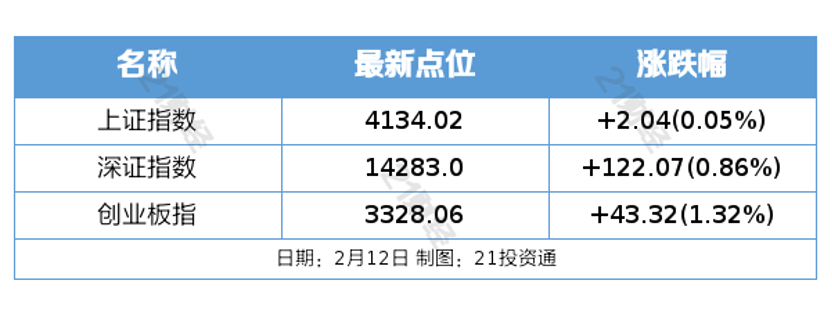
Market Performance - On February 12, the three major indices of A-shares collectively rose, with the ChiNext Index and the Sci-Tech Innovation 50 Index both increasing by over 1% [1] - The Shanghai Composite Index rose by 0.05% to 4134.02 points, the Shenzhen Component Index increased by 0.86% to 14283.0 points, and the ChiNext Index rose by 1.32% to 3328.06 points [2] - The total trading volume of the Shanghai and Shenzhen markets reached 2.14 trillion yuan, an increase of 157.5 billion yuan compared to the previous trading day [1] Sector Performance - The computing power industry chain saw a collective surge, with strong performance in computing power leasing concepts, CPO concepts, and liquid cooling server concepts [1] - The consumer sector experienced a collective decline, with significant drops in the film and television, tourism, retail, and food and beverage sectors [1] International Market Overview - The New York stock market saw declines on February 12, with the Dow Jones Industrial Average falling by 669.42 points (1.34%) to 49451.98 points, the S&P 500 dropping by 108.71 points (1.57%) to 6832.76 points, and the Nasdaq Composite decreasing by 469.32 points (2.03%) to 22597.15 points [3] - In Europe, the FTSE 100 index fell by 0.67%, while the CAC 40 index rose by 0.33%, and the DAX index saw a negligible decline of 0.01% [3] Central Bank Actions - The People's Bank of China announced a 10 billion yuan reverse repurchase operation scheduled for February 13 to maintain ample liquidity in the banking system [5] Policy Developments - The National Development and Reform Commission and other departments plan to establish a mandatory insurance system for unmanned aerial vehicles by 2027, aiming to enhance the low-altitude economy [6] - The Ministry of Commerce announced that starting February 13, 2026, it will impose countervailing duties on imported dairy products from the EU due to subsidies causing substantial harm to domestic industries [8] Technological Advancements - Shenzhen aims to strengthen its semiconductor industry by leveraging AI technology in key areas of the semiconductor supply chain, focusing on high-performance AI chips for various applications [10] - A breakthrough in 3D printing technology allows for the high-resolution printing of complex objects in just 0.6 seconds, marking a significant advancement in the field [13] Automotive Industry Developments - Several automakers, including Geely and Chery, have outlined plans to begin demonstration work on solid-state batteries by 2027, with goals for small-scale industrialization by 2026 [14] Investment Insights - Southwest Securities highlighted the increasing adoption of liquid cooling solutions in AI servers, indicating a structural growth opportunity in the AI computing power chain [15] - Zhongyin International suggested that the real estate sector may present significant profit opportunities in 2026, with some companies potentially reversing previous losses [15]
全球大公司要闻 | Anthropic融资300亿美元,存储巨头业绩展望远超预期
Wind万得· 2026-02-13 00:56
Core Viewpoint - The article highlights significant developments in the AI and technology sectors, including price adjustments by companies, substantial funding rounds, and new product launches that indicate a strong growth trajectory in the industry. Group 1: AI and Technology Developments - Zhiyu announced a structural price adjustment for its GLM Coding Plan, with an overall price increase starting from 30%, effective February 12, 2026, while maintaining prices for existing subscribers [2] - Anthropic completed a Series G funding round of $30 billion, achieving a post-money valuation of $380 billion, with annual revenue reaching $14 billion [2] - OpenAI launched its first AI model, GPT-5.3-Codex-Spark, running on Cerebras Systems chips to reduce dependency on Nvidia chips and lower operational costs [2] Group 2: Financial Performance and Investments - SoftBank Group reported a net profit of 248.59 billion JPY (approximately $1.6 billion) for Q3, significantly below market expectations, with a notable gain of $19.8 billion from its investment in OpenAI [3] - Xiechuang Data plans to procure servers worth up to 11 billion CNY to support its expansion in data centers and related businesses [3] Group 3: Company News in Greater China - MiniMax launched its flagship programming model MiniMax M2.5, designed for agent scenarios, competing with top international models [5] - Meitu announced a stock incentive plan for all employees to promote long-term growth [6] - Huahong Semiconductor achieved a record sales revenue of $659.9 million in Q4 2025, a year-on-year increase of 22.4% [7] Group 4: Company News in the Americas - Microsoft signed a memorandum of understanding with Saudi Aramco to advance industrial AI and digital talent transformation [9] - Meta announced a quarterly cash dividend and plans to invest over $10 billion in a large-scale AI data center in Indiana [9] - Amazon faced a tax investigation in Italy regarding potential tax evasion from 2019 to 2024 [10] Group 5: Company News in Asia-Pacific - Kioxia reported a net profit of 87.81 billion JPY for Q3, below market expectations, while projecting annual net sales between 2.18 trillion JPY and 2.27 trillion JPY [13] - Toyota is extending the acquisition period for a public offer to improve success rates and is collaborating with a Japanese oil giant to build a solid-state electrolyte factory [13] Group 6: Company News in Europe and Oceania - Mercedes-Benz adjusted its EBIT forecast for 2025 to €8.2 billion, a 40% decline year-on-year, with plans to launch over 15 new models in China by 2026 [16] - Nestlé is recalling specific batches of infant formula in China due to contamination concerns, with no confirmed cases of illness reported [18]





【立方早知道】A股千亿级并购火速获批/算力龙头宣布百亿级大单/河南有望再添一家上市公司
Sou Hu Cai Jing· 2026-02-13 00:12
Group 1 - Gold and silver prices experienced significant declines, with spot gold dropping to $4,890 per ounce, a decrease of 0.68%, and spot silver falling by 10.89% to $75.0942 per ounce [1] - China Shenhua's acquisition plan was approved, allowing the company to issue shares to purchase assets and raise up to 20 billion yuan, with a total transaction value of 133.598 billion yuan [6] - Double Good Energy received a regulatory warning after a social media post led to a surge in stock price, claiming new overseas orders for equipment used in SpaceX projects [4] Group 2 - Henan Jiachen Intelligent Control Co., Ltd. successfully passed the listing review, marking the fourth company from Henan to achieve this in two months [2] - Shenzhen released an "Artificial Intelligence + Advanced Manufacturing Action Plan" aiming to establish a national AI application pilot base by 2027 [8][9] - The automotive industry is facing new compliance guidelines to regulate pricing behaviors, aiming to maintain fair competition [12] Group 3 - Huaxia Bank reported a decline in net profit by 1.72% for the year 2025, with total profit down by 4.75% [21] - Xiamen Airport plans to acquire 100% of Zhaoxiang Technology for 1.193 billion yuan as part of its strategic transition with the new airport [24][25] - Chengdu-based aerospace company completed a D++ round financing of 5.037 billion yuan, indicating strong investor interest in the commercial space sector [16]