医药生物

Search documents
11月17日融资余额24744.4亿元,相较上个交易日增加75.78亿元
Sou Hu Cai Jing· 2025-11-18 00:59
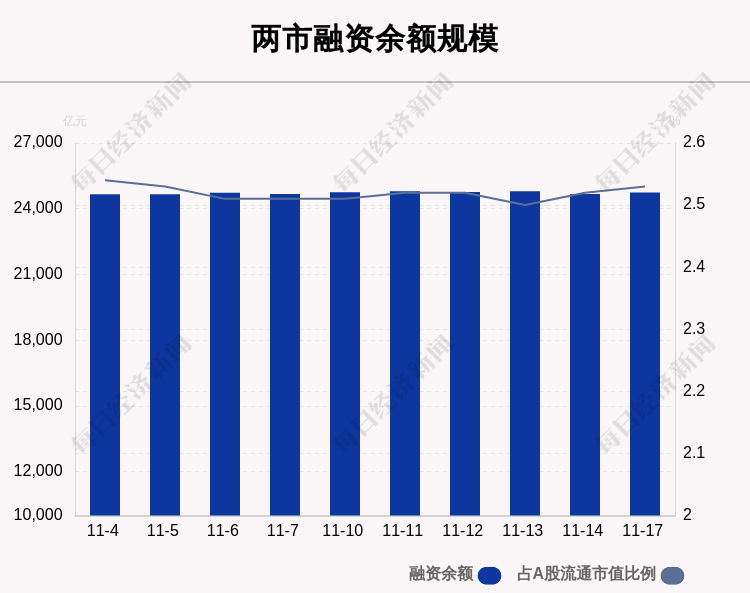
每经AI快讯,据交易所最新公布的数据显示,截至11月17日,沪深两市的融资融券余额为24924.54亿元,相较上个交易日增加 75.88亿元,其中融资余额24744.4亿元,相较上个交易日增加75.78亿元。分市场来看,沪市两融余额为12692.64亿元,相较上个 交易日增加38.03亿元,深市两融余额12231.9亿元,相较上个交易日增加37.84亿元。 从融资资金净买入金额来看,共有35只个股净买入金额超亿元,其中宁德时代、江淮汽车、天华新能排名前三,买入金额分别 为18.47亿元、3.89亿元、3.18亿元。 | | 行 | | | | | | | --- | --- | --- | --- | --- | --- | --- | | 603019.SH | 中科曙 | 100.85 | 20946 | 0.14 | 0.15 | | | | 光 | | | | | 机 | | 300094.SZ | 国联水 | 4.22 | 18625.73 | 3.99 | 9.33 | 衣林 | | | | | | | | 牧渔 | | 301150.SZ | 科 | 62.74 | 17920 | 1.28 | ...

【早盘三分钟】11月18日ETF早知道
Xin Lang Ji Jin· 2025-11-18 00:56
Core Insights - The article discusses the current trends in the ETF market, highlighting the performance of various sectors and the impact of geopolitical tensions on the defense industry [1][7]. Market Temperature - The market temperature indicator shows that the Shanghai Composite Index, Shenzhen Component Index, and ChiNext Index have percentile valuations of 97.53%, 80.71%, and 39.08% respectively, indicating a mixed valuation landscape [1]. Sector Performance - The top-performing sectors on November 17, 2025, included: - Computer: +1.67% - Defense Industry: +1.59% - Banking: +1.10% - The sectors that experienced declines were: - Real Estate: -1.11% - Non-bank Financials: -1.31% - Pharmaceuticals: -1.73% [2]. Fund Flow Signals - The top three sectors with net inflows were: - Computer: 4.331 billion - Defense Industry: 2.657 billion - Banking: 0.838 billion - The sectors with the highest net outflows included: - Pharmaceuticals: -6.216 billion - Electronics: -5.311 billion - Power Equipment: -4.718 billion [2]. ETF Performance - The "创业板人工智能ETF华宝" showed a 6-month increase of 78.53% and a daily increase of 2.20% [5]. - The "国防军工ETF" has a strong outlook due to geopolitical tensions and is expected to benefit from increased military orders and technological advancements [7][10]. Geopolitical Impact on Defense Sector - The defense industry is experiencing a surge due to heightened geopolitical tensions, with the 中证军工指数 rising over 1% on November 17, 2025. Key stocks like 长城军工 and 航天发展 reached new highs [7]. - The upcoming "十五五" military orders are anticipated to boost the sector further, alongside military trade catalysts [7].

A股市场大势研判:指数低开低走
Dongguan Securities· 2025-11-17 23:30
Market Performance - The A-share market experienced a decline, with the Shanghai Composite Index closing at 3972.03, down by 0.46% [2] - The Shenzhen Component Index closed at 13202.00, down by 0.11%, while the CSI 300 Index fell by 0.65% to 4598.05 [2] - The ChiNext Index and the STAR 50 Index also saw declines of 0.20% and 0.53%, respectively [2] Sector Performance - The top-performing sectors included Computer (1.67%), Defense and Military Industry (1.59%), Coal (1.32%), Communication (1.10%), and Real Estate (1.00%) [3] - Conversely, the worst-performing sectors were Pharmaceutical Biology (-1.73%), Banking (-1.31%), Non-Bank Financials (-1.11%), Building Materials (-0.93%), and Home Appliances (-0.84%) [3] Concept Index Performance - The leading concept indices were related to Military Equipment Restructuring (4.72%), MLOps (3.42%), Web3.0 (3.10%), Digital Watermarking (2.71%), and Electronic ID (2.68%) [3] - The lagging concept indices included Cell Immunotherapy (-1.87%), Weight Loss Drugs (-1.87%), Innovative Drugs (-1.72%), Recombinant Proteins (-1.71%), and Fentanyl (-1.68%) [3] Future Outlook - The market is expected to experience short-term fluctuations due to profit-taking, but a gradual improvement in the economic fundamentals is anticipated in the fourth quarter, supported by policy measures [5] - The report suggests focusing on sectors such as Banking, Non-Bank Financials, Transportation, Public Utilities, Coal, and TMT for potential investment opportunities [5] Water Conservation Industry - The water conservation industry in China is showing robust growth, with an estimated market size exceeding 760 billion yuan, driven by key regions such as Beijing-Tianjin-Hebei, Yangtze River Delta, and Guangdong-Hong Kong-Macau Greater Bay Area [4][5] - The development of water-saving industrial parks and leading enterprises in agriculture, industry, and urban life is contributing to this growth [5]
浙商早知道-20251118
ZHESHANG SECURITIES· 2025-11-17 23:30
Market Overview - On November 17, the Shanghai Composite Index fell by 0.46%, the CSI 300 decreased by 0.65%, the STAR 50 dropped by 0.53%, while the CSI 1000 rose by 0.27%, and the ChiNext Index declined by 0.2%. The Hang Seng Index also decreased by 0.71% [4][5]. - The best-performing sectors on November 17 included Computer (+1.67%), Defense and Military Industry (+1.59%), Coal (+1.32%), Communication (+1.1%), and Real Estate (+1%). The worst-performing sectors were Pharmaceutical and Biological (-1.73%), Banking (-1.31%), Non-Bank Financials (-1.11%), Building Materials (-0.93%), and Home Appliances (-0.84%) [4][5]. Key Recommendations - The report recommends Yanzhou Coal Mining Company (600188) with a focus on its capacity expansion towards 300 million tons, indicating a potential turnaround in the industry cycle. The company is expected to benefit from both internal expansion and external acquisitions, with coal prices anticipated to rebound [6]. - The target price for Yanzhou Coal is set at 18.9 CNY, representing a 29% upside from the current price [6]. - Revenue projections for Yanzhou Coal from 2025 to 2027 are estimated at 130,266.60 million CNY, 170,012.53 million CNY, and 186,826.14 million CNY, with growth rates of -6.37%, 30.51%, and 9.89% respectively. Net profit is forecasted at 10,017.42 million CNY, 15,232.49 million CNY, and 18,048.79 million CNY, with growth rates of -30.56%, 52.06%, and 18.49% respectively [6]. Industry Insights - The report highlights that the TMT (Technology, Media, and Telecommunications) sector and the pharmaceutical industry have significantly contributed to the profitability of the STAR Market, with overall earnings improving compared to the mid-year reports [8]. - The rapid development of the AI industry, particularly in the upstream computing power segment, is driving growth in the technology sector, with notable increases in net profit for companies in computing, communication, and electronics [8][9]. - Approximately 80% of industries reported positive capacity expansion rates in the third quarter of 2025, indicating a favorable supply-demand outlook [9].

【医药】流感样病例占比持续走高,关注流感疫苗、呼吸道病毒检测、感冒药等板块——行业跨市场周报(251117)(王明瑞/黎一江)
光大证券研究· 2025-11-17 23:03
Group 1 - The pharmaceutical and biotechnology index increased by 3.29%, outperforming the CSI 300 index by 4.37 percentage points and the ChiNext index by 4.59 percentage points, ranking 5th among 31 sub-industries [4] - The Hong Kong Hang Seng Healthcare Index rose by 6.8%, surpassing the Hang Seng China Enterprises Index by 5.4 percentage points [4] Group 2 - There is a notable increase in flu-like cases since the beginning of autumn 2025, indicating a potentially severe flu season this year. In the 45th week of 2025, 21,412 flu-like case samples were tested, with positive samples primarily being A(H3N2) [5] - The change in circulating strains compared to previous years may increase the risk of breaching herd immunity, although predicting respiratory virus outbreaks remains uncertain [5] Group 3 - Future investments in the pharmaceutical sector should focus on the clinical value of drugs, addressing the clinical needs of patients, as both domestic healthcare policies and global expansion strategies increasingly emphasize clinical value [6] - Risks include unexpected cost control policies, research and development failures, insufficient policy support, and slower-than-expected promotion of commercial health insurance [6]

20cm速递|关注创业板50ETF国泰(159375)投资机会,市场聚焦科技成长板块配置价值
Mei Ri Jing Ji Xin Wen· 2025-11-17 15:39
Group 1 - The core viewpoint is that the securities industry is expected to be active in 2025, with a significant rise in the equity market, particularly the ChiNext Index, which has increased by 48.84% from January to October, outperforming the CSI 300 Index (+17.94%) and the Shanghai Composite Index (+17.99%) [1] - After the implementation of asset management regulations, the scale of securities firms' asset management has stabilized, with a year-on-year growth of 25% in collective asset management scale, indicating a clear trend towards active management transformation [1] - The favorable equity market has led to an increase in the proprietary trading income of securities firms, with the technology growth sector represented by the ChiNext 50 becoming a key investment direction [1] Group 2 - The rapid development of ETFs provides new opportunities for securities firms in wealth management transformation, with the scale of ChiNext 50-related ETFs growing quickly, and securities firms holding a significant 58% share in the distribution of equity products [1] - Overall profitability in the industry has improved, with listed securities firms reporting a 62% year-on-year increase in net profit attributable to shareholders in the first three quarters, significantly driven by sectors like technology and pharmaceuticals, which have a high weight in the ChiNext 50 [1] - The ChiNext 50 ETF (159375) tracks the ChiNext 50 Index (399673), which includes 50 stocks with high average daily trading volumes, focusing on high-growth sectors such as power equipment and biomedicine, serving as an important indicator of the development trends in China's emerging industries [1]

8.75亿元资金今日流出银行股
Zheng Quan Shi Bao Wang· 2025-11-17 14:30
Market Overview - The Shanghai Composite Index fell by 0.46% on November 17, with 17 industries experiencing gains, led by the computer and defense industries, which rose by 1.67% and 1.59% respectively [1] - The pharmaceutical and banking sectors had the largest declines, with drops of 1.73% and 1.31% respectively [1] Capital Flow - The net outflow of capital from the two markets was 31.953 billion yuan, with six industries seeing net inflows [1] - The computer industry had the highest net inflow of capital at 7.211 billion yuan, followed by the defense industry with 2.892 billion yuan [1] - A total of 25 industries experienced net capital outflows, with the pharmaceutical industry leading at 8.789 billion yuan, followed by the power equipment sector with 7.644 billion yuan [1] Banking Sector Performance - The banking sector declined by 1.31% with a net outflow of 875 million yuan, out of 42 listed banks, only 2 saw gains while 40 experienced losses [2] - Among the banks, Minsheng Bank had the highest net inflow of 141 million yuan, followed by China Merchants Bank and Qilu Bank with inflows of 99.896 million yuan and 73.512 million yuan respectively [2] - The banks with the largest net outflows included Agricultural Bank of China, Postal Savings Bank, and Shanghai Pudong Development Bank, with outflows of 428 million yuan, 279 million yuan, and 134 million yuan respectively [2] Individual Bank Performance - The table of bank performance shows various banks' daily changes, turnover rates, and main capital flows, highlighting significant outflows from major banks [3] - Agricultural Bank of China saw a decline of 2.12% with a net outflow of 427.5 million yuan, while Minsheng Bank was the only bank to gain, increasing by 0.99% with a net inflow of 1.414 billion yuan [3]





基金市场与ESG产品周报20251117:医药主题基金表现占优,TMT、科创主题ETF受被动资金加仓-20251117
EBSCN· 2025-11-17 12:22
Quantitative Models and Construction Methods 1. Model Name: Active Equity Fund Position Estimation Model - **Model Construction Idea**: The model aims to estimate the high-frequency positions of active equity funds using quantitative methods based on daily disclosed net value sequences[64] - **Model Construction Process**: - Utilize constrained multivariate regression models to find the optimal estimation results of fund positions among the constructed asset sequences[64] - Construct simulated portfolios for each fund to improve the accuracy of position estimation[64] - Measure the overall position change trend of active equity funds and further estimate their latest industry preferences[64] - **Model Evaluation**: The model provides a high-frequency estimation of fund positions, which is crucial for understanding the investment behavior of active equity funds[64] 2. Model Name: REITs Series Index Construction Model - **Model Construction Idea**: The model provides a new perspective for asset allocation using REITs indices based on index investment philosophy[48] - **Model Construction Process**: - Construct a complete series of REITs indices to reflect the market performance comprehensively[48] - Provide detailed sub-indices for different underlying assets and project types, considering the high dividend characteristics of REITs[48] - Use a tiered rounding method to ensure the stability of the index calculation[48] - Apply the divisor adjustment method to maintain the continuity of the index when non-trading factors (e.g., new issuance, expansion) occur[48] - **Model Evaluation**: The model effectively captures the performance of various REITs assets and provides valuable tools for investors to measure the risk-return profile of REITs[48] Model Backtesting Results Active Equity Fund Position Estimation Model - **Weekly Position Change**: The estimated positions of active equity funds decreased by 0.19 percentage points compared to the previous week[64] - **Industry Allocation Trends**: Increased allocation in electronics, home appliances, and automobiles; decreased allocation in computers, non-bank finance, and banking sectors[64] REITs Series Index Construction Model - **Weekly Performance**: The comprehensive REITs index increased by 0.87%[50] - **Sub-Indices Performance**: - Property REITs Index: +0.81%[50] - Franchise REITs Index: +1.00%[50] - Affordable Rental Housing REITs Index: +1.51%[50] Quantitative Factors and Construction Methods 1. Factor Name: ESG Fund Performance Tracking - **Factor Construction Idea**: Track the performance of ESG funds by considering environmental, social, and governance factors in investment strategies[79] - **Factor Construction Process**: - Classify ESG funds into thematic ESG funds and general ESG funds based on their investment strategies[79] - Thematic ESG funds include "ESG," "sustainable," and "responsible investment" themes[79] - General ESG funds cover themes like "low carbon," "carbon neutral," "green," "environment," "climate," "ecology," "Yangtze River protection," etc.[79] - Social themes include "social responsibility," "poverty alleviation," "rural revitalization," "Belt and Road," "Silk Road," "regional development," etc.[79] - Governance themes include "corporate governance" and "governance"[79] - **Factor Evaluation**: The factor provides a comprehensive classification and tracking of ESG funds, helping investors understand the performance and impact of ESG investments[79] Factor Backtesting Results ESG Fund Performance Tracking - **Number of ESG Funds**: 213 funds with a total scale of 1520.28 billion yuan[80] - **Thematic Distribution**: - ESG Theme: 172.07 billion yuan[80] - Environmental Theme: 1185.57 billion yuan[80] - Social Theme: 137.23 billion yuan[80] - Governance Theme: 25.41 billion yuan[80] - **Type Distribution**: - Active Equity Funds: 804.90 billion yuan[80] - Stock Passive Index Funds: 202.64 billion yuan[80] - Pure Bond Funds: 221.67 billion yuan[80] - Bond Passive Index Funds: 278.98 billion yuan[80] - QDII Funds: 12.08 billion yuan[80] - **Weekly Performance**: - Active Equity ESG Funds: Median net value change of -1.67%[84] - Stock Passive Index ESG Funds: Median net value change of -1.13%[84] - Bond ESG Funds: Median net value change of +0.04%[84]
主力资金丨4股尾盘获大手笔加仓
Zheng Quan Shi Bao Wang· 2025-11-17 11:44
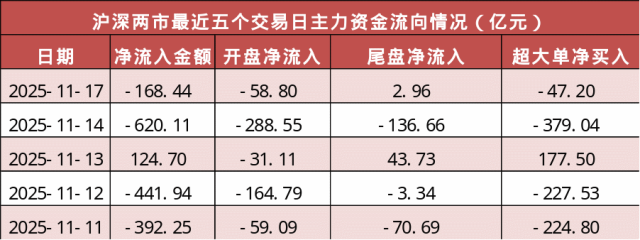
Group 1 - The core point of the article highlights that the main funds in the Shanghai and Shenzhen markets experienced a net outflow of 168.44 billion yuan on November 17, with the ChiNext board seeing a net outflow of 75.05 billion yuan and the CSI 300 index stocks a net outflow of 83.5 billion yuan [2] - Among the 17 industries tracked, 10 industries saw a net inflow of main funds, with the computer industry leading at 43.31 billion yuan, followed by the national defense and military industry at 26.57 billion yuan [2] - The pharmaceutical and biological industry faced the largest net outflow of 62.16 billion yuan, while the electronic industry had a net outflow of 53.12 billion yuan [2] Group 2 - In terms of individual stocks, 94 stocks had a net inflow of over 1 billion yuan, with 20 stocks exceeding 3 billion yuan in net inflow [3] - The stock of Zhongdian Xindong, involved in smart city projects, saw a net inflow of 8.63 billion yuan, marking a significant breakthrough in the urban rail transit sector [3] - Longcheng Military Industry also attracted a net inflow of 7.9 billion yuan, benefiting from a strong opening in the military equipment sector [3] Group 3 - Conversely, 100 stocks experienced a net outflow of over 1 billion yuan, with three leading stocks seeing significant outflows: Ningde Times at 17.62 billion yuan, and both Sunshine Power and Century Huatuo exceeding 10 billion yuan [5] - Century Huatuo's stock hit a limit down, closing with a drop of 9.16% [5] - In the tail end of trading, the total net inflow was 2.96 billion yuan, with Zhongdian Xinchuan leading at 2.6 billion yuan [6][7]




【17日资金路线图】两市主力资金净流出近170亿元 计算机等行业实现净流入
Zheng Quan Shi Bao· 2025-11-17 11:40
Market Overview - The A-share market experienced an overall decline on November 17, with the Shanghai Composite Index closing at 3972.03 points, down 0.46%, the Shenzhen Component Index at 13202 points, down 0.11%, and the ChiNext Index at 3105.2 points, down 0.2% [1] - The total trading volume for both markets was 19107.91 billion yuan, a decrease of 472.88 billion yuan compared to the previous trading day [1] Capital Flow - The net outflow of main funds from the Shanghai and Shenzhen markets reached approximately 170 billion yuan, with an opening net outflow of 58.8 billion yuan and a closing net inflow of 2.96 billion yuan, resulting in a total net outflow of 168.44 billion yuan for the day [2][3] - The CSI 300 index saw a net outflow of 83.5 billion yuan, while the ChiNext index experienced a net outflow of 75.05 billion yuan [4][5] Sector Performance - The computer industry achieved a net inflow of 80.23 billion yuan, with a growth of 1.92%, driven by stocks like Tuowei Information [6][7] - Other sectors with net inflows included media (31.27 billion yuan), communication (16.87 billion yuan), coal (10.69 billion yuan), and food and beverage (9.40 billion yuan) [7] - Conversely, the biopharmaceutical sector faced a significant net outflow of 156.04 billion yuan, declining by 1.57%, along with the electric equipment sector (90.44 billion yuan outflow) and banking (53.47 billion yuan outflow) [7] Institutional Activity - Notable institutional buying included Yahua Group with a net purchase of 41.69 million yuan and Binhai Energy with 19.24 million yuan [11] - Conversely, significant selling was observed in stocks like Shida Shenghua with a net outflow of 24694.51 million yuan and Zhongkuang Resources with 26231.12 million yuan [11] Analyst Recommendations - Recent analyst ratings include TuoBang Co. with a target price of 15.71 yuan, currently at 13.42 yuan, indicating a potential upside of 17.06% [12] - Other stocks with favorable ratings include Kede CNC with a target price of 86.95 yuan, currently at 60.79 yuan, suggesting a 43.03% upside [12]