
服务业

Search documents
再拉930亿反制清单,欧盟已在为“谈崩”做准备?
2 1 Shi Ji Jing Ji Bao Dao· 2025-07-25 14:42
Group 1 - The European Union (EU) has approved a unified retaliation list against the U.S. totaling €93 billion, which will take effect if no satisfactory trade agreement is reached by August 1 [1][2] - The EU's retaliation measures include two previous rounds of tariffs, with the first round targeting U.S. steel and aluminum tariffs amounting to approximately €21 billion, and the second round responding to threats of a 30% tariff on EU goods, valued at around €72 billion [1][2] - Germany's shift towards a more confrontational stance against the U.S. reflects a broader change in the EU's negotiation strategy, indicating a readiness to escalate tensions if necessary [2][3] Group 2 - The EU is considering the use of a "counter-coercion tool," a mechanism that has never been formally activated, which would allow the EU to impose trade and investment restrictions on countries attempting to coerce member states [2] - Recent economic data shows that the Eurozone has shown resilience against the initial impacts of the trade war, with the July PMI rising to 51, indicating growth in manufacturing and services [5] - However, there are concerns about potential supply chain disruptions and the impact on the service sector, particularly in areas heavily reliant on U.S. exports [5]
股指、黄金周度报告-20250725
Xin Ji Yuan Qi Huo· 2025-07-25 11:04
Report Industry Investment Rating - Not provided in the content Core Views - In the short term, due to the continuous fermentation of the policy expectations of "anti - involution" and eliminating backward production capacity, risk appetite rises, but corporate profits have not significantly improved, so be cautious about the short - term rebound of stock index futures and protect the profits of long positions; the end of the grace period for the US equivalent tariff policy is approaching, and trade agreements have been reached with important trading partners, leading to a significant decline in risk aversion, so gold may continue to adjust after the end of the rebound, and short positions can be attempted. In the medium to long term, the valuation of stock indices is dragged down by the decline in corporate profit growth at the molecular end, and the support at the denominator end comes from the rise in risk appetite, so the stock index maintains a wide - range oscillation; the US may reach more trade agreements, risk aversion declines significantly, and with the approaching of the Fed's July interest rate decision, gold may face a deep adjustment [47] Summary by Relevant Catalogs 1. Domestic and Foreign Macroeconomic Data - From January to June this year, the growth rate of fixed - asset investment continued to decline, the decline in real estate investment widened, and the growth rates of infrastructure and manufacturing investment slowed down. The year - on - year decline in new housing construction area narrowed, while the decline in commercial housing sales area and sales volume widened, indicating that real estate investment will still be restricted [5] 2. Stock Index and Gold Spot Price Trends - Not provided in the content 3. Stock Index Fundamental Data 3.1 Corporate Profit - Driven by the policy expectations of "anti - involution" and eliminating backward production capacity, commodity prices have risen continuously, which helps improve the profits of upstream raw material processing industries. However, downstream enterprises still face great operating pressure and are in the stage of active inventory reduction [20] 3.2 Capital - The balance of margin trading in the Shanghai and Shenzhen stock markets has continued to increase. The central bank conducted 1.6563 trillion yuan of 7 - day reverse repurchase operations and 400 billion yuan of MLF operations this week, achieving a net investment of 12.95 billion yuan [24] 4. Gold Fundamental Data 4.1 US Economic Indicators - In June, the US S&P Global Manufacturing PMI dropped from 59.2 to 49.5, while the Services PMI rose to 55.2, reaching a new high this year. The number of initial jobless claims has declined for 6 consecutive weeks, indicating that the US manufacturing activity has slowed down, but the labor market remains strong, and the 10 - year US Treasury yield is running at a high level [30][31] 4.2 Gold Inventory - The warehouse receipts and inventory of Shanghai gold futures have increased significantly, while the New York futures inventory has continued to decline, and the market's bullish sentiment has cooled down [45]
IFO:德国经济的好转仍然乏力
news flash· 2025-07-25 08:29
IFO:德国经济的好转仍然乏力 金十数据7月25日讯,德国智库IFO周五公布的一项调查显示,德国企业7月对现阶段经营环境持更积极 看法,但对未来经济前景的担忧依然存在,从而限制了整体信心的回升力度。数据显示,德国商业景气 指数从6月份的88.4升至7月份的88.6,低于市场预期的89。德国智库IFO总裁Clemens Fuest表示:"德国 经济的好转仍然乏力。企业对当前业务的满意度略高,但对未来业务的预期基本保持不变。"此外, IFO数据显示,7月制造业和建筑业指数上升,但服务业和贸易指数下降。 ...
成都上半年经济运行情况公布 GDP达12108.2亿元 同比增长5.8%
Si Chuan Ri Bao· 2025-07-25 07:26
Economic Overview - Chengdu's GDP for the first half of the year reached 12,108.2 billion yuan, with a year-on-year growth of 5.8% at constant prices [1] - The primary industry added value was 186.7 billion yuan, growing by 2.7% [1] - The secondary industry added value was 3,267.4 billion yuan, growing by 5.3% [1] - The tertiary industry added value was 8,654.2 billion yuan, growing by 6.0% [1] Industrial Growth - The industrial added value for large-scale enterprises in Chengdu increased by 7.8% year-on-year [2] - Among 37 major industries, 25 experienced positive growth, with non-ferrous metal smelting and rolling processing, automotive manufacturing, and electronic equipment manufacturing showing significant increases of 41.7%, 23.6%, and 17.3% respectively [2] - High-tech manufacturing added value grew by 12.1% [2] - Key industrial products saw substantial production increases, including new energy vehicles (352.2%), smartwatches (119.2%), and lithium-ion batteries (45.8%) [2] Service Sector Performance - The service sector's added value grew by 6.0% year-on-year [2] - Notable growth was seen in leasing and business services (10.7%), information transmission and software services (10.7%), and transportation and storage (7.4%) [2] - By the end of June, financial institutions reported a 9.8% increase in deposits and a 10.4% increase in loans [2] Investment Trends - Fixed asset investment in Chengdu grew by 6.0% year-on-year [3] - Investment in the primary industry increased by 15.3%, while the secondary industry saw a 40.7% increase, with industrial investment specifically rising by 41.3% [3] - The tertiary industry investment declined by 0.8%, with real estate development investment down by 2.8% [3] - High-tech industry investment surged by 37.4%, with high-tech manufacturing investment growing by 59.1% [3] Consumer Market Insights - The total retail sales of consumer goods reached 5,622.3 billion yuan, reflecting a year-on-year growth of 6.1% [3] - Urban retail sales amounted to 4,928.6 billion yuan (6.0% growth), while rural retail sales were 693.7 billion yuan (6.6% growth) [3] - Key consumer categories showed varied growth, with telecommunications equipment retail sales increasing by 64.5% and home appliances by 34.5% [3] - New energy vehicles saw a growth of 21.0% within the automotive category [3]
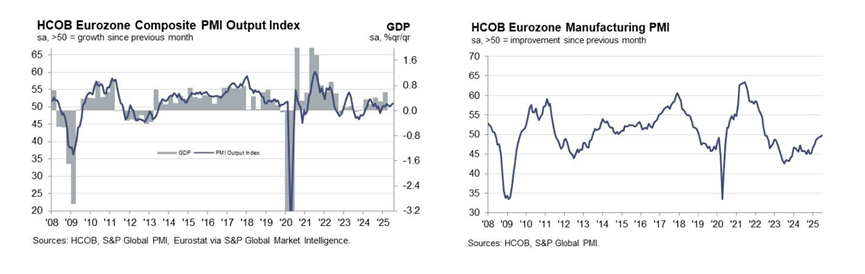
欧元区7月PMI升至51创近一年新高,德国制造业复苏,法国因政治僵局持续萎缩
Hua Er Jie Jian Wen· 2025-07-24 10:31
尽管面临与美国迫在眉睫的贸易摊牌,欧元区经济仍在7月展现出韧性,私营部门活动以近一年来最快的速度扩张。 根据标普全球周四公布的数据,欧元区7月综合采购经理人指数(PMI)从6月的50.6升至51,高于分析师预期的50.7,进一步站稳荣枯线50以上。 这一增长主要得益于持续三年的制造业衰退接近尾声,同时服务业出人意料地加速增长。 与此同时,德国私营部门活动连续第五个月保持扩张,主要得益于制造业出现复苏迹象及服务业的企稳;法国私营部门活动连续第11个月出现萎 缩,受国内的政治僵局的影响。 欧元区7月PMI超预期扩张,经济韧性显现 对于欧洲央行而言,最新的PMI数据虽然带来一丝宽慰。 具体而言,欧元区7月新订单在连续13个月萎缩后趋于稳定,服务业新业务增加,但制造业新订单再次下降,出口订单也持续下滑。就业方面,欧 元区企业连续第五个月增加员工,主要得益于服务业的招聘,尽管德国和法国的员工数量仍在下降。积压工作量持续减少但速度放缓。 物价方面,投入成本通胀放缓至九个月低点,制造业成本持续下降。产出价格与6月持平,德国销售价格通胀放缓,但法国和欧元区其他地区加 速。库存和供应链方面,制造业采购活动降幅收窄,库存减少速度 ...

英国7月制造业PMI初值为48.2,预期48;7月服务业PMI初值为51.2,预期53。
news flash· 2025-07-24 08:31
Group 1 - The preliminary manufacturing PMI for the UK in July is reported at 48.2, which is below the expected value of 48 [1] - The preliminary services PMI for the UK in July is reported at 51.2, which is also below the expected value of 53 [1]
德国7月私营部门增长持续疲弱
news flash· 2025-07-24 07:36
Group 1 - The core viewpoint of the article highlights the continued weakness in Germany's private sector growth as indicated by the July PMI data, particularly in manufacturing [1] - Manufacturing PMI remains below the neutral line, suggesting ongoing fragility in the sector, although manufacturing output has expanded for five consecutive months, indicating signs of recovery [1] - The services sector is no longer a drag on economic growth, with new business volumes in July experiencing their first increase in nearly a year after ten months of decline [1] Group 2 - The improvement in economic outlook aligns with expectations, driven by real wage growth and expansionary fiscal policies that are likely to support overall economic stabilization [1]
7月24日电,德国7月制造业PMI初值为49.2,预期49.5;7月服务业PMI初值为50.1,预期50。
news flash· 2025-07-24 07:33
智通财经7月24日电,德国7月制造业PMI初值为49.2,预期49.5;7月服务业PMI初值为50.1,预期50。 ...
15929.58亿元 上半年重庆实现地区生产总值同比增长5%
Sou Hu Cai Jing· 2025-07-24 02:14
7月23日,市统计局、国家统计局重庆调查总队联合公布今年上半年我市经济运行数据,上半年全市实 现地区生产总值15929.58亿元,同比增长5%。其中,第一产业实现增加值714.82亿元,同比增长3.1%; 第二产业实现增加值5555.75亿元,同比增长4.2%;第三产业实现增加值9659.01亿元,同比增长5.6%。 上半年经济呈现回升向好态势 (数据来源:市统计局、国家统计局重庆调查总队) 农业 实现增加值714.82亿元,同比增长3.1% 工业 实现增加值5555.75亿元,同比增长4.2% 服务 业 实现增加值9659.01亿元,同比增长5.6% 消费 社会消费品零售总额8300.37亿元,同比增长4.5% 投资 固定资产投资同比增长3.2%,设备工器具投资同比增长31.8% 收入 全体居民人均可支配收入22117元,同比增长5.1%;城乡收入比由上年同期的2.41∶1下降为 2.37∶1 上半年,全市上下全面落实党中央、国务院决策部署,突出稳进增效、改革创新、除险固安、强企富民 工作导向,主动服务和融入新发展格局,加快推进"六区一高地"建设,生产供给稳定增长,社会需求不 断扩大,就业物价总体平稳,新质 ...
日本7月标普全球服务业PMI报53.5
news flash· 2025-07-24 00:55
标普全球7月24日发布数据显示,日本7月标普全球综合PMI报51.5,日本7月标普全球服务业PMI报 53.5,日本7月标普全球制造业PMI报48.8。 ...
