
先进轨道交通装备

Search documents
教育部:动态调整专业设置,重点增设低空经济、人工智能、高端装备、城市更新、民生紧缺等领域新专业
Jin Rong Jie· 2026-02-12 02:24
Core Viewpoint - The Ministry of Education has released opinions on deepening the reform of key elements in vocational education, emphasizing the need for dynamic adjustments in professional settings and the introduction of new majors in emerging fields such as low-altitude economy, artificial intelligence, and high-end equipment [1] Group 1: Professional Adjustments - The reform includes the addition of new majors in critical areas and the elimination or upgrading of existing ones to better align with industry needs [1] - Specific fields targeted for new major development include low-altitude economy, artificial intelligence, high-end equipment, urban renewal, and areas with a shortage of skilled labor [1] Group 2: Curriculum Design - The initiative calls for a scientific design of course combinations and the establishment of a curriculum list for new and upgraded courses, along with a capability map for courses [1] - There is a focus on enhancing ideological education and general education courses, as well as diversifying textbook formats and developing urgently needed teaching materials [1] Group 3: Teacher Development - The plan includes a detailed teacher capability list and the establishment of a dual-flow mechanism for teachers and industry talent [1] - This aims to facilitate the movement of educators between educational institutions and enterprises, enhancing the practical relevance of vocational training [1] Group 4: Industry-Education Integration - The construction of internship and training bases through various collaborative methods, such as enterprise commissioning and school-enterprise joint construction, is emphasized [1] - The initiative will promote a "high-skilled talent cluster training plan" focusing on major strategies and key areas, leveraging the strengths of industry, enterprises, and educational institutions [1] Group 5: Pilot Programs - Six advanced manufacturing sectors with significant talent shortages have been selected as pilot areas, including new energy vehicles, advanced rail transit equipment, aerospace equipment, high-end CNC machine tools, robotics, and agricultural machinery [1]
大连跻身东北首个万亿之城,为东北振兴注入动能
Zhong Guo Xin Wen Wang· 2026-01-23 15:10
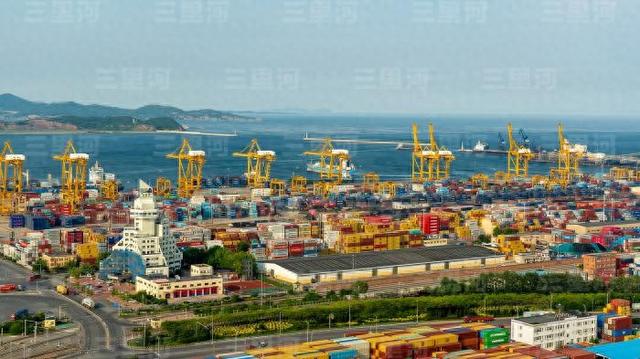
Core Insights - Dalian has become the first city in Northeast China to achieve a GDP exceeding 1 trillion yuan, reaching 10,002.1 billion yuan in 2025, with a year-on-year growth of 5.7% at constant prices [1][3]. Economic Contributions - The industrial economy and port economy are significant contributors to Dalian's growth, with the industrial sector accounting for 60% of GDP growth in 2023 [4]. - Dalian's petrochemical industry is a key player, projected to reach a production value of 425.6 billion yuan in 2024, ranking first in Northeast China and fourth nationally [4]. - The port economy is vital, with Dalian Port ranking fourth globally in the Container Port Performance Index for 2020-2024 [5][7]. Emerging Industries - Dalian is fostering new economic drivers, with a new generation information technology industry forming a 200 billion yuan cluster and advancements in the new energy sector [8]. - Strategic emerging industries now account for 15% of GDP, indicating a shift towards innovation and modernization [8]. Regional Impact - Dalian's success is seen as a potential catalyst for the revitalization of Northeast China, with expectations to attract more investment and talent [9]. - The city aims to serve as a model for other cities in the region, demonstrating a pathway from traditional industry to emerging sectors [9]. Future Goals - Dalian's government has set a target for GDP growth of over 5% in the upcoming years, indicating a commitment to sustained economic development [10].

又一座“准万亿”之城“出分”了
Mei Ri Jing Ji Xin Wen· 2026-01-15 00:40
Economic Growth Projections - Dalian's GDP is expected to grow by over 5.5% in 2025, with industrial added value increasing by over 11.7% and retail sales of consumer goods growing around 3% [1] - The "14th Five-Year Plan" outlines 20 key indicators for economic and social development, including an average annual GDP growth of 5% and urbanization rate reaching 83.75% by 2030 [1][2] - Dalian aims for a GDP growth target of over 5% in 2026, with industrial added value growth of 7% and fixed asset investment growth of around 5% [1] Industrial Development - Dalian's industrial growth has been significant, achieving a two-digit growth rate of over 11.7% in industrial added value, surpassing the initial target of 7% [2] - The city is focusing on transforming its industrial structure, with the green petrochemical industry maintaining a stable scale of around 400 billion yuan, and new energy vehicle industry output exceeding 100 billion yuan [2] - Dalian's shipbuilding and marine engineering equipment industry has reached an output value of 80 billion yuan, while high-end bearings and advanced rail transit equipment have generated 58 billion yuan [2] Innovation and R&D - Dalian's government report sets specific innovation-driven targets, including a research and development expenditure intensity of around 3.2% by 2030 and a digital economy core industry value added accounting for 14.5% of GDP [3] - The city aims to achieve a high-value invention patent ownership of 23.5 per 10,000 people [3] Comparison with Other Cities - Other northeastern cities like Shenyang and Changchun are also focusing on economic stability and growth, with Shenyang emphasizing internal demand and Changchun projecting a GDP growth of over 5% by 2025 [3]
屈贤明:重点突破领域应增加智能仪器仪表、生物制造产业
Feng Huang Wang Cai Jing· 2025-12-29 06:26
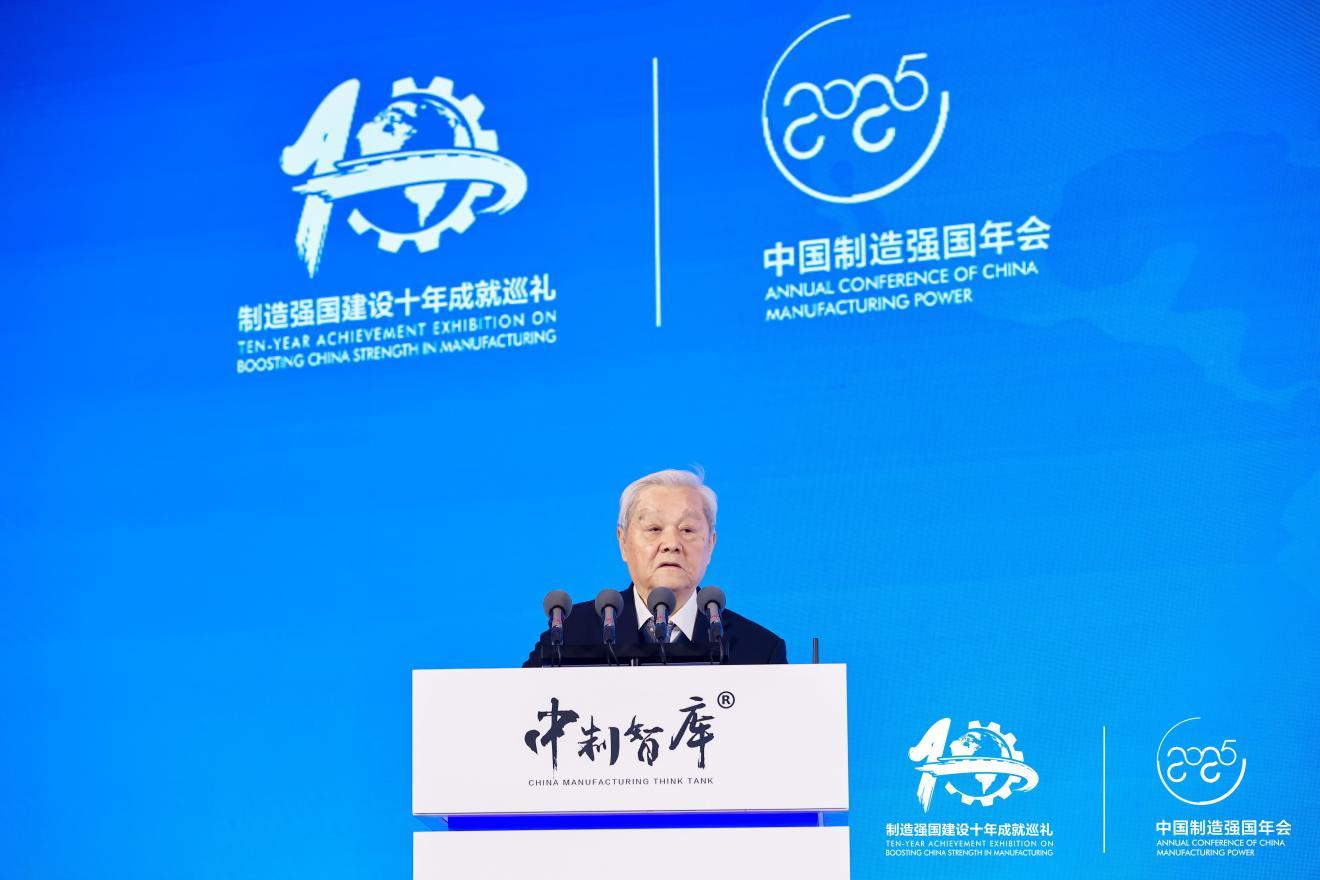
Group 1 - The 10th China Manufacturing Power Conference was successfully held in Beijing, focusing on the theme "Rooted in Reality, Moving Towards New Directions" and discussing the high-quality development path of China's manufacturing industry during the 14th and 15th Five-Year Plans [1] - The conference highlighted the achievements of China's manufacturing sector over the past decade, particularly in ten key areas, reinforcing China's position as the world's leading manufacturing power and its entry into the second tier of global manufacturing powers [3] - The future strategy for manufacturing power construction will involve two main aspects: continuing the "key breakthroughs" strategy with adjustments to include smart instruments and biological manufacturing, and increasing support for foundational research and cutting-edge technologies in five industries that have reached world-leading levels [3] Group 2 - Five industries, including information communication equipment and new energy vehicles, are currently at the forefront globally, with expectations for five to six more key industries to achieve breakthroughs in the next decade [3] - The overall goal is for China's manufacturing industry to transition into the mid-to-high-end sector within the next ten years [3]
屈贤明展望:未来十年再突破五、六个产业,中国制造将整体迈入中高端
Xin Lang Cai Jing· 2025-12-29 03:56
Core Viewpoint - The "10th China Manufacturing Power Conference" highlighted China's achievements in manufacturing over the past decade and outlined future strategies for advancing its manufacturing capabilities [1][3][5]. Group 1: Achievements in Manufacturing - Over the past ten years, China has made significant breakthroughs in ten key areas of manufacturing, solidifying its position as the world's leading manufacturing power [3][5]. - China has entered the second tier of global manufacturing powers, with five industries—information and communication equipment, marine engineering equipment and high-tech ships, advanced rail transit equipment, new energy vehicles, and electric power equipment—leading the world [3][5]. Group 2: Future Strategies - For the next decade, the second phase of the manufacturing power strategy will focus on two main areas: continuing the "key breakthroughs" strategy while adjusting the focus to include smart instruments and biological manufacturing [3][5]. - Increased support for basic research and cutting-edge technologies in the five leading industries is essential to achieve breakthroughs in original innovation [3][5]. - It is anticipated that five to six additional key industries will achieve breakthroughs and join the ranks of world-leading industries, elevating China's manufacturing sector to a mid-to-high-end level overall [3][5].
工信部原副部长刘利华:未来五年,推动制造业实现战略性跨越应聚焦四个方面
Xin Lang Cai Jing· 2025-12-28 02:39
Core Viewpoint - The 10th China Manufacturing Power Conference highlighted the significant achievements of China's manufacturing sector during the 14th Five-Year Plan, emphasizing the need for continued innovation and adaptation in a rapidly changing global environment [3][4][9]. Group 1: Achievements in Manufacturing - China's manufacturing value added has maintained a stable global share of around 30%, holding the top position for 15 consecutive years [3][8]. - Key industries such as new energy vehicles, information communication equipment, and advanced rail transit have reached world-leading status, while aerospace, automotive, steel, petrochemicals, and building materials have achieved advanced global levels [3][8]. - In the first 11 months of 2025, China's goods trade surplus exceeded $1.08 trillion, marking a historical high, with contributions shifting from labor-intensive sectors to technology-intensive sectors like electric vehicles and lithium batteries [3][8]. Group 2: Challenges and Strategic Focus - The international environment presents uncertainties, including major power competition and technological rivalry, which pose challenges to the manufacturing sector [4][9]. - The upcoming Five-Year Plan emphasizes the importance of building a modern industrial system, with manufacturing as a key focus, and aims to maintain a reasonable proportion of advanced manufacturing [4][9]. - Future strategies for manufacturing should focus on four areas: solidifying industrial foundations, accelerating technological self-reliance, nurturing new productive forces, and optimizing the development ecosystem [10][11].
美国会报告扭捏承认:10年,12个关键领域,中国真成了
Guan Cha Zhe Wang· 2025-11-18 07:43
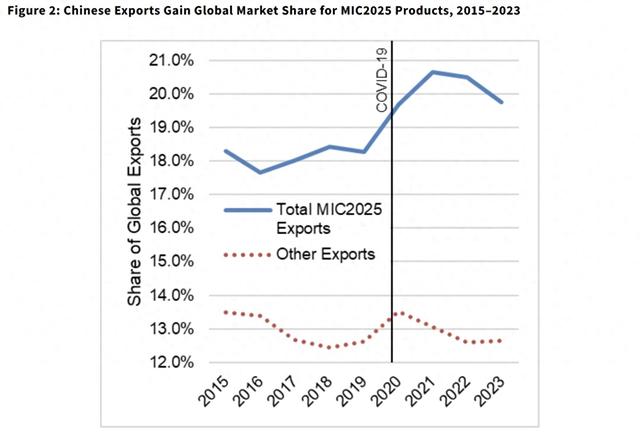
Core Viewpoint - The US-China Economic and Security Review Commission (USCC) acknowledges significant advancements in China's innovation capabilities and its position in the global manufacturing sector, particularly through the "Made in China 2025" initiative, despite its historically critical stance towards China [1][6]. Group 1: Report Findings - The USCC's recent report evaluates the "Made in China 2025" plan, concluding that China has significantly improved its innovation capabilities and solidified its status as a global manufacturing powerhouse over the past decade [1][6]. - The report covers 12 key industries, including semiconductors, high-end CNC machine tools, robotics, and new energy vehicles, assessing performance based on global market share, localization rates, and technology R&D goals [3][6]. - China has reportedly met or exceeded most core targets in sectors such as energy-saving and new energy vehicles, power equipment, and biomedicine, with notable achievements in shipbuilding and power equipment even before the initiative's launch [3][5]. Group 2: Market Impact - From 2015 to 2023, China's share of global exports for MIC2025-related products has steadily increased, with Chinese enterprises accounting for nearly one-quarter of the global export growth in the top ten related fields [6][7]. - In 2023, China exported MIC2025-related products worth $1.5 trillion, representing nearly 20% of the global total for similar products [6][7]. Group 3: Challenges and Innovations - While challenges remain in sectors like agriculture machinery and semiconductors, the report acknowledges significant industrial development in these areas, with China's semiconductor production capacity growing at over four times the global demand growth rate from 2015 to 2023 [4][6]. - The report highlights that China's industrial policy has fostered a highly advanced industrial community, enabling rapid technological breakthroughs across interconnected fields, such as electric vehicles and robotics [7][8]. Group 4: Strategic Implications - The USCC report suggests that China's industrial policies pose challenges not only in specific technologies but also in the overall competitiveness of China's manufacturing and innovation ecosystem [6][7]. - The report emphasizes that the strategic significance of MIC2025 extends beyond individual performance metrics, contributing to enhanced innovation capabilities and greater shares of global manufacturing value [6][7].
六大重点领域大规模集群式培养高技能人才 职教学子迎来全新数字教材
Yang Shi Wang· 2025-10-22 06:59
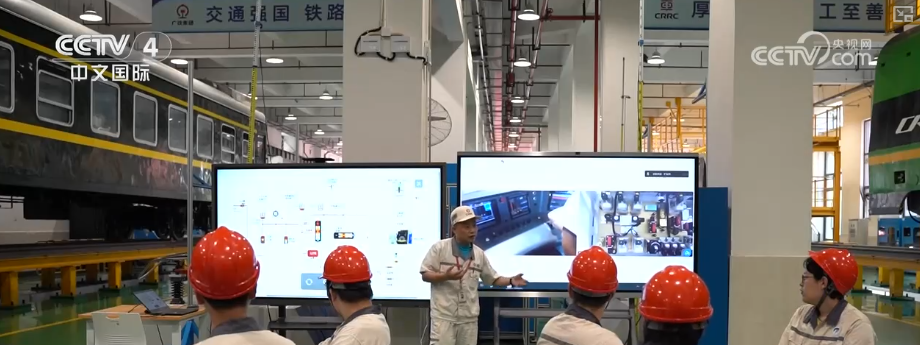
Core Points - The "High-Skilled Talent Cluster Training Program" is being implemented in six key advanced manufacturing sectors, including new energy vehicles and aerospace equipment, as part of the comprehensive reform pilot for building an education powerhouse [1][10] - The program involves over 150 leading enterprises, 67 high-level schools, and 15 national industry organizations, with participation from more than 1,500 skilled craftsmen, technical backbones, professional teachers, and industry experts [6] Group 1 - The program aims to reform five key elements of vocational education: profession, curriculum, teaching materials, teachers, and internship training, shifting the focus from traditional knowledge transfer to comprehensive ability enhancement [6] - The initial focus is on six critical high-skill labor shortage areas within national production lines to explore and break through existing challenges [10] Group 2 - A new digital textbook initiative has been launched, covering 28 majors and benefiting over 1,100 vocational schools and more than 1.5 million students [11][15] - Over 500 industry and enterprise technology standards, job specifications, and production processes have been opened up to ensure that textbook development aligns with industry advancements [17] - The textbook "Integration and Application of Intelligent Workshops" features a virtual smart workshop, addressing challenges faced by students in traditional internship settings [17]
从“知识传授”到“能力提升” 6大先进制造业领域高技能人才培养有了新路径
Yang Shi Wang· 2025-10-22 03:55
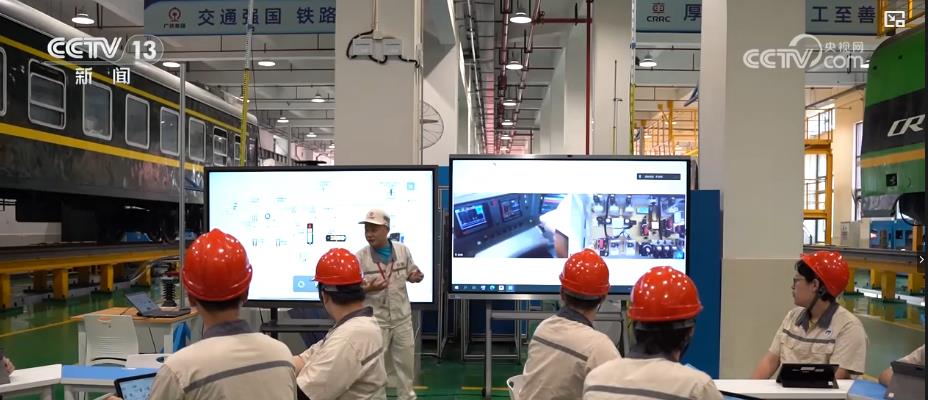
Core Points - The "High-Skilled Talent Cluster Cultivation Plan" is being implemented in six key advanced manufacturing sectors, including new energy vehicles, advanced rail transit equipment, aerospace equipment, high-end CNC machine tools and robots, agricultural machinery, and new generation information technology [1][2] Group 1 - The plan aims to address the significant labor shortage in high-skilled positions within these critical industries by aligning educational standards with industry needs [2][3] - Over 150 leading enterprises, 67 high-level schools, and 15 national industry organizations are participating, involving more than 1,500 skilled craftsmen, technical backbones, professional teachers, and industry experts [2][3] - The reform focuses on five key elements of vocational education: professional standards, curriculum, teaching materials, teachers, and practical training, shifting from traditional knowledge transfer to comprehensive ability enhancement [2][3] Group 2 - More than 500 industry and enterprise technical standards, job specifications, and production processes have been opened up to ensure that educational materials align with industry developments [5] - A new digital textbook, "Integration and Application of Intelligent Workshops," has been developed, featuring a virtual smart workshop to address challenges faced in traditional practical training [5] - The first batch of new digital textbooks has been released, covering 28 majors and benefiting over 1,100 vocational colleges and more than 1.5 million students [6]
围绕六大重点领域 教育部推进实施“高技能人才集群培养计划”
Xin Lang Cai Jing· 2025-10-22 02:25
Core Viewpoint - The "High-Skilled Talent Cluster Cultivation Plan" is being implemented in six key advanced manufacturing sectors, marking a significant step in the comprehensive reform pilot for building an education powerhouse [1] Group 1: Key Sectors - The plan focuses on six advanced manufacturing sectors: new energy vehicles, advanced rail transit equipment, aerospace equipment, high-end CNC machine tools and robots, agricultural machinery, and next-generation information technology [1] Group 2: Collaborative Efforts - Over 150 leading enterprises, 67 high-level schools, and 15 national industry organizations are involved, contributing more than 1,500 national craftsmen, technical backbones, professional teachers, and industry experts [1] Group 3: Educational Reform - The initiative aims to systematically promote reforms in five key elements of vocational education: profession, curriculum, teaching materials, teachers, and internship training, shifting the focus from traditional knowledge transmission to comprehensive ability enhancement [1]