
区域性银行

Search documents
超5000次调研!公募扎堆调研线路图曝光,这三大行业受关注
券商中国· 2026-02-16 15:18
Core Viewpoint - The public fund research roadmap for 2026 reveals heightened enthusiasm among public funds for A-share market research, with over 5,000 research activities covering more than 1,000 stocks since the beginning of the year [2]. Group 1: Key Companies Under Research - Tian Shun Wind Power and Da Jin Heavy Industry have emerged as the most researched companies, with 68 and 66 fund companies participating in their respective research activities [3]. - Tian Shun Wind Power's stock price has increased by over 37% in 2026, attracting significant institutional interest due to its offshore wind power shipment expectations and capacity layout [3]. - Da Jin Heavy Industry is transitioning from a basic equipment supplier to a one-stop solution provider, with a projected net profit doubling in 2025, leading to a stock price increase of over 154% [4]. - Other companies like Hai Tian Rui Sheng, Nai Pu Mining, and Sheng Hui Integration have also garnered attention from multiple fund companies, with Sheng Hui Integration's revenue growth reaching 46% in the first three quarters of 2025 [4]. Group 2: Investment Focus Areas - The technology, cyclical, and dividend sectors are the primary focus areas for public funds, with strategic emerging industries in technology being a core interest [5][6]. - Companies in the semiconductor and AI sectors, such as Hai Tian Rui Sheng and Zhong Ji Xu Chuang, are receiving significant attention due to their long-term growth potential [6]. - Regional banks like Shanghai Bank and Nanjing Bank are highlighted as key representatives in the dividend sector, with multiple fund companies conducting research on them [7]. - In the cyclical sector, companies like He Steel Resources and Bao Wu Magnesium Industry are being closely monitored, with Bao Wu reporting a 10% increase in magnesium alloy sales since October [7][8]. Group 3: Market Trends and Predictions - Fund managers are focusing on sectors with supply constraints and recovering demand, such as chemicals and industrial metals, while also considering opportunities in real estate [8]. - Despite the strong performance of the technology sector, the dividend investment logic remains relevant, with consumer dividend assets expected to become a high-potential direction as domestic demand recovers [8].


170家机构盯上1家公司
Yang Zi Wan Bao Wang· 2026-02-01 07:44
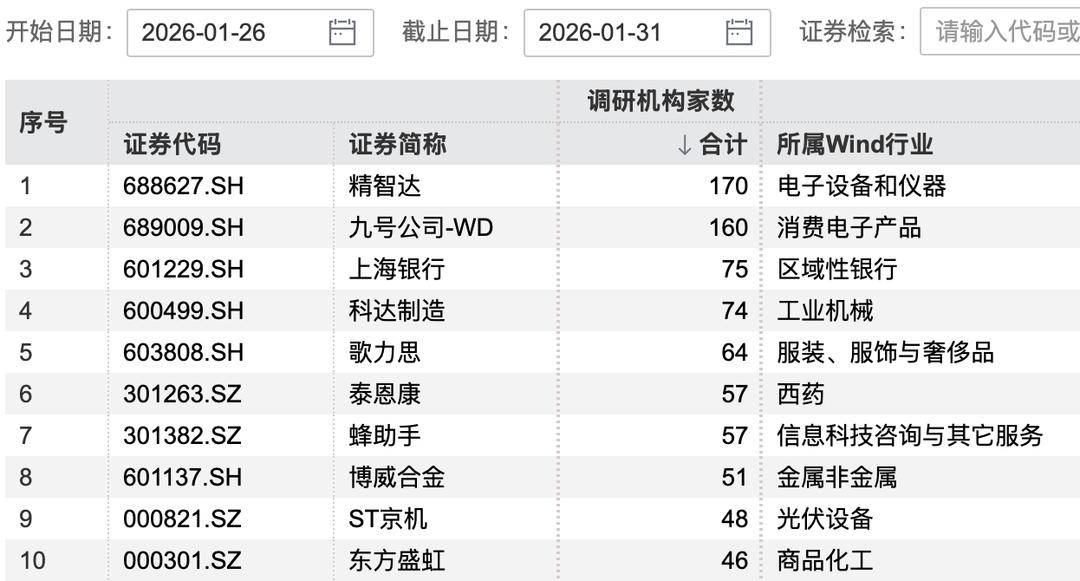
Group 1 - The core point of the article highlights that Jingzhida (精智达) received the highest number of institutional research visits among listed companies, with 170 institutions conducting research during the last working week of January [1][2] - Jingzhida signed a significant sales contract worth 1.311 billion yuan (including tax) for semiconductor testing equipment, which has garnered considerable market attention [1][3] - The order is seen as a strong validation of the company's long-term investments and its solid market position, especially amid tight delivery schedules from international suppliers [3] Group 2 - In January, over 600 listed companies disclosed records of institutional investor research, with Dajin Heavy Industry (大金重工) receiving the most visits at 209 institutions [3][4] - The electronic and mechanical equipment sectors have shown high levels of interest from institutional investors, with these industries leading in the number of research visits [5] - The overall trend indicates a sustained enthusiasm for institutional research in the machinery and computer sectors, with a notable focus on electronic and mechanical equipment industries [5]

华尔街看好“小盘股”行情延续 但需警惕“高波动陷阱”
Zhi Tong Cai Jing· 2026-01-28 12:53
Group 1 - The Russell 2000 index, representing small-cap stocks, has recently achieved the longest streak of outperforming large-cap stocks since 1996, indicating a significant moment for small-cap stocks in the market [1] - Analysts are optimistic about the outlook for small-cap stocks, driven by expectations of declining interest rates and economic growth, which are anticipated to accelerate earnings for these stocks [1][2] - T Rowe Price's Chief Investment Officer, Sebastian Page, believes that moderate economic growth and falling interest rates could support small-cap stocks for the next six months, despite acknowledging the risks associated with this sector [1][2] Group 2 - Many investors and strategists share the view that the current weakness in small-cap stocks is temporary, with expectations for a significant rebound in performance compared to large-cap stocks [2] - The dual support from macroeconomic factors and fundamentals is expected to benefit small-cap stocks, particularly if artificial intelligence proves to enhance productivity, which would favor companies with lower profit bases [2] - Investors are betting on fiscal stimulus measures, including tax reforms, to provide support for small-cap stocks through the 2026 fiscal year, as these companies are more concentrated in the U.S. economy [2] Group 3 - The relative volatility of small-cap stocks is expected to become more normalized, with traders advised to plan accordingly [3] - Major companies like Apple, Alphabet, and Nvidia have market capitalizations exceeding that of the entire Russell 2000 index, highlighting potential liquidity challenges when investors rotate from large-cap to small-cap stocks [3] - Despite the risks associated with lower liquidity, many investors view small-cap stocks as undervalued and currently enjoying multiple tailwinds, making it an attractive entry point [3]
【广发宏观陈嘉荔】9月非农回升削弱降息必要性
郭磊宏观茶座· 2025-11-21 01:56
Core Viewpoint - The U.S. labor market shows signs of resilience with a notable rebound in non-farm payrolls, indicating that employment changes are not linear and that previous weaknesses were partly due to external shocks like tariffs [1][5][6]. Group 1: Non-Farm Payrolls and Employment Trends - In September, the U.S. added 119,000 non-farm jobs, significantly exceeding the expected 50,000 and the Dallas Fed's estimated 30,000 jobs needed for labor market balance [1][5]. - The healthcare sector contributed the most with 57,000 jobs, followed by leisure and hospitality with 47,000, and construction with 19,000 [1][6]. - The transportation and warehousing sector saw a decline of 25,000 jobs, reflecting broader economic sensitivity and automation trends [6]. Group 2: Unemployment Rate and Labor Force Participation - The unemployment rate rose to 4.44%, marking a high point for the current cycle, with an increase in both employed (251,000) and unemployed (219,000) individuals [2][7]. - Labor force participation slightly increased to 62.4%, with notable improvements among younger demographics, while the core working age group (25-54) saw stagnant participation and rising unemployment [7][8]. Group 3: Wage Growth and Labor Market Indicators - Average hourly earnings increased by 3.79% year-over-year, slightly lower than the previous 3.83%, while the Index of Aggregate Payrolls Private showed a stronger growth of 4.65% [12][13]. - Average weekly hours remained stable at 34.2 hours, indicating cautious labor scheduling by employers [12][13]. Group 4: Federal Reserve Outlook - The Federal Open Market Committee (FOMC) is likely to pause interest rate cuts in December, influenced by the rebound in non-farm payrolls and the lack of new data due to government shutdowns [3][14][18]. - Market expectations for a rate cut in December are modest, with a probability of 39.6%, reflecting limited changes in economic conditions [4][20]. Group 5: Market Reactions and Sector Performance - Following the employment data release, U.S. stock indices fell, with the S&P 500 down 1.56%, indicating a risk-off sentiment among investors [4][21]. - Defensive sectors such as utilities and healthcare performed relatively well, while technology stocks faced significant declines [21].

15家银行理财子公司年内调研上市公司374次 招银理财最积极
Xin Hua Wang· 2025-08-12 06:29
Core Viewpoint - The frequency of bank wealth management subsidiaries conducting research on listed companies has significantly increased in 2023, indicating a growing interest in equity investments and the development of their investment research capabilities [1][2]. Group 1: Research Activity - As of March 22, 2023, 15 bank wealth management subsidiaries conducted research on listed companies 374 times, compared to over 350 times in the first half of the previous year [1]. - Notable participants in the research include Zhuhai Wealth Management with 100 research instances covering 86 companies, followed by Xingyin Wealth Management with 93 instances [1]. - Other subsidiaries such as Huizhou Wealth Management, Hangzhou Wealth Management, and Ningbo Wealth Management also showed significant research activity, each exceeding 10 instances [1]. Group 2: Investment Preferences - The sectors attracting attention from bank wealth management subsidiaries include electronics, biotechnology, industrial machinery, healthcare, food, and regional banks, reflecting a broader interest in various industries [1][2]. - The preference for these sectors is attributed to their status as market hotspots or sectors with improved fundamentals, thus presenting high allocation value [2]. Group 3: Regulatory Environment - The China Banking and Insurance Regulatory Commission (CBIRC) has emphasized increasing the issuance of equity asset management products, supporting wealth management companies in enhancing their equity product ratios [2][3]. - Over the past two years, regulatory encouragement has led to a gradual maturation of bank wealth management subsidiaries in equity investments, although the number of equity products remains limited [2]. Group 4: Market Dynamics - In a declining interest rate environment, high-quality debt assets are becoming scarce, prompting bank wealth management subsidiaries to increase their allocation to equity assets to enhance product yield [3]. - The need for these subsidiaries to strengthen their compliance and risk management systems is highlighted, as they navigate the shift towards more equity-focused products while considering their clients' lower risk appetites [3].
险资调研重点关注高股息+科技成长板块,A500指数ETF(159351)昨日“吸金”超2300万元
2 1 Shi Ji Jing Ji Bao Dao· 2025-05-22 02:34
Group 1 - A-shares showed mixed performance on May 22, with growth sectors like semiconductors, communications, and charging piles leading the gains [1] - The A500 Index ETF (159351) saw active trading, with a transaction amount exceeding 500 million yuan and a turnover rate over 3.5% [1] - The A500 Index ETF recorded a net inflow of over 23 million yuan on May 21, bringing its latest scale to 14.379 billion yuan [1] Group 2 - Insurance funds have conducted a total of 7,677 surveys on A-share listed companies as of May 21, focusing on high-dividend and technology growth sectors [2] - Experts indicate that insurance capital is likely to continue optimizing a "barbell" asset allocation strategy, seeking long-term sustainable investment opportunities [2] - Financial analysts suggest maintaining a balanced allocation strategy, with a focus on export industry chains, self-sufficiency, and high-dividend sectors in the current market environment [2]
年内险资调研超7600次 重点关注科技股
Zheng Quan Ri Bao· 2025-05-21 16:53
Core Viewpoint - Insurance capital is focusing on high dividend and technology growth sectors, with a total of 7,677 research activities conducted on A-share listed companies as of May 21 this year, indicating a strategic shift towards stable cash flow and growth potential [1][2]. Group 1: Research Activities - A total of 180 insurance institutions conducted 7,677 research activities on 1,292 A-share listed companies, showing a decrease in frequency compared to the same period last year [2]. - Among insurance asset management institutions, Taikang Asset Management and Huatai Asset Management led with 428 and 317 research activities, respectively [2]. - Pension insurance companies were the most active in research, with the top five being Ping An Pension Insurance, Changjiang Pension Insurance, China Life Pension Insurance, Taiping Pension Insurance, and China People's Pension Insurance [2]. Group 2: Reasons for Decrease in Research Frequency - The decline in research frequency is attributed to three main factors: focus on high dividend stocks in a low-interest environment, more precise investment strategies due to regulatory clarity, and established market consensus on certain technology growth sectors [3]. - Despite the decrease in research frequency, the allocation of stocks by insurance companies has increased, with the proportion of funds allocated to stocks rising to 7.56% for property insurance companies and 8.43% for life insurance companies, up by 1.2 and 1.65 percentage points year-on-year, respectively [3]. Group 3: Investment Focus - The primary focus of insurance capital research includes high dividend sectors and technology growth sectors, such as electronic components, industrial machinery, electrical components and equipment, integrated circuits, medical equipment, and regional banks [4]. - Over 500 of the researched companies are listed on the Sci-Tech Innovation Board or the Growth Enterprise Market, accounting for nearly 40% of the total [4]. - The core characteristics of the sectors being focused on are the stable cash flow from high dividend assets and the growth potential of high-tech assets, which are supported by government policies [4]. Group 4: Future Outlook - Insurance capital is expected to continue optimizing a "barbell" asset allocation strategy, balancing high dividend assets for stable returns with investments in technology innovation, green low-carbon initiatives, and health care sectors [5]. - The use of innovative tools such as long-term equity investments and REITs will be emphasized to enhance portfolio structure while strengthening ESG risk management [5]. - The industry is encouraged to maintain a long-term investment philosophy and actively seek sustainable investment opportunities [5].