工业有色金属

Search documents
供需共振推高有色行情,天弘中证工业有色金属主题指数基金(A/C:017192/017193)助力把握有色赛道高景气机遇
Sou Hu Cai Jing· 2026-02-26 07:06
Group 1 - The Chinese government announced a 100% zero tariff on goods from 53 African countries starting May 1, 2026, which will reduce import tax burdens for domestic non-ferrous metal companies and enhance customs efficiency [1] - Zimbabwe's Ministry of Mines announced a ban on lithium ore exports, which will tighten short-term supply and potentially drive lithium prices significantly higher, as Zimbabwe accounted for 19% of China's lithium ore imports in 2025 [1] - The metal industry is expected to experience increased price volatility due to supply-side disruptions, with cobalt, tin, lithium, copper, and nickel prices anticipated to rise significantly [2] Group 2 - The Tianhong CSI Industrial Nonferrous Metals Theme Index Fund, established on May 30, 2023, aims to track the CSI Industrial Nonferrous Metals Theme Index closely, investing in non-ferrous metal ETFs [2] - The fund manager believes that the market underestimates the growth potential of industrial non-ferrous metals, which may transition from being viewed as "cyclical" to "growth" assets, leading to a potential "Davis Double Play" scenario [3] - As of February 25, 2026, the top ten weighted stocks in the CSI Industrial Nonferrous Metals Theme Index accounted for 54.46% of the index, with significant representation from companies like Luoyang Molybdenum and Northern Rare Earth [3] Group 3 - The Tianhong CSI Industrial Nonferrous Metals Theme Index Fund had a total scale of 2.308 billion yuan as of December 31, 2025, with A-class and C-class shares at 267 million yuan and 2.041 billion yuan, respectively [3] - The fund's historical performance for 2025 showed impressive returns, with A-class shares at 93.08% and C-class shares at 92.60% [3] - The fund's management and custody fee is set at 0.6%, with a sales service fee of 0.25% for C-class shares, making it suitable for short-term investors [4]

聚焦高端制造业“硬核底色”,量化大司旗下有色ETF富国(159168)今起发行
Sou Hu Cai Jing· 2026-01-26 02:07
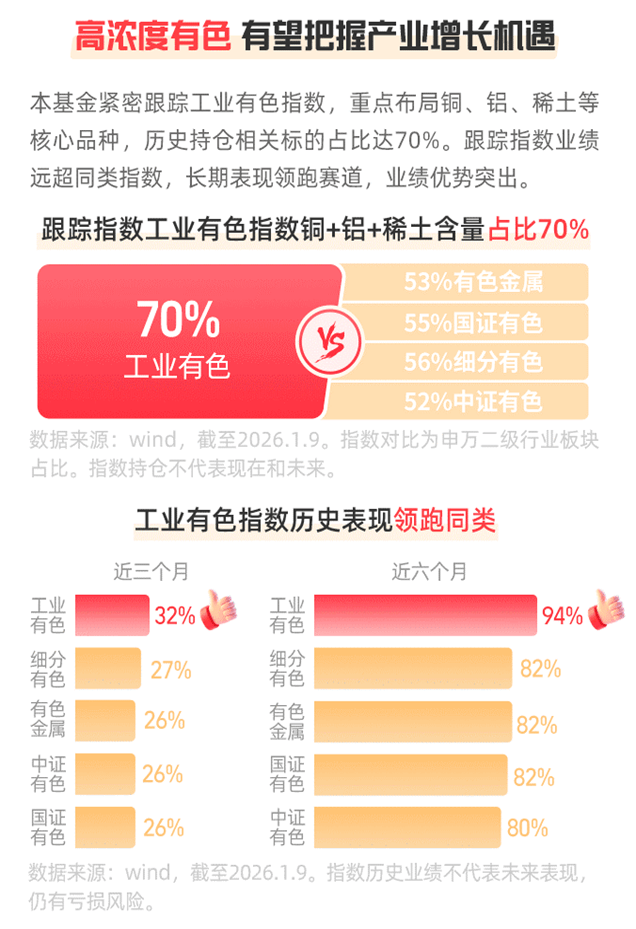
Core Viewpoint - The industrial sector in China is projected to grow, with a focus on the manufacturing industry, which is expected to maintain its global leadership for 16 consecutive years, driven by robust demand for upstream raw materials like copper, aluminum, and rare earths [1] Group 1: Industrial Growth and Demand - The Ministry of Industry and Information Technology forecasts a 5.9% year-on-year growth in industrial added value by 2025, with equipment manufacturing and high-tech manufacturing increasing by 9.2% and 9.4% respectively, serving as key growth engines [1] - The demand for upstream raw materials such as copper, aluminum, and rare earths is supported by strong macroeconomic data, indicating a resilient industrial economy [1] Group 2: ETF Launch and Investment Strategy - The newly launched ETF, "Fuguo" (code: 159168), aims to provide investors with a straightforward way to invest in the industrial non-ferrous metals sector [1] - The ETF tracks the CSI Industrial Non-Ferrous Metals Theme Index (code: H11059.CSI), which includes 30 major stocks in the non-ferrous metals sector, focusing on core varieties and covering nearly 70% of the index's weight with copper (34.4%), aluminum (21.8%), and rare earths (13.6%) [2] Group 3: Historical Performance and Investment Value - Historical performance shows that the Industrial Non-Ferrous Metals Index has outperformed the CSI 300 Index, with a cumulative increase of 161.24% since September 24, 2024, compared to the CSI 300's 46.37% [3] - In 2025, the Industrial Non-Ferrous Metals Index recorded a 96.14% increase, significantly surpassing the CSI 300's 17.66% and other related indices [3] Group 4: Changing Investment Logic - The investment logic for industrial non-ferrous metals has shifted from traditional cyclical patterns to being driven by supply-demand gaps, macroeconomic support, and global resource strategies [4] - Demand for industrial non-ferrous metals is transitioning from traditional uses to technology-driven growth assets, with copper expanding into AI and renewable energy sectors, and aluminum moving towards high-end manufacturing applications [4] Group 5: Strategic Importance and ETF Features - The strategic importance of key mineral resources like copper and rare earths has risen, positioning industrial non-ferrous metals as assets with strategic value beyond traditional commodities [5] - The "Fuguo" ETF employs a full replication strategy to minimize tracking error and is managed by Fuguo Fund, which has over 16 years of experience in quantitative index investment [5]
电网投资提速提振工业金属需求,有色ETF富国(159168)1月26日起正式发行
Bei Jing Shang Bao· 2026-01-22 06:06
Group 1 - The new infrastructure sector, represented by ultra-high voltage and grid upgrades, is gaining significant market attention, highlighting the strategic value of industrial non-ferrous metals [1] - The supply-demand dynamics of industrial non-ferrous metals are expected to improve, supporting a price increase and broad investment opportunities [1] - The launch of the non-ferrous ETF by the established quantitative firm, FuGuo Fund, aims to provide investors with an efficient tool to invest in the industrial non-ferrous metals sector [1] Group 2 - The industrial non-ferrous index tracked by the ETF includes 30 leading companies in the copper, aluminum, rare earth, and lead-zinc sectors, focusing on industrial and rare metals while avoiding precious metals volatility [2] - As of January 21, 2026, the top ten constituents of the industrial non-ferrous index account for 56.18% of the total weight, indicating a strong presence of large-cap leaders with advantages in resource reserves and cost control [2] - Historical data shows that the industrial non-ferrous index has significantly outperformed the CSI 300 index, with a cumulative increase of 155.88% from September 24, 2024, to January 21, 2026, and a single-year increase of 101.27% in 2025 [2] Group 3 - FuGuo Fund, one of the "old ten" public fund companies in China, has over 16 years of experience in quantitative investment, particularly in index quantitative investment [3] - The firm is actively expanding its product line to meet diverse investor needs, including index enhancement, passive index/ETF, absolute return, and active quantitative strategies [3]
有色金属ETF天弘(159157)将于本周五提前结募,新能源转型及全球供应链重构助力有色行情!
Sou Hu Cai Jing· 2026-01-22 04:49
Core Insights - The Tianhong Nonferrous Metals ETF (159157) is set to begin fundraising on January 19, 2026, with the deadline moved up to January 23, 2026, reflecting strong market interest in the nonferrous metals sector [1] - The nonferrous metals sector has shown significant growth, with the CSI Industrial Nonferrous Metals Theme Index rising by 17.19% year-to-date as of January 21, 2026, indicating a bullish market sentiment [1] - The fund focuses on key industrial nonferrous metals such as copper, aluminum, and rare earths, capitalizing on the investment opportunities driven by the AI industry [1] Product Highlights - The Tianhong Nonferrous Metals ETF tracks the CSI Industrial Nonferrous Metals Theme Index, which includes 30 listed companies in the industrial nonferrous metals sector, showcasing high industry concentration [1] - The fund provides a one-stop efficient solution for investors looking to capitalize on the upward cycle of the industrial nonferrous metals sector and policy benefits [1] Market Trends - A significant increase in demand for copper and aluminum is anticipated, with the global AI data centers expected to drive an additional demand of 330,000 tons for copper, expanding the supply-demand gap from 340,000 tons to 670,000 tons [1] - The aluminum market is projected to face a supply gap of 990,000 tons due to increased demand from photovoltaic frames and liquid-cooled servers [1] - Supply-side challenges include production halts in Chile and the Democratic Republic of Congo, as well as discussions in Indonesia regarding bauxite export bans, which further constrict supply [1] Policy Developments - On January 20, 2026, Shanghai released a significant policy aimed at enhancing the global pricing influence of nonferrous metals, promoting market interconnectivity and resource allocation capabilities [2] - The policy supports Shanghai's development as a global center for nonferrous metal commodities, aligning with broader economic goals [2] Institutional Perspectives - China Galaxy Securities recommends leveraging the convergence of the "AI leap" and "century change" to capitalize on the super cycle of nonferrous metals, drawing parallels to historical macroeconomic narratives [2]
降息预期点燃有色金属情绪,天弘中证工业有色金属主题指数(A类:017192;C类:017193)标的指数盘中涨超2%,冲击3连涨
Sou Hu Cai Jing· 2025-12-05 03:15
Group 1 - The non-ferrous metal sector is showing strong performance, with the Zhongzheng Industrial Non-Ferrous Metal Theme Index rising by 1.40% and reaching a peak increase of over 2%, indicating a potential three-day rally [1] - Key stocks leading the gains include Nanshan Aluminum, Shenhuo Co., Electric Power Investment Energy, and China Aluminum [1] - The recent drop in the US ADP employment figures by 32,000, the largest decline since March 2023, has increased the likelihood of a 25 basis point rate cut by the Federal Reserve in December, which is expected to support the prices of industrial metals like copper and aluminum [1] Group 2 - The Chilean state-owned copper company has set a historical high for copper premiums offered to US customers, contributing to the rapid increase in LME copper prices [1] - Analysts suggest that the key factors to monitor in the short term include the Federal Reserve's interest rate decision and domestic downstream operating data, with critical support and resistance levels for copper and zinc prices identified [1] - In the medium to long term, three main variables are expected to influence the industry: the Federal Reserve's policy direction and dollar trends, the impact of domestic growth stabilization policies on industrial demand, and disruptions in overseas mining supply alongside domestic capacity regulation [1] Group 3 - The China Copper Raw Material Joint Negotiation Group (CSPT) has reached a consensus to reduce copper concentrate production capacity by over 10% for 2026, which may tighten the supply-demand balance for copper [2] - The potential reduction in production from smelting companies could lead to tighter supplies of refined copper in 2026, further driving up copper prices [2] - The non-ferrous metal industry remains relatively stable, with slight increases in copper and aluminum prices, while high inventory levels indicate strong resilience [2]
ETF收评| 有色板块领涨,黄金股票ETF基金涨4%
Ge Long Hui· 2025-12-01 08:30
Market Performance - The three major A-share indices opened higher and closed positively, with the Shanghai Composite Index returning above 3900 points, closing at 3914 points, up 0.65% [1] - The Shenzhen Component Index rose by 1.25%, and the ChiNext Index increased by 1.31% [1] - Total market turnover reached 1.89 trillion yuan, an increase of 291.7 billion yuan compared to the previous trading day, with nearly 3400 stocks rising [1] Sector Performance - AI mobile phones and smart wearable technology sectors were active [1] - The semiconductor industry chain saw a midday surge, with photolithography machines and MCU chips leading the gains [1] - Stocks related to 6G, satellite navigation, commercial aerospace, servers, and memory concepts showed significant increases [1] - E-commerce and lithium battery concept stocks performed poorly [1] ETF Performance - The metals sector experienced a broad rally, with Ping An Fund's gold stock ETF and Wan Jia Fund's industrial metals ETF rising by 4.09% and 3.99%, respectively [1] - The satellite internet sector also rose, with the Southern and Huatai Baichuan Fund's IoT ETFs increasing by 3.69% and 3.36% [1] - The communication equipment ETF from Fortune Fund rose by 3.48% [1] - The soybean meal ETF fell by 2.52%, and the S&P biotechnology ETF decreased by 2.3% [1] International Market - Japanese stocks declined, with the Nikkei 225 ETF from E Fund and Nikkei ETF falling by 1.78% and 1.61%, respectively [1]
万家中证工业有色金属主题ETF投资价值分析:供需紧平衡支撑行业景气,工业有色金属价值凸显
Shenwan Hongyuan Securities· 2025-11-26 13:43
- The "CSI Industrial Nonferrous Metals Theme Index" (H11059.CSI) focuses on industrial nonferrous metals, selecting 30 large-cap securities involved in industries such as copper, aluminum, lead-zinc, and rare earth metals to reflect the overall performance of listed companies in this theme. The index uses adjusted free-float market capitalization weighting, with individual sample weights capped at 15%, and the top five samples collectively capped at 60%[24][25][26] - The index is rebalanced semi-annually, with sample adjustments implemented on the next trading day following the second Friday of June and December[25] - The index's top five constituent stocks account for 36.57% of the total weight, while the top ten account for 54.18%, with leading companies like Northern Rare Earth, China Molybdenum, and Aluminum Corporation of China having significant weightage. This concentration enhances the index's sensitivity to price cycles and supply-demand changes in key resources like rare earths, copper, and aluminum[28][29][30] - Compared to other nonferrous metal indices, such as the CSI SW Nonferrous Metals Index, the CSI Industrial Nonferrous Metals Theme Index has lower exposure to energy and precious metals, making it more focused on industrial metals closely tied to macroeconomic cycles. This characteristic provides higher elasticity during manufacturing recovery and economic rebound phases[30][33][34] - Over the backtesting period from January 1, 2021, to November 10, 2025, the index achieved an annualized return of 9.18%, outperforming broad-based indices like CSI 300, CSI 500, and ChiNext Index. However, it also exhibited higher annualized volatility (32.29%) and a maximum drawdown of -61%[35][39][40] - The index's valuation (PE_TTM) has shown a downward trend over the past five years, with a recent recovery driven by market sentiment and sector rebound. As of November 10, 2025, the index's PE ratio stood at 20.41x, at the 68.56th percentile of its five-year valuation range, indicating reasonable investment value amid improving industry fundamentals[41][43][44] - The index's profit scale has grown significantly, with total profits increasing from 46.139 billion yuan in 2020 to 168.052 billion yuan in 2022, representing a compound growth rate of over 90%. After a temporary decline in 2023, profits rebounded in 2024 with a 19.05% year-on-year growth, and further growth is expected in 2025 and 2026[45][47]
【ETF观察】9月17日行业主题ETF净流入39.78亿元
Sou Hu Cai Jing· 2025-09-17 23:58
Summary of Key Points Core Viewpoint - On September 17, a total of 39.78 billion yuan net inflow was recorded for industry-themed ETF funds, with a cumulative net inflow of 124.46 billion yuan over the past five trading days, indicating strong investor interest in these funds [1]. Fund Inflows - A total of 123 industry-themed ETF funds experienced net inflows on September 17, with the leading fund being the Guotai CSI All-Share Securities Company ETF (512880), which saw an increase of 9.36 million shares and a net inflow of 11.88 billion yuan [1][3]. - Other notable funds with significant net inflows include: - Huabao CSI Financial Technology Theme ETF (159851) with a net inflow of 5.25 billion yuan [3]. - Huaxia CSI Robotics ETF (562500) with a net inflow of 5.01 billion yuan [3]. - Guotai Securities ETF (512000) with a net inflow of 3.59 billion yuan [3]. Fund Outflows - On the same day, 164 industry-themed ETF funds experienced net outflows, with the Guotai CSI Coal ETF (515220) leading the outflows, which saw a reduction of 4.21 million shares and a net outflow of 4.6 billion yuan [4][5]. - Other funds with significant net outflows include: - Huabao CSI Medical ETF (512170) with a net outflow of 1.50 billion yuan [5]. - Penghua CSI Sub-Segment Chemical Industry ETF (159870) with a net outflow of 1.49 billion yuan [5]. - Huatai-PineBridge CSI Rare Earth Industry ETF (516780) with a net outflow of 1.36 billion yuan [5].
【广发金工】均线情绪修复
广发金融工程研究· 2025-06-15 14:28
Market Performance - The Sci-Tech 50 Index decreased by 1.89% over the last five trading days, while the ChiNext Index increased by 0.22%. The large-cap value index rose by 0.10%, and the large-cap growth index fell by 0.16%. The Shanghai Stock Exchange 50 Index declined by 0.46%, and the small-cap index represented by the CSI 2000 dropped by 0.74%. The non-ferrous metals and oil & petrochemical sectors performed well, whereas household appliances and food & beverage sectors lagged behind [1]. Risk Premium Analysis - The static PE of the CSI All Index minus the yield of 10-year government bonds indicates a risk premium. Historical extreme bottoms have shown this data to be at two standard deviations above the mean, with notable instances in 2012, 2018, and 2020. As of April 26, 2022, the risk premium reached 4.17%, and on October 28, 2022, it rose to 4.08%. The latest reading on January 19, 2024, was 4.11%, marking the fifth instance since 2016 exceeding 4%. As of June 13, 2025, the indicator was at 3.83%, with the two standard deviation boundary at 4.75% [1]. Valuation Levels - As of June 13, 2025, the CSI All Index's PE TTM percentile was at 54%. The Shanghai Stock Exchange 50 and CSI 300 had percentiles of 62% and 52%, respectively. The ChiNext Index was close to 13%, while the CSI 500 and CSI 1000 were at 30% and 22%, respectively. The ChiNext Index's valuation is relatively low compared to historical averages [2]. Long-term Market Trends - The technical analysis of the Deep 100 Index indicates a bear market every three years, followed by a bull market. Historical declines ranged from 40% to 45%, with the current adjustment starting in Q1 2021 showing sufficient time and space for a potential upward cycle [2]. Fund Flow and Trading Activity - In the last five trading days, ETF funds saw an outflow of 17 billion yuan, while margin trading increased by approximately 9.4 billion yuan. The average daily trading volume across both markets was 1.3392 trillion yuan [2]. AI and Machine Learning Insights - A convolutional neural network (CNN) was utilized to model price and volume data, mapping learned features to industry themes. The latest recommended themes include non-ferrous metals and banking sectors [7].

【广发金工】均线情绪修复
广发金融工程研究· 2025-06-15 14:28
Market Performance - The Sci-Tech 50 Index decreased by 1.89% over the last five trading days, while the ChiNext Index increased by 0.22%. The large-cap value index rose by 0.10%, and the large-cap growth index fell by 0.16%. The Shanghai 50 Index declined by 0.46%, and the small-cap index represented by the CSI 2000 dropped by 0.74%. The non-ferrous metals and oil & petrochemical sectors performed well, whereas household appliances and food & beverage sectors lagged behind [1]. Risk Premium Analysis - The static PE of the CSI All Index minus the yield of 10-year government bonds indicates a risk premium. Historical extreme bottoms have shown this data to be at two standard deviations above the mean, with notable peaks in 2012, 2018, and 2020. As of April 26, 2022, the risk premium reached 4.17%, and on October 28, 2022, it rose to 4.08%. The latest reading on January 19, 2024, was 4.11%, marking the fifth instance since 2016 exceeding 4%. As of June 13, 2025, the indicator was at 3.83%, with the two standard deviation boundary at 4.75% [1]. Valuation Levels - As of June 13, 2025, the CSI All Index's P/E TTM percentile was at 54%. The Shanghai 50 and CSI 300 indices were at 62% and 52%, respectively. The ChiNext Index was close to 13%, while the CSI 500 and CSI 1000 indices were at 30% and 22%. The ChiNext Index's valuation is relatively low compared to historical averages [2]. Long-term Market Trends - The technical analysis of the Deep 100 Index indicates a bear market every three years, followed by a bull market. Historical declines ranged from 40% to 45%, with the current adjustment starting in Q1 2021 showing sufficient time and space for a potential upward cycle [2]. Fund Flow and Trading Activity - Over the last five trading days, ETF funds saw an outflow of 17 billion yuan, while margin financing increased by approximately 9.4 billion yuan. The average daily trading volume across both markets was 1.3392 trillion yuan [2]. Neural Network Analysis - A convolutional neural network (CNN) was utilized to model price and volume data, mapping learned features to industry themes. The latest recommended themes include non-ferrous metals and banking sectors [9].