
文体休闲服务

Search documents
国家统计局公布2025年国民经济数据 体育娱乐用品类零售额增速领跑消费市场
Xin Lang Cai Jing· 2026-01-21 00:01
Core Insights - The sports industry in China is experiencing significant growth, driven by consumption upgrades and improved service quality, making it a key engine for the development of the tertiary sector and expansion of domestic demand [1][5] Group 1: Sports Consumption Growth - In 2025, the total retail sales of consumer goods in China reached 50,120.2 billion yuan, with a year-on-year growth of 3.7%. Sports-related consumption emerged as a highlight, showcasing a dual-driven pattern of "quality improvement in goods consumption and expansion in service consumption" [1] - Retail sales of sports entertainment products in large retail units increased by 15.7% year-on-year, significantly surpassing the average growth rate of 3.7% for total retail sales of consumer goods, indicating strong demand for sports equipment and fitness gear [1] Group 2: Online Consumption Channels - The expansion of online consumption channels further boosted sports consumption, with total online retail sales reaching 15,972.2 billion yuan in 2025, a year-on-year increase of 8.6%. Physical goods online retail sales accounted for 13,092.3 billion yuan, growing by 5.2% and representing 26.1% of total retail sales [2] - Sports entertainment products, being well-suited for online sales, benefited from the penetration of e-commerce channels, enriching the integrated online and offline consumption scenarios [2] Group 3: Development of Sports Services - The sports industry is deeply integrating with leisure and cultural tourism sectors, becoming a significant force driving growth in service retail. The value added of the service industry grew by 5.4% year-on-year in 2025, with sports and leisure services experiencing rapid growth [3] - The per capita disposable income of residents reached 43,377 yuan, with a real growth of 5.0%, indicating a shift in consumption from basic needs to development and enjoyment-oriented demands, with sports and health-related consumption continuing to rise [3] Group 4: Industrial Synergy and High-Quality Development - The rapid development of the sports industry in 2025 is supported by a stable economic environment and inter-industry synergy. The value added of the equipment manufacturing industry grew by 9.2%, and high-tech manufacturing grew by 9.4%, providing technological support for the development of smart fitness equipment and high-end sports gear [4] - The sports industry not only stimulates consumption and promotes employment but also plays a crucial role in enhancing public health and fitness levels, contributing to job growth in related sectors such as sports venue operations and fitness training [4] Group 5: Future Outlook - Overall, the sports industry in China is characterized by "consumption upgrade leadership, service quality enhancement, and industrial synergy," becoming a new highlight in the high-quality development of the national economy. The industry is expected to further unleash growth potential, contributing to domestic demand expansion and optimization of industrial structure [5]
消费市场新意浓(锐财经)
Ren Min Ri Bao Hai Wai Ban· 2025-12-19 23:40
Group 1 - The core viewpoint of the articles highlights the steady growth of the consumption market in China, driven by various policies aimed at boosting consumption and the emergence of new consumption patterns [1][3][5] - From January to November, the total retail sales of consumer goods increased by 4% year-on-year, surpassing both the same period last year and the overall growth rate for the previous year [1][2] - The service consumption sector has shown rapid growth, with service retail sales increasing by 5.4% year-on-year, outpacing the growth of goods retail sales [2][5] Group 2 - The trend of quality upgrading in consumption is evident, with new consumption models such as instant retail and live e-commerce gaining traction [4][5] - Digital, green, and health-related consumption are emerging as new hotspots, contributing significantly to the overall consumption landscape [5][6] - The potential for consumption upgrade remains substantial, with a large middle-income group in China and expectations for GDP per capita to exceed $13,000 in 2024, leading to a shift from basic needs to more discretionary spending [5][6] Group 3 - There are challenges in enhancing residents' consumption capacity and confidence, with the current consumption rate at 39.9%, which is significantly lower than that of developed countries [6][7] - Future efforts will focus on increasing residents' consumption willingness and enhancing their purchasing power through various policies, including employment stabilization and urban renewal initiatives [6][7] - The market's resilience and potential are expected to continue to manifest as new consumption scenarios and environments are developed [7]


制定实施城乡居民增收计划 持续提升居民消费能力
Zheng Quan Ri Bao· 2025-12-17 16:13
Core Viewpoint - The central economic work meeting emphasizes the importance of domestic demand and plans to implement a rural and urban resident income increase plan as a priority for 2026 economic tasks [1][2]. Group 1: Economic Policy Focus - The 2026 economic strategy will focus on increasing urban and rural residents' income through multiple channels to enhance consumption capacity and stimulate effective demand [2]. - The policy aims to combine "investment in goods" and "investment in people" to create an endogenous growth model driven by domestic demand and consumption [3]. Group 2: Consumption Trends - Recent data shows significant growth in retail sales of household appliances and communication devices, with year-on-year increases of 14.8%, 18.2%, and 20.9% respectively for the first 11 months of the year [2]. - The shift in consumption patterns indicates a move towards equal emphasis on goods and service consumption, with service consumption expected to be a key focus in 2026 [3]. Group 3: Infrastructure and Investment - To unlock consumer potential, there is a need to enhance investment in consumer infrastructure such as parking lots, charging stations, and healthcare services, which will support consumption structure upgrades [3]. - The policy will also focus on increasing the proportion of investment in livelihood-related sectors to support consumption growth [3].
前11个月我国服务业发展持续向好
Yang Shi Wang· 2025-12-17 12:25
Group 1 - The core viewpoint of the articles indicates that China's service industry has shown continuous improvement in the first 11 months of the year, with a significant contribution to economic growth [1] - The national service production index increased by 5.6% year-on-year, with the business activity index for railway transportation and monetary financial services remaining above 55.0%, indicating a high level of economic activity [1] Group 2 - Investment in high-tech services has been increasing, with a year-on-year growth of 4.1% in the first 11 months, which is an increase of 0.6 percentage points compared to the same period last year [3] - Investment in information services has seen a remarkable growth of 29.6% [3] Group 3 - Service consumption potential is being released more rapidly, with service retail sales increasing by 5.4% year-on-year, marking a continuous recovery over three months and outpacing the growth rate of goods retail sales [5] - Retail sales in cultural, sports, and leisure services, as well as communication and information services, have both exceeded 10% year-on-year growth [5]
2025年11月经济增长数据点评:服务消费增速加快
Ping An Securities· 2025-12-17 01:55
Economic Growth Overview - In November 2025, China's industrial added value grew by 4.8% year-on-year, slightly down by 0.1 percentage points from the previous month[3] - The service production index increased by 4.2% year-on-year, a decrease of 0.4 percentage points compared to October[3] - Retail sales of consumer goods rose by 1.3% year-on-year, down 1.6 percentage points from the previous month[3] Sector Performance - High-tech manufacturing added value increased by 8.4%, accelerating by 1.2 percentage points from the previous month, outpacing the overall industrial growth rate by 3.6 percentage points[3] - The export delivery value showed a marginal recovery, with a year-on-year decline of 0.1%, improving by 2.0 percentage points from October[3] - The service retail sales grew by 5.4% year-on-year from January to November, with a 0.1 percentage point increase compared to the previous month[3] Investment Trends - Fixed asset investment saw a cumulative year-on-year decline of 2.6% from January to November, a drop of 0.9 percentage points from the previous month[3] - Infrastructure and manufacturing investments maintained expansion, with cumulative year-on-year growth rates of 0.1% and 1.9%, respectively[3] - Equipment purchase investment rose by 12.2% year-on-year, contributing 1.8 percentage points to overall investment growth[3] Risks and Outlook - Risks include potential underperformance of growth stabilization policies, unexpected severity of overseas economic downturns, and escalation of geopolitical conflicts[3]
“实现全年预期目标有较好条件”(权威发布)
Ren Min Ri Bao· 2025-12-15 22:12
Core Viewpoint - The macroeconomic policies in November have shown positive effects, with a focus on strengthening domestic circulation, leading to stable economic growth and a favorable environment for achieving annual targets [1] Economic Performance - Industrial production maintained steady growth, with the industrial added value of large-scale enterprises increasing by 4.8% year-on-year in November, remaining stable compared to the previous month [2] - The service sector also saw growth, with a production index increase of 4.2%, particularly in information transmission and business services, which grew by 12.9% and 8.4% respectively [2] - Retail sales of consumer goods rose by 1.3% year-on-year in November, with service retail sales increasing by 5.4% from January to November, indicating a slight acceleration in growth [2] - Foreign trade showed resilience, with total goods imports and exports increasing by 4.1% year-on-year in November, a significant acceleration compared to the previous month [2] Employment and Prices - The urban unemployment rate remained stable at 5.1% in November, while consumer prices rose by 0.7% year-on-year, marking three consecutive months of increase [2] Energy Supply and Investment - Energy supply has been strengthened to meet winter demands, with industrial crude oil, natural gas, and electricity production increasing by 2.2%, 5.7%, and 2.7% respectively in November [3] - Investment in accommodation, catering, wholesale, and retail sectors grew by 7.1% each, and electricity and heat production and supply saw a 12.5% increase [3] New Production Capacity and Industrial Upgrades - The development of new productive forces has accelerated, with high-tech manufacturing value added increasing by 9.2% from January to November, and smart consumer equipment manufacturing growing by 7.6% [4] - Traditional industries are undergoing transformation, with biomass fuel processing value added rising by 15.6%, contributing to the growth of the petroleum processing industry [4] - The digital economy is also on the rise, with the value added of large-scale digital product manufacturing increasing by 9.3% [4] Consumption and Investment Potential - Consumption potential continues to be released, with retail sales of cultural and office supplies and communication equipment growing by 11.7% and 20.6% respectively in November [7] - Online retail sales of physical goods increased by 5.7%, accounting for 25.9% of total retail sales, indicating a shift towards new consumption models [7] - Fixed asset investment (excluding rural households) decreased by 2.6% year-on-year, but project investment excluding real estate development grew by 0.8% [7] - Investment potential remains significant, with ongoing measures to promote investment growth in various sectors, including education, healthcare, and public services [8]
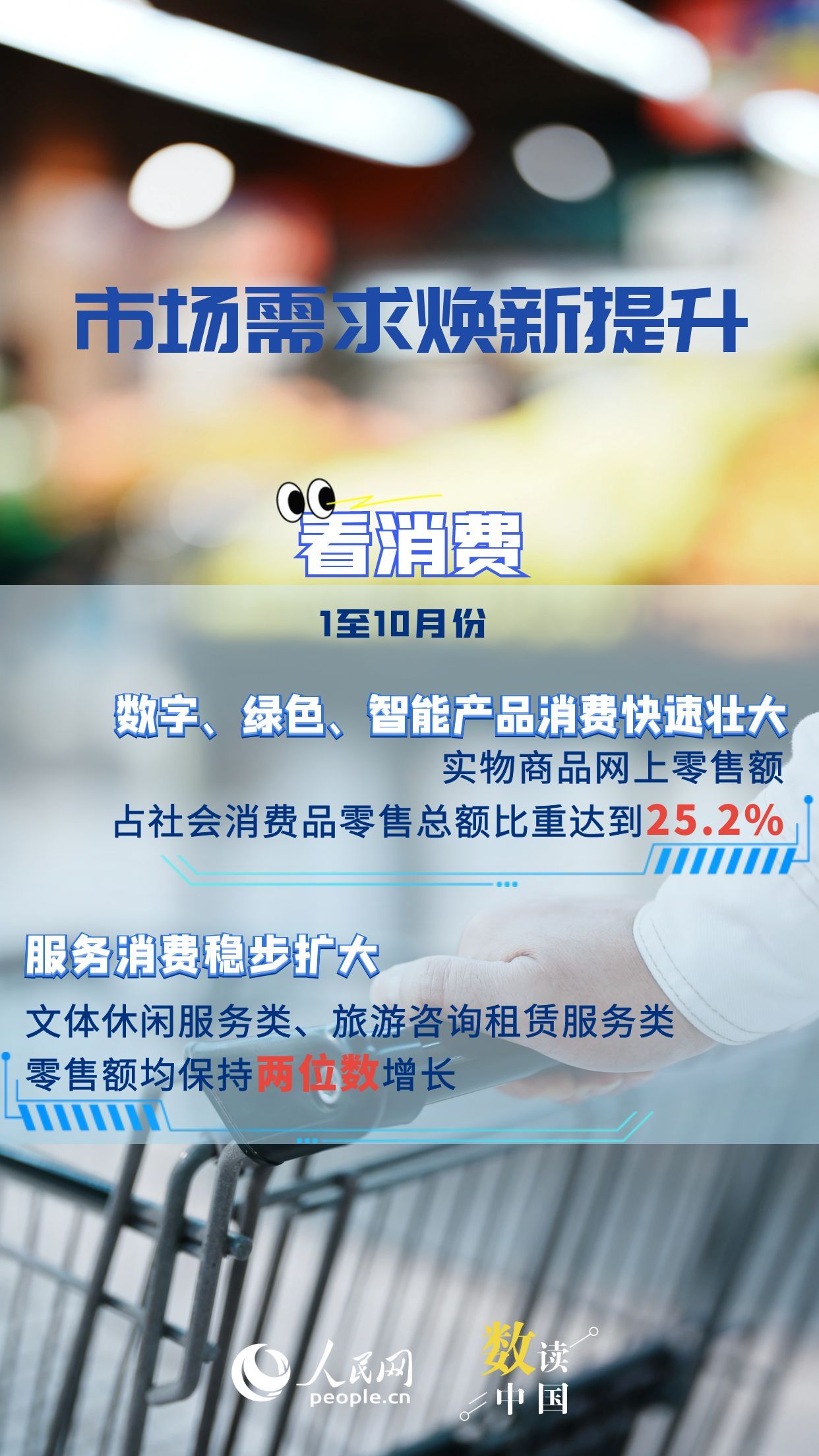
数读中国 需求焕新、产业升级 经济新动能加快培育
Ren Min Wang· 2025-11-16 01:47
Group 1 - The core viewpoint is that China's economic structure adjustment and the cultivation of new growth drivers have achieved positive results, supporting stable economic operation from January to October [1] - The digital economy and platform economy are expanding, leading to rapid development of emerging industries and significant industrial upgrades [1] Group 2 - The retail sales of cultural, leisure services, and tourism consulting rental services have maintained double-digit growth [4] - The manufacturing sector, particularly in digital and intelligent manufacturing, has shown strong growth, with value-added in electronic components and equipment manufacturing increasing by 11.1% and 12.3% respectively [11]
从一系列关键数据看国民经济运行的“稳”与“进” 多领域发展“强信心”
Yang Shi Wang· 2025-09-15 04:50
Economic Overview - In August, the national economy operated smoothly with macro policies working in coordination, and high-quality development achieved new results [1] - The industrial added value of large-scale industries increased by 5.2% year-on-year in August [1] Industrial Performance - The added value of the equipment manufacturing industry grew by 8.1%, and the high-tech manufacturing industry increased by 9.3%, both exceeding the overall industrial growth by 2.9 and 4.1 percentage points respectively [3] Service Sector Growth - The service production index rose by 5.6% year-on-year in August, with positive developments in modern service sectors such as information transmission, software, IT services, and finance [5] Consumer Market - The total retail sales of consumer goods reached 39,668 billion yuan in August, marking a year-on-year growth of 3.4% [7] - Retail sales in cultural, sports, leisure services, tourism consulting, and transportation services experienced rapid growth [7] Real Estate Market - The year-on-year decline in commodity housing sales prices across various city tiers continued to narrow in August, with first, second, and third-tier cities seeing reductions of 0.2, 0.4, and 0.5 percentage points respectively [8] Fixed Asset Investment - In the first eight months, fixed asset investment totaled 326,111 billion yuan, with a year-on-year growth of 0.5%, particularly in the manufacturing sector [9] - National railway fixed asset investment exceeded 504.1 billion yuan, reflecting a year-on-year increase of 5.6% [11] Agricultural Sector - Over 100 million tons of summer grain have been purchased, with the market expected to become more active as traditional consumption peaks approach [15] Service Trade Conference - The 2025 China International Service Trade Fair concluded with over 900 outcomes achieved across various sectors, including construction, IT, and finance [16][18] - The event featured 13 thematic forums and 81 specialized forums, attracting 11.6 million professional attendees, a 12% increase from the previous year [16]
中经评论:从供需两端激活消费“主引擎”
Zhong Guo Jing Ji Wang· 2025-07-19 07:10
Group 1 - The core viewpoint of the articles highlights the robust growth of consumer spending in China, which significantly contributes to GDP growth, with domestic demand accounting for 68.8% of GDP growth in the first half of the year, and final consumption expenditure contributing 52% [1][3] - The increase in consumer spending is attributed to a series of incremental policies that have effectively stimulated the market, showcasing the potential of China's large-scale economy [1][3] - Consumer preferences are shifting from basic needs to quality and experience, as evidenced by the strong sales of home appliances and cultural products, with retail sales in these categories growing by 30.7%, 25.4%, 24.1%, and 22.9% respectively [1][2] Group 2 - The emergence of new consumer demands is driving growth in niche markets, with initiatives like the "cool economy" and various local events aimed at enhancing consumer experience [2] - Local governments are actively promoting diverse and personalized consumption, with initiatives such as fashion consumption expansion plans and unique local events to stimulate market dynamics [2] - The government has prioritized boosting consumption and investment efficiency as a key task for 2025, with specific action plans to address barriers to consumer spending [3]