
水泥等

Search documents
行业轮动ETF策略周报-20260330
金融街证券· 2026-03-30 13:37
Core Insights - The report emphasizes the construction of a strategy portfolio based on industry and thematic ETFs, leveraging quantitative analysis of industry style continuation and switching perspectives [2]. - The strategy update indicates adjustments in holdings, with specific ETFs being added or maintained based on their performance and market signals [3][12]. ETF Holdings and Performance - The report lists various ETFs along with their market values and sector weights, highlighting significant holdings such as the Shipbuilding ETF with 41.57% in marine equipment and the Wine ETF with 84.12% in liquor [3]. - The strategy's cumulative net return from March 23 to March 27, 2026, was approximately -1.33%, with an excess return of about 0.15% compared to the CSI 300 ETF [3][11]. - Since October 14, 2024, the strategy has achieved a cumulative return of approximately 27.53%, outperforming the CSI 300 ETF by about 8.23% [3]. Recommended Sectors and Products - For the upcoming week, the report recommends focusing on sectors such as marine equipment, liquor, and securities, with specific ETFs like the Shipbuilding ETF and Securities Insurance ETF being highlighted for addition to the portfolio [12]. - The report also notes that some ETFs and indices have provided daily or weekly risk signals, indicating potential market volatility [12].
策略周报:行业轮动ETF策略周报-20260330
金融街证券· 2026-03-30 12:43
Group 1: Report Industry Investment Rating - No relevant content Group 2: Core Viewpoints of the Report - The Financial Street Securities Research Institute constructs a strategy portfolio based on industry and thematic ETFs, and the model recommends allocating sectors such as marine equipment, liquor, and securities in the week of March 30, 2026 [2][12] - The strategy will newly hold products like the Ship ETF Fuguo, Securities and Insurance ETF E Fund, and Aerospace ETF Huatai-PineBridge, and continue to hold products like the Liquor ETF Penghua and Building Materials ETF Guotai in the next week [12] - As of last weekend, the trading timing signals of some ETFs and underlying indexes gave daily or weekly risk warnings [12] Group 3: Summary by Relevant Catalogs Strategy Portfolio Construction - The Financial Street Securities Research Institute constructs a strategy portfolio based on industry and thematic ETFs, referring to the strategy reports "Strategy Portfolio Report under Industry Rotation: Quantitative Analysis from the Perspective of Industry Style Continuity and Switching" (20241007) and "Research on the Overview and Allocation Methods of the Stock ETF Market: Taking the ETF Portfolio Based on the Industry Rotation Strategy as an Example" (20241013) [2] ETF Portfolio Information - The ETF portfolio includes multiple products such as the Ship ETF Fuguo, Liquor ETF Penghua, and Securities and Insurance ETF E Fund, with details on their market values, holding situations, heavy - held Shenwan industries and their weights, as well as weekly and daily timing signals [3] Performance Tracking - From March 23 to March 27, 2026, the cumulative net return of the strategy was approximately - 1.33%, and the excess return relative to the CSI 300 ETF was approximately 0.15% [3] - From October 14, 2024, to March 27, 2026, the out - of - sample cumulative return of the strategy was approximately 27.53%, and the cumulative excess return relative to the CSI 300 ETF was approximately 8.23% [3] ETF Portfolio Changes - In the week of March 23 - 29, 2026, some ETFs such as the Film and Television ETF Yin Hua, Telecommunications ETF E Fund were调出, while the Liquor ETF Penghua and Building Materials ETF Guotai were continued to be held. The average return of the ETF portfolio was - 1.33%, and the excess return relative to the CSI 300 ETF was 0.15% [11]
广东省阳江市扎实推进重点工业产品质量监管工作
Xin Lang Cai Jing· 2026-02-10 04:36
Group 1 - The core viewpoint emphasizes the proactive measures taken by the Yangjiang Market Supervision Bureau in Guangdong Province to enhance the quality and safety of key industrial products, focusing on consumer protection and risk management since 2025 [1] - The bureau has conducted inspections on 2,864 enterprises, addressing 75 quality hazards and handling 76 cases of quality violations, resulting in fines totaling 870,000 yuan [1] - A total of 998 key enterprises have been encouraged to appoint quality safety directors and establish a tiered responsibility management system to improve quality management at the source [1] Group 2 - The annual supervision and inspection plan has led to a 55.12% increase in product inspections, with 712 products checked and a coverage rate of 5.65%, identifying 21 non-compliant products [2] - A credit classification system has been established for 2,991 enterprises, with 2,951 rated as trustworthy (A-class), 36 as general (B-class), 3 as key regulatory (C-class), and 1 as particularly regulated (D-class) [2] - Targeted rectification measures have been implemented for high-risk products, with inspections conducted at 65 production enterprises and 950 retail units, resulting in 13 rectifications and 8 cases filed [2] Group 3 - Technical support has been provided to 850 enterprises, with 130 expert visits and training sessions held for over 1,500 participants to enhance quality management capabilities [3] - Public awareness campaigns have been conducted, distributing over 5,300 promotional materials and engaging with nearly 350 individuals to educate on consumer rights and quality issues [3] - Industry associations have been leveraged to promote quality ratings and credit evaluations, fostering collaboration to address common industry challenges [3]
2025年工业领域可再生能源应用:低温热能及蒸汽电气化研究报告(英文版)-IEA国际能源署
Sou Hu Cai Jing· 2025-12-27 17:40
Core Insights - The International Energy Agency (IEA) report highlights that the industrial sector accounts for 30% of global energy consumption, with low-temperature heat and steam demand representing 70% of this consumption, making electrification a cost-effective path for industrial decarbonization [1][14][29] - The report emphasizes the potential of electrification technologies such as industrial heat pumps, electric boilers, and thermal energy storage to significantly reduce emissions and enhance energy security [2][15][38] Group 1: Core Technologies and Application Potential - Industrial heat pumps can provide heat up to 150°C with a coefficient of performance (COP) around 3, while electric boilers can generate steam at 350°C and 70 bar pressure with efficiencies of 95%-98% [2][35] - The global potential for these technologies is substantial, with the EU able to reduce fossil fuel consumption by nearly 3,000 PJ and China by 9,000 PJ, corresponding to significant reductions in natural gas imports [2][41] - Thermal energy storage systems, using low-cost materials, can store energy at a cost of $15-20 per kWh, addressing the intermittency of renewable energy sources [2][36] Group 2: Regional Development Status and Differences - The EU is leading in electrification due to favorable policies and energy prices, with industrial heat pumps becoming cost-competitive in countries like Finland and Spain [3][39] - China is pushing for industrial electrification through its dual carbon goals, focusing on industrial parks and renewable energy integration, which can reduce steam costs significantly [3][41][44] - The ASEAN region faces challenges due to its reliance on coal, but has potential for solar energy integration in industrial parks, with ongoing financial reforms to lower barriers [3][45] Group 3: Key Barriers and Action Pathways - Major barriers to electrification include long grid connection times, unfair energy taxation, high upfront investment costs, and a shortage of skilled labor [4][46] - The report suggests six priority actions to accelerate electrification, including integrating heat electrification into national energy plans, reforming energy taxes, and enhancing workforce training [4][46][50]


7349亿元!A股公司今年以来大手笔分红
Zhong Guo Zheng Quan Bao· 2025-11-02 09:11
Core Insights - The overall performance of listed companies in China has shown continuous improvement, with a notable contribution from technology-driven enterprises, indicating a shift towards high-quality development [1][2] Group 1: Economic Performance - China's GDP grew by 5.2% year-on-year in the first three quarters of 2025, reflecting a stable economic development [1] - Total revenue for listed companies reached 53.46 trillion yuan, with a net profit of 4.70 trillion yuan, marking year-on-year growth of 1.36% and 5.50% respectively [2] - In the third quarter alone, revenue and net profit increased by 3.82% and 11.45% year-on-year, with quarter-on-quarter growth of 2.40% and 14.12% [2] Group 2: Sector Performance - Among 19 industry categories, 17 reported profits, with 9 experiencing revenue growth and 10 showing net profit growth [3] - The semiconductor industry saw a revenue increase of 16.08% and a net profit increase of 26.44% due to rising demand for AI data storage [3] - The new energy vehicle sector also reported significant growth, with revenue and net profit growth rates exceeding 10% and 20% respectively [3] Group 3: Innovation and R&D - Listed companies invested a total of 1.16 trillion yuan in R&D, marking a year-on-year increase of 3.88% [4] - The overall R&D intensity across the market was 2.16%, with the ChiNext, Sci-Tech Innovation Board, and Beijing Stock Exchange showing higher intensities of 4.54%, 11.22%, and 4.42% respectively [4] Group 4: Shareholder Returns - A total of 1,033 listed companies announced cash dividend plans, with a total cash dividend amounting to 734.9 billion yuan [5] - The number of companies engaging in share buybacks reached 1,195, with a total buyback amount of 92.3 billion yuan [6]
规上工业产能利用率回升,反内卷成效初显
Di Yi Cai Jing· 2025-10-22 13:29
Core Insights - The recent data from the National Bureau of Statistics indicates a positive improvement in industrial enterprise prices and profits, reflecting the initial effects of anti-involution policies [1] - The capacity utilization rate for large-scale industrial enterprises in Q3 2025 reached 74.6%, an increase of 0.6 percentage points from Q2, although it is still down 0.5 percentage points year-on-year [1][2] - The anti-involution measures aim to address chaotic competition in various industries, with a focus on enhancing quality and promoting technological innovation [1][6] Capacity Utilization - In Q3 2025, 21 out of 41 major industrial sectors saw a month-on-month increase in capacity utilization, with a recovery rate of 51.2% [2] - The mining sector's capacity utilization was 72.5%, manufacturing at 74.8%, and utilities at 74.3% [2] - Notable increases in capacity utilization were observed in the automotive and electrical machinery sectors, with rises of 2 and 1.4 percentage points, respectively [2][3] Profit and Price Trends - From January to August 2025, profits of large-scale industrial enterprises shifted from a year-on-year decline of 1.7% to a growth of 0.9%, reversing a downward trend since May [3] - The Producer Price Index (PPI) for September showed a year-on-year decline of 2.3%, but the rate of decline narrowed by 0.6 percentage points compared to the previous month [3] - The steel industry has returned to profitability, with raw material manufacturing profits increasing by 22.1% year-on-year [3] Policy Measures - The newly revised Anti-Unfair Competition Law has been implemented, marking a significant step in regulating chaotic competition and promoting fair market practices [1][6][7] - The National Development and Reform Commission has emphasized the need to strengthen capacity governance in key industries, particularly in new energy vehicles and photovoltaics [1][6] - Recent announcements from regulatory bodies focus on maintaining fair market pricing and preventing disorderly competition through various measures [7][8] Industry Outlook - The anti-involution policies are expected to gradually alleviate price deflation pressures, particularly in traditional industries facing dual pressures of demand contraction and supply optimization [5] - The emphasis on innovation and green transformation aims to enhance competitiveness across both emerging and traditional sectors [5][6] - The current phase of demand insufficiency is identified as a fundamental cause of the ongoing involution, necessitating a strategic focus on expanding domestic demand [9]
兴业证券:这是一轮“健康牛”
智通财经网· 2025-08-17 10:46
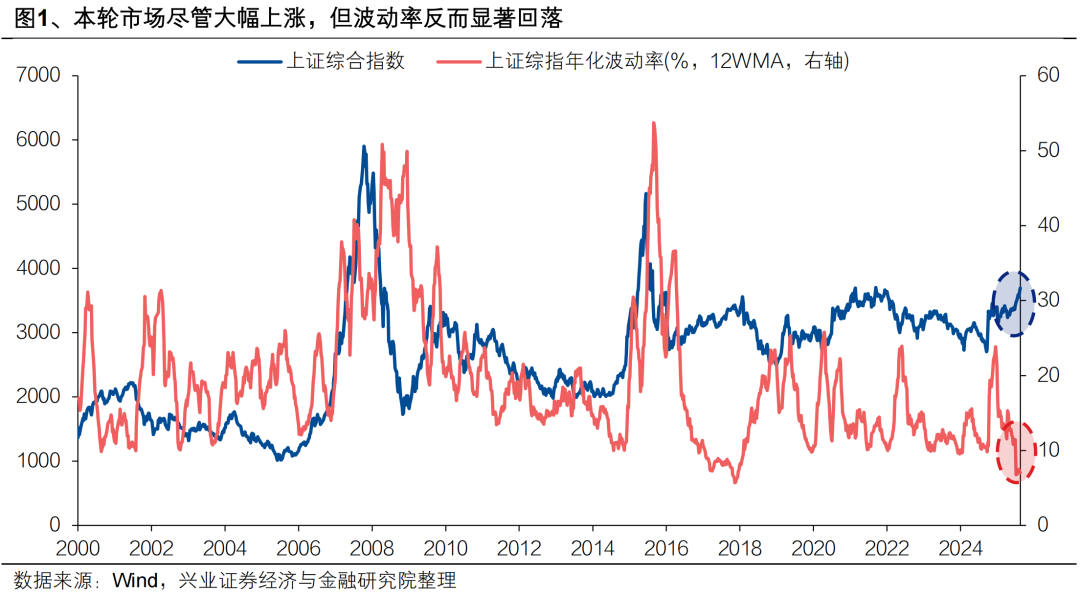
Group 1 - The current market is experiencing a "healthy bull" phase, characterized by a steady upward trend in A-shares and a consensus on the bull market's continuation [1][2] - The market is expected to serve the real economy, focusing on high-quality development and wealth effect to boost market confidence, indicating a gradual and stable market rather than volatile fluctuations [2][5] - Despite new index highs, most industries remain at moderate levels of crowding, allowing for a "multi-point blooming" market where various sectors and themes take turns in gaining attention [5][7] Group 2 - Institutional advantages are becoming more apparent as the market warms up, with active public funds showing significant performance gains, indicating a potential "institutional bull" market [7][11] - The number of new institutional accounts has surged to historical highs, suggesting a positive correlation with the issuance of equity funds [11][14] Group 3 - The brokerage sector is highlighted as a direct vehicle for the "healthy bull," with expected strong performance due to market activity and relatively low current valuations [15][16] - The AI sector has emerged as a strong market leader, showing no signs of overheating despite previous rapid gains, indicating a sustainable upward trend [18][24] Group 4 - The military industry is poised for growth due to upcoming events like military parades and the "Five-Year Plan" meeting, which historically catalyze stock performance [30][33] - The military sector is expected to benefit from both domestic strategic planning and increased global competitiveness, with significant order releases anticipated [36][37][38] Group 5 - The "anti-involution" theme is becoming a long-term focus, with policies aimed at breaking negative cycles and improving industry profitability, particularly in sectors like steel and glass [40][42] - Key industries involved in "anti-involution" are currently at historical lows in profitability and capital expenditure, indicating a strong willingness to participate in positive changes [42]

湖北融资连续三年保持8000亿 储备“金银种子”企业超1300家
Chang Jiang Shang Bao· 2025-07-02 03:58
Group 1 - Hubei Province's direct financing has maintained a high level of around 800 billion yuan for three consecutive years, with nearly 80% of listed companies achieving profitability [1][2] - As of June 30, 2025, Hubei has 191 listed companies, ranking 10th nationally, with 153 domestic and 38 overseas listings [2][3] - The province has a reserve of 1,355 "gold and silver seed" enterprises to support more quality companies to go public [1][4] Group 2 - In Q1 2025, over 70% of Hubei's listed companies were profitable, with notable companies like Jiuzhoutong, CITIC Special Steel, and Wentai Technology reporting revenues exceeding 10 billion yuan [3] - The top ten companies by revenue in Hubei all exceeded 4 billion yuan, indicating strong performance in the region [3] - Hubei has implemented a comprehensive service system for companies to enter the multi-level capital market, aiming to enhance the quality of enterprises [4] Group 3 - Hubei's capital market reforms have led to 20 new listings and approvals annually from 2021 to 2023, with the province ranking 6th nationally for new listings in 2024 [2] - The province aims to achieve five major goals by 2030, including increasing the total number of listed companies and ensuring coverage across all regions [4]


