石油开采业

Search documents
上证指数ETF富国(510210)开盘涨0.21%,重仓股农业银行涨0.00%,中国石油跌3.09%
Xin Lang Cai Jing· 2026-03-25 01:32
Group 1 - The Shanghai Stock Index ETF (510210) opened at 0.977 yuan, with a gain of 0.21% on March 25 [1][2] - Major holdings of the ETF include Agricultural Bank (0.00%), China Petroleum (-3.09%), Kweichow Moutai (0.20%), Industrial Fulian (1.13%), Bank of China (-0.18%), Zijin Mining (4.04%), China Shenhua (-2.06%), China Life (0.28%), China Merchants Bank (0.20%), and Ping An Insurance (0.65%) [1][2] - The ETF's performance benchmark is the Shanghai Composite Index, managed by Fortune Fund Management Co., with fund managers Fang Min and Wang Baohe [2] Group 2 - Since its establishment on January 30, 2011, the ETF has achieved a return of 106.07%, while the return over the past month is -5.74% [2] - A MACD golden cross signal has formed, indicating a positive trend for certain stocks [3]




数据点评 | 如何理解1月通胀分化?(申万宏观·赵伟团队)
赵伟宏观探索· 2026-02-12 16:03
Core Viewpoints - January inflation shows divergence, influenced by the misalignment of the Spring Festival, external factors driving increases, and weak demand [2][8] - The decline in PPI has narrowed significantly, primarily due to the increased impact of copper prices and some influence from the base period rotation [2][8] - January PPI increased by 0.4% month-on-month and improved by 0.5 percentage points year-on-year to -1.4% [2][8] PPI Analysis - The base period rotation, which occurs every five years, will see a new adjustment starting in 2026, but its impact on monthly PPI year-on-year is minimal at about 0.08 percentage points [2][8] - The rise in copper prices in January was significant, with a month-on-month increase of 9.3%, contributing to a 0.5% increase in PPI [2][8] - Prices in the non-ferrous mining and processing sectors rose by 5.7% and 5.2% respectively, making them the strongest contributors to the PPI increase [2][8] Commodity Price Trends - In contrast, prices for major commodities like crude oil and coal showed weakness, with crude oil prices down 3.1% and refined oil product prices down 2.5%, negatively impacting PPI by -0.08% and -0.15% respectively [12][71] - The utilization rate in downstream sectors has not improved significantly, limiting the upward price transmission from upstream to downstream [12][71] CPI Analysis - The misalignment of the Spring Festival led to a significant year-on-year decline in CPI, which fell by 0.6 percentage points to 0.2% [3][17] - The month-on-month CPI increase was only 0.2%, notably lower than the previous year's pre-Spring Festival performance of 0.6%, indicating overall weakness in CPI [3][17] - Food CPI saw a substantial decline, dropping by 1.8 percentage points to -0.7%, influenced by high pig inventory levels keeping pork prices low [3][17] Core CPI Insights - Excluding the impact of gold prices, the core CPI also showed weakness, falling by 0.4 percentage points to 1.6% [24][72] - The price of gold jewelry rose significantly, with a year-on-year increase of 77.4%, while other core goods CPI fell by 1 percentage point to -1.7% [24][72] Service CPI Trends - The service CPI was weaker than in previous years, likely due to an early "return home" trend for the Spring Festival, with a year-on-year decline of 0.5 percentage points to 0.1% [4][28] - Rent demand remains weak, causing the rent CPI to continue its decline, down 0.1 percentage points to -0.4% [4][28] - Core service CPI also showed weakness, with a month-on-month increase of only 0.3%, lower than the previous year's performance of 0.6% [4][28] Future Outlook - The performance of downstream prices will be more critical than the impact of upstream price increases, with ongoing monitoring of the effects of anti-involution policies in the downstream sector [39][73] - Despite potential continued increases in commodity prices, the transmission of upstream price increases to downstream sectors remains obstructed, limiting the recovery of PPI [39][73] - For CPI, the low base in February, combined with high gold prices and improvements in service consumption, may lead to a significant rebound, potentially resulting in a "V-shaped" trend early in the year [39][73]

国家统计局:输入性因素影响国内有色金属和石油相关行业价格走势分化
Xin Hua Cai Jing· 2026-02-11 02:13
Group 1 - In January, the Producer Price Index (PPI) increased by 0.4% month-on-month, marking the fourth consecutive month of growth, with the growth rate expanding by 0.2 percentage points compared to the previous month [1] - The construction of a unified national market has driven price increases in certain industries, with prices in cement manufacturing and lithium-ion battery manufacturing rising by 0.1% month-on-month, both continuing their upward trend for four months [1] - The demand increase has led to price rises in related industries, with prices in the computer communication and other electronic equipment manufacturing sector rising by 0.5% month-on-month, driven by the growth in computing power demand [1] Group 2 - Year-on-year, the PPI decreased by 1.4%, with the decline narrowing by 0.5 percentage points compared to the previous month [2] - The non-ferrous metal mining sector saw a price increase of 22.7%, while the cultural, educational, and sports goods manufacturing sector experienced a 21.2% rise [2] - Energy-related industries continued to see price declines, with the oil and gas extraction sector's prices dropping by 16.7% [2]
优化供需结构,持续提振投资与消费预期
2 1 Shi Ji Jing Ji Bao Dao· 2026-01-10 03:15
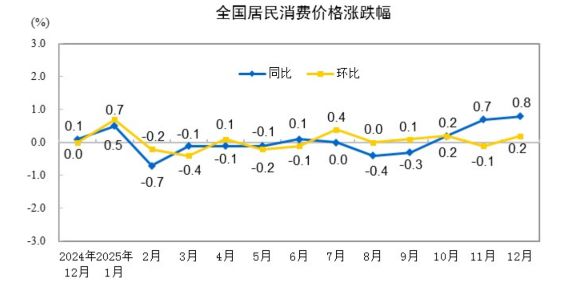
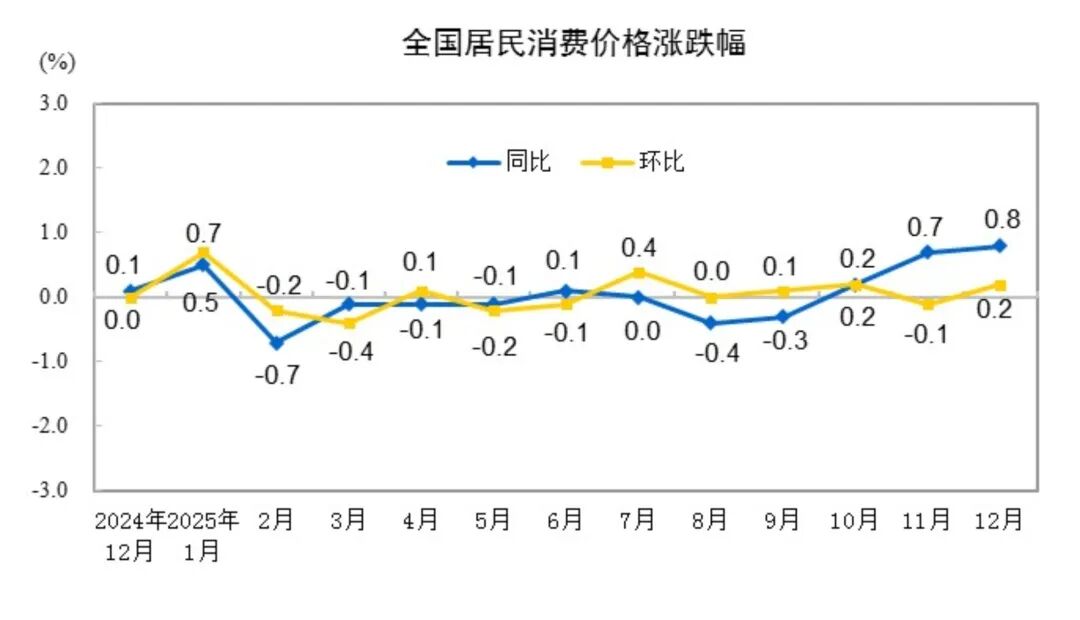
Group 1 - The latest data from the National Bureau of Statistics indicates that the domestic CPI rose by 0.8% year-on-year in December 2025, surpassing the previous value of 0.7%, with a month-on-month increase of 0.2%, marking a near three-year high [1] - The month-on-month increase in CPI is primarily driven by rising prices of industrial consumer goods excluding energy, which increased by 0.6%, contributing approximately 0.16 percentage points to the CPI increase [1] - The core CPI, excluding food and energy, rose by 1.2% year-on-year, maintaining a growth rate above 1% for four consecutive months, indicating a positive trend [1] Group 2 - The main factors affecting CPI include energy and automobile prices, with energy prices decreasing by 0.5% month-on-month and gasoline prices down by 1.2% [2] - PPI showed an expanding month-on-month increase and a narrowing year-on-year decline, with positive factors stemming from industry capacity governance and market competition order improvements [2] - International commodity prices, particularly for non-ferrous metals, have positively impacted domestic PPI levels, while the decline in international oil prices has negatively affected domestic oil extraction and refining prices [3] Group 3 - The current price recovery is a direct result of the demand-side expansion and supply-side governance policies in 2025, characterized by structural features and policy-driven characteristics [3] - The transition from short-term policy-driven effects to sustainable market-driven growth is a key task for 2026, with strong price expectations playing a crucial role in boosting investment and consumption [3] - Continued efforts to expand domestic demand and improve supply-demand relationships are essential for stabilizing the real estate market and stimulating stock market vitality, promoting a virtuous cycle in the Chinese economy [4]
2025年物价低位温和回升
Xin Lang Cai Jing· 2026-01-09 22:52
Group 1: CPI Analysis - In December 2025, the Consumer Price Index (CPI) increased by 0.2% month-on-month and 0.8% year-on-year, with the core CPI (excluding food and energy) rising by 1.2% year-on-year, marking a stable recovery in demand [1][2] - The year 2025 saw the CPI remain flat compared to the previous year, while the PPI decreased by 2.6% year-on-year, indicating a low and moderate recovery in price levels [1][4] - The increase in CPI was primarily driven by rising prices of industrial consumer goods, with a notable increase in prices for communication tools, baby products, and entertainment durable goods, which rose between 1.4% and 3.0% [1][2] Group 2: PPI Analysis - The Producer Price Index (PPI) rose by 0.2% month-on-month in December 2025, marking three consecutive months of increase, influenced by improved supply-demand dynamics and ongoing capacity governance in key industries [2][3] - Year-on-year, the PPI decreased by 1.9%, but the decline was less severe than in previous months, reflecting positive changes in certain industries due to macroeconomic policies [3][5] - The PPI's year-on-year decline was initially exacerbated by insufficient external demand and structural adjustments, but improved market competition and policy effects led to a narrowing of the decline in the latter half of the year [5] Group 3: Economic Outlook - The changes in CPI and PPI in December 2025 indicate a stable and improving economic environment, with demand gradually recovering and supply-side structural optimization continuing [3][5] - The implementation of consumption-boosting policies and the deepening of the unified national market are expected to support a moderate and stable price environment moving forward [3][5] - Looking ahead to 2026, a more proactive macroeconomic policy is anticipated to foster economic growth and reasonable price recovery, with the potential for PPI to enter a recovery phase, although it may take time to turn positive [5]
提振消费政策显效、企业竞争秩序优化、新动能快速成长——2025年物价低位温和回升
Jing Ji Ri Bao· 2026-01-09 22:02
Group 1: CPI Analysis - In December 2025, the Consumer Price Index (CPI) increased by 0.2% month-on-month and 0.8% year-on-year, with the core CPI (excluding food and energy) rising by 1.2% year-on-year [1][2] - The year 2025 saw the CPI remain flat compared to the previous year, while the PPI decreased by 2.6% year-on-year, indicating a generally low and mild recovery in price levels [1][4] - The increase in CPI is attributed to rising prices of industrial consumer goods, with a notable increase in prices for communication tools, baby products, and entertainment durable goods, which rose between 1.4% and 3.0% [1][2] Group 2: PPI Analysis - The Producer Price Index (PPI) rose by 0.2% month-on-month in December 2025, marking three consecutive months of increase, despite a year-on-year decline of 1.9% [2][3] - The PPI's year-on-year decline narrowed by 0.3 percentage points compared to the previous month, reflecting improvements in supply-demand structures and effective policies in key industries [3][5] - Prices in the coal mining and processing sectors, as well as lithium-ion battery manufacturing and cement production, have shown consistent increases, indicating a positive trend in certain industries [2][3] Group 3: Economic Outlook - Analysts suggest that the changes in CPI and PPI reflect a stable and improving economic environment in China, with demand gradually recovering and supply-side structural optimization continuing [3][5] - The implementation of consumption-boosting policies and the deepening of the national unified market construction are expected to support a stable and mild recovery in prices moving forward [3][5] - Looking ahead to 2026, a more proactive macroeconomic policy environment is anticipated to foster economic growth and reasonable price recovery, with CPI expected to rise steadily [5]
解读:2025年12月份CPI同比涨幅继续扩大 PPI同比降幅收窄
Guo Jia Tong Ji Ju· 2026-01-09 03:00
Group 1: CPI Analysis - The Consumer Price Index (CPI) increased by 0.2% month-on-month and 0.8% year-on-year, with the core CPI rising by 1.2% year-on-year, indicating a recovery in consumer demand as New Year's approaches [1][2][3] - The month-on-month increase in CPI was primarily driven by rising prices of industrial consumer goods, excluding energy, which rose by 0.6%, contributing approximately 0.16 percentage points to the CPI increase [2] - Food prices rose by 1.1% year-on-year, with significant increases in fresh vegetables (18.2%) and fresh fruits (4.4%), contributing approximately 0.17 percentage points to the year-on-year CPI increase [3] Group 2: PPI Analysis - The Producer Price Index (PPI) rose by 0.2% month-on-month, marking the third consecutive month of increase, with the growth rate expanding by 0.1 percentage points compared to the previous month [4] - The month-on-month PPI increase was supported by improved supply-demand dynamics, with notable price increases in coal mining (1.3%) and lithium-ion battery manufacturing (1.0%) [4] - Year-on-year, the PPI decreased by 1.9%, but the decline rate narrowed by 0.3 percentage points, reflecting positive changes in certain industries due to ongoing macroeconomic policies [4]
最新CPI数据公布!
Zhong Guo Zheng Quan Bao· 2026-01-09 02:43
Group 1: Consumer Price Index (CPI) - In December 2025, the national Consumer Price Index (CPI) increased by 0.8% year-on-year and by 0.2% month-on-month, marking the highest year-on-year increase since March 2023 [1][5] - The rise in CPI was primarily driven by an increase in food prices, which rose by 1.1% year-on-year, contributing approximately 0.17 percentage points to the CPI increase [5] - The core CPI, excluding food and energy prices, rose by 1.2% year-on-year, maintaining a growth rate above 1% for four consecutive months [5] Group 2: Producer Price Index (PPI) - In December 2025, the national Producer Price Index (PPI) decreased by 1.9% year-on-year but increased by 0.2% month-on-month, marking a continuous increase for three months [7][8] - The month-on-month increase in PPI was influenced by rising prices in certain industries, such as coal mining and processing, which saw price increases of 1.3% and 0.8% respectively [10] - Year-on-year, the decline in PPI narrowed by 0.3 percentage points, with significant price increases in sectors related to the digital economy and green transformation, such as a 15.3% increase in prices for external storage devices [11][12]
国家统计局:PPI环比涨幅扩大 同比降幅收窄
Sou Hu Cai Jing· 2026-01-09 02:36
Group 1 - The Producer Price Index (PPI) for industrial producers increased by 0.2% month-on-month in December 2025, marking the third consecutive month of growth, with the year-on-year decline narrowing to 1.9% [1] - Key industries such as coal mining and lithium-ion battery manufacturing saw price increases, with coal mining prices rising by 1.3% and lithium-ion battery prices by 1.0%, both continuing their upward trend for three months [1][2] - Seasonal demand increases contributed to price rises in gas production and supply, as well as electricity and heat production, with respective increases of 1.2% and 1.0% [1] Group 2 - Domestic prices in the non-ferrous metals and petroleum sectors showed divergence due to external factors, with non-ferrous metal mining and smelting prices rising by 3.7% and 2.8% respectively, while oil extraction and refining prices fell by 2.3% and 0.9% [2] - The narrowing year-on-year decline in PPI reflects the effectiveness of macroeconomic policies, with certain industries experiencing positive price changes [2] - The construction of a unified national market is progressing, leading to a continuous reduction in year-on-year price declines across various industries [2] Group 3 - Consumer potential is being effectively released, driving price increases in related industries, with prices for arts and crafts manufacturing rising by 23.3% and sports ball manufacturing by 4.0% [3] - The implementation of special actions to boost consumption has led to rapid growth in cultural and quality-related consumption [3]
2025年CPI数据发布
Di Yi Cai Jing Zi Xun· 2026-01-09 02:08
Core Viewpoint - In December 2025, the Consumer Price Index (CPI) increased by 0.8% year-on-year, with urban areas rising by 0.9% and rural areas by 0.6%, indicating a steady increase in consumer prices driven by food and non-food price changes [1][4][6]. CPI Summary - The CPI rose by 0.2% month-on-month in December, reversing a previous decline of 0.1% [5]. - Core CPI, excluding food and energy, increased by 1.2% year-on-year, maintaining a growth rate above 1% for four consecutive months [6]. - Food prices rose by 1.1% year-on-year, with significant increases in fresh vegetables (18.2%) and fresh fruits (4.4%), contributing to the overall CPI increase [6][8]. - Energy prices decreased by 3.8% year-on-year, with gasoline prices dropping by 8.4% [6]. PPI Summary - The Producer Price Index (PPI) increased by 0.2% month-on-month, marking three consecutive months of growth [8]. - Year-on-year, the PPI decreased by 1.9%, but the decline was less severe than in previous months, indicating some stabilization in industrial prices [9]. - Key industries such as coal mining and lithium-ion battery manufacturing saw price increases, reflecting improved supply-demand dynamics [8][9]. - Input factors like international commodity prices influenced the price trends in domestic industries, with non-ferrous metal prices rising due to global market conditions [8][9].