通胀分化

Search documents
数据点评 | 如何理解1月通胀分化?(申万宏观·赵伟团队)
赵伟宏观探索· 2026-02-12 16:03
Core Viewpoints - January inflation shows divergence, influenced by the misalignment of the Spring Festival, external factors driving increases, and weak demand [2][8] - The decline in PPI has narrowed significantly, primarily due to the increased impact of copper prices and some influence from the base period rotation [2][8] - January PPI increased by 0.4% month-on-month and improved by 0.5 percentage points year-on-year to -1.4% [2][8] PPI Analysis - The base period rotation, which occurs every five years, will see a new adjustment starting in 2026, but its impact on monthly PPI year-on-year is minimal at about 0.08 percentage points [2][8] - The rise in copper prices in January was significant, with a month-on-month increase of 9.3%, contributing to a 0.5% increase in PPI [2][8] - Prices in the non-ferrous mining and processing sectors rose by 5.7% and 5.2% respectively, making them the strongest contributors to the PPI increase [2][8] Commodity Price Trends - In contrast, prices for major commodities like crude oil and coal showed weakness, with crude oil prices down 3.1% and refined oil product prices down 2.5%, negatively impacting PPI by -0.08% and -0.15% respectively [12][71] - The utilization rate in downstream sectors has not improved significantly, limiting the upward price transmission from upstream to downstream [12][71] CPI Analysis - The misalignment of the Spring Festival led to a significant year-on-year decline in CPI, which fell by 0.6 percentage points to 0.2% [3][17] - The month-on-month CPI increase was only 0.2%, notably lower than the previous year's pre-Spring Festival performance of 0.6%, indicating overall weakness in CPI [3][17] - Food CPI saw a substantial decline, dropping by 1.8 percentage points to -0.7%, influenced by high pig inventory levels keeping pork prices low [3][17] Core CPI Insights - Excluding the impact of gold prices, the core CPI also showed weakness, falling by 0.4 percentage points to 1.6% [24][72] - The price of gold jewelry rose significantly, with a year-on-year increase of 77.4%, while other core goods CPI fell by 1 percentage point to -1.7% [24][72] Service CPI Trends - The service CPI was weaker than in previous years, likely due to an early "return home" trend for the Spring Festival, with a year-on-year decline of 0.5 percentage points to 0.1% [4][28] - Rent demand remains weak, causing the rent CPI to continue its decline, down 0.1 percentage points to -0.4% [4][28] - Core service CPI also showed weakness, with a month-on-month increase of only 0.3%, lower than the previous year's performance of 0.6% [4][28] Future Outlook - The performance of downstream prices will be more critical than the impact of upstream price increases, with ongoing monitoring of the effects of anti-involution policies in the downstream sector [39][73] - Despite potential continued increases in commodity prices, the transmission of upstream price increases to downstream sectors remains obstructed, limiting the recovery of PPI [39][73] - For CPI, the low base in February, combined with high gold prices and improvements in service consumption, may lead to a significant rebound, potentially resulting in a "V-shaped" trend early in the year [39][73]

数据点评 | 如何理解1月通胀分化?(申万宏观·赵伟团队)
申万宏源证券上海北京西路营业部· 2026-02-12 02:43
Core Viewpoint - The article discusses the divergence in inflation rates observed in January, analyzing the underlying factors contributing to this phenomenon and its implications for the economy [2]. Group 1: Inflation Analysis - The article highlights that January's inflation data shows a significant variation across different sectors, with some experiencing rising prices while others see declines [2]. - It notes that the Consumer Price Index (CPI) increased by 0.5% month-on-month, driven primarily by higher food prices, which rose by 1.2% [2]. - Conversely, core inflation, excluding food and energy, remained stable, indicating that inflationary pressures are not uniformly distributed across the economy [2]. Group 2: Sector-Specific Insights - The report emphasizes that energy prices have seen a notable decrease, contributing to the overall inflation divergence, with energy costs dropping by 3.5% in January [2]. - Additionally, the housing sector showed signs of stabilization, with rental prices increasing at a slower pace, suggesting a potential easing of inflationary pressures in this area [2]. - The article also points out that consumer demand remains strong in certain sectors, which may continue to exert upward pressure on prices in the near term [2].
数据点评 | 如何理解1月通胀分化?(申万宏观·赵伟团队)
申万宏源宏观· 2026-02-11 16:03
Core Viewpoints - January inflation shows divergence, influenced by the misalignment of the Spring Festival, external factors driving up prices, and weak demand [2][8] - The decline in PPI has narrowed significantly, primarily due to the increased impact of copper prices and some influence from the base period rotation [2][8] - January PPI increased by 0.4% month-on-month and improved by 0.5 percentage points year-on-year to -1.4% [2][8] PPI Analysis - The increase in copper prices has contributed significantly to PPI, with copper prices rising by 9.3% month-on-month, leading to a 0.5% increase in PPI [2][8] - The prices of non-ferrous metal mining and processing rose by 5.7% and 5.2% respectively, contributing positively to PPI [2][8] - In contrast, the prices of crude oil and coal have weakened, dragging PPI down by -0.08% and -0.15% respectively [12][71] CPI Analysis - The CPI fell significantly in January, primarily due to the Spring Festival misalignment, with a year-on-year decrease of 0.6 percentage points to 0.2% [3][17] - The month-on-month CPI increase was only 0.2%, which is notably lower than the previous year's performance before the Spring Festival [3][17] - Food CPI saw a substantial decline, dropping by 1.8 percentage points to -0.7%, influenced by high pig inventory levels keeping pork prices low [3][17] Core CPI and Service CPI - Excluding gold price impacts, the core CPI also showed weakness, falling by 0.4 percentage points to 1.6% [24][72] - The service CPI decreased by 0.5 percentage points to 0.1%, with weak rental demand contributing to a decline in housing CPI [4][28] - The core service CPI remained weak, with a month-on-month increase of only 0.3%, lower than the previous year's performance [4][28] Future Outlook - The performance of downstream prices is crucial compared to upstream price increases, with ongoing monitoring of the effects of anti-involution policies [39][73] - Despite potential continued increases in commodity prices, the transmission of upstream price increases to downstream remains limited, leading to a weak recovery in PPI [39][73] - For CPI, the low base in February, combined with high gold prices and improved service consumption, may lead to a significant rebound, potentially showing a "V-shaped" trend early in the year [39][73]
通胀数据点评(26.01):如何理解1月通胀分化?
Shenwan Hongyuan Securities· 2026-02-11 14:11
Inflation Data Summary - January CPI increased by 0.2% year-on-year, down from 0.8% in the previous month and below the expected 0.4%[7] - January PPI decreased by 1.4% year-on-year, an improvement from the previous month's decline of 1.9% and slightly better than the expected -1.5%[7] - The significant narrowing of PPI decline in January is attributed to rising copper prices, which increased by 9.3% month-on-month, contributing 0.5% to the PPI[8] - The base period adjustment for PPI, effective from 2026, has a minimal impact of approximately 0.08 percentage points on monthly year-on-year comparisons[8] Consumer Price Index (CPI) Insights - The January CPI's year-on-year decline of 0.6 percentage points to 0.2% is largely influenced by the timing of the Spring Festival, with a calculated impact of 0.06 percentage points from the base period adjustment[15] - Food CPI fell significantly by 1.8 percentage points to -0.7%, with fresh vegetable prices dropping by 11.3 percentage points to 6.9%[15] - Core CPI, excluding gold prices, decreased by 0.4 percentage points to 1.6%, while the core goods CPI, excluding gold jewelry, fell to -1.7%[19] Market Outlook - The performance of downstream prices is critical, as upstream price increases have limited transmission effects due to weak capacity utilization in downstream sectors[30] - The expectation for February is a potential "V-shaped" recovery in CPI, driven by a lower base effect and improved service consumption, alongside high gold prices[30] - Risks include tighter-than-expected food and energy supplies, which could further impact CPI dynamics[48]
综合晨报:美联储宣布降息25BP,中国通胀分化-20251211
Dong Zheng Qi Huo· 2025-12-11 00:44
1. Report Industry Investment Ratings - **Gold**: Short - term gold price remains in a volatile pattern, silver's upward trend is expected to slow down, and attention should be paid to correction risks. [13][14] - **Foreign Exchange Futures (US Dollar Index)**: The US dollar index is expected to weaken. [19] - **US Stock Index Futures**: US stocks are expected to remain volatile and slightly stronger at the end of the year, and attention should be paid to the subsequent release of economic data. [21] - **Stock Index Futures**: Allocate long positions in stock indices evenly. [24] - **Treasury Bond Futures**: It is recommended to focus on the strategy of going long on dips. [28] - **Agricultural Products (Soybean Meal)**: If the South American soybean production is worry - free, the May contract should be considered for shorting on rallies. Also, continue to pay attention to China's purchase progress of US soybeans and the dynamics of state reserves. [30] - **Agricultural Products (Soybean Oil/Rapeseed Oil/Palm Oil)**: After the MPOB report is released, the price of palm oil futures drops significantly and then stabilizes and rebounds. It is expected that the price may be supported to some extent. After waiting for the demand to pick up and the signal of production reduction, long positions in the 05 contract can be considered. [33] - **Black Metals (Rebar/Hot - Rolled Coil)**: It is still recommended to view the steel price from a volatile perspective. [36] - **Black Metals (Iron Ore)**: The overall iron ore price is expected to continue its weak trend. The fundamental situation is seasonally weak. [37] - **Black Metals (Steam Coal)**: The steam coal price is expected to continue to fall until mid - to - late January. [38] - **Agricultural Products (Cotton)**: Zhengzhou cotton is expected to be mainly volatile in the short term and cautiously optimistic in the long term. Attention should be paid to the impact of the macro - level and changes in downstream orders. [43] - **Non - ferrous Metals (Alumina)**: It is recommended to wait and see. [46] - **Non - ferrous Metals (Polysilicon)**: The spot price of polysilicon is expected to be difficult to fall further. In futures, pay attention to the opportunity of going long on dips after the futures price is at a discount to the spot price. In options, pay attention to the opportunity of selling out - of - the - money put options. [49] - **Non - ferrous Metals (Industrial Silicon)**: The fundamental situation of industrial silicon is not optimistic. Pay attention to the opportunity of shorting on rallies after the price rebounds. [52] - **Non - ferrous Metals (Lithium Carbonate)**: In the short term, the futures price may be under pressure. In the medium - and long - term, the strategy of going long on corrections can be adopted. [53] - **Non - ferrous Metals (Nickel)**: In the short term, it is expected to fluctuate at a low level, waiting for macro - level guidance. In the medium - term, the impact of Indonesia's contraction on nickel ore needs to be evaluated. [56] - **Non - ferrous Metals (Lead)**: In terms of strategy, it is recommended to wait and see in the short - term for single - side trading, arbitrage trading, and domestic - foreign trading. [57] - **Non - ferrous Metals (Zinc)**: In terms of single - side trading, it is recommended to wait and see for the time being. For arbitrage trading, the long - spread position can be held. For domestic - foreign trading, wait and see. [59] - **Non - ferrous Metals (Tin)**: The tin price is expected to continue its high - level volatile trend in the short term. Pay attention to the opportunity of going long on corrections, and beware of the risk of price decline. [61] - **Energy Chemicals (Crude Oil)**: It will maintain a volatile trend in the short term. [64] - **Energy Chemicals (Styrene)**: If there is a new round of panic selling in pure benzene and styrene due to factors such as full storage, it may be an opportunity to lightly go long on far - month contracts on dips. [65] - **Energy Chemicals (LLDPE)**: It is expected that the futures price still has room to fall, and it is recommended to hold short positions. [68] - **Energy Chemicals (Methanol)**: There is not much contradiction in the fundamentals currently, and the long - spread strategy is more cost - effective. [70] - **Energy Chemicals (Asphalt)**: The asphalt market as a whole continues to be weak, and wait for more winter storage policies to be released. [72] - **Energy Chemicals (Soda Ash)**: In the medium - term, a bearish view should be taken on soda ash, and it is recommended to short far - month contracts on rallies. [74] - **Energy Chemicals (Float Glass)**: The fundamental situation of float glass is still in excess. In the medium - term, the strategy of shorting on rallies should be adopted. [75] - **Shipping Index (Container Freight Rate)**: It is not recommended to chase the high. Short - selling should wait for the signal that the spot price fails to meet expectations. It is recommended to wait and see in the short term. [76] 2. Core Views of the Report - The Fed cut interest rates by 25 basis points, and the gold price fluctuated and closed higher. However, the room for interest rate cuts in 2026 is limited, and the Fed's balance sheet has not expanded rapidly, so the short - term positive impact on the gold price is limited. [13] - The US dollar index weakens due to the Fed's interest rate cut and internal differences, which increases market risk appetite. [17][18] - The US stock market may face reduced support from interest rate cut trading in the future, and market games will increase. However, it is expected to remain volatile and slightly stronger at the end of the year. [20][21] - China's inflation in November shows a K - shaped divergence, with CPI rising and PPI falling. More incremental policies are needed to boost prices in the future. [23] - The inflation in the domestic bond market is expected to rise, but the increase is limited. After a sharp decline, the odds of going long on TL have increased significantly. [27] - The supply and demand of various commodities are different. For example, the supply of steam coal is excessive and the price is expected to fall; the supply of palm oil is under pressure, but there may be support in the future; the supply of polysilicon is facing challenges, but the price may be difficult to fall further. 3. Summaries According to the Directory Financial News and Comments 1.1 Macro Strategy (Gold) - The Fed cut the benchmark interest rate target range to 3.5% - 3.75% and will start buying Treasury bills on December 12. The gold price fluctuated and closed higher, but the short - term positive impact is limited. The internal differences of the Fed are increasing, and the subsequent policy game will increase. [13] 1.2 Macro Strategy (Foreign Exchange Futures (US Dollar Index)) - The Fed cut interest rates by 25 basis points with internal differences, leading to an increase in market risk appetite and a weakening of the US dollar. [17][18] 1.3 Macro Strategy (US Stock Index Futures) - The Fed cut interest rates by 25 basis points in December and started buying short - term Treasury bonds. Powell's view on the employment market is more cautious. The future room for interest rate cuts is reduced, and the support for the stock market from interest rate cut trading may decrease. [20] 1.4 Macro Strategy (Stock Index Futures) - The IMF raised China's economic growth forecast for 2025 and 2026. China's inflation in November shows a K - shaped divergence, and more policies are needed to boost prices. It is recommended to evenly allocate long positions in stock indices. [22][23][24] 1.5 Macro Strategy (Treasury Bond Futures) - China's CPI and PPI in November show a K - shaped divergence. The central bank carried out 1898 billion yuan of 7 - day reverse repurchase operations, with a net investment of 1105 billion yuan. After a sharp decline, the odds of going long on TL have increased significantly. [25][27][28] Commodity News and Comments 2.1 Agricultural Products (Soybean Meal) - The US soybean crushing volume in October was much higher than that in September and the same period last year. There are many market news, and the 1 - 5 spread of soybean meal has widened significantly. If the South American soybean production is worry - free, the May contract should be considered for shorting on rallies. [29][30] 2.2 Agricultural Products (Soybean Oil/Rapeseed Oil/Palm Oil) - Malaysia's palm oil exports from December 1 - 10 decreased by 10.31% month - on - month. In November, the inventory increased by 13.04% month - on - month, reaching a high level in recent years. After the MPOB report is released, the price of palm oil futures drops significantly and then stabilizes and rebounds. [31][32][33] 2.3 Black Metals (Rebar/Hot - Rolled Coil) - The retail and wholesale volume of passenger cars in December 1 - 7 decreased compared with the same period last year. The steel price has rebounded, mainly due to the expectation of real - estate policies. It is still recommended to view the steel price from a volatile perspective. [34][35][36] 2.4 Black Metals (Iron Ore) - MinRes' Lamb Creek project is under construction. The iron ore price is expected to continue its weak trend. The fundamental situation is seasonally weak, and the port inventory is still at a high level. [37] 2.5 Black Metals (Steam Coal) - The price of steam coal in the North Port market on December 10 was weak. The inventory continued to accumulate, and the demand was weak. It is expected that the price will continue to fall until mid - to - late January. [38] 2.6 Agricultural Products (Cotton) - As of December 2, Brazil's cotton planting progress was 5.3%, slower than the same period last year. The USDA's December report slightly adjusted the supply - demand balance sheets of US and global cotton. The short - term trend of Zhengzhou cotton is expected to be volatile, and it is cautiously optimistic in the long term. [39][41][43] 2.7 Non - ferrous Metals (Alumina) - 30,000 tons of alumina were traded in East Australia. The alumina price in the spot market declined, and the new production capacity is about to be put into operation, causing the futures price to be weak. It is recommended to wait and see. [44][45][46] 2.8 Non - ferrous Metals (Polysilicon) - The shareholder list of the polysilicon platform company was disclosed. The polysilicon industry inventory continues to accumulate, but the spot price may be difficult to fall further. Pay attention to the opportunity of going long on dips in futures and selling out - of - the - money put options in options. [47][48][49] 2.9 Non - ferrous Metals (Industrial Silicon) - A silicon enterprise's industrial silicon device has potential safety hazards. The fundamental situation of industrial silicon is not optimistic. Pay attention to the opportunity of shorting on rallies after the price rebounds. [50][51][52] 2.10 Non - ferrous Metals (Lithium Carbonate) - Samsung SDI signed a battery supply agreement. The short - term futures price may be under pressure, and the strategy of going long on corrections can be adopted in the medium - and long - term. [53] 2.11 Non - ferrous Metals (Nickel) - Indonesia issued a new regulation on fines for illegal mining in forest areas. The nickel - iron production in China and Indonesia in November remained at a high level. In the short term, the nickel price is expected to fluctuate at a low level, waiting for macro - level guidance. [54][55][56] 2.12 Non - ferrous Metals (Lead) - The LME lead 0 - 3 spread was at a discount. The LME inventory decreased, and the SHFE warehouse receipts decreased marginally. The lead price is expected to be mainly volatile. It is recommended to wait and see in all aspects. [57] 2.13 Non - ferrous Metals (Zinc) - Chile's zinc concentrate exports from January to October decreased by 17.8% year - on - year, and Peru's exports in September decreased by 22% month - on - month. The zinc price is expected to face some upper - level pressure. It is recommended to wait and see for single - side trading and domestic - foreign trading, and hold long - spread positions for arbitrage trading. [58][59] 2.14 Non - ferrous Metals (Tin) - The LME tin 0 - 3 spread was at a premium. The LME inventory increased, and the SHFE warehouse receipts decreased. The tin market is in a situation of weak supply and demand, and the price is expected to continue its high - level volatile trend. Pay attention to the opportunity of going long on corrections and beware of risks. [60][61] 2.15 Energy Chemicals (Crude Oil) - The US EIA commercial crude oil inventory decreased, but the gasoline and refined oil inventories increased. The oil price fluctuated and rose. It will maintain a volatile trend in the short term. [62][63][64] 2.16 Energy Chemicals (Styrene) - A new styrene device was put into operation. The pure benzene and styrene markets are in a consolidation state. If there is a new round of panic selling in pure benzene and styrene due to factors such as full storage, it may be an opportunity to lightly go long on far - month contracts on dips. [65] 2.17 Energy Chemicals (LLDPE) - The inventory of polyethylene production enterprises increased. The futures price is expected to fall further, and it is recommended to hold short positions. [66][67][68] 2.18 Energy Chemicals (Methanol) - The methanol port inventory decreased. The short - term methanol futures price is expected to remain volatile. The long - spread strategy is more cost - effective. [69][70] 2.19 Energy Chemicals (Asphalt) - The asphalt production capacity utilization rate decreased. The asphalt market is weak, and wait for more winter storage policies to be released. [71][72] 2.20 Energy Chemicals (Soda Ash) - A soda ash device was reduced in production. The soda ash futures price is under pressure due to factors such as cost reduction and increased production capacity. In the medium - term, a bearish view should be taken, and it is recommended to short far - month contracts on rallies. [73][74] 2.21 Energy Chemicals (Float Glass) - The price of float glass in Hubei remained unchanged. The float glass market is in excess supply, and in the medium - term, the strategy of shorting on rallies should be adopted. [75] 2.22 Shipping Index (Container Freight Rate) - CMA CGM adjusted the D&D fees. The container freight rate 02 contract has rebounded, but there is a lack of effective positive drivers. It is not recommended to chase the high, and short - selling should wait for the signal that the spot price fails to meet expectations. It is recommended to wait and see in the short term. [76]
2025中国银行全球经济金融展望报告:全球经济增长显现韧性,跨境资本流动
Sou Hu Cai Jing· 2025-10-03 02:03
Global Economic Overview - The global economy showed signs of recovery in Q3 2025, with total demand slightly rebounding and overall supply remaining stable, although inflation rates are decreasing at a slower pace and becoming more differentiated [1][10] - Consumer spending accounts for over 50% of global GDP, with mixed growth across major economies; U.S. retail sales expanded for two consecutive months, while the Eurozone and Japan experienced a slowdown in retail sales [1][17] - Private investment and government spending have increased, indicating a recovery in global manufacturing investment demand [1][19] Supply Side Analysis - Agricultural output remains stable, with global grain production expected to reach a record high of 2.961 billion tons, a 3.5% increase year-on-year [2][14] - Manufacturing activity is rebounding, with JPMorgan's global manufacturing PMI returning to expansion territory; the U.S. and Eurozone manufacturing PMIs showed strong performance [2][13] - Service sector activity has slightly weakened but remains in a prosperous range, particularly in emerging markets like India [2][16] Inflation Trends - Global inflation is showing a trend of differentiation, with U.S. CPI rising to 2.9% year-on-year in August, while Eurozone CPI increased by 2.1% [2][22] - Major emerging economies, except for South Africa and Mexico, are experiencing a decline in CPI growth rates [2][22] - Overall, global inflation is expected to stabilize, with a projected CPI growth rate of around 3.1% for Q4 2025 [2][23] Trade Dynamics - U.S. tariff policies have seen a reduction in impact, with the WTO revising the global goods trade growth forecast for 2025 from -0.2% to 0.9% [3][26] - China's exports showed resilience, with a year-on-year growth of 7.2% in July, while the U.S. share of China's total exports decreased [3][27] - Uncertainties remain regarding U.S. tariff policies, which could lead to further trade risks and protectionist measures from other economies [3][28] Monetary Policy Insights - The Federal Reserve adopted a dovish stance, with a 25 basis point rate cut in September, while the ECB maintained a neutral rate [3][10] - Expectations for further rate cuts by the Fed are rising, with potential implications for inflation and employment risks [3][10] - The monetary policy framework of the Fed is evolving towards a more balanced model, emphasizing price stability alongside maximum employment [3][10] Financial Market Overview - The U.S. dollar index is expected to remain weak, while emerging market equities are becoming more attractive due to valuation advantages [4][10] - Global stock markets showed strong performance in Q3, with several indices reaching new highs, although adjustments may be necessary in the near term [4][10] - Commodity prices are experiencing increased volatility, with oil prices significantly down from the beginning of the year, while gold prices are rising due to Fed rate cut expectations [4][10]


通胀分化掩盖表面稳定 内部差异加大欧洲央行利率决策难度
Zhi Tong Cai Jing· 2025-08-07 06:53
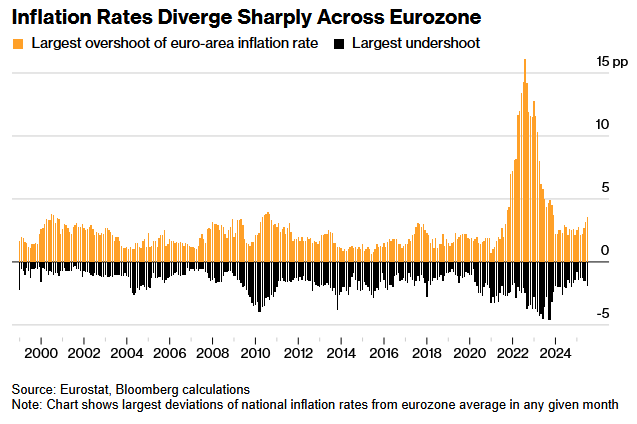
Core Viewpoint - The European Central Bank (ECB) is celebrating the stability of inflation in the Eurozone, with a current inflation rate of 2%, but significant disparities exist among member countries, complicating economic management [1][3]. Group 1: Inflation Rates Across Eurozone - In July, only Finland's inflation rate met the ECB's target of 2%, while other major economies like Germany, France, and Italy reported rates below this target [1]. - The gap in inflation rates among Eurozone countries has widened to 5.5 percentage points, up from a low earlier in the year, indicating increasing divergence in economic conditions [3]. - The ECB has maintained interest rates after eight consecutive cuts, with President Lagarde expressing confidence in the stability of inflation at the target level [3]. Group 2: National Central Bank Perspectives - The Greek central bank governor indicated a balance has been achieved between inflation, banking development, and economic growth, suggesting a reluctance to lower rates further, with Greece's inflation at 3.7% [4]. - The Spanish central bank governor emphasized patience in decision-making, with Spain's inflation at 2.7% [4]. - The French central bank governor highlighted the importance of keeping future decisions open, as France's inflation rate has been below 2% for nearly a year, currently at 0.9% [4]. Group 3: Future Inflation Predictions - Predictions indicate that the average inflation rate in the Eurozone is expected to reach 2% by 2027, but only three countries are projected to meet this target [6]. - Service inflation has consistently outpaced overall inflation for two years, driven by recent wage growth, with the current gap exceeding the historical average [9]. - Factors such as a strong euro, influx of cheap goods from countries facing high U.S. tariffs, and weakened export demand may lead to lower-than-expected price growth in the future [12].