
中证1000期权

Search documents
大越期货商品期权日报-20260224
Da Yue Qi Huo· 2026-02-24 05:05
1. Report Industry Investment Rating - No information provided about the report industry investment rating 2. Core Viewpoints - No core viewpoints are explicitly presented in the provided content 3. Summary by Relevant Catalogs 3.1 Option Quotes - **Call Options**: The daily percentage changes of call options for various commodities are as follows: Douyi (32.30%), eggs (30.29%), apples (25.74%), logs (22.22%), Douer (17.11%), soybean meal (16.82%), lithium carbonate (16.71%), industrial silicon (13.50%), rapeseed meal (12.93%), and polysilicon (12.47%) [1] - **Put Options**: The daily percentage changes of put options for various commodities are as follows: liquefied petroleum gas (58.13%), pure benzene (44.28%), iron ore (43.87%), asphalt (38.57%), crude oil (34.53%), plastic (33.22%), styrene (32.76%), polypropylene (29.60%), gold (29.06%), and silver (26.41%) [1] 3.2 Option Positions - **Call Options**: The daily changes in call option positions for various commodities are as follows: methanol (16,193), Douyi (12,028), glass (8,384), cotton (7,740), soda ash (7,737), PTA (7,334), coking coal (6,456), palm oil (5,177), p - xylene (4,784), and lithium carbonate (4,133) [2] - **Put Options**: The daily changes in put option positions for various commodities are as follows: soda ash (16,344), Douyi (13,372), soybean meal (11,655), PTA (10,736), cotton (6,508), glass (4,875), corn (4,536), caustic soda (4,488), lithium carbonate (3,790), and iron ore (3,618) [2] 3.3 Option Position Put - Call Ratio (PCR) - **High - PCR Varieties**: Apple (1.9784), short - fiber (1.0889), Douyi (1.0463), cast aluminum alloy (0.9924), rapeseed meal (0.9845), bottle chips (0.9752), ferrosilicon (0.9579), silver (0.9331), propylene (0.9331), and iron ore (0.9248) [5] - **Low - PCR Varieties**: Alumina (0.2472), red dates (0.3004), live pigs (0.3043), soda ash (0.3172), logs (0.3895), coking coal (0.4008), PVC (0.4469), industrial silicon (0.4522), ethylene glycol (0.4582), and rebar (0.4898) [5] 3.4 Option Trading Volume Put - Call Ratio (PCR) - **High - PCR Varieties**: Asphalt (1.4194), silver (1.4077), synthetic rubber (1.232), iron ore (1.1115), styrene (1.1066), copper (1.0804), tin (1.0511), ferrosilicon (0.9963), palladium (0.9538), and plastic (0.9515) [6] - **Low - PCR Varieties**: Red dates (0.2179), caustic soda (0.3295), coking coal (0.3411), urea (0.3623), liquefied petroleum gas (0.3778), ethylene glycol (0.3851), industrial silicon (0.3923), Douyi (0.3963), live pigs (0.4195), and offset printing paper (0.4286) [6] 3.5 Daily Selections - **Call Options**: Recommended call options include apple (AP605C10000), Douyi (a2605 - C - 4750), urea (UR605C1860), corn (c2605 - C - 2320), corn starch (cs2605 - C - 2650), soybean meal (m2605 - C - 2800), cotton (CF605C14800), and rapeseed meal (RM605C2325) [7] - **Put Options**: Recommended put options include ethylene glycol (eg2605 - P - 3500), ferrosilicon (SF605P5200), soda ash (SA605P1080), rapeseed oil (OI605P8700), PVC (v2605 - P - 4750), palm oil (p2605 - P - 8300), manganese silicon (SM605P5600), and iron ore (i2605 - P - 730) [7] 3.6 Near - Expiry Options - **Call Options**: For near - expiry call options, details such as remaining days, option closing prices, underlying settlement prices, break - even points, and break - even price increases are provided for various commodities like apple, p - xylene, liquefied petroleum gas, etc [8][9] - **Put Options**: For near - expiry put options, details such as remaining days, option closing prices, underlying settlement prices, break - even points, and break - even price decreases are provided for various commodities like apple, p - xylene, liquefied petroleum gas, etc [8][9]
大越期货商品期权日报-20260213
Da Yue Qi Huo· 2026-02-13 03:11
Report Summary 1. Report Industry Investment Rating No information provided in the given content. 2. Core View of the Report No information provided in the given content. 3. Summary by Relevant Catalogs Option Quotes - Urea and synthetic rubber had the highest daily price increases among call and put options, with 55.56% and 86.88% respectively [1]. - Other notable increases included 52.40% for soybeans (call) and 34.23% for ferrosilicon (put) [1]. Option Positions - Glass had the largest daily change in call option positions at 21,671, while glass also had a significant change in put option positions at 15,422 [2]. - Other significant changes included 11,392 for soda ash (call) and 12,690 for soybeans (put) [2]. Option Position Put - Call Ratio (PCR) - Apple had the highest position PCR at 1.838, while soda ash had the lowest at 0.2721 [5]. Option Volume Put - Call Ratio (PCR) - Ferrosilicon had the highest volume PCR at 1.4399, while ethylene glycol had the lowest at 0.2174 [6]. Daily Selections - For call options, soybeans (a2605 - C - 4750) had a trend degree of 53 and a put - call ratio of 1.03 with 64 days remaining [7]. - For put options, ferrosilicon (SF605P5200) had a trend degree of - 55 and a put - call ratio of 0.95 with 60 days remaining [7]. Near - Expiry Options - For call options, casting aluminum alloy (ad2603C22200) needed a 0.64% increase in the underlying price to break even and a 1.03% increase for the option to double, with 1 day remaining [8][9]. - For put options, silver (ag2603P21100) needed a 2.83% decrease in the underlying price to break even and a 5.53% decrease for the option to double, with 1 day remaining [9][10].
市场环境因子跟踪周报(2025.12.19):贵金属行情火热,权益等待春季行情-20251224
HWABAO SECURITIES· 2025-12-24 11:53
- The report tracks various quantitative factors across equity, commodity, options, and convertible bond markets, providing insights into market trends and factor performance during the week of December 15-19, 2025[3][9][24] - **Equity Market Factors**: - **Market Style**: The market showed a slight preference for large-cap and value styles, reversing the trend from the previous week[10][12] - **Market Structure**: Industry excess return dispersion and rotation speed increased, while the proportion of rising constituent stocks decreased. Concentration in the top 100 stocks remained stable, and the top 5 industries saw a slight decline in transaction concentration[10][12] - **Market Activity**: Both market volatility and turnover rate continued to decline[11][12] - **Commodity Market Factors**: - **Trend Strength**: All sectors except the black sector showed an increase in trend strength[24][29] - **Volatility**: Volatility decreased in the precious metals and agricultural sectors but increased in other sectors[24][29] - **Liquidity**: Liquidity declined in the energy and agricultural sectors but slightly improved in other sectors[24][29] - **Basis Momentum**: Basis momentum increased in the energy and black sectors but decreased in other sectors[24][29] - **Options Market Factors**: - Implied volatility for both the SSE 50 and CSI 1000 rebounded from low levels. The skew of call and put options for the SSE 50 decreased, while the skew of put options for the CSI 1000 continued to rise, indicating risk release in large-cap stocks and risk accumulation in small-cap stocks[32][36] - **Convertible Bond Market Factors**: - The market stabilized and recovered, with transaction volume exceeding the median level of the past year. The premium rate for bonds priced at 100 yuan reached a new annual high, while the proportion of low premium rate bonds continued to decline[34][38][40]
贵金属行情火热,权益等待春季行情——市场环境因子跟踪周报(2025.12.19)
华宝财富魔方· 2025-12-24 09:35
Market Overview - A-shares remain stable with controllable risks, suggesting opportunities for low-cost investments in high-prosperity sectors. The macro strategy team indicates that market enthusiasm for chasing high prices is still weak, but the index remains relatively stable, expected to maintain a fluctuating structure with controllable risks. Signs of market stabilization have become more apparent since December, particularly in high-prosperity sectors that have shown resilience. It is recommended to preferentially invest in industries with upward trends in prosperity and patiently await the upcoming spring market [1][4][6]. Stock Market Factors - Last week, market style shifted slightly towards large-cap stocks, with a value-oriented approach gaining traction compared to the previous week. The volatility of both large-cap and value-growth styles remained low. The dispersion of excess returns among industries and the speed of industry rotation have reversed, showing an increase, while the proportion of rising constituent stocks has decreased. The trading concentration of the top 100 stocks remained stable, with a slight decline in the trading concentration of the top five industries [6][8]. Commodity Market Factors - In the commodity market, all sectors except for the black metal sector showed an upward trend in strength. The efficiency coefficients for precious metals, non-ferrous metals, and agricultural products remained high. The basis momentum for precious metals saw a significant decline, while the basis momentum for energy and black metal sectors increased. Volatility increased in all sectors except for precious metals and agricultural products, and liquidity decreased in the energy and agricultural sectors, while other sectors saw a slight increase [20][21]. Options Market Factors - The implied volatility of the Shanghai Stock Exchange 50 and the CSI 1000 rebounded from low levels last week. In terms of volatility skew, both call and put options for the Shanghai index decreased, while the put option skew for the CSI 1000 continued to rise, indicating that the market has experienced some risk release, with small-cap styles still accumulating risks [29]. Convertible Bond Market Factors - The convertible bond market stabilized and showed signs of recovery last week. The valuation of bonds reached a new high for the year in terms of the premium rate for conversion at 100 yuan, maintaining a trend of oscillation and increase. The pure bond premium rate for debt-type groupings saw a slight increase, while the proportion of low premium conversion bonds continued to decline, remaining at a low level. Market transaction volume rebounded, surpassing the historical median for the past year [31].


海纳百川有容乃大——第十九届全国期货(期权)实盘交易大赛总结报告
Qi Huo Ri Bao Wang· 2025-11-17 00:52
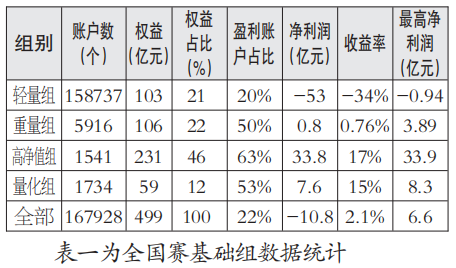
Core Insights - The 19th National Futures (Options) Trading Competition saw a total of 167,928 participating accounts, with total equity reaching 49.9 billion yuan, marking an increase of 11.22% compared to the previous competition [4][5][6] - Professional traders demonstrated a significant advantage, with over half of the profits coming from them, while smaller traders faced increased losses [1][11] - The competition highlighted a shift towards institutionalization in the trading landscape, with high-net-worth and quantitative groups showing substantial profitability [35][36] Participation and Equity - The total number of participating accounts increased by 3.91% compared to the last competition, with the high-net-worth group seeing a growth of 5.84% [4][5] - Total equity peaked at 52.2 billion yuan during the competition, with 499 billion yuan recorded at the end [4][6] - The average equity per account in the high-net-worth group rose to 15.01 million yuan, an increase of 206,000 yuan from the previous year [6] Profitability Analysis - The overall loss for the competition was 2.1%, a significant improvement from the previous year's loss of 5.2% [11][12] - The high-net-worth group achieved a profit of 33.8 million yuan, while the quantitative group made 7.6 million yuan, both marking their third consecutive year of profitability [9][11] - The lightweight group, however, recorded a loss of 53 million yuan, the highest in five years [9][11] Trading Volume and Performance - A total of 80 futures varieties were traded, with a transaction volume of 450 million contracts, and the top five by volume included glass, soda ash, and焦煤 [29][30] - The trading volume for the lightweight group accounted for 53% of total transactions, despite having a lower equity share [30] - The competition saw a notable increase in the number of accounts trading options, with 66,354 accounts participating, representing 39.51% of total accounts [28][33] Market Trends and Insights - The competition's profitability was closely tied to market trends, with participants capitalizing on bullish trends in precious metals and stock index futures [19][31] - The high-net-worth and quantitative groups displayed superior market handling, effectively mitigating the impact of market volatility on profits [21][36] - The competition served as a platform for talent development, with many successful participants being recruited by private equity and risk management firms post-competition [35][36]
【金融工程】市场波动加剧,但上行趋势不变——市场环境因子跟踪周报(2025.09.17)
华宝财富魔方· 2025-09-17 09:18
Group 1 - The recent stock market has experienced increased volatility, while the bond market shows signs of improvement but remains oscillatory. The optimistic expectation for the resumption of government bond trading operations has contributed to this recovery, with the ten-year government bond yield dropping below 1.75% [2][5] - The market style has slightly shifted towards small-cap stocks, with growth styles prevailing. The volatility of market styles has increased, while the volatility of value and growth styles has decreased [7][8] - In the commodity market, the strength of the non-ferrous and energy chemical sectors has increased, while the trend strength of other sectors remains stable. The basis momentum across all sectors has decreased [3][20][23] Group 2 - In the options market, the implied volatility of the Shanghai Stock Exchange 50 index remains stable, while the implied volatility of the CSI 1000 index has begun to decline. The market experienced a brief pullback in early September, particularly affecting small-cap stocks, but current sentiment has eased [28] - The convertible bond market showed a relatively flat performance, with the index primarily oscillating. The premium rate for convertible bonds remains stable, and the proportion of low premium convertible bonds has not changed significantly [30]

市场环境因子跟踪周报(2025.09.03):市场或有颠簸,但牛市不变-20250903
HWABAO SECURITIES· 2025-09-03 10:55
Quantitative Factors and Construction 1. Factor Name: Market Style Factor - **Construction Idea**: This factor tracks the relative performance and volatility of different market styles, such as large-cap vs. small-cap and value vs. growth styles, to understand market preferences and dynamics[10][12] - **Construction Process**: - **Style Performance**: Measure the relative returns of large-cap vs. small-cap stocks and value vs. growth stocks over the week - **Style Volatility**: Calculate the weekly changes in the volatility of these style returns - **Evaluation**: The factor effectively captures the market's preference for growth over value and the balanced performance between large-cap and small-cap stocks during the observed period[10][12] 2. Factor Name: Market Structure Factor - **Construction Idea**: This factor evaluates the dispersion of industry returns, the speed of industry rotation, and the concentration of trading activity to assess market structure and dynamics[10][12] - **Construction Process**: - **Industry Return Dispersion**: Compute the standard deviation of excess returns across industry indices - **Industry Rotation Speed**: Measure the rate of change in leading industries over the week - **Trading Concentration**: Calculate the proportion of total trading volume contributed by the top 100 stocks and the top 5 industries - **Evaluation**: The factor highlights an increase in industry return dispersion and trading concentration, indicating a more focused market structure[10][12] 3. Factor Name: Market Activity Factor - **Construction Idea**: This factor tracks market volatility and turnover rates to gauge overall market activity levels[11][12] - **Construction Process**: - **Volatility**: Measure the weekly changes in index-level volatility - **Turnover Rate**: Calculate the weekly changes in market turnover rates - **Evaluation**: The factor shows a rise in both market volatility and turnover, reflecting heightened market activity during the week[11][12] 4. Factor Name: Commodity Market Factor - **Construction Idea**: This factor monitors the strength of trends, basis momentum, volatility, and liquidity in commodity markets to understand their dynamics[19][25] - **Construction Process**: - **Trend Strength**: Assess the directional movement of commodity indices - **Basis Momentum**: Measure the changes in the basis (spot price vs. futures price) for energy and precious metals - **Volatility**: Calculate the weekly changes in commodity price volatility - **Liquidity**: Track the weekly changes in trading volume and bid-ask spreads - **Evaluation**: The factor indicates a decline in trend strength and volatility, while basis momentum for energy and precious metals increased, and liquidity showed a downward trend[19][25] 5. Factor Name: Option Market Factor - **Construction Idea**: This factor evaluates implied volatility, skewness, and discount rates in the options market to assess market sentiment and hedging activity[28] - **Construction Process**: - **Implied Volatility**: Track the implied volatility levels of the SSE 50 and CSI 1000 indices - **Skewness and Discount Rates**: Measure the skewness of put options and the implied discount rates for these indices - **Evaluation**: The factor reveals high implied volatility levels, with an increase in put skewness and discount rates for the CSI 1000 index, suggesting rising hedging activity and market divergence[28] 6. Factor Name: Convertible Bond Market Factor - **Construction Idea**: This factor examines the premium rates and trading activity in the convertible bond market to understand its dynamics[30] - **Construction Process**: - **Premium Rates**: Analyze the average premium rates for bonds with low conversion premiums - **Trading Activity**: Measure the weekly changes in trading volume - **Evaluation**: The factor shows an increase in the proportion of low-premium bonds and stable trading activity, indicating potential short-term adjustments in the market[30] --- Factor Backtesting Results 1. Market Style Factor - **Large-Cap vs. Small-Cap Performance**: Balanced[10][12] - **Value vs. Growth Performance**: Growth outperformed value[10][12] - **Style Volatility**: Large-cap/small-cap volatility decreased; value/growth volatility increased[10][12] 2. Market Structure Factor - **Industry Return Dispersion**: Increased[10][12] - **Industry Rotation Speed**: Peaked and then declined[10][12] - **Trading Concentration**: Increased for both top 100 stocks and top 5 industries[10][12] 3. Market Activity Factor - **Volatility**: Increased[11][12] - **Turnover Rate**: Increased[11][12] 4. Commodity Market Factor - **Trend Strength**: Declined[19][25] - **Basis Momentum**: Increased for energy and precious metals[19][25] - **Volatility**: Declined[19][25] - **Liquidity**: Declined[19][25] 5. Option Market Factor - **Implied Volatility**: High for SSE 50 and CSI 1000[28] - **Skewness and Discount Rates**: Increased for CSI 1000[28] 6. Convertible Bond Market Factor - **Premium Rates**: Low-premium bonds increased[30] - **Trading Activity**: Stable[30]
大类资产周报:避险资产领涨,波动率低位反弹-20250616
Guoyuan Securities· 2025-06-16 08:48
Market Overview - Global markets are dominated by geopolitical conflicts, particularly the Israel-Iran situation, leading to a surge in safe-haven assets like oil and gold, with Brent crude rising by 9% to $75.18 per barrel and gold surpassing $3,452 per ounce[4] - The VIX index has rebounded, indicating increased market volatility, while A-shares have shown a decline in price but an increase in trading volume, with small-cap growth stocks outperforming[4] Asset Allocation Recommendations - Bonds: Maintain a focus on leverage and duration strategies supported by loose monetary policy, while closely monitoring central bank liquidity operations and U.S. CPI data[5] - Overseas equities: Overweight non-U.S. market assets, such as Hong Kong and South Korean stocks, to capitalize on a weaker dollar and resilient fundamentals[5] - Commodities: Overall underweight due to weak supply and demand dynamics, with a focus on specific commodities like oil that may experience price fluctuations due to geopolitical tensions[7] Risk Factors - Key risks include policy adjustments, market volatility, geopolitical shocks, economic data validation risks, and liquidity transmission risks[6] Economic Indicators - The Chinese Business Conditions Index (BCI) recorded a slight increase to 50.30, indicating a marginal improvement but a significant drop from the March peak of 54.75, suggesting ongoing economic expansion challenges[40] - The Producer Price Index (PPI) expectations have reached new lows, indicating persistent price pressures at the production level, compounded by two consecutive months of negative CPI growth, reflecting weak consumer demand[49] Market Sentiment - The average daily trading volume in the A-share market increased by 13.1% to 1.341 trillion yuan, indicating heightened investor participation and a favorable liquidity environment for market valuation recovery[59] - The current valuation of A-shares is near historical averages, with the CSI 800's price-to-earnings ratio at the 48th percentile and price-to-book ratio at the 61st percentile, reflecting cautious optimism in economic fundamentals[64]
实值看涨期权的“低价买入+到期收敛”逻辑
Qi Huo Ri Bao Wang· 2025-06-09 00:40
Core Insights - The article discusses the strategy of buying in-the-money call options to capitalize on market mispricing in a deeply discounted futures market [1][5] - It highlights the characteristics of in-the-money options and their pricing dynamics, particularly in a market where option prices are below their intrinsic values [1][5] Pricing Characteristics - Discount refers to the state where futures prices are lower than spot prices, specifically in options, it indicates that option prices are below their intrinsic values [1] - For example, if the current index level is 6000 and the strike price of an in-the-money call option is 5500, the intrinsic value is 500 points, while the market price is only 484.8 points, indicating a pricing discrepancy of 15.2 points [1] Profit Pathway - As the option's expiration date approaches, the option price converges towards its intrinsic value, allowing investors to gain from the difference between intrinsic value and purchase cost if the discount is not fully corrected [2] - In-the-money call options have limited loss characteristics, where investors only lose the premium paid if the underlying asset declines significantly, unlike futures which can incur unlimited losses [2] - The Delta of deeply in-the-money call options is close to 1, meaning their price movements closely follow the underlying asset, providing dual profit opportunities from both price appreciation and discount correction [2] Risk and Trading Considerations - Time decay (Theta risk) can still affect in-the-money options, necessitating strict control over holding periods [3] - Liquidity risk may arise with certain deep in-the-money options due to low trading volumes, leading to wider bid-ask spreads or difficulties in closing positions [3] - Market sentiment can quickly shift, requiring timely profit-taking or adjustments in holding strategies based on market conditions [3] Case Study Analysis - A specific example involves buying a 5500 strike in-the-money call option with a market price of 484.8 points, where the intrinsic value is 544.2 points, indicating a discount of 59.4 points [4] - If the index remains at 6000 at expiration, the option value converges to 500 points, yielding a profit of 15.2 points; if the index rises to 6200, the profit increases to 200 points [4] - A hedging strategy can involve selling higher strike call options to reduce premium costs and lock in some profits [4] Conclusion - The strategy of buying in-the-money call options to "eat the discount" leverages market pricing discrepancies and convergence characteristics, offering controlled risk and significant leverage [5]
市场环境因子跟踪周报(2025.05.23):市场缩圈,小盘调整风险增加-20250528
HWABAO SECURITIES· 2025-05-28 13:13
- The report tracks various market environment factors, including stock market factors, commodity market factors, options market factors, and convertible bond market factors[1][3][6] Stock Market Factors 1. **Factor Name**: Market Style - **Construction Idea**: The factor tracks the performance of different market styles, such as large-cap vs. small-cap and value vs. growth[10] - **Construction Process**: The factor is constructed by analyzing the performance and volatility of different market styles. For example, the large-cap style is compared to the small-cap style, and the value style is compared to the growth style[10] - **Evaluation**: The large-cap value style is currently dominant, with increased volatility in both large-cap vs. small-cap and value vs. growth styles[10][12] 2. **Factor Name**: Market Structure - **Construction Idea**: The factor examines the structure of the market by analyzing industry index excess return dispersion, component stock rise ratio, and industry rotation speed[10] - **Construction Process**: The factor is constructed by measuring the dispersion of excess returns among industry indices, the proportion of rising component stocks, and the speed of industry rotation[10] - **Evaluation**: The dispersion of industry index excess returns and the proportion of rising component stocks have decreased, while the speed of industry rotation has also decreased[10][12] 3. **Factor Name**: Market Activity - **Construction Idea**: The factor tracks market activity by analyzing market volatility and turnover rate[11] - **Construction Process**: The factor is constructed by measuring the volatility and turnover rate of the market[11] - **Evaluation**: Market volatility remains low, and the turnover rate continues to decline[11][12] Commodity Market Factors 1. **Factor Name**: Trend Strength - **Construction Idea**: The factor tracks the strength of trends in different commodity sectors[25] - **Construction Process**: The factor is constructed by analyzing the trend strength in sectors such as energy, metals, and agriculture[25] - **Evaluation**: The energy and metals sectors show strong trends, while the trend strength in the precious metals sector is rising[25][29] 2. **Factor Name**: Basis Momentum - **Construction Idea**: The factor tracks the momentum of the basis in different commodity sectors[25] - **Construction Process**: The factor is constructed by measuring the basis momentum in sectors such as energy, metals, and agriculture[25] - **Evaluation**: Except for the agricultural sector, which has low basis momentum, other sectors have high basis momentum[25][29] 3. **Factor Name**: Volatility - **Construction Idea**: The factor tracks the volatility levels in different commodity sectors[25] - **Construction Process**: The factor is constructed by measuring the volatility levels in sectors such as energy, metals, and agriculture[25] - **Evaluation**: The energy sector has high volatility, while the metals and agricultural sectors have low volatility[25][29] 4. **Factor Name**: Liquidity - **Construction Idea**: The factor tracks the liquidity levels in different commodity sectors[25] - **Construction Process**: The factor is constructed by measuring the liquidity levels in sectors such as energy, metals, and agriculture[25] - **Evaluation**: Liquidity levels have decreased across all sectors[25][29] Options Market Factors 1. **Factor Name**: Implied Volatility - **Construction Idea**: The factor tracks the implied volatility levels of different options[35] - **Construction Process**: The factor is constructed by measuring the implied volatility levels of options on indices such as the SSE 50 and CSI 1000[35] - **Evaluation**: Implied volatility levels for both the SSE 50 and CSI 1000 options are rising[35] 2. **Factor Name**: Skewness - **Construction Idea**: The factor tracks the skewness of different options[35] - **Construction Process**: The factor is constructed by measuring the skewness of call and put options on indices such as the SSE 50 and CSI 1000[35] - **Evaluation**: The skewness of both call and put options on the SSE 50 has decreased, while the skewness of put options on the CSI 1000 remains higher than that of call options[35] Convertible Bond Market Factors 1. **Factor Name**: Valuation - **Construction Idea**: The factor tracks the valuation levels of convertible bonds[36] - **Construction Process**: The factor is constructed by measuring the premium rates of convertible bonds[36] - **Evaluation**: The premium rates of convertible bonds have slightly decreased, and the market activity has weakened[36] Factor Backtesting Results 1. **Market Style Factor**: Large-cap value style is dominant, with increased volatility in both large-cap vs. small-cap and value vs. growth styles[10][12] 2. **Market Structure Factor**: Decreased dispersion of industry index excess returns, decreased proportion of rising component stocks, and decreased speed of industry rotation[10][12] 3. **Market Activity Factor**: Low market volatility and declining turnover rate[11][12] 4. **Trend Strength Factor**: Strong trends in the energy and metals sectors, rising trend strength in the precious metals sector[25][29] 5. **Basis Momentum Factor**: High basis momentum in all sectors except agriculture[25][29] 6. **Volatility Factor**: High volatility in the energy sector, low volatility in the metals and agricultural sectors[25][29] 7. **Liquidity Factor**: Decreased liquidity levels across all sectors[25][29] 8. **Implied Volatility Factor**: Rising implied volatility levels for both SSE 50 and CSI 1000 options[35] 9. **Skewness Factor**: Decreased skewness for both call and put options on the SSE 50, higher skewness for put options on the CSI 1000 compared to call options[35] 10. **Valuation Factor**: Slightly decreased premium rates for convertible bonds, weakened market activity[36]