人工智能助手

Search documents
晶采观察丨增长5%!140万亿GDP背后的“质”变底气
Yang Guang Wang· 2026-01-21 10:33
Core Viewpoint - In 2025, China's GDP surpassed 140 trillion yuan, marking a 5.0% increase from the previous year, reflecting a stable and progressive economic performance under the "14th Five-Year Plan" [2][3]. Group 1: Economic Performance - The National Bureau of Statistics highlighted that the economic performance in 2025 can be summarized with the terms "stable, progressive, new, and resilient" [2]. - The R&D expenditure intensity reached 2.8%, exceeding the OECD average for the first time, indicating a strong commitment to innovation [3][4]. Group 2: Innovation and Technology - China ranked in the top ten globally for innovation index, with over 5 million valid invention patents, becoming the first country to achieve this milestone [4]. - The country maintained its position as the world leader in PCT international patent applications for six consecutive years, with a steady increase in high-value patents in key technology areas [4]. Group 3: Industrial Development - In 2025, the added value of equipment manufacturing and high-tech manufacturing accounted for 36.8% and 17.1% of the total industrial added value, respectively, indicating a shift towards high-end manufacturing [5]. - The production of civilian drones and industrial robots increased by 37.3% and 28%, respectively, showcasing the growth of the low-altitude economy and intelligent manufacturing [5]. Group 4: Digital Economy and Daily Life - The digital economy is rapidly advancing, with significant developments in artificial intelligence and robotics, leading to enhanced productivity and new job opportunities [5][6]. - Brain-computer interface technology is expected to see accelerated industrialization in 2025, expanding its application scenarios [6]. Group 5: Green Development - Daily production of new energy vehicles reached 45,000 units, contributing to a growing market share and lower costs for consumers [6]. - Traditional industries are experiencing reduced energy consumption levels, leading to more environmentally friendly building materials and products [6]. Group 6: Future Outlook - The cultivation of new productive forces and the benefits of reform are becoming increasingly evident, with emerging forces counteracting downward pressures on the economy [6]. - The commitment to strategic stability and adaptability is essential for continuing the modernization of China's economy [6].


增长5%!140万亿GDP背后的“质”变底气
Yang Guang Wang· 2026-01-21 08:23
Core Insights - In 2025, China's GDP surpassed 140 trillion yuan, achieving a growth rate of 5.0% compared to the previous year, marking a successful conclusion to the 14th Five-Year Plan and a strong start towards the second centenary goal [1] Group 1: Economic Performance - The economic performance of 2025 is characterized by stability, progress, innovation, and resilience, as summarized by the head of the National Bureau of Statistics [1] - The core driving force behind this performance is the emergence of new productive forces, which have integrated deeply into various aspects of production and daily life [2] Group 2: Innovation and R&D - R&D expenditure intensity increased to 2.8%, surpassing the OECD average for the first time, indicating a sustained commitment to innovation [2] - China ranked in the top ten globally for innovation index, with over 5 million valid invention patents, becoming the first country to reach this milestone [2] - The number of PCT international patent applications has ranked first in the world for six consecutive years, reflecting a steady expansion of high-value patents in key technology areas [2] Group 3: Technological Advancements - Significant technological achievements include the successful maiden flight of the "Nine Sky" drone, the launch of the Tianwen-2 mission, and the commissioning of the first electromagnetic catapult aircraft carrier, showcasing China's strides towards technological self-reliance [3] Group 4: Industrial Development - The digital economy is leading the development of new productive forces, with an average of 45,000 new energy vehicles produced daily and over 500 million express packages sent [5] - The added value of equipment manufacturing and high-tech manufacturing industries accounted for 36.8% and 17.1% of the total industrial added value, respectively [5] - The production of civilian drones and industrial robots increased by 37.3% and 28%, respectively, indicating robust growth in these sectors [5] Group 5: Digital Integration and Green Development - The integration of digital technologies into daily life is creating a "smart package," with brain-computer interface technology rapidly advancing and expanding its application scenarios [7] - The daily production of new energy vehicles reached 45,000, with over 50% market share, leading to more affordable and accessible options for consumers [7] - Traditional industries are experiencing reduced energy consumption levels, contributing to a more environmentally friendly living environment [7] Group 6: Economic Transition - The cultivation of new productive forces and the benefits of reform are becoming increasingly evident, with emerging forces helping to offset downward pressure and enhance upward momentum [8] - The high-quality development driven by new productive forces is seen as a guarantee for the modern industrial system and a testament to China's economic shift towards quality [10]
马斯克称10到20年内退休储蓄可能变得毫无意义
Xin Lang Cai Jing· 2026-01-11 23:48
Core Viewpoint - Elon Musk suggests that retirement savings may soon become meaningless due to advancements in AI, energy, and robotics that will significantly increase productivity and create abundant resources, leading to universal high incomes [1][3][4] Group 1: Future Predictions - Musk envisions a future where everyone can have anything they want, including better healthcare available to all within five years, and where goods and services are no longer scarce [1][3] - He warns that the transition to this utopian world will be bumpy, marked by significant changes and social upheaval [1][3] Group 2: Current Economic Context - Despite Musk's optimistic predictions, many Americans face a reality of persistent inflation, high interest rates, and stagnant wage growth, leading to a crisis of affordability [2][4] - Millions of people find the costs of obtaining a college degree, quality healthcare, housing, or starting a family to be prohibitively high, making a comfortable retirement seem out of reach [2][4] Group 3: Potential Risks of Musk's Advice - Musk's suggestion to not worry about saving for retirement may be seen as naive or even dangerous, as it could lead individuals to stop saving while the anticipated changes do not materialize, resulting in insufficient savings for retirement [2][4]

福特将于2028年推出首款“视线可脱离路面”驾驶辅助系统
Xin Lang Cai Jing· 2026-01-08 09:30
Core Viewpoint - Ford Motor Company announced plans to launch a Level 3 driver assistance system by 2028, allowing drivers to take their hands off the wheel and not focus on the road in specific highway segments [1][5]. Group 1: Technology and Product Development - The Level 3 system will first be integrated into a new electric vehicle platform developed by a specialized team in California, with the first model, a mid-size electric pickup, expected to launch in 2027 at a target price of $30,000 [1][6]. - The Level 3 system will not be a standard feature on the $30,000 model but will be offered as an optional add-on, with pricing details yet to be determined [2][6]. - Ford aims to develop the system in-house to reduce reliance on suppliers, lower costs, accelerate software updates, and improve product quality [2][6]. Group 2: Competitive Landscape - Other automakers, such as Mercedes-Benz and General Motors, are also developing Level 3 systems, with Mercedes already approved for use in certain states and GM planning a similar launch in 2028 with a starting price of over $125,000 [3][7]. - Tesla's CEO Elon Musk advocates for a camera-only approach to autonomous driving, while Ford's system will utilize lidar technology [7]. Group 3: Market Trends and Future Outlook - The driver assistance technology is seen as a precursor to fully autonomous vehicles, which could create significant new markets for ride-sharing fleets and personal autonomous vehicles [4][8]. - Ford is also planning to launch an AI assistant mobile app and a vehicle-integrated AI assistant, enhancing operational efficiency and user experience [4][8].

商界领袖认同人工智能是未来,但盼其当下就能派上用场
Xin Lang Cai Jing· 2025-12-16 11:55
Core Insights - The article discusses the challenges and limitations faced by companies in effectively implementing generative AI technologies, despite the initial hype and expectations surrounding them [1][2][14]. Group 1: AI Implementation Challenges - A survey by Forrester Research revealed that only 15% of executives reported AI improving profit margins in the past year, while only 5% believed AI provided widespread value to businesses [14]. - Companies are reassessing the speed at which generative AI can be effectively integrated into their operations, with predictions that about 25% of AI budgets will be delayed until 2026 [2][14]. - The tendency of AI models to cater to user preferences, known as "flattery bias," can undermine their ability to provide quality recommendations, as seen in the case of CellarTracker's wine recommendation feature [3][16]. Group 2: Human-AI Interaction - Companies like Klarna and Verizon are finding that while AI can handle simple tasks, complex customer interactions still require human involvement, with a significant percentage of consumers preferring to interact with human agents [19][20]. - AI's lack of empathy is identified as a key barrier to fully integrating AI into customer service roles, as customers often seek human interaction for more nuanced issues [22]. Group 3: Investment and Market Outlook - OpenAI's CEO indicated that the market for enterprise AI systems could reach $100 billion, highlighting the ongoing investment interest in AI technologies across various sectors [2][14]. - Experts warn that the current wave of investment in AI infrastructure could lead to a crisis similar to the early 2000s internet bubble if companies fail to find effective ways to leverage AI for revenue growth and innovation [15]. Group 4: AI Development and Support - Companies are increasingly focusing on developing tailored AI solutions for specific industries, as opposed to generic models, to create greater value [26]. - OpenAI is working on new products and support teams to help businesses effectively implement AI technologies, emphasizing the need for practical guidance in transforming AI tools into productive assets [26][12].
其实我们还没准备好面对人工智能代理的实际行动
3 6 Ke· 2025-11-10 01:24
Core Insights - The article discusses the transformative impact of AI agents on business operations, highlighting Klarna's successful deployment of an AI assistant that handled 2.3 million conversations in its first month, equivalent to the work of 700 full-time customer service representatives [1] - The author emphasizes that the advancements in AI are not just about technology but signify a fundamental change in work processes, with companies like Salesforce leading the charge with their Agentforce platform [3][9] Summary by Sections Klarna's AI Implementation - Klarna's AI assistant reduced problem resolution time from 11 minutes to under 2 minutes and decreased repeat inquiries by 25%, with customer satisfaction scores on par with human agents [1] - The company anticipates a profit increase of $40 million in 2024 due to this AI deployment [1] Salesforce's AI Agentforce - Salesforce launched its AI agent platform, Agentforce, which has shown impressive results, including a 15% reduction in average case handling time and a 22% increase in subscription user retention for Grupo Globo [3] - The platform has reached 12,000 clients, with a vision to empower 1 billion intelligent agents by the end of 2025 [3][9] Distinction of AI Agents - AI agents differ from traditional chatbots; they can autonomously observe, make decisions, and take actions without needing constant prompts from users [4][6] - These agents can handle complex tasks such as data extraction, analysis, and report generation in a single workflow [6][7] Market Growth and Adoption - The global AI agent market is projected to grow from $7.28 billion in 2025 to over $41 billion by 2030, with predictions that AI agents will manage 80% of digital workflows in customer service, IT, HR, and sales by 2030 [11] - Companies implementing AI agents report a 7.8% increase in productivity and a 30% reduction in time spent on repetitive tasks [11] Concerns and Future Outlook - There is a concern that the rapid development of AI technology may outpace the understanding of its implications and management [12][19] - Companies must learn to balance efficiency with the need for human interaction in complex situations, as demonstrated by Klarna's approach [8][12] - The article stresses the importance of preparing for the integration of AI agents into business processes and the need for training and structural changes within organizations [18][19]
美股异动 | NEBIUS(NBIS.US)涨超7% 传微软将使用其数据中心进行大语言模型开发
Zhi Tong Cai Jing· 2025-10-02 13:52
Core Viewpoint - NEBIUS (NBIS.US) has seen its stock price rise over 7%, reaching a historic high of $123.96, following news of a significant partnership with Microsoft (MSFT.US) [1] Group 1: Partnership Details - Microsoft has entered into a collaboration agreement with NEBIUS, which will provide computational power support for Microsoft's internal teams focused on developing large language models and consumer-facing AI assistants [1] - The value of the partnership agreement is reported to be as high as $19.4 billion [1]


NEBIUS(NBIS.US)涨超7% 传微软将使用其数据中心进行大语言模型开发
Zhi Tong Cai Jing· 2025-10-02 13:51
Core Viewpoint - NEBIUS (NBIS.US) has seen a significant stock price increase, opening over 7% higher and reaching a record high of $123.96, following news of a partnership with Microsoft (MSFT.US) [1] Group 1: Partnership Details - Microsoft has entered into a collaboration agreement with NEBIUS, which will provide computational power support for Microsoft's internal teams focused on developing large language models and consumer-facing AI assistants [1] - The value of the partnership agreement is reported to be as high as $19.4 billion [1]
智慧城市助力生活更美好
Ren Min Ri Bao· 2025-09-23 08:52
Group 1: Smart Community Development - The implementation of smart community construction in Longguang Jiulong Bay has significantly improved residents' safety and convenience through the use of technologies such as 5G, IoT, AI, big data, and cloud computing [1][2] - The community has deployed AI monitoring devices to address the issue of high-altitude objects being thrown, enhancing safety measures for residents [1] - A smart management platform has been established, integrating various functions such as repair management and access control, which has streamlined residents' requests and improved communication [2] Group 2: Smart Elderly Care - The establishment of the Jinchen Elderly Care Center in Jinan aims to meet the growing demand for elderly services, featuring 1,300 beds and a smart elderly care system [3][4] - The center includes safety features such as a pull cord alarm system and fall detection radar, which enhance the safety and health monitoring of residents [4] - Over 20 elderly care institutions in Lixia District have implemented smart elderly care systems, creating electronic health records for over 30,000 elderly residents [5] Group 3: AI in Healthcare - The integration of AI in healthcare at Ningbo University First Hospital has improved patient experience, reducing average visit times from 49 minutes to 28 minutes [6][7] - AI tools assist in pre-visit assessments and prescription audits, enhancing the efficiency of medical services [6] - The hospital has developed a comprehensive AI+medical ecosystem, utilizing deep learning models to optimize patient care and management [6][7] Group 4: Smart Waste Management - The introduction of smart waste sorting systems in Shenzhen has improved the efficiency of waste disposal and recycling, with over 600 smart recycling bins installed [8][9] - The system uses AI to assess the purity of waste and rewards residents for proper disposal, significantly increasing the accuracy of waste sorting from 60% to 90% [9] - Shenzhen's waste management initiatives have led to a daily separation of nearly 700 tons of kitchen waste, with a year-on-year increase of 40.17% in collection volume [9]
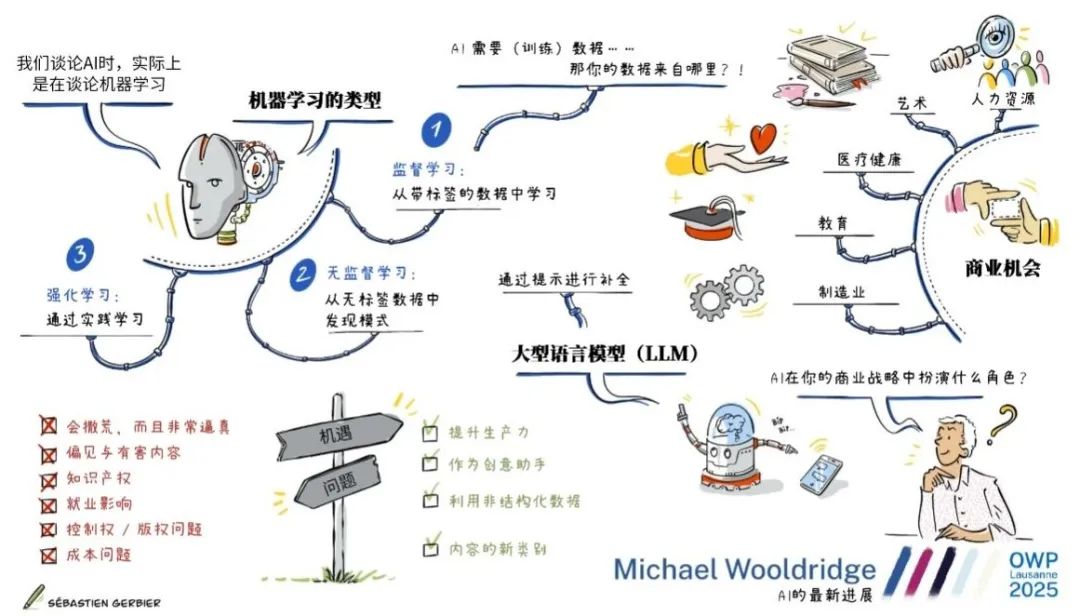
人工智能将为你预订假期,但暂时还不会帮你打扫厨房……
3 6 Ke· 2025-08-29 06:59
Group 1: Core Insights on AI Development - The advancement of artificial intelligence (AI) has reached a stage where large language models (LLMs) can engage in autonomous dialogue and problem-solving, yet achieving machines with true human-like intelligence remains a distant goal [1][6] - Despite the perception of AI being highly advanced, it still struggles to accurately replicate many fundamental human tasks, highlighting the limitations and risks that need to be addressed [1][6] - The most significant breakthrough in AI is its ability to analyze vast amounts of data to tackle complex problems and provide practical solutions, creating substantial opportunities for businesses and consumers [1][3] Group 2: AI Integration in Business Strategy - Executives should incorporate generative AI (GenAI) into workflows to save time and enhance efficiency, particularly in handling basic tasks like creating presentations [3] - LLMs can unlock hidden potential by extracting value from unstructured data accumulated in various computer systems, transforming emails, documents, and meeting notes into actionable insights [3] - LLMs also show promise in supporting creative work, generating numerous ideas for marketing campaigns, although the quality may vary [3][4] Group 3: Types of AI Assistants - Three categories of AI assistants are identified, each with increasing complexity and economic value: customer service assistants, automation process assistants, and collaborative assistants [4][6] - Customer service assistants can handle banking inquiries and modify account settings based on customer instructions [4] - Automation process assistants can provide personalized vacation plans and complete bookings using LLMs [4] - Collaborative assistants can solve problems through conversation, optimizing processes that require strict adherence to regulations [4] Group 4: Challenges and Risks of AI - AI usage presents significant flaws and risks that executives must be cautious of, including issues related to privacy, misinformation, bias, copyright, employment disruption, content pollution, and uncontrolled future developments [7][8] - The output from LLMs can often be misleading, producing seemingly credible but incorrect information, which poses a risk of misinformation [8] - The concentration of AI power among a few tech giants and government entities raises concerns about its impact on economic and democratic health [8][9]