
大唐

Search documents
比亚迪(002594):海内外经营表现韧性向上 三重周期共振发力在即
Xin Lang Cai Jing· 2026-03-30 02:36AI Processing
事件:3 月27 日,比亚迪发布2025 年业绩报告。公司2025 年全年营收8039.65 亿元,同比增长3.46%。 全年归母净利润326.2 亿元,同比下降19%。全年毛利1426.6 亿元,同比下降5.73%。 盈利预测:我们预测公司2026-2028 年实现营收9688/10792/12186 亿元,同比分别 +20.5%/+11.4%/+12.9%,实现利润470/580/700 亿元,同比分别+44.1%/+23.4%/+20.7%,对应PE 分别为 20x/17x/14x,维持"推荐"评级。 风险提示:出海销量不及预期,新车销量不及预期,新技术研发不及预期。 内需疲弱行业承压,公司经营指标略超预期。2025 年公司完成460.24 万台销量,其中海外销量实现 104.96 万台,Q4 公司海外销量占比提升至26%。 在内需承压情况下,公司ASP 持续上行,Q4 实现ASP17.7 万元,环比提升0.21 万元,同时环比市占率 不降反升:主品牌Q4 实现13.3%的国内市占率,环比Q3 基本持平,其中方程豹市占率Q4 达1.4%,首 次突破1%大关。全部四大品牌合计市占率达15.3%,环比Q3 ...

比亚迪 | 2025整装待发 2026出口加电【国联民生汽车 崔琰团队】
汽车琰究· 2026-03-30 01:21
Core Viewpoint - The company is expected to see revenue growth in the coming years, with a projected revenue of 921.9 billion yuan in 2026, reflecting a 14.7% increase from 2025, despite a decline in net profit for 2025 [10][11]. Revenue and Delivery - In Q4 2025, the company's revenue was 237.7 billion yuan, a year-on-year decrease of 13.5% but a quarter-on-quarter increase of 21.9%, primarily due to a significant rise in sales volume [3]. - The sales volume in Q4 2025 reached 1.342 million vehicles, down 11.9% year-on-year but up 20.5% quarter-on-quarter, with export sales showing a remarkable increase of 191.7% year-on-year [3]. Profitability - The overall gross margin in Q4 2025 was 17.4%, with a year-on-year increase of 0.4 percentage points, while the automotive and battery gross margin was 21.6%, up 1.8 percentage points year-on-year [4]. - The net profit attributable to the parent company in Q4 2025 was 9.29 billion yuan, down 38.2% year-on-year but up 18.6% quarter-on-quarter [5]. Electric Vehicle Technology - The company launched its second-generation blade battery and flash charging technology, achieving record charging speeds, which addresses key challenges in electric vehicle charging [6]. Export Growth - The company is expected to maintain its position as the leading exporter of Chinese electric vehicles, with exports in January-February 2026 reaching 201,000 units, a year-on-year increase of 50.8% [7]. Production and Sales - The company is making steady progress in building overseas factories, with significant milestones achieved in Brazil and Thailand, enhancing its global supply chain capabilities [8]. High-End Product Strategy - The company has seen a doubling in sales of its high-end brands, with continued strong performance in early 2026, indicating a successful high-end product strategy [9].


整车强势反弹-后市怎么看
2026-03-19 02:39
Summary of Conference Call Records Industry Overview - The automotive industry is experiencing a recovery in demand as of March 2026, with customer traffic nearing levels seen at the end of 2025, although still 10%-15% lower year-on-year [1][2] - The inventory pressure among leading new energy vehicle manufacturers is significant, with a combined inventory of approximately 900,000 units, and companies like BYD, Geely, and Leap Motor having inventory-to-sales ratios above 2.5 [1][3] Key Insights and Arguments - **BYD's Flash Charging Technology**: BYD's flash charging technology, which integrates "vehicle + charging pile + battery," is expected to drive monthly sales increases of 15,000 to 20,000 units for new models like the Yuan MAX [1][8] - **Xpeng's V2V22.0**: The launch of Xpeng's V2V22.0 has doubled store traffic, although order conversion rates still depend on word-of-mouth effects [1][2] - **Sales Forecasts**: Passenger car sales are expected to decline by over 10% in Q1 2026, with retail sales anticipated to remain flat or slightly decrease year-on-year due to purchasing power constraints [1][5] - **Export Trends**: Companies like SAIC, BYD, Chery, and Geely have competitive advantages in exports due to their own shipping fleets and established overseas channels [1][2] Market Dynamics - **Inventory Levels**: Major new energy manufacturers have high inventory levels, with BYD holding around 400,000 to 500,000 units, primarily in lower-end models. The inventory-to-sales ratio for BYD is expected to drop below 2.5 if March sales reach 220,000 to 250,000 units [3][4] - **Market Recovery Factors**: The recovery in the market is driven by local consumption subsidy policies and the impact of technology launch events, which have significantly increased customer traffic [2][3] - **Future Sales Expectations**: The overall passenger car market is expected to face challenges in Q1 2026, but a more vibrant market is anticipated in Q2 with numerous new product launches [5][6] Government Policies and Their Impact - The total amount for the 2026 consumer goods replacement subsidy is projected to be 250 billion yuan, which is expected to provide direct cash support for vehicle sales [6] - The extension of the personal consumption car loan interest subsidy policy may also support sales, but overall retail sales are expected to remain flat or slightly decrease [6] Competitive Landscape - **BYD vs. Geely**: BYD's rapid advancement in flash charging technology and ecosystem development is contrasted with Geely's slower progress in fast charging and energy supply networks [9][10] - **Emerging Players**: Companies like NIO and Leap Motor are highlighted as potential industry leaders due to their focus on core automotive manufacturing and competitive pricing strategies [14][15] Export Potential - **Leap Motor's Export Performance**: Leap Motor has shown strong export performance, with over 100,000 units exported, and has partnered with Stellantis for overseas expansion [15] Conclusion - The automotive industry is navigating a complex landscape of recovery, inventory management, and technological advancements, with significant implications for sales and market dynamics in 2026. The focus on new energy vehicles and competitive strategies will be crucial for companies aiming to capture market share in both domestic and international markets.
405批新车公告:800Km+竞逐升温,弗迪、宁德、中航等抓紧配套
高工锂电· 2026-03-17 10:19
Core Viewpoint - The article highlights the increasing competition in the electric vehicle (EV) market, focusing on advancements in battery technology, longer ranges, and faster charging capabilities, with a notable shift towards high-end models and significant changes in subsidy policies affecting market dynamics [1][4]. Group 1: New Vehicle Announcements - The Ministry of Industry and Information Technology announced 82 new vehicles, with 61 models equipped with LFP batteries and 18 with ternary batteries, indicating a strong presence of various battery technologies [1]. - BYD leads with 30 new models, primarily plug-in hybrid vehicles, making up 75% of its offerings in this announcement [1]. - CATL follows with new models including the D19 SUV and D99 MPV, showcasing its dual-core battery technology [2]. Group 2: Battery Technology and Performance - The latest models, such as the Huawei's AWE2026 showcased the Shangjie Z7 with a range of 905 km, indicating a trend towards higher capacity batteries [3]. - The competition among pure electric vehicles is intensifying, with ranges between 800-1000 km and fast charging capabilities exceeding 800V becoming the new standard [3]. Group 3: Market Trends and Future Projections - The proportion of B-class and above vehicles is projected to rise from 40.8% in 2023 to 51.4% by 2025, driven by new subsidy policies that favor higher-priced vehicles [4]. - By February 2026, C-class passenger vehicles are expected to account for 59% of market sales, indicating a shift towards the mid to high-end market segment [4]. - Major brands like Tengshi, Xiaomi, and BMW are launching 900 km pure electric models, primarily in the high-end segment, supported by leading battery suppliers [4].

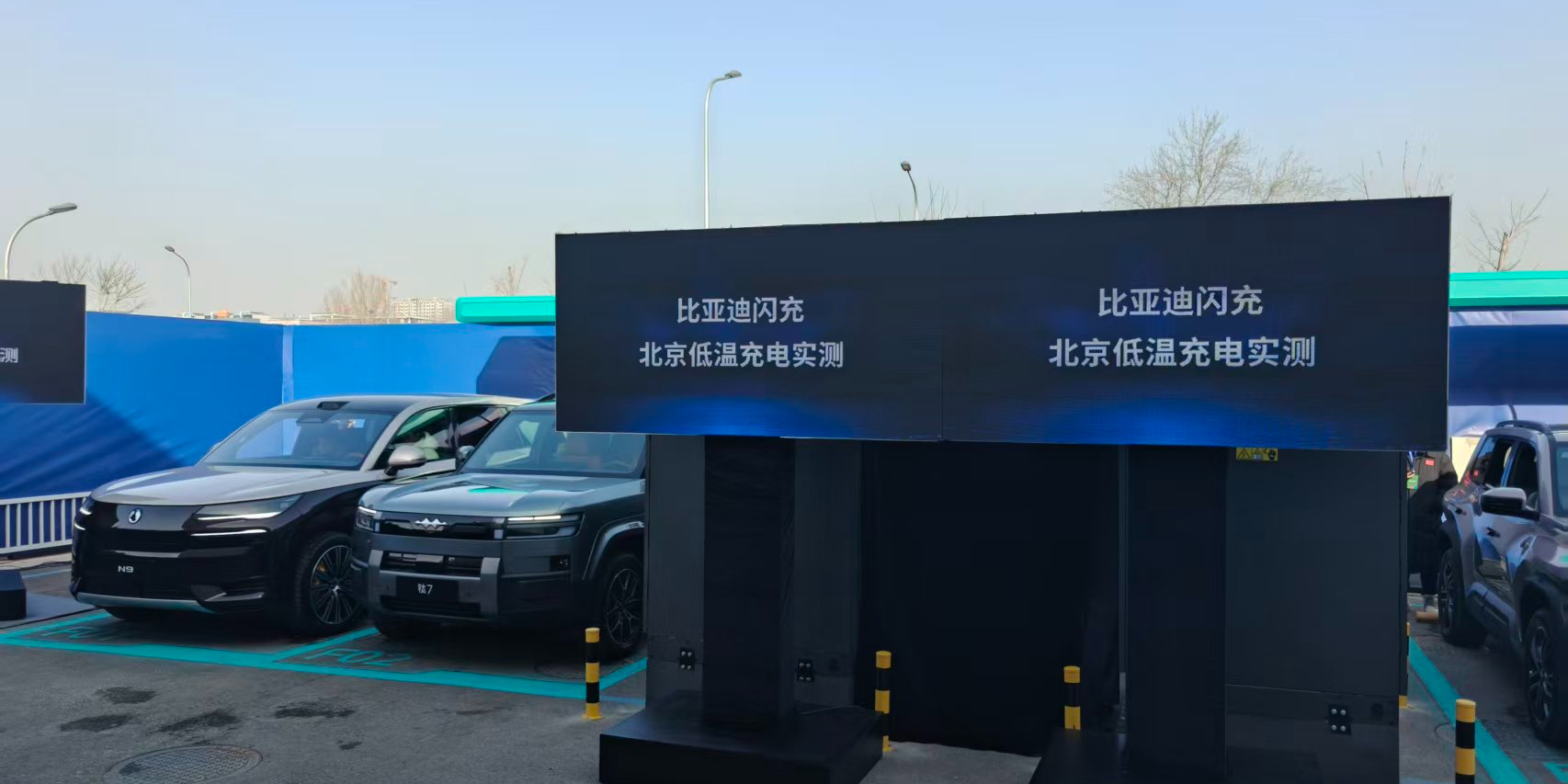
比亚迪第二代闪充北京实测:无“虚标”,充满最快9分42秒
Jing Ji Guan Cha Wang· 2026-03-17 02:52
Core Viewpoint - BYD's second-generation fast charging technology claims to charge an electric vehicle in 5 minutes for a partial charge and 9 minutes for a full charge, even in low temperatures, marking a significant advancement in charging efficiency [2] Group 1: Technology Performance - The second-generation fast charging technology was tested in Beijing on February 10, showcasing its performance in winter conditions with temperatures around zero degrees [2] - Eight BYD models participated in the test, with starting battery levels around 20%, charging to 97% capacity [2] - The fastest charging time recorded was 9 minutes and 42 seconds for the Song Ultra model, while the longest was 10 minutes and 22 seconds for the Tengshi N9 model [2][6] Group 2: Industry Impact - The second-generation fast charging technology addresses the common issue of long charging times for electric vehicles, especially in winter when charging efficiency typically decreases [2] - This technology significantly reduces charging anxiety for electric vehicle owners, bringing charging times closer to traditional fuel refueling times [7] - The advancement is expected to promote the growth of the electric vehicle industry, particularly increasing market penetration in northern regions [7]
比亚迪股份(1211.HK):第二代刀片电池和兆瓦闪充2.0发布 定义补能效率新基准
Ge Long Hui· 2026-03-11 04:55
Core Insights - BYD held a technology launch event showcasing its second-generation blade battery, MW Flash Charge 2.0, and integrated storage and charging system, along with the release of eleven new vehicle models across five brands [1][2] Group 1: Technology Advancements - The second-generation blade battery has a 5% increase in energy density compared to the first generation, enabling faster charging times: from 10% to 70% in 5 minutes and from 10% to 97% in 9 minutes at room temperature [1] - In extreme conditions (minus 20 degrees Celsius), charging from 20% to 97% can be completed in 12 minutes after the vehicle has been stationary for 24 hours [1] - BYD has enhanced battery technology to improve lifespan while implementing a lifetime warranty on battery cells [1] Group 2: Charging Infrastructure - BYD's flash charging station can reach a maximum charging power of 1500 kW and is compatible with existing fast charging stations [2] - The company plans to establish 20,000 flash charging stations nationwide by the end of 2026, including 18,000 mid-level and 2,000 high-speed stations [2] Group 3: New Vehicle Models - Eleven new models were launched, including the Tengshi Z9GT with a pure electric range exceeding 1,000 kilometers and a 0-100 km/h acceleration time of 2.7 seconds [2] - The Dynasty brand introduced the D-class SUV, Datang, which features a length of 5.3 meters and a wheelbase of 3.1 meters, equipped with flash charging technology and a range of 950 kilometers [2] Group 4: Market Performance and Outlook - BYD has made significant technological breakthroughs, enhancing the market penetration of electric vehicles and addressing core pain points such as charging efficiency [3] - Despite facing sales pressure in the domestic market, BYD's overseas business has shown strong growth, with a 41.4% year-on-year increase in overseas sales in February 2026, reaching 100,100 units [3] - The company expects to see an increase in profit margins as the share of overseas sales continues to rise [3]
招商证券:比亚迪股份二代刀片电池实现5分钟快充 维持“增持”评级
Zhi Tong Cai Jing· 2026-03-09 09:47
Core Viewpoint - BYD has launched its second-generation blade battery and fast-charging technology, significantly enhancing charging speed and efficiency, which is expected to strengthen its competitive advantage in the electric vehicle market [1][2] Group 1: Battery Technology - The new battery allows charging from 10% to 70% in 5 minutes and from 10% to 97% in 9 minutes, setting a new record for mass-produced vehicles [1] - The battery will be featured in 10 models, including the BYD Dynasty and Ocean series, with the Tengshi Z9GT achieving a range of 1,036 kilometers [1] - Performance improvements include enhanced charging in low temperatures, with charging from 20% to 97% taking about 12 minutes at -20 degrees Celsius [1] Group 2: Safety and Infrastructure - The new battery passed rigorous safety tests, including a 10-fold impact test without catching fire or exploding, and successfully completed 500 fast-charging cycles [1] - The company plans to implement the "Fast Charge China" strategy, aiming to build approximately 20,000 fast-charging stations by the end of 2026, with 4,239 already established [1] Group 3: Competitive Advantage - The significant technological advancements are expected to enhance BYD's competitive edge by improving charging efficiency and reducing the gap with fuel vehicles [2] - The vertical integration in battery technology, vehicle platforms, and charging networks is likely to strengthen BYD's technological moat and accelerate the launch of high-end models [2] - The new battery technology and product cycle are anticipated to improve market expectations and help BYD regain a differentiated competitive advantage amid temporary sales pressures [2]

比亚迪股份(01211):第二代刀片电池和兆瓦闪充2.0发布,定义补能效率新基准
BOCOM International· 2026-03-09 02:39
Investment Rating - The report maintains a "Buy" rating for BYD Company Limited (1211 HK) with a target price of HKD 133.00, indicating a potential upside of 43.63% from the current price [6][7]. Core Insights - BYD has made significant technological advancements with the launch of the second-generation blade battery and the MW Flash Charge 2.0, setting new benchmarks for charging efficiency. The second-generation blade battery has a 5% increase in energy density and allows for rapid charging, achieving 70% charge in just 5 minutes at room temperature [1]. - The company is expanding its electric vehicle lineup with 11 new models across its brands, including the Tengshi Z9GT, which boasts a pure electric range exceeding 1000 kilometers and a 0-100 km/h acceleration time of just 2.7 seconds [1]. - Despite facing sales pressure in the domestic market, BYD's overseas sales have shown robust growth, particularly in Southeast Asia, Latin America, and Europe, with a 41.4% year-on-year increase in overseas sales in February 2026 [1]. Summary by Sections Technological Advancements - The second-generation blade battery improves energy density by 5% and enhances charging speed, allowing for a 10% to 70% charge in 5 minutes and 20% to 97% in 12 minutes at -20 degrees Celsius [1]. - The MW Flash Charge 2.0 system supports charging power up to 1500 kW, with plans to establish 20,000 flash charging stations across China by the end of 2026 [1]. New Vehicle Launches - BYD introduced 11 new vehicles featuring the second-generation blade battery and flash charging technology, covering its entire brand matrix [1]. - Notable models include the Tengshi Z9GT with a range of 1036 kilometers and the D-class SUV, Datang, with a length of 5.3 meters and a range of 950 kilometers [1]. Market Performance - BYD's overseas sales reached 100,100 units in February 2026, marking a 41.4% increase year-on-year and surpassing 50% of total sales for the first time [1]. - The report anticipates that as overseas sales continue to grow, the company's profit margins are expected to improve [1].

刀片再出鞘,王传福能否杀出“逆风局”?
虎嗅APP· 2026-03-08 11:42
Core Viewpoint - BYD's second-generation blade battery and new fast-charging technology are expected to enhance charging efficiency significantly, potentially disrupting competitors like NIO [6][8]. Group 1: Product Launch and Technology - The second-generation blade battery was the highlight of BYD's technology launch, boasting a charging speed improvement of approximately 30% to 50% compared to existing models [6]. - Charging times for the new battery are notably reduced: from 10% to 70% in 5 minutes, and from 10% to 97% in 9 minutes, with minimal impact in low temperatures [9]. - The launch included 10 new models equipped with the second-generation blade battery and fast-charging technology, which are crucial for BYD's upcoming market strategy [15]. Group 2: Market Challenges and Strategy - BYD has faced a decline in domestic sales for three consecutive months, attributed to increased competition and a slowdown in technological advancement [13][14]. - The company is strategically reducing wholesale shipments to manage inventory and align production with the new product launch cycle [15]. - Despite current challenges, BYD aims to leverage its technological advancements to regain market momentum [15]. Group 3: Future Outlook and International Expansion - BYD's future growth is expected to be driven by international expansion, with a target of 1.3 million overseas sales by 2026 [20]. - The company has established production facilities in several countries, including Thailand and Brazil, and is planning further expansions in Hungary and Malaysia [19]. - The long-term goal is to position BYD as a global automotive leader, akin to Toyota, rather than solely dominating the domestic market [21].

比亚迪(002594):信息点评:\兆瓦闪充\直击补能痛点,驱动产品新周期
GUOTAI HAITONG SECURITIES· 2026-03-08 01:28
Investment Rating - The report maintains a "Buy" rating for BYD [2][6]. Core Views - The launch of the second-generation blade battery and flash charging technology addresses key pain points in energy replenishment and initiates a new vehicle cycle across all brands [2][12]. - The second-generation blade battery achieves a rapid charging speed, allowing 10%-70% charge in 5 minutes and 10%-97% in 9 minutes, significantly improving charging efficiency and performance in low-temperature conditions [12]. - BYD plans to establish 20,000 flash charging stations by the end of 2026, enhancing its charging network coverage in urban and highway areas [12]. - New models from all brands will feature the "megawatt flash charging + second-generation blade battery," with promotional offers to boost market penetration [12]. Financial Summary - Total revenue is projected to grow from 602.3 billion CNY in 2023 to 1,296.1 billion CNY in 2027, reflecting a compound annual growth rate (CAGR) of approximately 20% [4]. - Net profit attributable to shareholders is expected to increase from 30.0 billion CNY in 2023 to 62.6 billion CNY in 2027, with a notable growth of 80.7% in 2024 [4]. - Earnings per share (EPS) are forecasted to be 3.29 CNY in 2023, rising to 6.86 CNY by 2027 [4]. - The price-to-earnings (P/E) ratio is projected to decrease from 28.41 in 2023 to 13.64 in 2027, indicating improved valuation over time [4].