
招聘服务

Search documents
中国城市95后人才吸引力排名:2025
泽平宏观· 2026-03-24 16:07
Core Insights - The article emphasizes the importance of talent as a primary resource and innovation as a driving force for economic development, particularly focusing on the job-seeking trends of the post-95 generation in China [3][4]. Group 1: Characteristics of Post-95 Job Seekers - Approximately 260 million individuals belong to the post-95 generation (born between 1995-2009), with around 200 million in the labor age group (17-29 years) [11]. - Among job seekers, about 80% hold a college degree or higher, significantly surpassing the national average of 22.1% [11]. - The proportion of cross-city job seekers among the post-95 generation is about 50%, higher than the overall national average of 40% [11]. - Female job seekers in the post-95 group account for 43.6%, higher than the national average of 38.6%, indicating a trend of higher education and independence among young women [12]. - 61.5% of post-95 job seekers have a bachelor's degree or higher, compared to 53.7% of the overall job-seeking population [14]. - The IT industry attracts 21.5% of post-95 job seekers, indicating a preference for emerging industries over traditional sectors like real estate [16]. Group 2: Talent Attraction Rankings - The top cities for attracting post-95 talent are Shenzhen, Beijing, and Shanghai, with Shenzhen leading for three consecutive years [5][18]. - The report highlights that cities in the Yangtze River Delta and Pearl River Delta are particularly attractive to post-95 talent, with Shenzhen having a lower residency threshold and a robust job market [5][20]. - In the top 50 cities, 37 are located in the eastern region, indicating a strong preference for economically developed areas [19]. Group 3: Talent Flow Trends - By 2025, the net inflow of post-95 talent to eastern regions is projected to be 17%, higher than the national average of 13% [24]. - The net inflow of post-95 talent to first-tier cities is 16.9%, indicating a growing attraction compared to the overall talent flow [28]. - The five major city clusters show a net inflow of 13.3% for post-95 talent, significantly above the national average of 10.1% [31][32]. Group 4: Key Cities and Policies - Shenzhen's low residency requirements and supportive policies contribute to its high net inflow of post-95 talent, with a net inflow rate of 2.2% [34][35]. - Cities like Hangzhou and Suzhou are also noted for their strong attraction to post-95 talent, with Hangzhou's net inflow rate exceeding the national average by 0.5% [39]. - Tianjin has entered the top ten cities for post-95 talent attraction for the first time, aided by policies like the "Haihe Talent" initiative [41].


姑苏区启动春风行动暨就业援助季活动
Su Zhou Ri Bao· 2026-02-03 03:01
Group 1 - The core initiative "Spring Warm Heart" service activity was launched in Suzhou to support returning workers during the Spring Festival, providing practical gifts and festive blessings [1] - The event included one-stop services such as policy consultation and rights protection support, organized by various local departments [1] - The initiative is part of the "Spring Breeze Action" and aims to enhance employment services through activities like enterprise visits and labor cooperation [1] Group 2 - A New Year job fair was held, featuring 8 companies and 24 positions, offering 176 quality job opportunities across various industries [2] - Online job promotion activities were conducted, allowing job seekers to secure positions from home, alongside one-stop services from skill training schools and entrepreneurial incubators [2] - An AI-themed training session was conducted to provide employment experience for job seekers, particularly targeting those facing employment difficulties [2] Group 3 - During the Spring Breeze Action, 38 skill training courses will be offered through online platforms and local institutions, covering practical skills from pastry making to AI applications [3] - The district plans to optimize public recruitment services with over 40 recruitment events, providing more than 10,000 job positions [3] - The initiative aims to ensure seamless transitions for employment and production before and after the holiday, facilitating connections between employers and job seekers [3]
中国城市人才吸引力排名:2025
泽平宏观· 2026-01-26 16:05
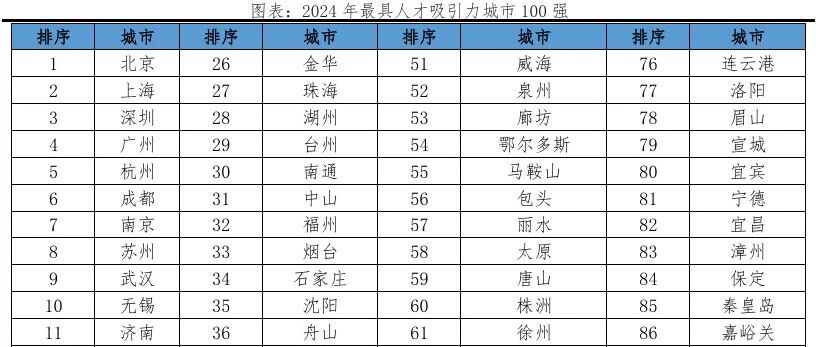
Core Insights - The article emphasizes the ongoing trend of talent migration towards major cities and metropolitan areas in China, highlighting the importance of population and talent as fundamental resources for economic activities. The 2024 talent flow continues to show a trend of differentiation [1][4]. Group 1: Data Overview - Zhilian Recruitment has over 374 million workplace users, with approximately 80% holding a college degree or higher, significantly above the national employment population average of 22.1%. About 25% of job seekers are cross-city job seekers [1][9]. - In 2024, male talent constitutes 61% of the mobile talent pool, higher than the overall job seeker demographic of 56% [2][10]. - Among mobile talent, 67% are aged 18-30, surpassing the overall job seeker demographic of 61%, indicating younger individuals are more likely to seek cross-city employment [3][13]. - 54% of mobile talent hold a bachelor's degree or higher, compared to 47% of the overall job seeker population, suggesting that higher-educated individuals are more inclined to move across cities [3][16]. - In 2024, 55% of mobile talent are distributed across the IT, real estate, and manufacturing sectors, a slight decrease of 0.5 percentage points from 2023 [3][17]. Group 2: Talent Attraction Rankings - The top three cities for talent attraction in 2024 remain Beijing, Shanghai, and Shenzhen, with no changes in ranking from 2023. The top ten cities include Guangzhou, Hangzhou, Chengdu, Nanjing, Suzhou, Wuhan, and Wuxi [4][21]. - The talent attraction index is defined by factors such as talent inflow and outflow ratios, indicating that eastern cities continue to attract talent while central and western regions experience net outflows [4][20]. - In 2024, over 60% of talent flows towards five major city clusters, with the Yangtze River Delta and Pearl River Delta continuing to attract talent [4][30]. Group 3: Key Cities Analysis - In first-tier cities, the net inflow of talent in Beijing, Shanghai, and Guangzhou has slightly decreased, while Shenzhen remains stable. The net inflow percentages for these cities are 0.4%, 1.3%, 1.2%, and 0.8% respectively [5][36]. - In second-tier cities, Hangzhou leads with a net inflow of 1.3%, followed by Chengdu, Nanjing, Suzhou, Wuhan, and Wuxi, with stable or slightly increasing net inflow percentages [6][72]. - Hangzhou's talent net inflow remains above 1.2% over the past five years, driven by rapid development in sectors like smart IoT and biomedicine [6][77].
商社2026年年度策略报告:周期复苏与AI创新的共振-20251214
CAITONG SECURITIES· 2025-12-14 11:54
Group 1: Retail and Service Industry Insights - The report highlights a recovery in the hotel and duty-free sectors, suggesting that the hotel prices have gradually increased since the second half of this year, with a recommendation to focus on hotel stocks such as Huazhu Group, Jinjiang Hotels, and ShouLai Hotels [6][12][17] - Duty-free sales are showing signs of bottoming out, with new policies implemented to expand the range of duty-free products and eligible consumers, leading to a significant increase in sales figures [12][15][16] - The report emphasizes the importance of service consumption policies, particularly in the context of the ice and snow economy, silver-haired economy, and sports events, recommending investments in companies like Changbai Mountain and Sanchuan Tourism [26][28][29] Group 2: AI Applications in Various Industries - The report discusses the acceleration of AI applications in the education and human resources sectors, with companies like Keri International and Beijing Renli leveraging AI to enhance recruitment efficiency [39][44] - AI's integration into 3D printing and e-commerce is highlighted, with a focus on companies like Huina Technology and Xiaogoods City, which are expected to benefit from cost reductions through full-chain penetration [6][39] - The report notes that AI applications are driving significant changes in operational efficiency and commercial opportunities across various sectors, particularly in human resources [39][44] Group 3: Beauty and Personal Care Sector - The beauty and personal care industry is experiencing a mild recovery, with domestic brands showing strong performance during the Double Eleven shopping festival, indicating a shift in competitive dynamics [6][32] - The report identifies key players in the beauty sector, recommending brands like Mao Ge Ping and Shanghai Jahwa, while also suggesting a focus on high-growth segments within the industry [6][32] - The medical beauty sector is under pressure but is seeing consolidation and innovation, with recommendations for companies like Jinbo Biological and Kedi-B [6][32] Group 4: Jewelry and Precious Metals - The jewelry sector is undergoing a transformation, with a focus on overseas expansion as a second growth curve, recommending companies like Laopu Gold and Chaohongji [6][32] - The report emphasizes the importance of high-value jewelry products and the impact of new tax regulations on the market dynamics [6][32] Group 5: Food and Beverage Industry - The food and beverage sector is witnessing a shift, with a focus on leading brands expanding their store counts and product categories, particularly in the tea and dining segments [32][38] - The report highlights the competitive landscape in the restaurant industry, noting the resilience of Western fast food and the growth of Chinese casual dining brands [32][38]


北京人力(600861):25 年三季报点评:积极拥抱技术变革,经营持续稳健
Haitong Securities International· 2025-11-14 08:12
Investment Rating - The report maintains an "Outperform" rating for the company, with a target price set at 35.6 RMB, reflecting a potential upside of 34% [5][8]. Core Insights - The company is expected to achieve net profits attributable to shareholders of 1.11 billion RMB in 2025, 1.01 billion RMB in 2026, and 1.12 billion RMB in 2027, with significant growth driven by non-recurring gains from the transfer of shares in Beijing Urban-Rural Commercial (Group) Co., Ltd. [5][9]. - Despite a slight decline in revenue in Q3 2025 due to macroeconomic factors, the company demonstrated resilience, with a year-on-year revenue of 11.12 billion RMB, down 1.74% [9][11]. - The company has effectively controlled costs, with a decrease in sales expense ratio to 1.09% and general and administrative expense ratio to 1.89% in Q3 2025 [11]. Financial Summary - Total revenue projections for the company are as follows: 38.31 billion RMB in 2023, 43.03 billion RMB in 2024, 46.82 billion RMB in 2025, 52.66 billion RMB in 2026, and 57.44 billion RMB in 2027, reflecting growth rates of 18.5%, 12.3%, 8.8%, 12.5%, and 9.1% respectively [2][4]. - Net profit attributable to shareholders is projected to be 548 million RMB in 2023, 791 million RMB in 2024, 1.11 billion RMB in 2025, 1.01 billion RMB in 2026, and 1.12 billion RMB in 2027, with growth rates of 32.2%, 44.4%, 40.0%, -8.9%, and 10.6% respectively [2][4]. - The earnings per share (EPS) is expected to increase from 0.97 RMB in 2023 to 1.96 RMB in 2025, before slightly declining to 1.78 RMB in 2026 and recovering to 1.97 RMB in 2027 [2][4]. Operational Highlights - The company is leveraging AI technology to enhance its recruitment processes, achieving a fully digitized management system that reduces reliance on external platforms and improves recruitment efficiency [11]. - The timing of government subsidies has varied, impacting quarterly growth rates, with significant amounts recorded in different quarters of 2024 and 2025 [10].

城市24小时 | “贴身”竞速,辽宁靠什么守位?
Mei Ri Jing Ji Xin Wen· 2025-10-23 15:28
Economic Overview - Liaoning Province's GDP for the first three quarters reached 24,283.9 billion yuan, with a year-on-year growth of 4.3% [1] - The primary industry added value was 1,611.5 billion yuan (4.3% growth), the secondary industry 8,367.7 billion yuan (2.1% growth), and the tertiary industry 14,304.7 billion yuan (5.4% growth) [1] - Social retail sales totaled 7,866.0 billion yuan, growing by 4.1%, while fixed asset investment declined by 9.1% [1] Comparison with Yunnan - Yunnan Province's GDP for the same period was 23,518.47 billion yuan, also growing at 4.3%, but both provinces lagged behind the national average by 0.9 percentage points [1] - The economic gap between Liaoning and Yunnan has widened, with Liaoning's GDP adjusted to 32,612.7 billion yuan and Yunnan's to 31,534.1 billion yuan for 2024, a difference of over 1,000 billion yuan [2] Industrial Performance - Liaoning's industrial added value for large-scale industries grew by 2.2%, a decline from 3.5% in the first half of the year [2] - In the automotive sector, added value decreased by 5.4%, with total vehicle production down by 10.1%, while new energy vehicle production increased by 22.2% [2] - 24 out of 40 industrial categories in Liaoning saw year-on-year growth, indicating a growth rate of 60.0% [2] Strategic Initiatives - New energy vehicles have been identified as one of the ten strategic emerging industry clusters in Liaoning [3] - The establishment of the Shenyang Automotive Industry Investment Fund aims to focus on electrification, intelligence, and low-carbon directions within the automotive industry [3] Economic Goals - Liaoning's targets for the year include a GDP growth of over 5% and an industrial added value growth of over 4.5% [3] - Yunnan's goals are similar, aiming for a GDP growth of around 5% and a 7% increase in industrial investment [3]
agilon health(AGL) - 2025 FY - Earnings Call Transcript
2025-08-27 23:02
Financial Data and Key Metrics Changes - Revenue for FY 2025 was $165.2 million, down 22% from the prior year [17] - Net loss after tax was €2.9 million, an improvement from a €10 million loss in the previous year [17] - Operating expenses were reduced by £6 million through property consolidation and resizing support teams [17][18] - No dividend was declared for the year ending March 31, 2025, reflecting a prudent approach due to uncertain economic conditions [13][17] Business Line Data and Key Metrics Changes - AWF delivered improved profitability year on year despite a challenging environment [21] - Madison launched a greenfield health channel and secured a place on two key panels within the health sector [22] - Jackson Stone and Wellington were significantly impacted by government spending reductions [23] - Absolute IT was hardest hit nationally but retained key capabilities [23] Market Data and Key Metrics Changes - Unemployment rates reached 5.1% in March, reflecting a 53% increase over two years [25] - The labor market showed signs of strain, with a notable increase in tender activity and preferred supplier contract awards [29] - The contractor book reduced as clients implemented cost control measures [21] Company Strategy and Development Direction - The company is focused on financial sustainability, recovery, and growth, with an emphasis on maintaining operational capacity without compromising service quality [15][18] - Strategic focus on sectors with long-term robustness, including infrastructure, health, and professional services [20] - The company aims to leverage AI and digitization to enhance operational efficiency while maintaining a human touch in recruitment processes [42][43] Management's Comments on Operating Environment and Future Outlook - Management acknowledged the prolonged and challenging trading cycle but expressed optimism about future recovery [14][15] - The company is preparing for better economic conditions, with expectations for FY 2026 to be a year of rebuild and improved financial performance [25][44] - Management emphasized the importance of maintaining strong relationships with clients and focusing on high-value roles [30][32] Other Important Information - The company maintained a strong banking relationship with ASB, with facilities extending to April 2026 [18] - Continuous conversations with ASB are aimed at reducing net debt and improving gearing metrics [19] Q&A Session Summary Question: Concerns about capital and debt levels - A shareholder expressed concerns about the company's capital needs and suggested that more capital is necessary to navigate current challenges [67][68] - Management acknowledged the importance of retaining quality staff and emphasized that the company does not need to be capital intensive [82][84] Question: Impact of AI on service delivery - A shareholder inquired about how AI might fine-tune the company's processes and operations [92] - Management discussed the integration of AI into core operating platforms to enhance efficiency while maintaining a human touch in recruitment [43][96]

agilon health(AGL) - 2025 FY - Earnings Call Transcript
2025-08-27 23:00
Financial Data and Key Metrics Changes - Revenue for FY 2025 was $165.2 million, down 22% from the prior year [17] - Net loss after tax was €2.9 million, an improvement from a €10 million loss in the previous year [17] - Operating expenses were reduced by £6 million through property consolidation and resizing support teams [18] - No dividend was declared for the year ending March 31, 2025, reflecting a prudent approach due to uncertain economic conditions [17][13] Business Line Data and Key Metrics Changes - AWF delivered improved profitability year on year despite a challenging environment, focusing on efficiency and quality business [22] - Madison strengthened its position in mid-senior recruitments and launched a new health channel, securing a place on key panels [22][23] - Jackson Stone and Wellington were significantly impacted by government spending reductions, affecting permanent and contract hires [24] - Absolute IT faced the hardest hit nationally but retained key capabilities [24] Market Data and Key Metrics Changes - Unemployment rates reached 5.1%, a 53% increase over two years, reflecting a seismic shift in the labor market [26] - The labor market participation rate decreased, indicating potential underreporting of unemployment figures [28] - ANZ's business outlook showed a dip in employment intentions, indicating nervousness in hiring across sectors [30] Company Strategy and Development Direction - The company is focusing on high-value roles and longer-term contingent workforce solutions to provide clients with necessary flexibility [32] - There is a strategic emphasis on sectors with greater long-term robustness, such as infrastructure and health [21] - The company aims to leverage its scale as New Zealand's largest recruitment business to capture more opportunities [33] Management's Comments on Operating Environment and Future Outlook - Management acknowledged the prolonged and challenging trading cycle but emphasized a positive leadership approach [15] - The focus remains on financial sustainability, recovery, and growth, with expectations for better performance in FY 2026 and stronger in FY 2027 [26][50] - Management is preparing for an eventual economic rebound, despite current market instability [30][47] Other Important Information - The company is actively working on extending banking facilities with ASB to support growth and reduce interest costs [19] - There is a commitment to maintaining a strong banking relationship and avoiding delinquent debt [19] Q&A Session Summary Question: Concerns about capital requirements and company debt - A shareholder expressed concerns about the company's capital needs and suggested that additional capital could help address current challenges [72][74] - Management acknowledged the importance of retaining quality staff and emphasized that the company does not need to be capital-intensive [86][90] Question: Impact of AI on recruitment processes - A shareholder inquired about how AI might fine-tune recruitment processes and improve operational efficiency [96] - Management discussed ongoing digitization efforts and the integration of AI to enhance recruitment capabilities while maintaining the human touch [45][46]
百日千万招聘专项行动推出4个线上专场 2.7万余家用人单位参与
Ren Min Ri Bao· 2025-08-25 21:54
Group 1 - The core viewpoint of the article highlights the launch of a special recruitment initiative in China, which has attracted over 27,000 employers and generated recruitment demands exceeding 312,000 positions across various industries from August 18 to August 24 [1] Group 2 - In the machinery equipment sector, over 7,500 employers participated, offering positions such as system engineers, debugging engineers, CNC engineers, and welding engineers, with a recruitment demand exceeding 100,000 positions [1] - The cross-border e-commerce sector involved over 3,000 employers, providing roles like foreign trade business managers, foreign trade procurement specialists, sales representatives, and operation managers, with a recruitment demand exceeding 10,000 positions [1] - The healthcare sector saw participation from over 16,000 employers, offering positions for physicians, pharmacists, imaging technicians, and rehabilitation physicians, with a recruitment demand of 190,000 positions [1] - The automotive sector included over 700 employers, offering roles such as automotive assembly engineers, design engineers, and testing engineers, with a recruitment demand of 12,000 positions [1] - The "Employment Online" platform also organized live-streaming recruitment events featuring various industries, including manufacturing, transportation, warehousing, real estate, and business services, providing positions like quality engineers, process engineers, mechanical engineers, station attendants, real estate agents, and sales managers [1]
百日千万招聘专项行动推出机械设备等招聘专场
Xin Hua She· 2025-08-21 10:49
Core Points - The "Hundred Days, Millions of Jobs" recruitment initiative is being held from August 18 to August 24, focusing on four online recruitment sectors: machinery, cross-border e-commerce, healthcare, and automotive [1] - Over 27,000 employers are participating in the initiative, with recruitment demand exceeding 312,000 positions [1] Group 1: Machinery Industry - The machinery sector has organized over 7,500 employers, offering positions such as system engineers, PLC electrical engineers, debugging engineers, CNC engineers, and welding engineers, with a recruitment demand exceeding 100,000 positions [1] Group 2: Cross-Border E-Commerce - The cross-border e-commerce sector has organized over 3,000 employers, providing roles such as foreign trade business managers, foreign trade purchasing specialists, sales representatives, and operations managers, with a recruitment demand exceeding 10,000 positions [1] Group 3: Healthcare Industry - The healthcare sector has organized over 16,000 employers, offering positions such as physicians, pharmacists, imaging technicians, and rehabilitation physicians, with a recruitment demand of 190,000 positions [1] Group 4: Automotive Industry - The automotive sector has organized over 700 employers, providing roles such as automotive assembly engineers, design engineers, and testing engineers, with a recruitment demand of 12,000 positions [1] Group 5: Initiative Overview - The "Hundred Days, Millions of Jobs" initiative was launched on June 17, 2025, aiming to collect and develop millions of job postings, focusing on various laborers, especially recent graduates [1]