新增专项债券

Search documents
兼顾“稳增长”与“防风险” 开年以来地方债券发行加速
Zheng Quan Ri Bao· 2026-02-08 17:14
Core Insights - The issuance of local government bonds has accelerated significantly this year, reflecting a more proactive fiscal policy aimed at enhancing efficiency and effectiveness [1][2] - As of February 8, approximately 14,430 billion yuan in local bonds have been issued, marking a 127.7% increase compared to the same period in 2025 [1] - The bond issuance includes about 5,020 billion yuan in new special bonds and approximately 5,567 billion yuan in refinancing special bonds for replacing existing hidden debts, accounting for 34.8% and 38.6% of the total, respectively [1] Group 1 - The rapid increase in local bond issuance is intended to release fiscal funds early, ensuring the commencement of key infrastructure projects and investments in the public welfare sector [1][2] - The issuance of bonds is expected to alleviate short-term repayment pressures on local governments, providing more room for fiscal policy adjustments [1] - The focus of bond issuance is on new productive forces, public welfare infrastructure, and safety sectors, with improved efficiency in the issuance mechanism [2] Group 2 - In January alone, approximately 8,633 billion yuan in local bonds were issued, a 54.8% increase compared to January 2025 [2] - The January issuance included about 3,677 billion yuan in new special bonds and approximately 2,543 billion yuan in refinancing special bonds, representing 42.6% and 29.5% of the total, respectively [2] - The issuance strategy aims to balance growth stabilization, public welfare, and risk prevention, with a clear emphasis on preventing and mitigating hidden debt risks [2]
一季度地方债券计划发行规模超2万亿元
Zheng Quan Ri Bao· 2026-01-08 17:20
Core Viewpoint - The issuance of local government bonds in China is set to exceed 20 trillion yuan in the first quarter of 2023, reflecting a more proactive fiscal policy aimed at supporting economic stability and infrastructure investment [1][2]. Group 1: Bond Issuance Overview - On January 8, Ningbo issued a batch of local bonds, including 1 billion yuan in general bonds and 24.372 billion yuan in special bonds [1]. - As of January 8, the total planned issuance of local bonds across various regions for the first quarter is approximately 20,862 billion yuan, surpassing the 20 trillion yuan mark [1]. - Seven regions, including Sichuan, Shandong, Yunnan, and Hunan, plan to issue over 100 billion yuan each, with Sichuan leading at 188.7 billion yuan, followed by Shandong at 172.481 billion yuan and Yunnan at 145.136 billion yuan [1]. Group 2: Types of Bonds and Their Implications - In the first quarter, approximately 8,173 billion yuan of new bonds are planned for issuance, with 6,514 billion yuan designated as new special bonds and 12,689 billion yuan for refinancing bonds [2]. - Special bonds, which account for over 30% of the new bonds, are expected to directly supplement infrastructure investment funds [2]. - The issuance of special bonds is anticipated to have several highlights, including an accelerated issuance pace, optimized fund allocation towards urban village renovations and public infrastructure, and stricter project management and performance requirements to enhance the efficiency of investment [2].
2025地方债大盘点:首次突破10万亿,支持基建、楼市|财税益侃
Di Yi Cai Jing· 2026-01-08 12:27
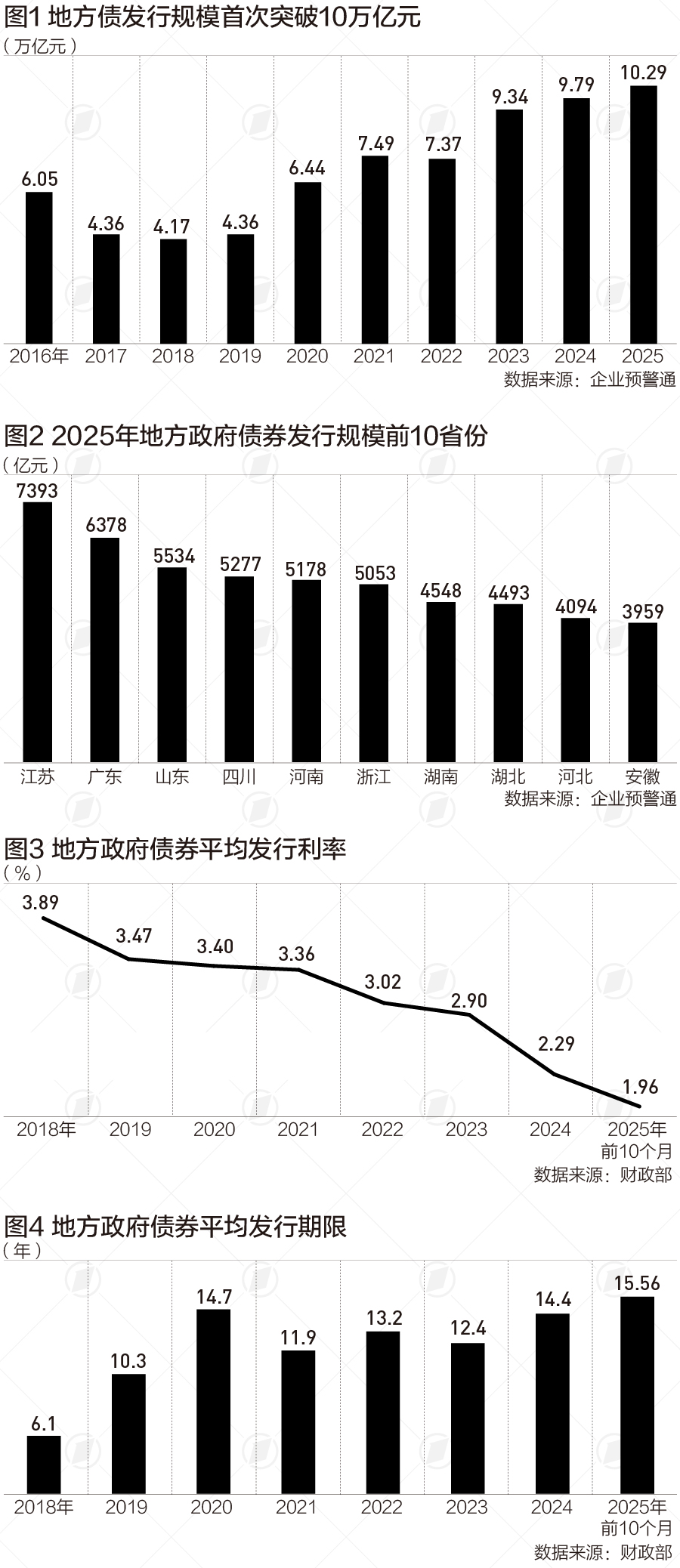
Core Viewpoint - The issuance of local government bonds in China reached a record high in 2025, with expectations for continued growth in 2026 to support economic stability and infrastructure projects [2][3][20]. Group 1: Bond Issuance Overview - In 2025, approximately 10.3 trillion yuan of local government bonds were issued, marking a 5.2% year-on-year increase and the first time the annual issuance exceeded 10 trillion yuan [3]. - The issuance included 5.37 trillion yuan of new bonds, a 13.9% increase, and 4.93 trillion yuan of refinancing bonds, which saw a 2.9% decrease [4]. - The average issuance interest rate for local government bonds fell below 2% for the first time, with extended maturities [16]. Group 2: Utilization of Bond Proceeds - The funds from new bonds were primarily allocated to major projects, with 26.5% directed towards municipal and industrial park infrastructure, 17% for land reserves, and 16.9% for transportation infrastructure [5]. - A significant portion of the new special bonds was used to support real estate projects, including land reserves and urban renewal, accounting for over 20% of the total [14]. - The issuance of special bonds for debt resolution reached 3.68 trillion yuan, an 8.8% increase, aiding in the replacement of hidden debts and improving local financial conditions [15]. Group 3: Debt Management and Innovations - The management of local government debt has been optimized, with pilot programs allowing for self-approval of special bond projects in select provinces, enhancing efficiency [19]. - The pilot provinces achieved a completion rate of 93% for new special bonds, significantly higher than non-pilot provinces [19]. - Recommendations for 2026 include maintaining a deficit rate above 4% and allocating approximately 5 trillion yuan for new special bonds to support infrastructure and strategic industries [20][21].

2026宏观经济十大看点
证券时报· 2026-01-05 00:25
Group 1 - The core viewpoint of the article emphasizes the focus on macroeconomic policies in 2026, highlighting the need for increased fiscal support and investment to stimulate economic growth [2][3][5]. Group 2 - Fiscal deficit and government bond issuance are expected to increase, with a projected fiscal deficit rate not lower than 4% and a deficit scale of at least 4.06 trillion yuan [2]. - The new special bonds limit may rise from 4.4 trillion yuan in 2025 to nearly 5 trillion yuan in 2026 to support major project construction [2]. - Monetary policy is anticipated to remain moderately loose, with a CPI target set around 2%, allowing for traditional monetary policy operations like rate cuts [3]. - The focus on expanding domestic demand, particularly through consumption, is highlighted as a primary task for 2026, with policies aimed at enhancing consumer purchasing power [5][6]. - Government investment is expected to play a crucial role in stabilizing fixed asset investment growth, with infrastructure investment set to accelerate due to new major projects [7]. - Real estate policies will focus on inventory reduction, with measures to optimize housing policies and increase support for home purchases [8][9]. - Capital market reforms will aim to deepen investment and financing reforms, enhancing support for technology innovation and improving market attractiveness [10]. - The construction of a unified national market is set to accelerate, with regulations aimed at reducing "involution" competition and improving market access [11]. - The integration of technological and industrial innovation is emphasized, with a focus on expanding AI applications across various sectors [12][13]. - State-owned enterprise reforms will continue, focusing on optimizing the layout of state-owned economies and enhancing modern enterprise systems [14]. - Policies aimed at improving income security and social welfare will be prioritized, with a focus on employment and income distribution [15].

2026宏观经济十大看点
Zheng Quan Shi Bao· 2026-01-04 17:39
Group 1: Fiscal Policy - In 2026, China will continue to implement a more proactive fiscal policy, with an expected fiscal deficit scale of no less than 4.06 trillion yuan, maintaining a deficit rate of at least 4% [3] - The new special bonds limit may increase from 4.4 trillion yuan in 2025 to nearly 5 trillion yuan in 2026 to support major project construction and real estate market adjustments [3] Group 2: Monetary Policy - The monetary policy in 2026 is expected to remain moderately loose, with a CPI growth target set around 2%, allowing for traditional monetary policy operations like rate cuts [4] - Structural monetary policy operations will focus on expanding domestic demand, supporting technological innovation, and aiding small and medium enterprises [4] Group 3: Consumption and Income Growth - Expanding domestic demand, particularly through boosting consumption, is a primary task for 2026, with policies aimed at enhancing consumer purchasing power [5][6] - The "Urban and Rural Residents Income Growth Plan" is anticipated to be implemented, aiming to enhance the income capacity of residents and stimulate consumption [6] Group 4: Investment and Infrastructure - Fixed asset investment growth is expected to stabilize in 2026, with government investment playing a crucial role in driving this recovery [7] - Infrastructure investment will accelerate with the commencement of new major projects under the "14th Five-Year Plan" [7] Group 5: Real Estate Market - The real estate market will focus on "de-stocking" as a primary task in 2026, with policies to optimize housing policies and increase support for home purchases [8] Group 6: Capital Market Reforms - The capital market will undergo comprehensive reforms to support technological innovation and improve the market's inclusivity and adaptability [9][10] - Measures will be taken to enhance investor experience and broaden channels for long-term capital investment [10] Group 7: Market Competition and Regulation - Efforts to address "involution" in competition will continue, with new regulations expected to enhance market access and fair competition [11] - The establishment of a national unified market construction regulation is anticipated to provide a framework for market entry and quality standards [11] Group 8: Technological and Industrial Innovation - The integration of technological and industrial innovation will be a key focus, with initiatives to promote AI applications across various sectors [12] - The expansion of international technology innovation centers in major regions will facilitate resource integration and innovation [12] Group 9: State-Owned Enterprise Reforms - A new round of state-owned enterprise reforms will focus on optimizing the layout of state-owned economies and enhancing modern enterprise systems [13][14] - The reforms will also emphasize strategic mergers and acquisitions to improve resource allocation efficiency [14] Group 10: Social Welfare and Employment - Policies aimed at improving employment and income distribution will be prioritized, with measures to support job retention and increase minimum wage standards [15]
财政部发布2025年上半年中国财政政策执行情况报告 2.2万科创类中小企业获贷约900亿
Chang Jiang Shang Bao· 2025-11-09 23:28
Core Insights - The report highlights the strong vitality and resilience of China's economy in the first half of 2025, with significant achievements in high-quality development and proactive fiscal policies aimed at stabilizing employment, enterprises, markets, and expectations [1] Fiscal Performance - China's fiscal operations in the first half of 2025 were generally stable, with good budget execution. The central government allocated 300 billion yuan for long-term special bonds to support the consumption of old goods, doubling the funding compared to 2024 [2] - A total of 1,620 billion yuan of these special bonds has been pre-allocated, driving sales exceeding 16 trillion yuan and contributing to a 5% year-on-year increase in retail sales of consumer goods, which is 1.5 percentage points higher than the full year of 2024 [2] - The central government issued 5,550 billion yuan in special bonds in the first half of 2025, with a new special bond limit of 4.4 trillion yuan fully allocated to local governments [2] Support for Innovation and Employment - The central budget for basic research increased by 12.1% compared to the previous year, with 6 billion yuan allocated to support local technological development [3] - Over 2,200 small and medium-sized enterprises in technology innovation received approximately 90 billion yuan in loans through a special guarantee plan [3] - Employment support funds of 66.74 billion yuan were allocated to assist local implementation of social insurance and vocational training subsidies [3] Future Fiscal Policy Directions - Future fiscal policies will focus on six areas: effectively utilizing proactive fiscal policies, supporting employment and foreign trade, fostering new development momentum, improving living standards, preventing risks in key areas, and enhancing fiscal governance [3] - The Ministry of Finance aims to ensure efficient budget execution and improve the effectiveness of fund usage while promoting consumption and supporting key sectors [4] Employment and Trade Stability - The Ministry of Finance plans to intensify employment stabilization policies, support public employment services, vocational training, and job retention efforts [4] - There will be a focus on helping enterprises stabilize orders, transition to domestic sales, and expand markets, addressing practical challenges faced by businesses [4]

前10月地方政府借钱超9万亿
第一财经· 2025-11-04 03:36
Core Insights - Local governments in China have significantly increased their borrowing to stabilize the economy and mitigate risks, with a total issuance of approximately 91,062 billion yuan in local government bonds in the first ten months of the year, marking a year-on-year increase of about 23% [3][5]. Group 1: Bond Issuance and Utilization - The issuance of local government bonds has accelerated, particularly in the first half of the year, with a notable decline in issuance from July onwards, culminating in approximately 5,600 billion yuan in October, slightly above January's issuance [3][5]. - Of the 91,062 billion yuan borrowed, around 60% was allocated to repay old debts, while approximately 40% was directed towards major project construction [5][7]. - The new local government bonds issued included about 47,000 billion yuan in new bonds (up 2% year-on-year) and 44,000 billion yuan in refinancing bonds (up 58% year-on-year), primarily aimed at repaying existing debts [5][7]. Group 2: Special Bonds and Project Funding - A total of approximately 12,500 billion yuan in special new bonds was issued, specifically for resolving local government hidden debt and settling overdue payments to enterprises, indicating a focus on debt repayment [7][8]. - The majority of new special bonds were utilized for significant public projects, with about 27% allocated to municipal and industrial park infrastructure, 18% to transportation infrastructure, and 16% to land reserves [8]. Group 3: Debt Management and Risk Control - As of September 2025, the total local government debt stood at 536,995 billion yuan, remaining within the approved debt limit of 579,874.3 billion yuan, indicating that local government debt risks are generally manageable [9]. - In the first three quarters of the year, local governments repaid 23,863 billion yuan in principal and paid 11,191 billion yuan in interest on bonds, demonstrating the ability to meet debt obligations [9].

年内新增专项债券发行突破6500亿元 二季度发行节奏有望加快
Zheng Quan Ri Bao· 2025-08-08 07:31
Group 1 - The central government has set a new local government special bond limit of 39 billion yuan for this year, an increase of 10 billion yuan from the previous year, aimed at supporting local governments in addressing key areas and filling gaps [1] - As of April 18, 2023, a total of 170 new special bonds have been issued by various regions, amounting to approximately 654.37 billion yuan, with the first quarter alone accounting for 634.12 billion yuan [1] - The issuance of special bonds is expected to accelerate in the second quarter to meet project funding needs and support economic growth and investment plans [2] Group 2 - The issuance, allocation, and utilization of special bonds in China have shown significant achievements, establishing a long-term mechanism for issuance, distribution, project evaluation, risk warning, and information disclosure [2] - The characteristics of special bond issuance in the second quarter are expected to include a stronger emphasis on the applicability of project lists, continuous expansion of issuance scale, and a focus on matching the physical workload generated by the bonds with their effectiveness [2]
前7月地方借钱6.7万亿,钱怎么花|财税益侃
Di Yi Cai Jing· 2025-08-07 12:17
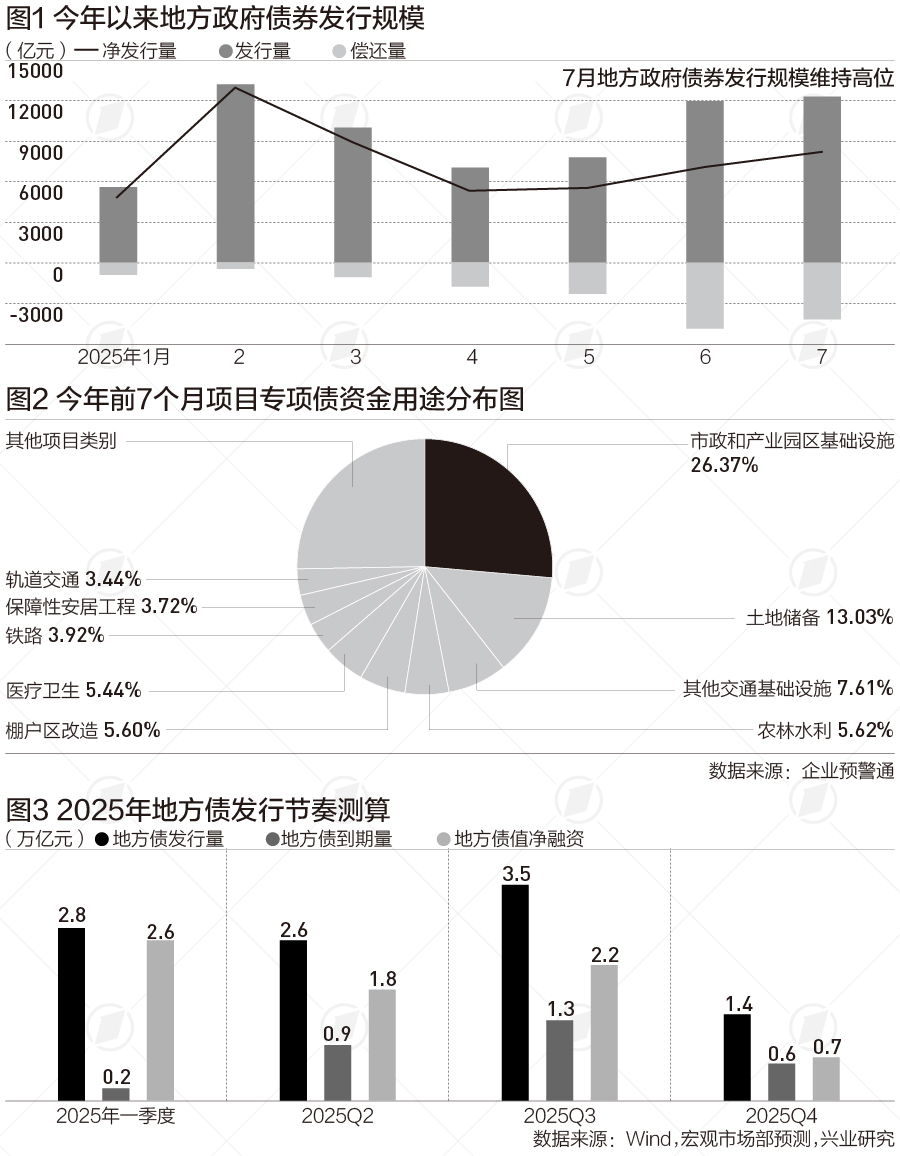
Core Viewpoint - Local government bond issuance has reached a record high in the first seven months of the year, with a total of 6.7 trillion yuan, primarily aimed at refinancing old debts and funding major projects [1][2]. Group 1: Bond Issuance and Purpose - In the first seven months, approximately 3.4 trillion yuan of refinancing bonds were issued, marking a 65% year-on-year increase, while new bonds totaled about 3.3 trillion yuan, up approximately 55% [1][2]. - More than half of the bond proceeds are allocated to repay old debts, with nearly half directed towards major project construction [1]. - The issuance of special bonds has been significant, with about 2.8 trillion yuan in new special bonds issued, accounting for over 60% of the annual target of 4.4 trillion yuan [2]. Group 2: Debt Management and Financial Impact - The average interest cost of replaced hidden debts has decreased by over 2.5 percentage points, significantly easing repayment pressure and releasing fiscal space for development and public welfare [2]. - Special new bonds, totaling approximately 755 billion yuan, are specifically aimed at resolving hidden debt issues and addressing overdue payments to enterprises [2]. Group 3: Project Funding Allocation - Of the nearly 2 trillion yuan allocated for project construction from new special bonds, approximately 26.37% is directed towards municipal and industrial park infrastructure, 17.63% towards transportation infrastructure, and 13.03% towards land reserve projects [8]. - The issuance of land reserve special bonds has surged, exceeding 260 billion yuan, aimed at recovering idle land and stabilizing the real estate market [8]. Group 4: Future Expectations and Efficiency - The central government has called for accelerated bond issuance and improved fund utilization efficiency, with expectations that local governments will complete the issuance of 4.4 trillion yuan in new special bonds by the end of October [9]. - The State Council has significantly relaxed the restrictions on the use of special bond funds, allowing for greater flexibility and autonomy in project funding [10]. - As of June 2025, the total local government debt is projected to be 51.95 trillion yuan, remaining below the debt ceiling of approximately 57.99 trillion yuan, indicating manageable debt risk [10].